eyes that often seem capable seeing things not visible to men
Any sort of disturbance, whether man-made or elemental, is of immense interest to a goose, and geese watch the world through eyes that often seem capable of seeing things not visible to men. I have always envied a goose its look of deep, superior wisdom. I miss the cordiality of geese, the midnight cordiality. And they are the world’s best drinkers, forever at it. —
Postscript to “The Eye of Edna,” April 1962; Points of My Compass, p. 14
Part of the series of Haiku inspired by from In the Words of E. B. White: Quotations from America’s Most Companionable of Writers (2011, Cornell University Press) by Mary White. This book was compiled by Mr. White’s grand daughter and while I am grateful she pulled all these together in one book, I am not sure I don’t consider this cheating.
uncanny – was like nothing that had ever come to the world before
It was the miracle God had wrought. And it was patently the sort of thing that could only happen once. Mechanically uncanny, it was like nothing that had ever come to the world before. Flourishing industries rose and fell with it. As a vehicle, it was hard-working, commonplace, heroic; and it often seemed to transmit those qualities to the persons who rode in it.—
“Farewell, My Lovely,” ca. 1936; Essays of E. B. White, p. 162, and Farewell to Model T; From Sea to Shining Sea, pp. 16–17.
Part of the series of Haiku inspired by the book In the Words of E. B. White: Quotations from America’s Most Companionable of Writers (2011, Cornell University Press) by Mary White.
This book was compiled by Mr. White’s grand daughter and while I am grateful she pulled all these together in one book, I am not sure I don’t consider this cheating.
when all one’s prospect landscapes, portraits, flowers, are nothing but a line
If my Readers have followed me with any attention up to this point, they will not be surprised to hear that life is somewhat dull in Flatland.
I do not, of course, mean that there are not battles, conspiracies, tumults, factions, and all those other phenomena which are supposed to make History interesting; nor would I deny that the strange mixture of the problems of life and the problems of Mathematics, continually inducing conjecture and giving the opportunity of immediate verification, imparts to our existence a zest which you in Spaceland can hardly comprehend.
I speak now from the æsthetic and artistic point of view when I say that life with us is dull; æsthetically and artistically, very dull indeed.
How can it be otherwise, when all one’s prospect, all one’s landscapes, historical pieces, portraits, flowers, still life, are nothing but a single line, with no varieties except degrees of brightness and obscurity?
From the book, Flatland — A Romance of Many Dimensions (1884) by Edwin Abbott Abbott (1838-1926).
I am struck by the line … when all one’s prospect, all one’s landscapes, historical pieces, portraits, flowers, still life, are nothing but a single line, with no varieties except degrees of brightness and obscurity?
I feel had Mr. Abbott been writing today he would be thinking of … Florida.
Something dull, æsthetically and artistically, very dull indeed.
How can it be otherwise?
I am also reminded of James Thurber’s long short story, The Wonderful O, about an island community where everything with the letter O in it is banned.
Geese are okay as long there are geese, but if there was just one bird, it’s goose was cooked.
Words with the letter O are banned.
When Father storms out the door and is asked, “Where are going?”
“UT!” he replies, and “UT he went”, writes Mr. Thurber.
For so long, if ever I was asked where I was going I would reply, “UT and UT HE WENT!”.
So much so did I say that, that when I saw a University of Toronto sweatshirt in a Toronto store that was emblazoned with a bold UT, my friends told me, “Hoffman You HAVE TO GET THAT!”
And I did.
And I wore it for years.
And I explained why as well, when ever I could.
The people of the Island put up with this O business for a while until they figure out that without the letter O you lose the word FREEDOM.
As Thurber writes:
Then they heard the ringing of a distant bell, sounding near and sounding nearer, ringing clear and ringing clearer, till all the sky was filled with music as by magic.
“Freedom!” Andrea echoed after him, and the sound of the greatest word turned the vandals pale and made them tremble.
Take away that word.
Take away that letter O.
And what do you have but a place where all one’s prospect, all one’s landscapes, historical pieces, portraits, flowers, still life, are nothing but a single line, with no varieties except degrees of brightness and obscurity?
crimson light of a rising sun fresh from creative burning hand of God
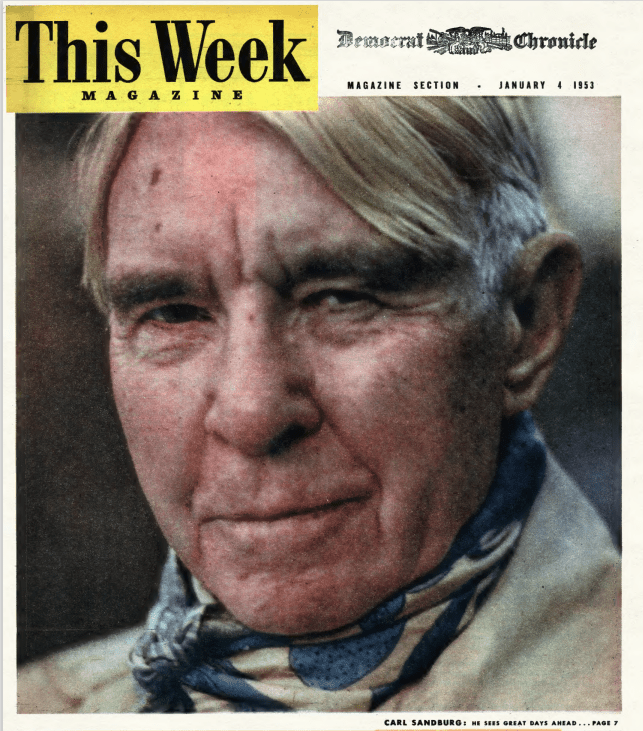
According to Wikipedia, This Week Magazine was a nationally syndicated Sunday magazine supplement that was included in American newspapers between 1935 and 1969. In the early 1950s, it accompanied 37 Sunday newspapers. A decade later, at its peak in 1963, This Week was distributed with the Sunday editions of 42 newspapers for a total circulation of 14.6 million.
When it went out of business in 1969 it was the oldest syndicated newspaper supplement in the United States. It was distributed with the Los Angeles Times, The Dallas Morning News, The Plain Dealer (Cleveland, Ohio), the Boston Herald, and others. Magazine historian Phil Stephensen-Payne noted, “It grew from a circulation of four million in 1935 to nearly 12 million in 1957, far outstripping other fiction-carrying weeklies such as Collier’s, Liberty and even The Saturday Evening Post (all of which eventually folded).”
“I see America, not in the setting sun of a black night of despair ahead of us, I see America in the crimson light of a rising sun fresh from the burning, creative hand of God.
I see great days ahead, great days possible to men and women of will and vision”
The text of the complete quote is even better at least for those who like to hope for better days,
“I have spent,” he said gravely, “as strenuous a life as any man surviving three wars and two major depressions, but never, not for a moment, did I lose faith in America’s future.
Time and time again, I saw the faces of her men and women torn and shaken in turmoil, chaos, and storm.
In each Major crisis, I have seen despair on the faces of some of the foremost strugglers, but their ideas always won.
Their visions always came through.
“I see America, not in the setting sun of a black night of despair ahead of us,
I see America in the crimson light of a rising sun fresh from the burning, creative hand of God.
I see great days ahead, great days possible to men and women of will and vision. . . “
I end with the last line of the story.
He took off his hat, as if saluting the future, and ran his hand through his white hair and said with a smile, “May I offer my favorite toast? “To the storms to come and the stars coming after.”
To the storms to come and the stars coming after!
I like that.
I like that a lot, especially on a morning when I drove to work as the sun rose out of the Atlantic Ocean with a storm coming from the west.
To close, may I offer Mr. Sanburg’s favorite toast?
“To the storms to come and the stars coming after.“
*I reproduce the story best I can but if you click on this link, you can read a PDF of the complete issue. The advertisements are great and you might enjoy taking the Are You in the Know quiz.
Carl Sandburg Speaking: I See Great Days Ahead
Here is an article that will bring you a thrill. In it, you will walk along a city street with a beloved story-teller, and hear America talking
BY FREDERICK VAN RYN
Mr. Van Ryn, is a former editor and motion-picture executive who has been associated with Sandburg for 20 years.
SEVENTY-FIVE years ago this coming Tuesday, a child was born in a three-room frame house on Third Street, just east of the Chicago, Burlington & Quincy tracks, in Galesburg, Ill. A Swedish midwife said to the dark, stickily built man who was waiting outside, “Det är en pojke” — “It’s a boy.” The man nodded, ate his breakfast in silence, and went out to his job in the CB&Q blacksmith shop. He was good at swinging a hammer, but he was not very demonstrative.
The boy was christened Carl August Sandburg but he dropped his middle name. The various jobs he tried — he delivered milk and newspapers, he was a hobo and a dishwasher, a shoeshine boy and a soldier — did not seem to rate a middle name.
A few weeks ago, while on a short visit to New York, Sandburg went for a long walk with an old friend. He was in a reminiscent mood. He talked of his early days in Galesburg, of his youth in and around Chicago, of his present home in the mountains of North Carolina, and of America’s future.
The Prophecy
So stirring was his description of the days that lie ahead of us, that his companion wished that all Americans, particularly those who suffer because of little faith, could hear this prophecy of things to come. Sandburg was not making a speech, he was merely chatting. But it so happens that his conversational style is an amazing mixture of grave, sonorous phrases that seem to be lifted right out of “Pilgrim’s Progress” and the latest slang expressions that would be understood by the most boisterous of teen-agers. Once in a while, as he and his companion were waiting for a traffic light to change, a passer-by would look at Sandburg and say: “Excuse me, but your face seems familiar. Weren’t you on television a few nights ago?” This far-from-flattering way of identifying one of America’s most famous poets and the greatest biographer of Abraham Lincoln did not disturb Sandburg. He grinned. “I like New York,” he said, “but Lordy, oh Lordy, how I miss Chicago . .. New York is handsome and intelligent, but,” he raised a warning finger, “Chicago is steaks, pork chops, grain. When New York is sick, the rest of the country still struggles along, but let Chicago sneeze … why, the whole country runs a fever . . . New York may be this nation’s head, but Chicago is still its heart.
“ Country Boy”
“Why don’t I live in Chicago? That’s simple … I’m a country boy. When I wake up in the morning, I’ve got to be able to see either the prairie or the mountains. When I’m in a city, I feel like a visitor . . . I’m not certain of myself, I can’t think.” He stopped abruptly, raised his head, and looked at the group of massive buildings ahead. _“The Medical Center,” he said slowly. “Each time I look at those beautiful buildings, I think of the miracles that have occurred in America within my lifetime. You don’t hear nowadays about many children dying of diphtheria, do you? Well, when I was twelve, in Galesburg, my two kid brothers, Freddy, who was two years old, and Emil, who was seven, woke up one morning and complained of sore throats. Old Doc Wilson came, examined them and said, ‘It’s diphtheria. All we can do now is hope . . . They might get better, they might get worse. I can’t tell.’ “He came again the following morning and just shook his head . . . “It was Freddy who first stopped breathing. I can still see Mother touching Freddy’s forehead and saying, her voice shaking and the tears coming down her face, ‘He’s cold … our Freddy is gone…’
The Lincoln Book
“Em was a strong, fine boy, and we hoped he might pull through. We stood by his bed and watched … His breathing came slower and slower, and in less than half an hour, he seemed to have stopped breathing. Mother put her hands on him and said, ‘Oh God, Emil is gone, too…” “That was medicine in the late 1880’s. Look at it now. Why, nowadays, Freddy and Emil would be up and about in less than a week.”. After a long silence, Sandburg spoke up again. “Speaking about children,” he began, “once upon a time, I had a brainstorm. I decided I would write a book that kids could understand and enjoy. It dawned on me that someone ought to tell them about that strange man from the plains of Illinois named Abe Lincoln. So, I sat down and wrote the title page — THE STORY OF ABRAHAM LINCOLN — FOR THE VERY YOUNG. . .
“It was my intention to write a short book, not more than three hundred pages. I thought I could write it, maybe, in six months. I didn’t want to write anything about the Civil War. I thought it would be too gory for the kids. I was going to say on the first page, “You all know about the great Civil War. I am not going to say anything about it in this book, but I want to tell you the story of Lincoln when he was still a young man and lived in a prairie town. ..’””
Gathering Information
He laughed and nudged his companion. “Well sir, then I began gathering my ammunition … Weeks, months,. years went by. Every day, I would find either a letter that was never published before, or a clipping, or a photograph that nobody before paid any attention to. It took me eight years before I was ready to- write my story. By that time, I could hardly move in my attic. Every inch of space was taken by boxes, barrels, and trunks containing my data. “As far as the actual writing was concerned, it took me exactly sixteen years to write “The Prairie Years’ and “The War Years.’ All in in all . . .” he laughed again, “well, the first World War was still on when I conceived the bright notion of writing ‘Abraham Lincoln’s Story for the Very Young,’ but by the time I finally managed to deliver the last batch of stuff to my publishers, it was July, 1939, and the second World War was just around the corner … Lordy, Lordy, how I worked. Often sixteen, sometimes as many as twenty hours at a stretch … My bones ached.
“I guess what actually kept me alive during those years was the challenge . . . When I started gathering my ammunition, I said to myself, ‘Let’s find out whether that man, Lincoln, was really as good and as great as they say.’ That was the challenge. “Well, Lincoln won. It took me twenty-four years to find out that he was every inch as good and as great as he was described.” By now, Sandburg was within a block of his hotel. He stopped, lit a cigar, and spoke briefly of his new book. It is called, “Always the Young Strangers,” and Harcourt, Brace will bring it out on Tuesday, the poet’s birthday. It’s about the first 20 years of his life. He said he had to write it. There was no other way to “get rid” of the teeming memories of his past.
The Life of Riley
“There I was,” he said by way of explanation, “hibernating on my farm in Flat Rock, which is probably the smallest and the nicest town in my adopted State of North Carolina. I was living the life of Riley, staring at the Great Smoky Mountains, and watching my sixty goats that I brought with me from my farm in Michigan. “But my mind was far, far away, right back where I started from, in Galesburg, the town I was born in. … I would close my eyes and visualize the old burg as I knew it.
My father and mother, my sisters and brothers, the man who gave me my first job as a delivery boy … and the man who gave me hell because, instead of using a soft brush on his high silk hat, I dusted it with my whiskbroom … my school teachers and friends, and the storm. ..’” the Knox College campus where Lincoln and Douglas debated . . . Finally, it got too much for me. So, two years ago, I decided to re-visit Galesburg and maybe write a book about those far-gone days. “All the streets in Galesburg were paved by now, and the town looked happy and prosperous. Most of the people I knew were gone, but my cousin, Charlie Krans, with whom I played when we were kids, was still alive. So, I spent a day on his farm. When I was leaving, I said, ‘I think we’ll meet again, Charlie, we’re too ornery to die soon.’ ”
Never Lost Faith
Sandburg laughed uproariously. He was standing on the sidewalk in front of his hotel by this time and was about to go in when he suddenly changed his mind, turned around and looked at the lateafternoon sun that seemed to be setting afire the skyscrapers on lower Manhattan. His manner changed abruptly. He was no longer a jovial man who had gone to visit his old home town. His pale blue eyes were blazing, his finely chiseled face was set. He was a prophet. “I have spent,” he said gravely, “as strenuous a life as any man surviving three wars and two major depressions, but never, not for a moment, did I lose faith in America’s future. Time and time again, I saw the faces of her men and women torn and shaken in turmoil, chaos, and storm. In each Major crisis, I have seen despair on the faces of some of the foremost strugglers, but their ideas always won. Their visions always came through. “I see America, not in the setting sun of a black night of despair ahead of us, I see America in the crimson light of a rising sun fresh from the burning, creative hand of God. I see great days ahead, great days possible to men and women of will and vision. . . “” He took off his hat, as if saluting the future, and ran his hand through his white hair and said with a smile, “May I offer my favorite toast? “To the storms to come and the stars coming after.”
almost wondered devious, subconscious means could settle down safe
Adapted from the passage:
Macon leaned back in his chair with his coffee mug cupped in both hands.
The sun was warming the breakfast table, and the kitchen smelled of toast.
He almost wondered whether, by some devious, subconscious means, he had engineered this injury — every elaborate step leading up to it—just so he could settle down safe among the people he’d started out with.
As Mr. Thurber wrote, Nowadays most men lead lives of noisy desperation.
The Grizzly and the Gadgets
A grizzly bear who had been on a bender for several weeks following a Christmas party in his home at which his brother-in-law had set the Christmas tree on fire, his children had driven the family car through the front door and out the back, and all the attractive female bears had gone into hibernation before sunset returned home prepared to forgive, and live and let live. He found, to his mild annoyance, that the doorbell had been replaced by an ornamental knocker. When he lifted the knocker, he was startled to hear it play two bars of “Silent Night.”
When nobody answered his knock, he turned the doorknob, which said “Happy New Year” in a metallic voice, and a two-tone gong rang “Hello” somewhere deep within the house.
He called to his mate, who was always the first to lay the old aside, as well as the first by whom the new was tried, and got no answer. This was because the walls of his house had been soundproofed by a sound proofer who had soundproofed them so well nobody could hear anybody say anything six feet away. Inside the living room the grizzly bear turned on the light switch, and the lights went on all right, but the turning of the switch had also released an odor of pine cones, which this particular bear had always found offensive. The head of the house, now becoming almost as angry as he had been on Christmas Day, sank into an easy chair and began bouncing up and down and up and down, for it was a brand-new contraption called “Sitpretty” which made you bounce up and down and up and down when you sat on it. Now thoroughly exasperated, the bear jumped up from the chair and began searching for a cigarette. He found a cigarette box, a new-fangled cigarette box he had never seen before, which was made of metal and plastic in the shape of a castle, complete with portal and drawbridge and tower. The trouble was that the bear couldn’t get the thing open. Then he made out, in tiny raised letters on the portal, a legend in rhyme: “You can have a cigarette on me If you can find the castle key.” The bear could not find the castle key, and he threw the trick cigarette box through a windowpane out into the front yard, letting in a blast of cold air, and he howled when it hit the back of his neck. He was a little mollified when he found that he had a cigar in his pocket, but no matches, and so he began looking around the living room for a matchbox. At last he saw one on a shelf. There were matches in it, all right, but no scratching surface on which to scratch them. On the bottom of the box, however, there was a neat legend explaining this lack. The message on the box read: “Safety safety matches are doubly safe because there is no dangerous dangerous sandpaper surface to scratch them on. Strike them on a windowpane or on the seat of your pants.”
Enraged, infuriated, beside himself, seeing red and thinking black, the grizzly bear began taking the living room apart. He pounded the matchbox into splinters, knocked over lamps, pulled pictures off the wall, threw rugs out of the broken window, swept vases and a clock off the mantelpiece, and overturned chairs and tables, growling and howling and roaring, shouting and bawling and cursing, until his wife was aroused from a deep dream of marrying a panda, neighbors appeared from blocks around, and the attractive female bears who had gone into hibernation began coming out of it to see what was going on.
The bear, deaf to the pleas of his mate, heedless of his neighbors’ advice, and unafraid of the police, kicked over whatever was still standing in the house, and went roaring away for good, taking the most attractive of the attractive female bears, one named Honey, with him.
MORAL: Nowadays most men lead lives of noisy desperation.



 No Haiku For You