11.3.2020 – There is ruin, decay

There is ruin, decay
winds blow bleak, all gone away
nothing more to say

Adapted from The House on the Hill by Edwin Arlington Robinson

They are all gone away,
The House is shut and still,
There is nothing more to say.

Through broken walls and gray
The winds blow bleak and shrill:
They are all gone away.

Nor is there one to-day
To speak them good or ill:
There is nothing more to say.

Why is it then we stray
Around the sunken sill?
They are all gone away,

And our poor fancy-play
For them is wasted skill:
There is nothing more to say.

There is ruin and decay
In the House on the Hill:
They are all gone away,
There is nothing more to say.

I was attracted to this poem for today, election day 2020, as finally, there is nothing more to say.

I have always felt that one of the most forlorn sights is a Halloween Pumpkin on November 1st.

How much more so election signs all across everywhere the day after an election.

All those candidates, they are all gone away.

I looked up the poem to make sure I got the poet’s first name correct and I learned that this poem:

‘The House on the Hill’ by Edward Arlington Robinson is a six stanza villanelle that is divided into sets of three lines, known as tercets, and then one final set of four lines, or quatrain. The lines follow a very simple rhyme scheme of ABA, with the traditional repetition one can expect from a villanelle. The first and third lines of the first stanza is repeated, alternatively, in the next five.

It isn’t just a poem but a a six stanza villanelle!

WOW.

Villanelle.

Never ran across that term before.

Sounds much harder than a haiku but explains why I had trouble getting a seven syllable line out of it when all the lines are six syllables.

The page I learned this on also said, in the way of analysis:

It is meant to be a symbol for the speaker’s past and it’s decay a representative of how he’s losing contact with his own past acquaintances and experiences.

On election day 2020, I hope we aren’t losing contact with our past.

I hope it isn’t all gone away.

Bleak and shrill.

No good or ill.

And I hope it is not ruin and decay.

But we all have to wait.

There is nothing more to say.
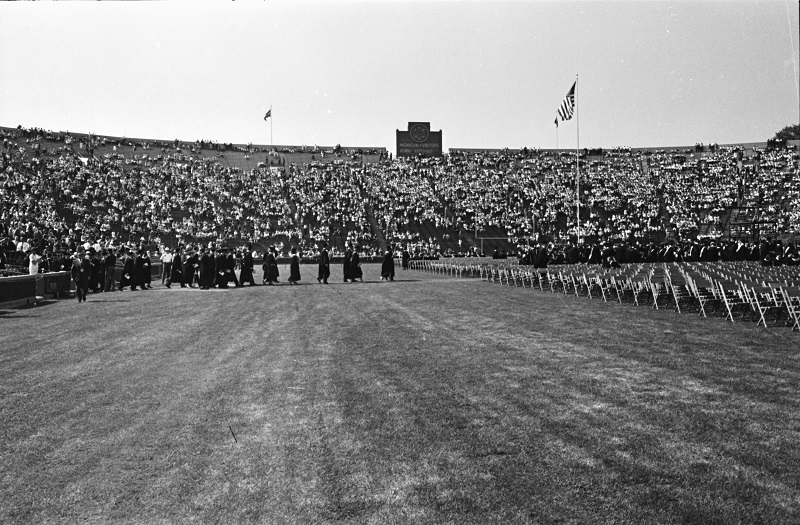
10.23.2020 – powerful forces

powerful forces
will take us beyond the bounds
of imagination

Adapted from the line:

Within your lifetime powerful forces, already loosed, will take us toward a way of life beyond the realm of our experience, almost beyond the bounds of our imagination.

The line comes from the Commencement Address at the University of Michigan in Ann Arbor, Michigan, on May 22, 1964, delivered by President Lyndon Johnson.

It is an address known to history as the “Great Society Speech.”

According to Wikipedia the Great Society was “New major spending programs that addressed education, medical care, urban problems, rural poverty, and transportation were launched during this period. The program and its initiatives were subsequently promoted by him and fellow Democrats in Congress in the 1960s and years following. The Great Society in scope and sweep resembled the New Deal domestic agenda of Franklin D. Roosevelt.”

LBJ said:

Within your lifetime powerful forces, already loosed, will take us toward a way of life beyond the realm of our experience, almost beyond the bounds of our imagination.

For better or for worse, your generation has been appointed by history to deal with those problems and to lead America toward a new age. You have the chance never before afforded to any people in any age. You can help build a society where the demands of morality, and the needs of the spirit, can be realized in the life of the Nation.

So, will you join in the battle to give every citizen the full equality which God enjoins and the law requires, whatever his belief, or race, or the color of his skin?

Will you join in the battle to give every citizen an escape from the crushing weight of poverty?

Will you join in the battle to make it possible for all nations to live in enduring peace — as neighbors and not as mortal enemies?

Will you join in the battle to build the Great Society, to prove that our material progress is only the foundation on which we will build a richer life of mind and spirit?

There are those timid souls who say this battle cannot be won; that we are condemned to a soulless wealth. I do not agree. We have the power to shape the civilization that we want. But we need your will, your labor, your hearts, if we are to build that kind of society.

Those who came to this land sought to build more than just a new country.

They sought a new world.

So I have come here today to your campus to say that you can make their vision our reality.

So let us from this moment begin our work so that in the future men will look back and say: It was then, after a long and weary way, that man turned the exploits of his genius to the full enrichment of his life.

Over 50 years later it seems like “soulless wealth” is winning out.

Going back to the speech, for better or for worse, this generation has been appointed by history to deal with those problems and to lead America toward a new age.

We have the chance never before afforded to any people in any age.

We can help build a society where the demands of morality, and the needs of the spirit, can be realized in the life of the Nation.

We can.

We can?

Can we?

10.21.2020 – thankful for those who

thankful for those who
will plant trees under whose shade
they will never sit

Based on a fragment from a quote that states:

“old men plant trees they will never sit under.”

I came across the quote in the book, His Very Best: Jimmy Carter, a Life by Jonathan Alter,

Mr. Atler considers President Carter as “a man who lived the advice of the columnist Walter Lippman to ‘plant trees we will never sit under.’ “

The book is interesting in its efforts to paint Mr. Carter as the most renaissance President since Thomas Jefferson.

I will not go into that now but I will say that the book is full of interesting historical observations including the fact that Mr. Carter was the first President to be born in a hospital.

Back to the quote.

As I said, Mr. Atler attributes the quote to Walter Lippman.

Mr. Lippmann wrote, “Yet this corporate being, though so insubstantial to our senses, binds, in Burkes words, a man to his country with ties which though light as air, are as strong as links of iron. That is why young men die in battle for their country’s sake and why old men plant trees they will never sit under.”

Mr. Lippman published this thought in a 1955 in a book titled. Essays in The Public Philosophy by Walter Lippmann, Chapter 3: The Derangement of Powers, Section 2: The People and the Voters

First I have to stop and ask does anyone today know who Walter Lippmann was or remember the role he in played in United States Political History?

I know the name from 4 years of college course on United States history.

But today?

Wikipedia says that Mr. Lippmann “was an early and influential commentator on mass culture.”

Mr. Lippmann wrote a nationally syndicated column, Today and Tomorrow, that appeared across the country in US newspapers from 1931 to 1967.

An early and influential commentator on mass culture.

In an age before twitter.

In an age of complete sentences.

In a age of the printed word.

Mr. Lippman somehow was still a person of influence.

A person of influence for 36 years.

And barely remembered today.

Indication for the future of the Kardashians I hope.

ANYWAY, put the quote into the google and versions of the statement are shown to go back to Cicero when he said, serit arbores, quae alteri saeclo prosint, or he plants trees, which will be of use to another age.

It is a good thought.

A lasting thought.

Not a bad way to be described.

Where are these people today?

Let’s look at the entire quote again starting with, “Yet this corporate being.”

Mr. Lippmann is writing about The People as in WE, the People.

Yet this corporate being,

though so insubstantial to our senses,

binds, in Burkes words,

a man to his country with ties

which though light as air,

are as strong as links of iron.

That is why young men die in battle for their country’s sake …

and why old men plant trees they will never sit under.

Sorry to say that one review of this essay referred to Mr. Lippmann’s “Unattainable Ideal.”

Maybe I am just jaded by the leadership available today.

Lots of old men.

Hard to imagine them planting trees that others, let alone not themselves, might sit under.

They are out there.

People who plant the trees for others.

And I am thankful they are there.

Excuse me while I go plant a tree.

10.14.2020 – grievous consequence

grievous consequence
what has been done and undone
futile intentions

It is the most grievous consequence which we have yet experienced of what we have done and of what we have left undone in the last four years.

Four years of futile good intentions.

Four years of eager search for the line of least resistance.

Four years of uninterrupted retreat of US power.

Four years of neglect of US defenses.

Those are the features which I stand here to declare and which marked an improvident stewardship for which the United States has dearly to pay.

We have been reduced in those four years from a position of security so overwhelming and so unchallengeable that we never cared to think about it.

We have been reduced from a position where the very word “war” was considered one which would be used only by persons qualifying for a lunatic asylum.

We have been reduced from a position of safety and power.

Power to do good.

Power to be generous.

Reduced in four years from a position safe and unchallenged to where we stand now …

This is paraphrased and adapted for today’s affairs of the world from a speech by Winston Churchill.

Mr. Churchill delivered his speech has part of the British Parliamentary Debate on the Munich Agreement on October 3, 1938.

Mr. Churchill was speaking about Great Britain and France and the efforts of the governments of those countries to maintain peace in Europe with Nazi Germany.

Those two countries working with Germany and France had signed an agreement that pretty much dissolved the country of Czechoslovakia and made it a part of Hitler’s Germany in the hope Hitler would be happy.

I adapted what Mr. Churchill to what the United States seems to face abroad after four years of the current administration of the Government of the United States.

I understand what the governments of Great Britain and France were trying to do.

I fail to understand.

I cannot grasp what the current administration is trying to do.

Mr. Churchill said:

“It is the most grievous consequence which we have yet experienced of what we have done and of what we have left undone in the last five years-five years offutile good intention, five years of eager search forthe line of least resistance, five years of uninterruptedretreat of British power, five years of neglect of our air defences. Those are the features which I stand here to declare and which marked an improvident stewardship for which Great Britain and France have dearly to pay. We have been reduced in those five years from a position of security so overwhelming and so unchallengeable that we never cared to think about it. We have been reduced from a position where the very word “war” was considered onewhich would be used only by persons qualifying fora lunatic asylum. We have been reduced from a position of safety and power–power to do good, power to be generous to a beaten foe, power to make terms with Germany, power to give her proper redress for her grievances, power to stop her arming if we chose, power to take any step in strength or mercy or justice which we thought right-reduced in five years from a position safe and unchallenged to where we stand now….

9.30.2020 – it carried away

it carried away
everything – there was no more
the end of something

The setting for Ernest Hemingway’s short story, The End of Something, is the little town of Horton’s Bay in the wonderfully located upper, lower Michigan.

The story is a story of a couple’s breaking up.

As a warning to what is coming for the couple, Mr. Hemingway opens the story with a short description of Horton’s Bay.

Mr. Hemingway wrote, “In the old days Hortons Bay was a lumbering town. No one who lived in it was out of sound of the big saws in the mill by the lake. Then one year there were no more logs to make lumber. The lumber schooners came into the bay and were loaded with the cut of the mill that stood stacked in the yard. All the piles of lumber were carried away. The big mill building had all its machinery that was removable taken out and hoisted on board one of the schooners by the men who had worked in the mill. The schooner moved out of the bay toward the open lake, carrying the two great saws, the travelling carriage that hurled the logs against the revolving, circular saws and all the rollers, wheels, belts and iron piled on a hull-deep load of lumber. Its open hold covered with canvas and lashed tight, the sails of the schooner filled and it moved out into the open lake, carrying with it everything that had made the mill a mill and Hortons Bay a town.

The trip taken by the ship loaded with the workings of the sawmill was a one way trip.

The ship, the machinery, the lumber, the trees, everything that made the mill a mill and the town a town, was not coming back.

It was the end of something.

I watched the first debate of the 2020 Election last night.

I had feelings to be sure.

But mostly I was sad and am sad this, the morning of the day after.

I had never seen nor had I imagined I would ever see such a display at what I thought was a showcase of what made the United States the United States.

Maybe I WAS seeing what makes the United States the United States.

It was not what I knew.

And in my heart of hearts I also know that the place I knew is not coming back.

Very sad.

I sat and I watched as if a crew was dismantling everything about the United States and loaded it on a schooner.

I watched as the crew lashed it all down tight.

And I watched as the sails of the schooner filled and it moved out into the open lake, carrying with it everything.

It hurt to watch.

It hurt to watch and realize what was leaving.

It hurts this morning.

It hurts to read that some folks felt the same.

It hurts to read that some folks did not notice.

It hurts to read that some folks noticed and did not care.

It was the end of something.