
nearly ashamed lest
it detain our attention
or attract gratitude
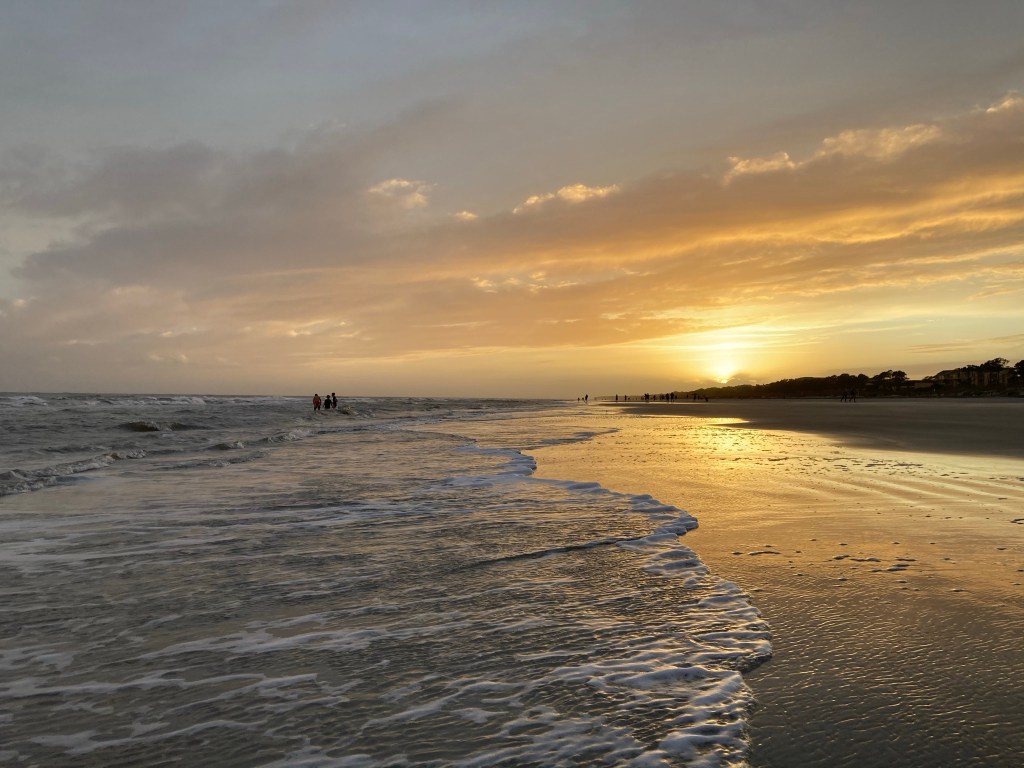
I asked my wife to go watch the sunset over the May River on Christmas Eve.
I had a lot of reasons.
I wanted to go was the main reason.
I often find that working from home, I can get to Friday and never been further from home than our daily walks.
And, We were alone with no kids at home and could go without worrying what might happen at home.
It was a warm night for us anyway in December.
It was a few days after the Winter Solstice so the sun would be setting at its most southern point in the sky over the river.
And also because of the solstice, it was conveniently timed at around 5:30 PM.
We got to the park on the bluff overlooking the river just as the sun disappeared.
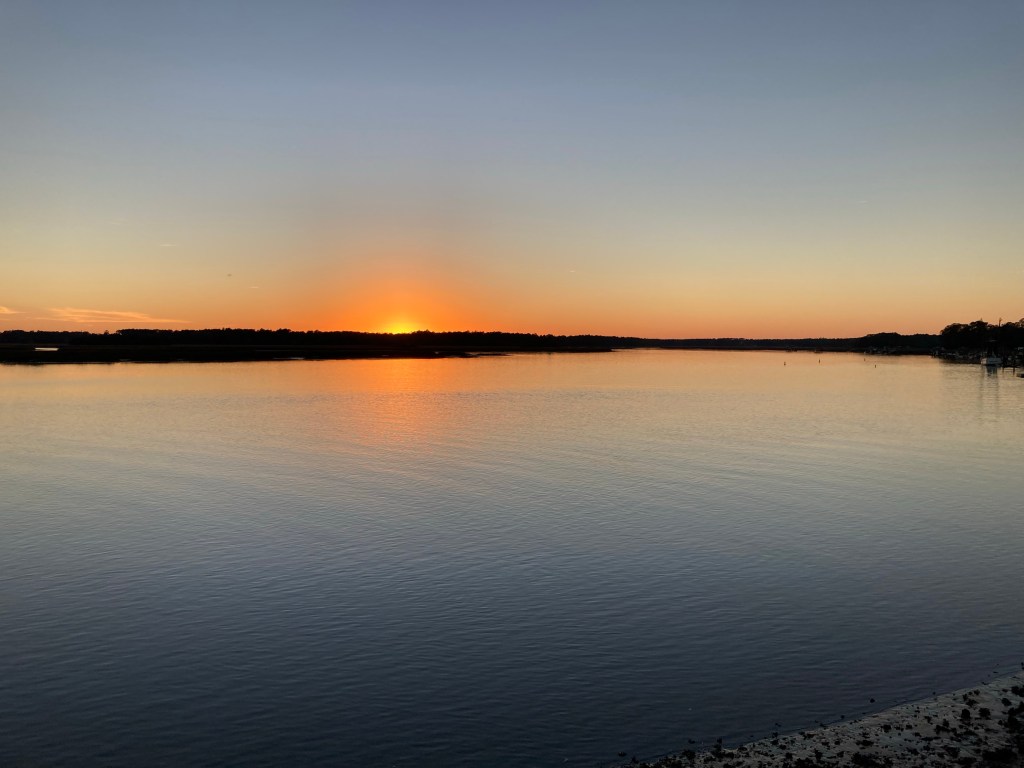
I wanted to run from the car to get to the dock to catch a photograph of the scene.
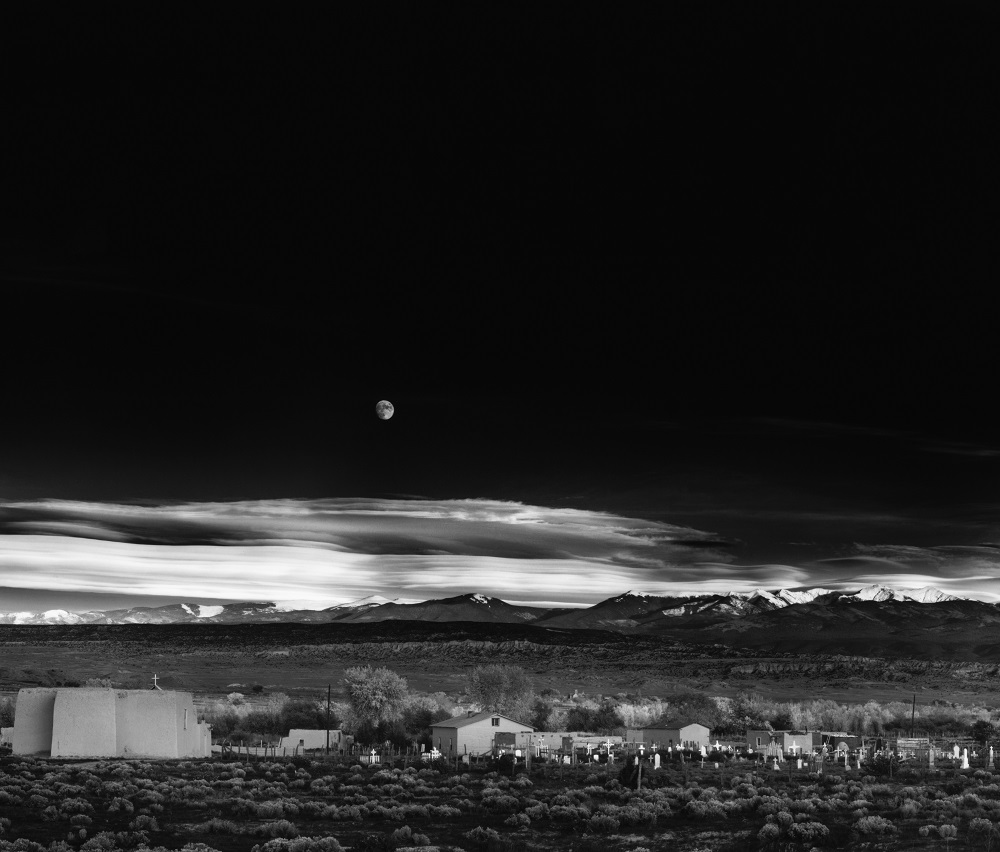
I thought of the photographer Ansel Adams, and his often repeated story of how he was driving with friends in Arizona and spotted the sunset scene of a small church at dusk with the moon rising over the horizon.
He pulls the car over and in a frenzy calls on his friends to help with the camera, tripod and other equipment.
The high point of the story for most photographers is when Mr. Adams admits he couldn’t find his light meter but he did know the amount of light the Moon gave off and was able to mentally calculate the exposure setting for his camera.
Thinking of this I hurried to the river front with my iPhone out.
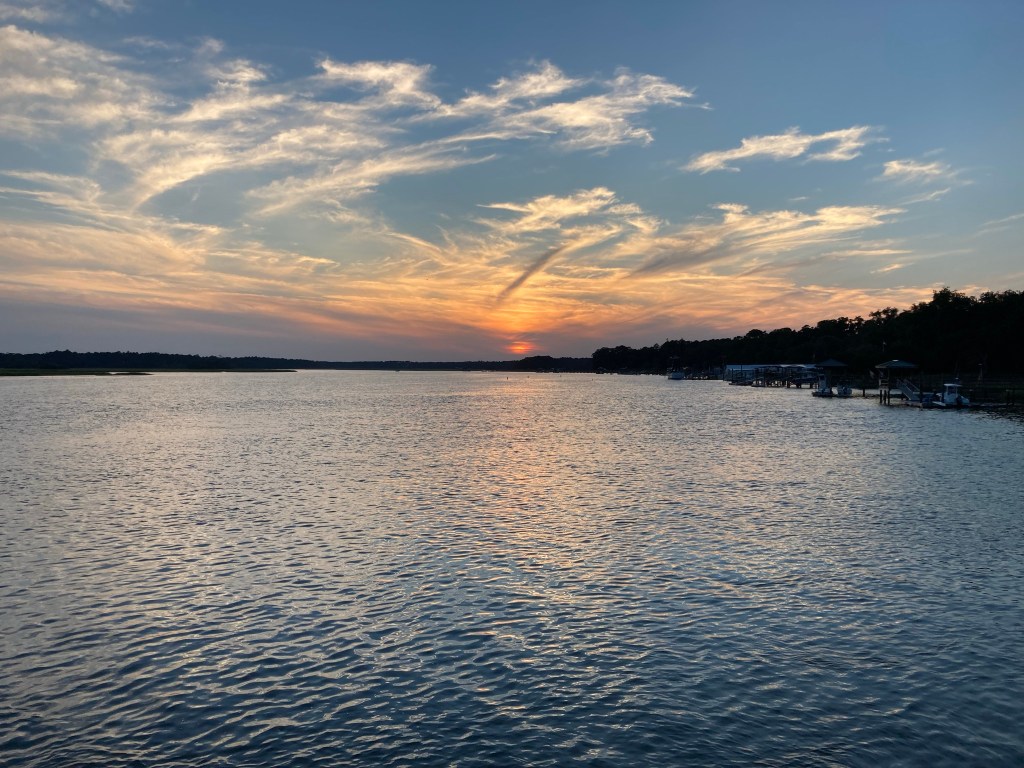
The scene itself of the sun setting on Christmas Eve over the May River, as I took it in, took away my urgency.
I have used the quote, “A dominant impulse on encountering beauty is to wish to hold on to it, to possess it and give it weight in one’s life. There is an urge to say, ‘I was here, I saw this and it mattered to me,” before.
I wanted to the take a picture to show I was here and that the scene mattered to me.
But when I got there, all I wanted to do was look.
Look and listen.
You could hear the birds and you could here the sound of the passage of water as the tide came in.
And somehow, you could hear the silence.
A few other people were there but for the most part, it was a private viewing for my wife and I.
I thought of this quote about a scene as described by the same author of the prior quote, “like an impartial judge, modest and willingly literal-minded about its own achievements, ashamed lest it detain our attention or attract our gratitude.”
It is odd, but I thought that about the scene I was seeing.
The river, the water, the clouds, the sun setting and the sounds.
I felt it was a scene, that with all its elements, was modest and willingly literal-minded about its own achievements, ashamed lest it detain our attention or attract our gratitude.
It was a fleeting moment to be sure.
One of a kind and special.
A moment to be remembered.
But at the same time …
Of all things, a passage in the book, “How Life Imitates the World Series” by Thomas Boswell came to mind.
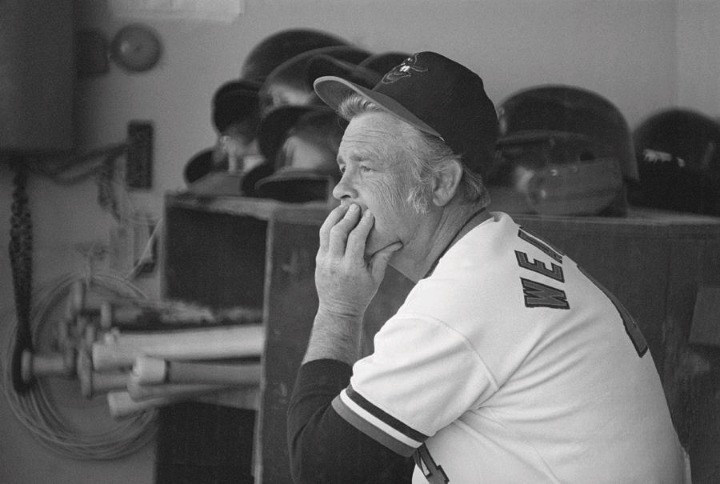
Mr. Boswell tells the story of how an interview in the dugout of Memorial Stadium in Baltimore with then Orioles Manager, Earl Weaver, went over long.
All of sudden, Mr. Boswell, writes, he became aware that the National Anthem was playing and the game was about the start.
The two stood up for the anthem and Mr. Weaver stopped telling the story he had been in the middle of.
The anthem came to end and and Mr. Weaver went to run out to home plate to give the lineup card to the umpires.
Mr. Weaver said to Mr. Boswell, “I’ll be right back and finish that story.”
Mr. Boswell writes that he thought this was crazy and that he was way over staying his time and apologized to Mr. Weaver and said he would get out the dugout as the game was about the start.
“Oh don’t worry about that”, said Mr. Weaver, “We do this every day.”
*Words in the Haiku were adapted from the book, The Architecture of Happiness (2009, Vintage Books) by Alain de Botton, and the passage:
In a valley so steep that its gelatinous walls seem never to have been warmed by the sun, a drop of hundreds of feet ends in a furious brown river clotted with stones and brambles. As the train curves around the mountainside, a view opens up along its length, revealing that, several carriages ahead, the burgundy-red locomotive has taken the unexpected decision to cross from one side of the valley to the other, a manoeuvre it proceeds to execute without so much as pausing to confer with higher authorities. It makes its way over the gap, and through a small cloud, with the brisk formality one might associate with the most routine of activities, to which prayer and worship would be at once unnecessary and theatrical supplements. What has rendered this supernatural feat possible is a bridge for which nothing in this setting has prepared us – a perfectly massive yet perfectly delicate concrete bridge, marred by not the slightest stain or impurity, which can only have been dropped from the air by the gods, for we cannot imagine that there would be anywhere in this forsaken spot for humans to rest their tools. The bridge seems unimpressed by the razor-sharp stones around it, by the childish moods of the river and the contorted, ugly grimaces of the rock-face. It stands content to reconcile the two sides of the ravine like an impartial judge, modest and willingly literal-minded about its own achievements, ashamed lest it detain our attention or attract our gratitude.
According the The New York Review of Books, this is “A perceptive, thoughtful, original, and richly illustrated exercise in the dramatic personification of buildings of all sorts.”
What I find irrestible in reading Mr. de Botton is his use of language.
I get the feeling that if you made a spread sheet of all the words, adverbs and adjectives used by Mr. de Botton, you just might find that he used each word just once.
Neat trick in writing a book.
If I knew how to do that, I would.

 No Haiku For You