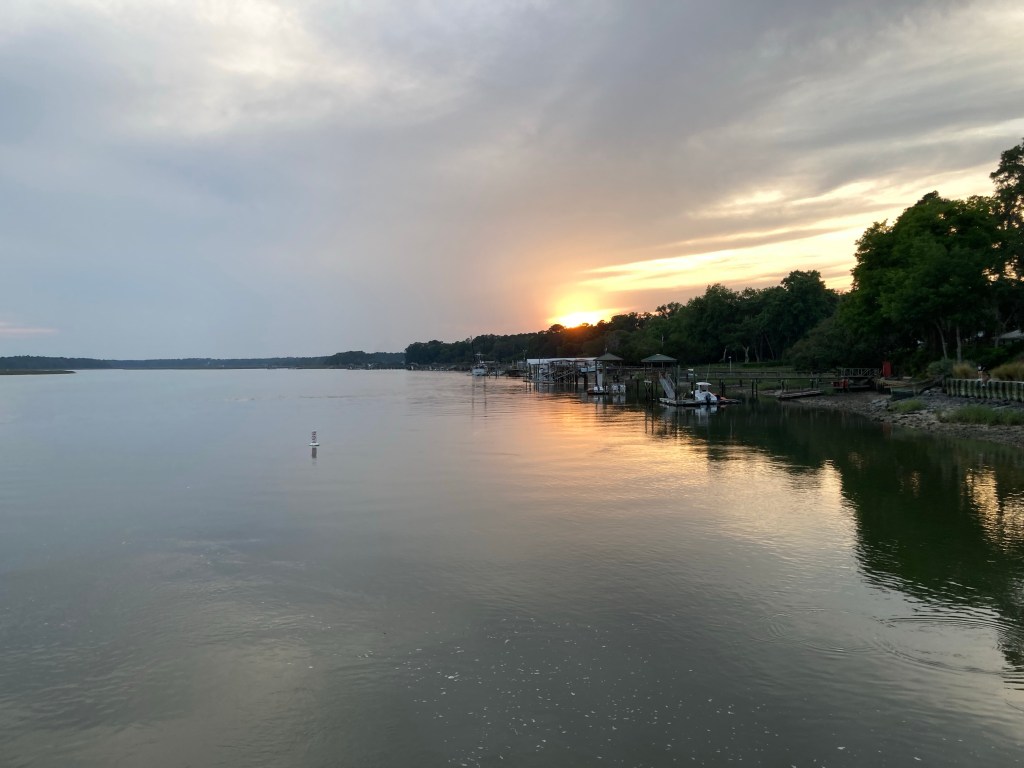
I despair of being able to convey to any reader my own idea of the beauty of Sydney Harbour, wrote Anthony Trollope. I feel that way about the May River Bluff in Bluffton, SC.
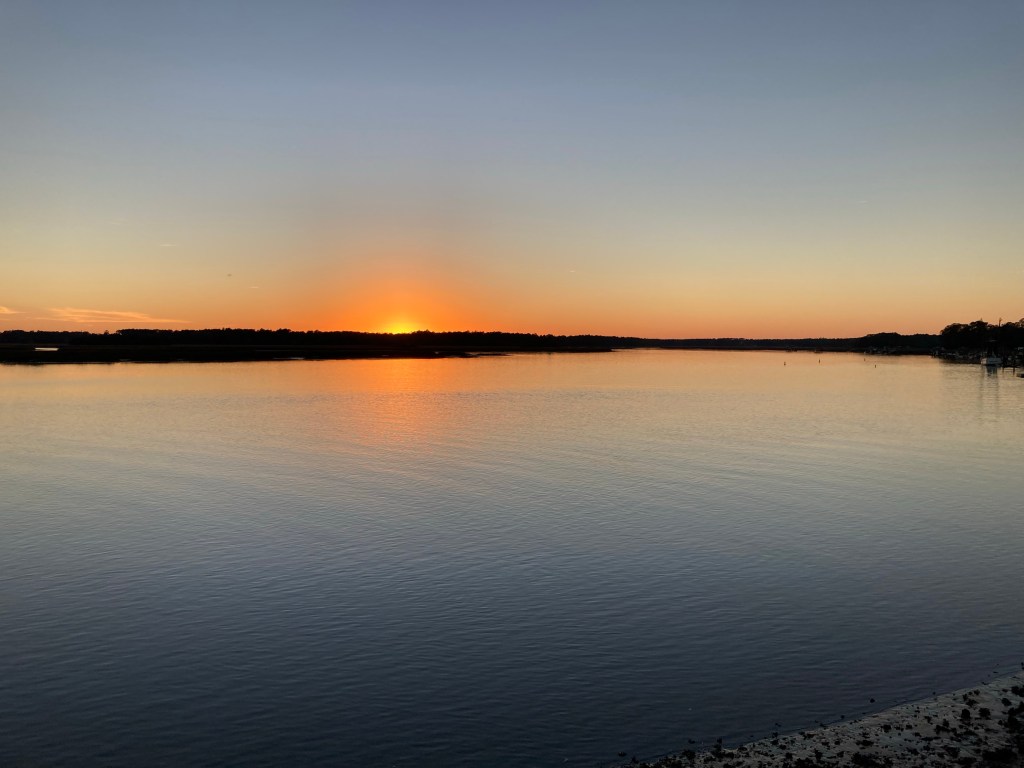
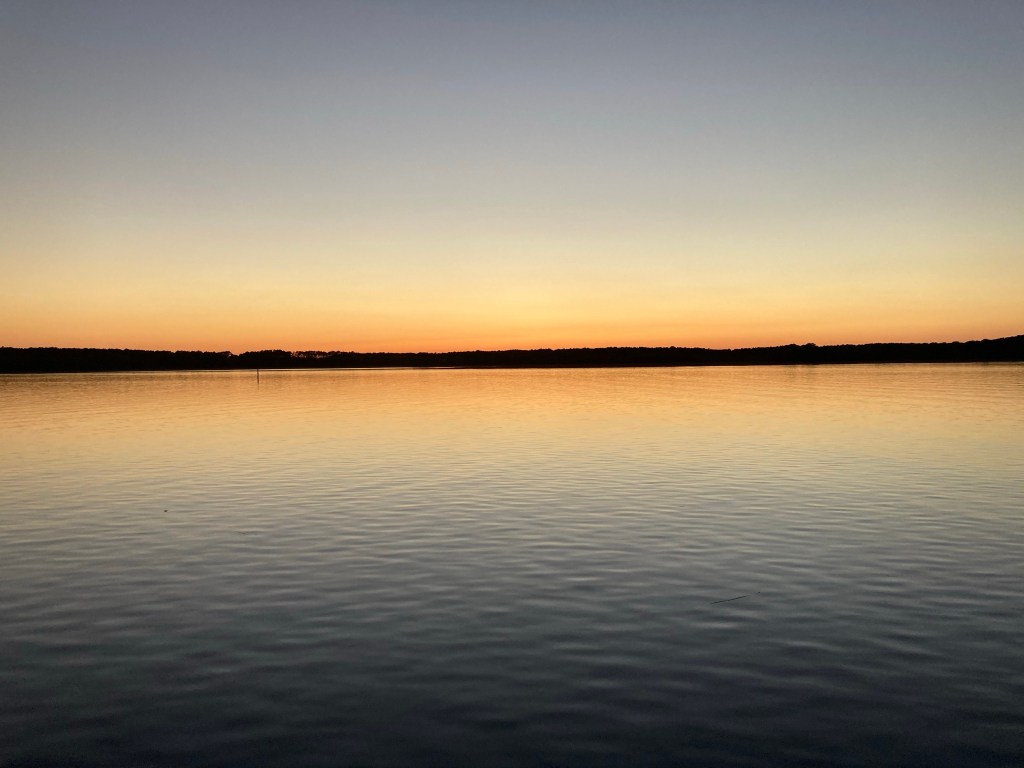
morning sky goes blue sunset sky goes bronze time is a storyteller
Adapted from The Fireborn are at Home in Fire by Carl Sandburg
Luck is a star. Money is a plaything. Time is a storyteller. The sky goes high, big. The sky goes wide and blue. And the fireborn — they go far — being at home in fire.
Can you compose yourself The same as a bright bandana, A bandana folded blue and cool, Whatever the high howling, The accents of blam blam? Can I, can John Smith, John Doe, Whatever the awful accents, Whatever the horst wessel hiss, Whatever books be burnt and crisp, Whatever hangmen bring their hemp, Whatever horsemen sweep the sunsets, Whatever hidden hovering candle Sways as a wafer of light?
Can you compose yourself The same as a bright bandana, A bandana folded blue and cool? Can I, too, drop deep down In a pool of cool remembers, In a float of fine smoke blue, In a keeping of one pale moon, Weaving our wrath in a pattern Woven of wrath gone down, Crossing our scarlet zigzags With pools of cool blue, With floats of smoke blue?
Can you, can I, compose ourselves In wraps of personal cool blue, In sheets of personal smoke blue? Bach did it, Johann Sebastian. So did the one and only John Milton. And the old slave Epictetus And the other slave Spartacus And Brother Francis of Assisi. So did General George Washington On a horse, in a saddle, On a boat, in heavy snow, In a loose cape overcoat And snow on his shoulders. So did John Adams, Jackson, Jefferson. So did Lincoln on a cavalry horse At the Chancellorsville review With platoons right, platoons left, In a wind nearly blowing the words away Asking the next man on a horse: “What’s going to become of all these boys when the war is over?”
The shape of your shadow Comes from you — and you only? Your personal fixed decision Out of you — and your mouth only? Your No, your Yes, your own?
Bronze old timers belong here. Yes, they might be saying: Shade the flame Back to final points Of all sun and fog In the moving frame Of your personal eyes. Then stand to the points. Let hunger and hell come. Or ashes and shame poured On your personal head. Let death shake its bones. The teaching goes back far: Compose yourself.
Luck is a star. Money is a plaything. Time is a storyteller. And the sky goes blue with mornings. And the sky goes bronze with sunsets. And the fireborn — they go far — being at home in fire.
over the whole scene dissolving lights drifted new marvels of color
I still keep in mind a certain wonderful sunset which I witnessed when steamboating was new to me.
A broad expanse of the river was turned to blood; in the middle distance the red hue brightened into gold, through which a solitary log came floating, black and conspicuous; in one place a long, slanting mark lay sparkling upon the water; in another the surface was broken by boiling, tumbling rings, that were as many-tinted as an opal; where the ruddy flush was faintest, was a smooth spot that was covered with graceful circles and radiating lines, ever so delicately traced; the shore on our left was densely wooded, and the somber shadow that fell from this forest was broken in one place by a long, ruffled trail that shone like silver; and high above the forest wall a clean-stemmed dead tree waved a single leafy bough that glowed like a flame in the unobstructed splendor that was flowing from the sun.
There were graceful curves, reflected images, woody heights, soft distances; and over the whole scene, far and near, the dissolving lights drifted steadily, enriching it, every passing moment, with new marvels of coloring.
it is something to face the sun know you are free one day of life so
Based on the poem Clean Hands by Carl Sandburg in Smoke and Steel, 1922.
IT is something to face the sun and know you are free. To hold your head in the shafts of daylight slanting the earth And know your heart has kept a promise and the blood runs clean: It is something. To go one day of your life among all men with clean hands, Clean for the day book today and the record of the after days, Held at your side proud, satisfied to the last, and ready, So to have clean hands: God, it is something, One day of life so And a memory fastened till the stars sputter out And a love washed as white linen in the noon drying. Yes, go find the men of clean hands one day and see the life, the memory, the love they have, to stay longer than the plunging sea wets the shores or the fires heave under the crust of the earth. O yes, clean hands is the chant and only one man knows its sob and its undersong and he dies clenching the secret more to him than any woman or chum. And O the great brave men, the silent little brave men, proud of their hands – clutching the knuckles of their fingers into fists ready for death and the dark, ready for life and the fight, the pay and the memories – O the men proud of their hands.
lost along the way had a talk with history can help? Then do it!
What do you do in January if you live in a beach community and the weather, wind and waves conspire together to take the beach out of your afternoon options?
If new to the Low Country, like we are, exploring the area is next on the list.
Was about to write, “The Low Country is famous for …” when it came to me that the while the Low Country is a lot of things, famous is not one of them.
Still, things happened here.
Things happened here that did not happen other places.
And some things happened here for the first time.
One of the things that happened here during the United States Civil War is that the armed forces of the United States had some of its earliest success stories here.
The Battle of Bull Run is fought in July of 1861 and as Stonewall Jackson got one of the great nicknames in military history the Union Army got chased out of Virginia.
In November of 1861, combined Union Army and Navy forces took over the Low Country when they attacked Port Royal Sound and the South Carolina Sea Islands of St. Helena and Hilton Head.
This led to what the South Carolina history books called the “Big Skedaddle” as all the white South Carolinians got out of the Low Country and went to Charleston or Savannah.
Leaving all their former slaves behind for the most part.
This early the war, Abraham Lincoln was not ready to declare and end to slavery and the Union Government really didn’t know what to do with former slaves until one Union General, a real off the wall political General but able lawyer, Ben Butler, said that the slaves were former property and as ‘abandoned property’ could now be considered ‘contraband of war’ that could be seized by the forces of the Federal Government and as such, free.
Okay, so then what?
Then what became known as the Port Royal Experiment.
According to Wikipedia, “The Port Royal Experiment was a program begun during the American Civil War in which former slaves successfully worked on the land abandoned by planters. In 1861 the Union captured the Sea Islands off the coast of South Carolina and their main harbor, Port Royal. The white residents fled, leaving behind 10,000 black slaves. Several private Northern charity organizations stepped in to help the former slaves become self-sufficient. The result was a model of what Reconstruction could have been.”
A special education commission was established which led to the establishment of the Penn Center on St. Helena island, just over a half hour drive away from where we live.
The Penn Center, Founded in 1862 by Quaker and Unitarian missionaries from Pennsylvania, it was the first school founded in the Southern United States specifically for the education of African-Americans.
It provided critical educational facilities to Gullah slaves freed after plantation owners fled the island, and continues to fulfill an educational mission.
The campus was designated a National Historic Landmark District in 1974 and you can tour the grounds and buildings to this day.
St. Helena Island is one of those places where you can say take THE ROAD, turn left at THE STOP LIGHT and go past THE GAS STATION because out on St. Helena there is pretty much one road (2 if you count the north-south road and the east-west road) one, stop light and one gas station.
Before the Civil War there were 50 Plantations out here.
The road is lined with flat (what else) fields being prepared for (in January!) strawberry planting.
Tunnels through the live oaks and Spanish moss with dust from the strawberry fields cloud the sun.
And we drove up to St. Helena to explore and one of our stops was the Penn Center.
Be we kinda, even with just two roads, got lost along the way and got there late.
We drove and parked by a building with a sign that said Welcome Center.
There was a small OPEN sign on the door.
But when we went in the room was dark.
Dark and empty of other people.
There were displays and such but no people.
Behind us the door opens and a voice calls out, “I am so sorry, but we are closed.”
We turned around and there was this lady with this smile who took the open sign down and turned it around to closed.
So they were closed but the lady with a smile took some time to talk with us for a minute about the Penn Center.
The minute turned into 10 minutes or more as we learned that the lady we were talking too had graduated from the Penn Center back in 1952.
She had moved away but when retirement came, she moved back to St. Helena and started to volunteer where she could.
She was amazing to listen.
It was like to TO history.
There was history in her voice and a graciousness to her style I could not describe with the words that I have.
We apologized for making her stay over long and told her we would be back and that we would bring out grand children.
As we left, I asked her name.
“Gardenia,” she said with her smile on her face.
And she locked the door behind us.
When I got a chance, I punched ‘Gardenia’ and ‘Penn Center Volunteer’ in the Google and found out who we had been talking to.
Gardenia Simmons-White was born on St. Helena Island, SC in 1934.
She was one of the last living graduates of the Penn Center.
NO
Now 87 years old, this wonderful lady was a wonder to listen too.
She said that volunteering as a docent at the Penn Center, “[is her] way of giving back to Penn for helping to shape my life and never forgetting the education I received which enabled me to reach higher heights.
I admit I have been a little off on everything with the covid and the economy and the news lately.
Kinda lost along the way.
To have talked with Ms. Simmons-White and heard her stories, heard just her voice, was a long drink of cool water.
Her story is one of those stories that makes you hope that maybe things can and will turn out okay.


 No Haiku For You