9.22.2025 – in the middle way

in the middle way
only fight to recover what
has been lost and found

East Coker, V (last section):

So here I am, in the middle way, having had twenty years—
Twenty years largely wasted, the years of l’entre deux guerres
Trying to use words, and every attempt
Is a wholly new start, and a different kind of failure
Because one has only learnt to get the better of words
For the thing one no longer has to say, or the way in which
One is no longer disposed to say it. And so each venture
Is a new beginning, a raid on the inarticulate
With shabby equipment always deteriorating
In the general mess of imprecision of feeling,
Undisciplined squads of emotion. And what there is to conquer
By strength and submission, has already been discovered
Once or twice, or several times, by men whom one cannot hope
To emulate—but there is no competition—
There is only the fight to recover what has been lost
And found and lost again and again: and now, under conditions
That seem unpropitious. But perhaps neither gain nor loss.
For us, there is only the trying. The rest is not our business.”

From Four Quartets by T. S. Eliot (1888-1965), (Harcourt, Brace & Company: New York, 1943) by T. S. Eliot (1888-1965).

I was out walking today in the low country South Carolina town of Bluffton.

Bluffton is part of the reason that this part of South Carolina is showing the fastest growth of almost anywhere in the United States.

Its a small town that back in 1990 had less than 900 people and now has over 40,000.

Things are coming to town like stoplights and roundabouts and sidewalks.

All things going modern and very fast.

Yet, as I walked down the sidewalk I noticed the east west straight line path of the sidewalk took a big loop that was out of line.

See, someone on the town planning commission noticed that make a nice, straight sidewalk, the city would have to take down a long leaf pine tree.

There are two types of pine trees that grow in the low country.

The lob lolly pine, the lumbermans delight, is fast-growing, especially in its first 50 years. Because of this, it’s heavily used in timber and pulpwood plantations where trees are typically harvested at 25–35 years old.

The long leaf pine can is much slower to mature. In its “grass stage,” it may stay low to the ground for up to 5–7 years, putting energy into its root system before shooting upward.

These trees can stick around for 250 to 300 years and some have been documented to have lived 400 years.

In an age when you can’t fight city hall, someone decided this tree which was here before we were and will most likely be here when we are gone, was worth making the effort to make a loop in a stretch of sidewalk.

For some reason, I found comfort in this.

For some reason, I found confidence that there is something here worth the fight.

Maybe we will lose again and again and again.

For us, there is only the trying.

The rest is not our business.

The trees will last longer than we do.

8.27.2025 – as false dawn outside

as false dawn outside
open window morning air
awash with angels

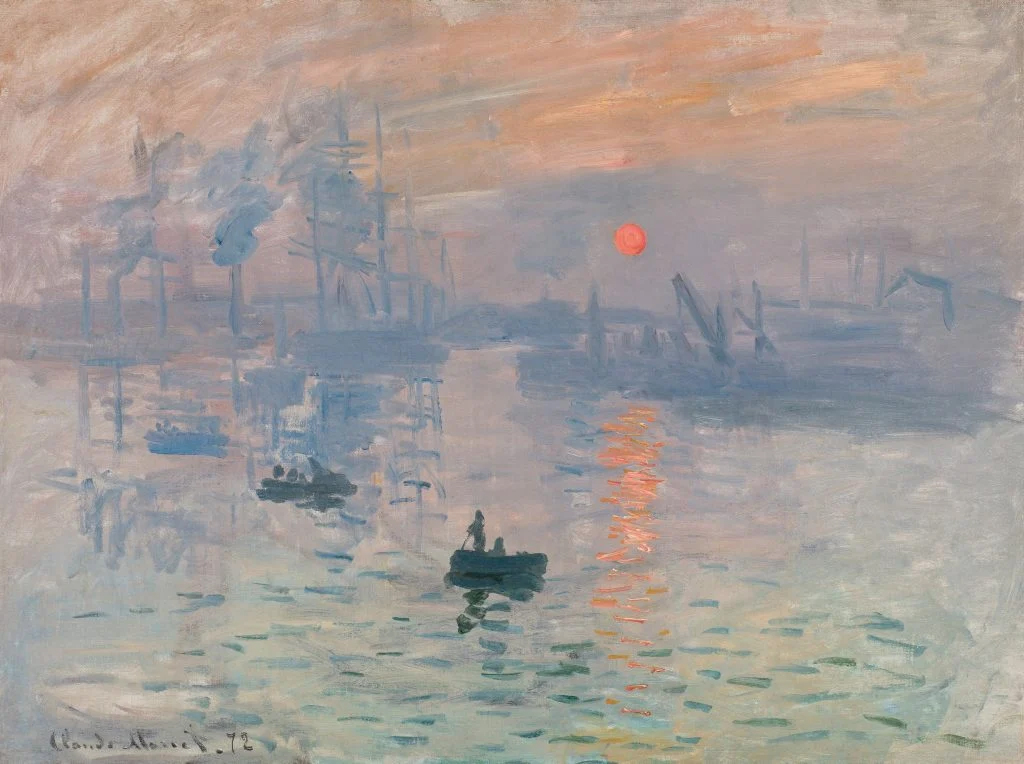
Sunrise over Skull Creek and Pinckney Island, SC

Love Calls Us to the Things of This World by Richard Wilbur

The eyes open to a cry of pulleys,
And spirited from sleep, the astounded soul
Hangs for a moment bodiless and simple
As false dawn.
Outside the open window
The morning air is all awash with angels.

Some are in bed-sheets, some are in blouses,

Some are in smocks: but truly there they are.
Now they are rising together in calm swells
Of halcyon feeling, filling whatever they wear
With the deep joy of their impersonal breathing;

Now they are flying in place, conveying

The terrible speed of their omnipresence, moving
And staying like white water; and now of a sudden
They swoon down into so rapt a quiet
That nobody seems to be there.
The soul shrinks

From all that it is about to remember,

From the punctual rape of every blessèd day,
And cries,
“Oh, let there be nothing on earth but laundry,
Nothing but rosy hands in the rising steam
And clear dances done in the sight of heaven.”

Yet, as the sun acknowledges

With a warm look the world’s hunks and colors,
The soul descends once more in bitter love
To accept the waking body, saying now
In a changed voice as the man yawns and rises,
“Bring them down from their ruddy gallows;
Let there be clean linen for the backs of thieves;
Let lovers go fresh and sweet to be undone,
And the heaviest nuns walk in a pure floating
Of dark habits,
keeping their difficult balance.”

From Collected Poems 1943-2004 by Richard Wilbur (New York, Houghton Mifflin Harcourt, 2004).

7.30.2025 – light mixed with it

light mixed with it
look with divided vision
see the reflection

Adapted from:

All our Concord waters have two colors at least; one when viewed at a distance, and another, more proper, close at hand.

The first depends more on the light, and follows the sky. In clear weather, in summer, they appear blue at a little distance, especially if agitated, and at a great distance all appear alike. In stormy weather they are sometimes of a dark slate color.

The sea, however, is said to be blue one day and green another without any perceptible change in the atmosphere.

I have seen our river, when, the landscape being covered with snow, both water and ice were almost as green as grass.

Some consider blue “to be the color of pure water, whether liquid or solid.”

But, looking directly down into our waters from a boat, they are seen to be of very different colors.

Walden is blue at one time and green at another, even from the same point of view.

Lying between the earth and the heavens, it partakes of the color of both.

Viewed from a hill-top it reflects the color of the sky; but near at hand it is of a yellowish tint next the shore where you can see the sand, then a light green, which gradually deepens to a uniform dark green in the body of the pond.

Like the rest of our waters, when much agitated, in clear weather, so that the surface of the waves may reflect the sky at the right angle, or because there is more light mixed with it, it appears at a little distance of a darker blue than the sky itself; and at such a time, being on its surface, and looking with divided vision, so as to see the reflection, I have discerned a matchless and indescribable light blue, such as watered or changeable silks and sword blades suggest, more cerulean than the sky itself, alternating with the original dark green on the opposite sides of the waves, which last appeared but muddy in comparison.

From Walden or, Life in the Woods, and On The Duty Of Civil Disobedience by Henry David Thoreau, (Houghton, Mifflin and Co., Boston and ; New York , 1897 Edition).

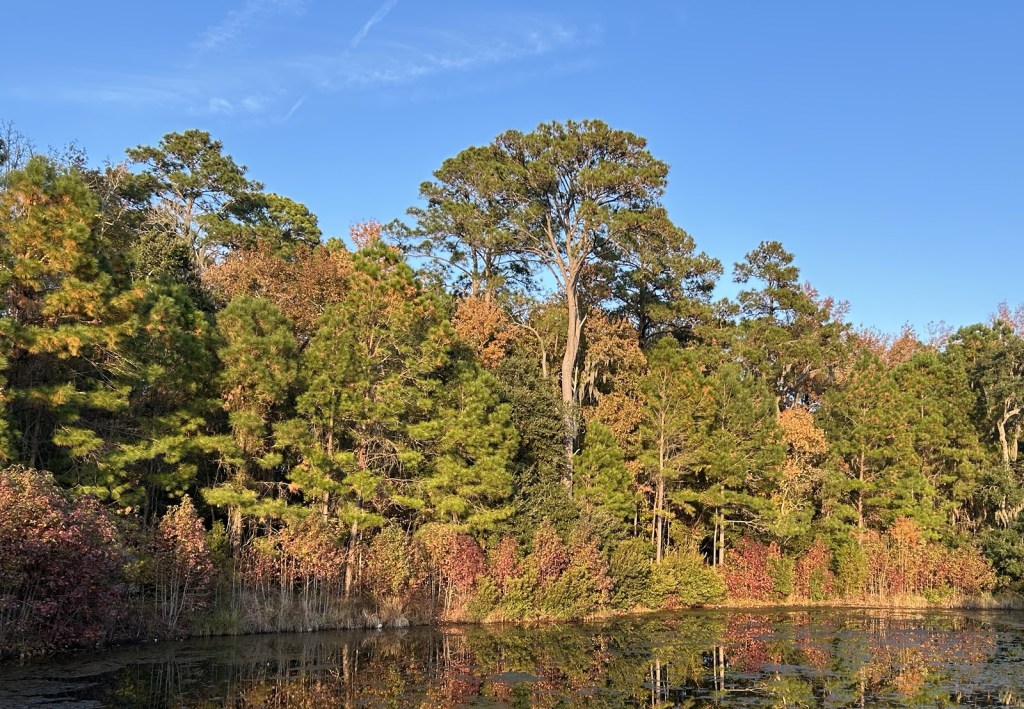
Sunset over Hidden Lakes pond, Bluffton, SC

7.15.2025 – sleep, o gentle sleep

sleep, o gentle sleep,
nature’s soft nurse, steep senses
in forgetfulness

Adapted from:

O sleep, O gentle sleep,
Nature’s soft nurse, how have I frightened thee,
That thou no more will weigh my eyelids down,
And steep my senses in forgetfulness?

From Henry IV, Part II, Act III, Scene 1 by William Shakespeare.

Where Big Bill has King wonder where sleep has gone, I manage to haiku it into a short prayer of thankfulness as well as write a sentence where haiku is used as a verb.

Editing Bill and turning haiku into a gerund without making it ‘haikuing’ is a pretty good start for a muggy muggy morning the low country of South Carolina.

Let me say that I have felt hot and cold, dry and wet and all other forms of weather but walking out into a steamy, thick, warm muggy morning a mile from the Atlantic coast is to be hit in the face with a soggy smelly towel, but I digress.

But morning it is and waking up is the issue.

Owen Johnson wrote about waking up in his book, The Prodigious Hickey: A Lawrenceville Story (The Century, 1908) saying:

” … the air with its clamour from the belfry of the old gymnasium, but no one rises. There is half an hour until the gong sounds for breakfast, a long delicious half hour—the best half hour of the day or night to prolong under the covers.”

There is half an hour until the gong sounds for breakfast …

a long delicious half hour …

the best half hour of the day or night to prolong under the covers …

O sleep.

O gentle sleep.

Nature’s soft nurse.

O, how I do hate to get up in the morning.

Weigh my eyelids down.

Steep my senses in forgetfulness.

PS: Anyone who dares quote Hamlet back to me with his whiney To sleep—perchance to dream. Ay, there’s the rub … will be shot.

Sunrise on a muggy South Carolina Morning

7.8.2025 – live in the sunlight

live in the sunlight
glad – know the day – that one might
dream in the shadows

Adapted from: That One Might Live in the Sunlight Glad by William H.A. Moore as published in “The Crisis” 1910-1926

That one might live in the sunlight glad
And know the day;
That one might dream in the shadows
And love alway.
To love and to live and to know,
To feel the sea’s strength and sea’s flow,
That one might sleep while the heart is mad
And sorrow play!
that one might speak when the soul’s athirst
And hear the cry;
That one might feel when the heart has burst
And love the why.
O to speak and to feel and to know,
O to love the wind’s strength and wind’s blow,
That one might walk with the sorrows first,
Nor weep, nor sigh!
O to know and to love and to live,
O to speak and hear and to give,
Nor fear to die!

According to the short bio in The book of American Negro poetry (New York: Harcourt, Brace, 1922) edited by James Weldon Johnson (who, according to a note on the dust jacket, Compiled this work because it was his belief that a group of people is not known) William W. H . Moore was born in New York City and received his education in the public schools and at the City College. He also did some special work at Columbia University. He has had a long career as a newspaper man, working on both white and colored publications. He now lives in Chicago. He is the author of Dusk Songs, a volume of poems.

This snippet is the basis of any and every mention or biography of Mr. Moore in the online world.

I also came across one discussion of Mr. Moore where the someone posted that they had searched for Dusk Songs every where they could think of with no success.

Hmmmmmmmmmmmmmmmmmmmmmmm.