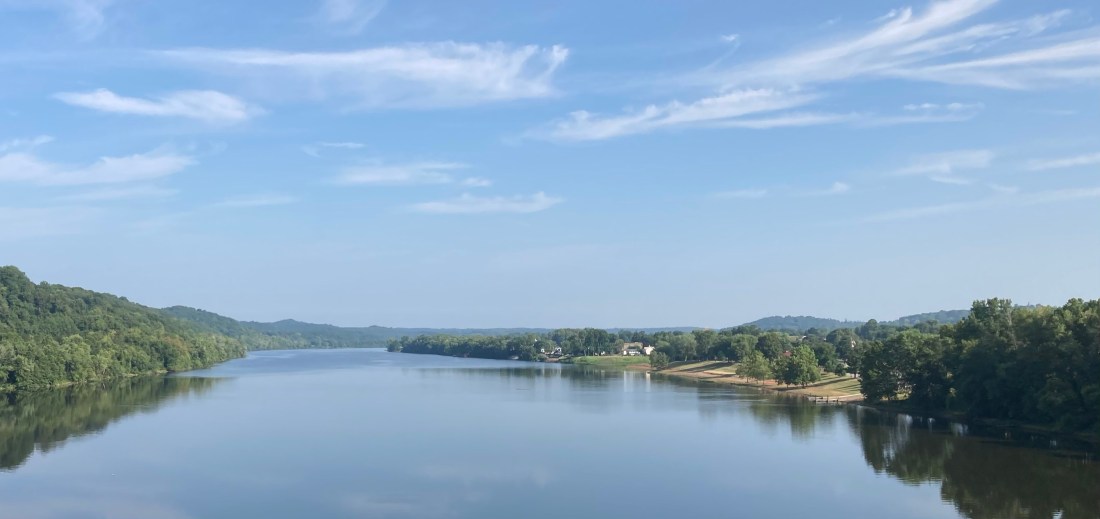
8.6.2021  – crossroads, street corners

crossroads, street corners

Not much better place to stand

Watch the passing show

If I had to pick ONE place in all of America where I could stand and watch the parade of American history pass in front of me there might not be a better a place than where I took this picture.

This is the Ohio River near Ravenswood, West Virginia.

My wife and I were driving from South Carolina to Columbus, Ohio when we crossed over the river.

Few places have seen the history float by like this place.

The Native Americans without numbers, the French, the British and the Americans and who knows who else took this nearly 1000 mile east-west super highway.

Quiet today.

Ignored today.

A backwater today.

But think of what you would have seen in the last 1000 years from this little river crossing.

8.1.2021 – hard to be Elvis

hard to be Elvis,
no one did fame like that, or
could do it for him

I came across a review of a new book on the life of Elvis.

The reviewer writes, “It was hard to be Elvis, no one had done fame like that before, and no one else could do it for him. He was trying to function within his reality.”

The author is trying to make the point that drugs, while playing a part, did not kill Mr. Presley as much has his bad family health history did.

The author also makes the point, “that Presley also felt responsible for his family (as many as 10 members lived with him at Graceland), his band and the Memphis Mafia – the courtiers who surrounded him. “By the time he’s touring again in the 70s, he was providing for more than 100 people. He says, ‘I’m sick, I don’t feel good, but I can’t stop because everybody is relying on me’.”

I was struck by two things.

One, that he felt the ‘responsibility’ for almost 100 people.

Two, that “no one had done fame like that before, and no one else could do it for him.”

I have to wonder how long Mr. Presley would have lasted in the age of social media.

It got me to thinking about the athlete’s today who beyond the responsibility for the their teammates and family are also expected to take on the weight of the world and to voice meaningful deep thoughts on any and all subjects far beyond the comprehension of most anyone.

And if any deep thoughts are expressed or even if there are not and maybe more if they are not expressed, the athlete is slammed from all directions with righteous demands for explanations, clarifications or retractions.

And right there is a problem.

Meaningful, deep thoughts on any subject are requested and expected at any time, all the time.

The concept of the post game media tent should terrify any person with half a brain.

The plan that puts another person in front of 100 or more reporters, all of whom have a deadline of 10 minutes ago and an assignment to produce copy that will get online clicks so the reporters ask about anything is a plan to make anyone go gaga in less time than any single Elvis 45 record.

And the world asks how come these athletes get ‘twisties’?

How come these athletes don’t want to talk to us?

How come these athletes don’t want to compete?

I am reminded of the great New York Yankee Joe DiMaggio.

It was said of Mr. DiMaggio that he played baseball as if every game was the 7th game of the World Series.

It was the only way he knew how to play.

Asked about this once, Mr. DiMaggio said that what he wanted to know is his heart was that if there was a person in the stands and this would be the only game that person would ever see, then Mr. DiMaggio wanted that person to know they had seen the best player of all time.

There is a great story of Marilyn Monroe coming back from a USO tour of Korea and saying to Mr. DiMaggio, “Can you imagine it? 10,000 people screaming your name?”

Mr. DiMaggio DID NOT play baseball in the age of social media.

Mr. DiMaggio played in an era of baseball writing that bought into the story of baseball and America as much as anyone.

Mr. DiMaggio played in an era of baseball writers who may have been terrified of getting on the bad side of Mr. DiMaggio and if that was they case, they was no reason that that reporter should cover the New York Yankee’s any more.

Mr. DiMaggio could go out to the ball park everyday and concentrate on being the best ball player ever because that was all anyone expected of him.

Mr. DiMaggio was not asked about opinion polls or global warming or EVER about his girl friend then wife then friend then lady-whose-grave-got-flowers-4-times a week.

It would be interesting to ask today’s athletes if might want to have the media relationship and expectations that Mr. DiMaggio enjoyed.

I doubt as a player Mr. DiMaggio ever even expressed a political statement.

He was just a ball player for crying out loud when you get right down to it.

Now, Mickey Mantle, well he DID express a political opinion once.

New York Yankee 2nd Baseman Bobby Richardson ran for Congress after retiring from baseball.

At a rally Mr. Richardson showed up with a bunch of ex Yankee teammates including Mickey Mantle.

One by one each of these one time team mates of Mr. Richardson got up and extolled the benefits of electing their friend to Congress.

Then Mickey Mantle got up, walked to the mic with the crowd cheering and cheering.

“Folks,” said Mickey Mantle, “I don’t know about you but I wouldn’t vote for Bobby Richardson for dog catcher.”

But I digress.

It is hard to be in the spotlight.

I don’t know who would choose to be today.

It was hard to be Elvis, no one had done fame like that before, and no one else could do it for him.

He was trying to function within his reality.

It is hard to be anyone today.

No one has done our life today like we are doing it.

No one else can do it for us.

7.25.2021 – remains aware how

remains aware how
complicated lives can become
easily give up

Adapted from the book, A Week at the Airport: A Heathrow Diary (2009, Vintage Books) by Alain de Botton, and the passage:

I admired the optimism with which Dudley confronted every new pair of shoes that paused at his station. Whatever their condition, he imagined the best for them, remedying their abuses with an armoury of brushes, waxes, creams and spray cleaners. He knew it was not evil that led people to go for eight months without applying even an all-purpose clear cream polish. He was like a kindly dentist who, on bringing down the ceiling-mounted halogen lamp and asking new patients to open their mouths (‘Let’s have a look in here, shall we?’), remains aware of how complicated lives can become and so how easily people may give up flossing their teeth while they try to save their companies or minister to a dying parent.

Part of the series of Haiku inspired by from A Week at the Airport: A Heathrow Diary (2009, Vintage Books) by Alain de Botton. I discovered this book entirely by accident. When searching for books online, I will use the term ‘collections’ and see what turns up. I figure that someone who has taken the time to gather together the etexts of any one author to create a collected works folder is enough for me to see what this author might be all about.

In this case I came across the writing of Alain de Botton. I enjoyed his use of language very much. Much of the words he strings together lend themselves to what I do.

As for his book, I recommend it very much though written in 2009, it misses the added layer of travel under covid but still the picture of the modern airport is worth the read.

7.23.2021 – power of the scene

power of the scene
appeared located in the
effect of the night

Adapted from the book, The Art of Travel (2002, Vintage Books) by Alain de Botton, and the passage:

I began word-painting.

Descriptive passages came most readily: the offices were tall; the top of one tower was like a pyramid; it had ruby-red lights on its side; the sky was not black but an orangey-yellow.

But because such a factual description seemed of little help to me in pinning down why I found the scene so impressive, I attempted to analyse its beauty in more psychological terms.

The power of the scene appeared to be located in the effect of the night and of the fog on the towers.

Night drew attention to facets of the offices that were submerged in the day.

Lit by the sun, the offices could seem normal, repelling questions as effectively as their windows repelled glances.

But night upset this claim to normality, it allowed one to see inside and wonder at how strange, frightening and admirable they were.

The offices embodied order and cooperation among thousands, and at the same time regimentation and tedium.

A bureaucratic vision of seriousness was undermined, or at least questioned, by the night.

One wondered in the darkness what the flipcharts and office terminals were for: not that they were redundant, just that they might be stranger and more dubitable than daylight had allowed us to think.

Adapted from the book, The Art of Travel (2002, Vintage Books) by Alain de Botton.

According to the website, GOOD READS, Any Baedeker will tell us where we ought to travel, but only Alain de Botton will tell us how and why.

As I said in the section on Architecture , what I find irresistible in reading Mr. de Botton is his use of language.

I get the feeling that if you made a spread sheet of all the words, adverbs and adjectives used by Mr. de Botton, you just might find that he used each word just once.

Neat trick in writing a book.

If I knew how to do that, hey, I would.

** More from the category TRAVEL — click here

7.21.2021 – too, different

too, different
shapes abstractly represent
two temperaments

*TOO is not a typo.

Work with me here.

Adapted from the book, The Architecture of Happiness (2009, Vintage Books) by Alain de Botton, and the passage:

Consider the struts on the backs of two chairs.

Both seem to express a mood.

The curved struts speak of ease and playfulness, the straight ones of seriousness and logic.

And yet neither set approximates a human shape.

Rather, the struts abstractly represent two different temperaments.

A straight piece of wood behaves in its own medium as a stable, unimaginative person will act in his or her life, while the meanders of a curved piece correspond, however obliquely, with the casual elegance of an unruffled and dandyish soul.

According the The New York Review of Books, this is “A perceptive, thoughtful, original, and richly illustrated exercise in the dramatic personification of buildings of all sorts.”

What I find irrestible in reading Mr. de Botton is his use of language.

I get the feeling that if you made a spread sheet of all the words, adverbs and adjectives used by Mr. de Botton, you just might find that he used each word just once.

Neat trick in writing a book.

If I knew how to do that, I would.