everything being of potential interest, layers of value
I based this haiku and several others like it from the writing in the book, The Art of Travel (2002, Vintage Books) by Alain de Botton, and the passage:
I tried to reverse the process of habituation, to dissociate my surroundings from the uses I had previously found for them. I forced myself to obey a strange sort of mental command: I was to look around me as though I had never been in this place before. And slowly, my travels began to bear fruit.
Once I began to consider everything as being of potential interest, objects released latent layers of value.
According to the website, GOOD READS, Any Baedeker will tell us where we ought to travel, but only Alain de Botton will tell us how and why.
As I said in the section on Architecture , what I find irresistible in reading Mr. de Botton is his use of language.
To also quote myself, I get the feeling that if you made a spread sheet of all the words, adverbs and adjectives used by Mr. de Botton, you just might find that he used each word just once.
book shop after hours slide money under the door good deed weary world
The Old Bay Marketplace is an arcade or covered outdoor walkway through the middle of a building that is lined with shops on either side of the walkway located on Bay Street in downtown Beaufort, South Carolina.
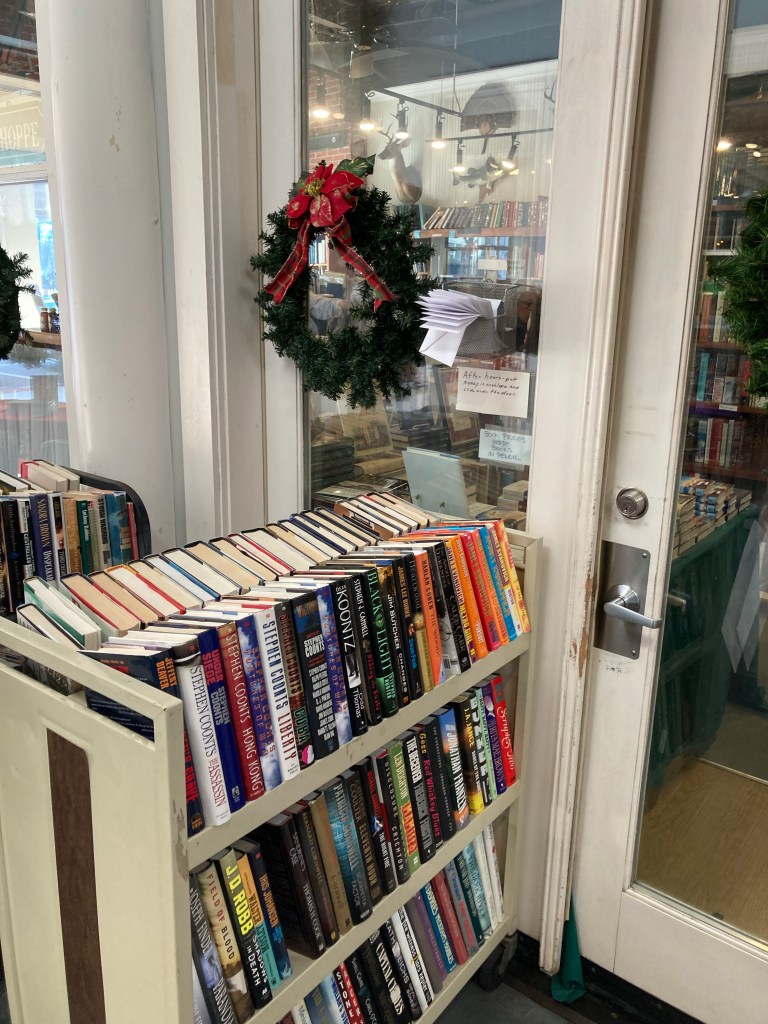
On the corner of the entrance to the arcade on Bay Street is a used bookstore named the McIntosh Book Shoppe.
The McIntosh Book Shoppe is situated there on the corner of the entrance into the arcade so that there is a door facing Bay Street and another back door that opens out into the covered walkway.
The space outside this back door under the covered walkway is crowded with book carts and tables that are filled with books for sale.
The back door to the McIntosh Book Shoppe
So many carts, tables and books are crowded into this space that moving all these carts, tables and books would be a lot of work to bring in at night and put back out the next day.
So the books, carts and tables are not brought in at night.
The books, carts and tables stay outside in the covered arcade.
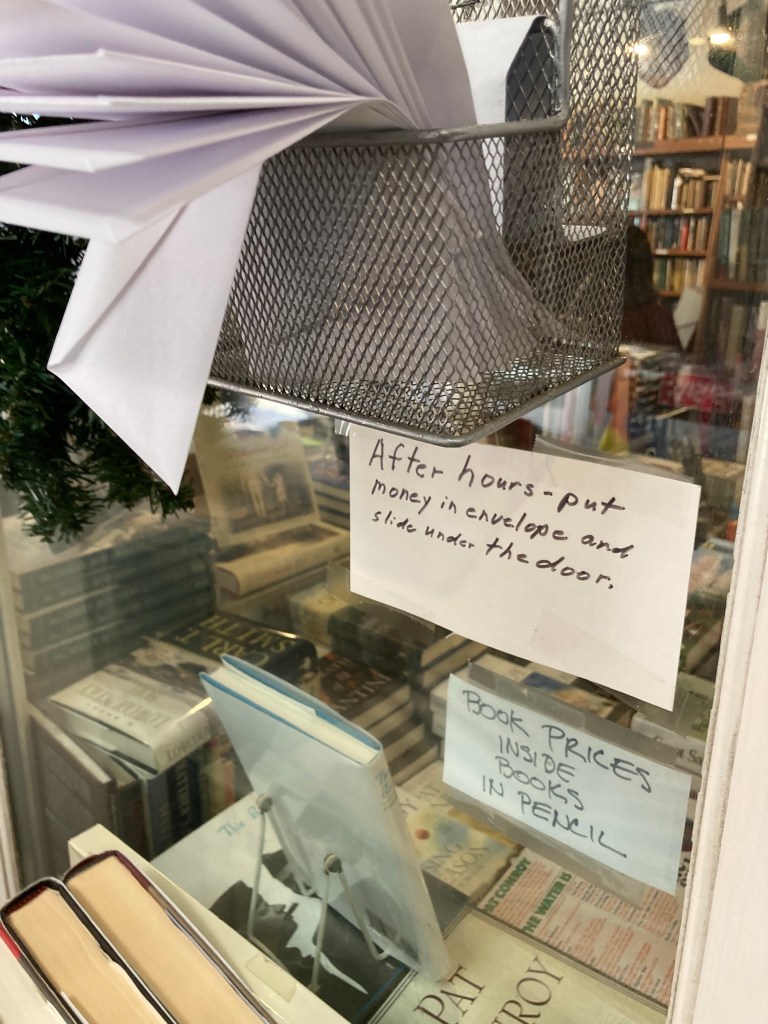
On the arcade wall, next to the door, is a metal rack stuffed full of envelopes.
Next to the metal rack stuffed full of envelopes is a small, hand lettered sign.
The sign reads:
After hours – put money in envelope and slide under the door.
It is altogether appropriate at this point to quote Big Bill’s, “How far that little candle throws his beams! So shines a good deed in a naughty world” (Merchant of Venice – Act V, Scene I)
But, somehow, it is better to quote Gene Wilder in the role of Willy Wonka.
So shines a good deed in a weary world.
PS: Admit it – this made you smile and feel a little bit of a warm bump inside – maybe a small kick of hope in your soul.
ideal place, right place known or unknown, actual or visionary
This is the most beautiful place on earth.
So reads the first line of Edward Abbey’s book, Desert Solitaire: A Season in the Wilderness.
Mr. Abbey is writing about the Utah desert.
Mr. Abbey goes on, “There are many such places.“
The first paragraph of Desert Solitaire reads,
This is the most beautiful place on earth.
There are many such places.
Every man, every woman, carries in heart and mind the image of the ideal place, the right place, the one true home, known or unknown, actual or visionary.
A houseboat in Kashmir, a view down Atlantic Avenue in Brooklyn, a gray gothic farmhouse two stories high at the end of a red dog road in the Allegheny Mountains, a cabin on the shore of a blue lake in spruce and fir country, a greasy alley near the Hoboken waterfront, or even, possibly, for those of a less demanding sensibility, the world to be seen from a comfortable apartment high in the tender, velvety smog of Manhattan, Chicago, Paris, Tokyo, Rio, or Rome – there’s no limit to the human capacity for the homing sentiment.
I do not want to get into nor do I intend to get into a debate about Mr. Abbey and the person that he was.
Suffice it say that ANYONE whose first line of their Wikipedia Bio states, “American author, essayist, and anarchist” will be a person about whom, other people have strong opinions.
For me today, let me focus on the line, “Every man, every woman, carries in heart and mind the image of the ideal place, the right place, the one true home, the ideal place, the right place, actual or visionary.”
If you ask me about where I live I would respond that I live in the most beautiful place on earth.
If you ask me about where I live I would respond that I live in the ideal place, the right place.
I would like to say this is where I always wanted to live but, until a year ago, I did not know this place existed apart from a name on map.
Known or unknown.
Actual or visionary.
Maybe the best part is I know this works for me and I know that every man, every woman, carries in heart and mind the image of the ideal place, the right place.
It is not the same place.
The book, Lost Horizon, by James Hilton, the story of a man looking for his ideal place, the right place, the last line is, “Do you think he will ever find it?“
The Frank Capra movie of the same title with the same story ends with, “Here is my hope, that we all find our Shangri-La.”
where is orion? what equinox precession? see that southern cross?
When I was a kid, growing up in Grand Rapids, Michigan, me, my family, my friends and the whole neighborhood would go sledding at night in the winter time on the hill by our school, Crestview Elementary.
The hill wasn’t a mountain or anything but it was high enough and long enough to be the best sliding hill in the world for little kids.
Our neighborhood had been built on an golf course.
The mainstreet through the neighborhood, my street, Sligh Blvd., followed a more of less, east-west path of what had been a small creek and ravine through the middle of the golf course.
Even though my Dad had grown up on the North End of Grand Rapids and knew that the property had been a golf course, he didn’t realize what building a house along what had been an existing watercourse would mean.
But we learned and relearned every spring when our basement would fill with water.
This was really odd as there were no windows in our basement but there were two floor drains that were connected to the storm sewers.
You can figure out the rest of that story.
The streets that connected to Sligh and went north and south went up hill no matter which direction you turned.
Houses were built along these streets until you got down by our house and the developer must have decided that it was just to much of a hill and the land was left vacant and a public school and park was built there.
Our house was on the south side of the street.
On the north side, there was a single row of houses and then the school property started.
Crossing the street and passing that row of houses, we were at the bottom of the longest, widest hill on the North End.
And that is what we called it.
The North End.
There was even an NE on the street signs.
People from out of town thought that the NE stood for North East.
We all knew it was for North End.
Grand Rapids, had and still has, a North End, a South End and a West Side.
Back when we had a high school, we were the CRESTON POLAR BEARS because we were on the North End.
I recently had to answer some security questions at my bank and when the lady asked what my high school mascot was, she kind of paused and then said, “You are the only Polar Bears I have ever heard of.”
But back to the hill.
It was possibly the best sliding hill ever.
It was a wide, long, long gentle slope with few trees.
A fence ran along one side where there were houses that you had to worry about if you went of to the left, which was an attraction as that side of the hill was steep but then there was that fence at the bottom.
What you wanted to do was stay on the main hill and slide as far and as long as you could.
When conditions were right, you could slide forever.
There are a lot of things I remember about sledding on that hill.
There were always a bunch of kids up there.
There was a wide range of sliding equipment from sleds and saucers to toboggans.
The single bladed snurfer came along at some point.
Over the course of the winter the snow on the hill would get packed down into something just this side of ice in an ice rink.
When that happened, all the old fashioned sleds came out and you could fly down that hill.
Then someone would build a jump and we would all take our chances with that.
No safety gear, no helmets.
Kids started showing up in school with cuts and bruises on their chins that you got laying head first on a sled and speeding down the hill with your face inches above the surface, and you chin banging on the handles.
There was that long walk back up the hill that was the price for a really long slide.
There was the cold.
There was the wet.
Winter meant a lot of cold, wet and cold, wet wool.
I can feel it.
I can smell it.
But what really sticks in my brain were the stars.
I have rarely seen stars like the stars we saw as kids sledding on Crestview hill.
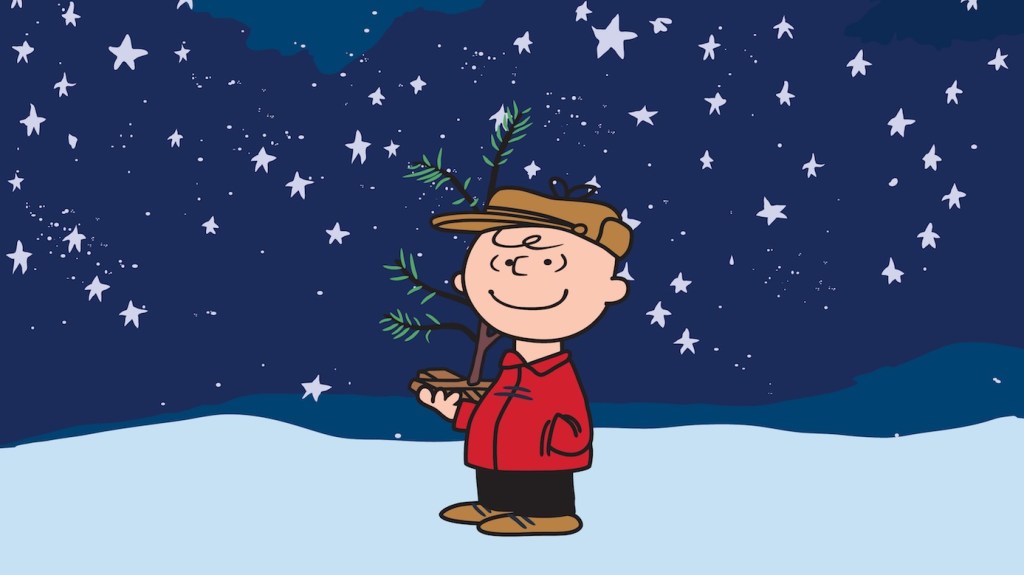
In my mind, it was like the winking twinkling stars in A Charlie Brown Christmas.
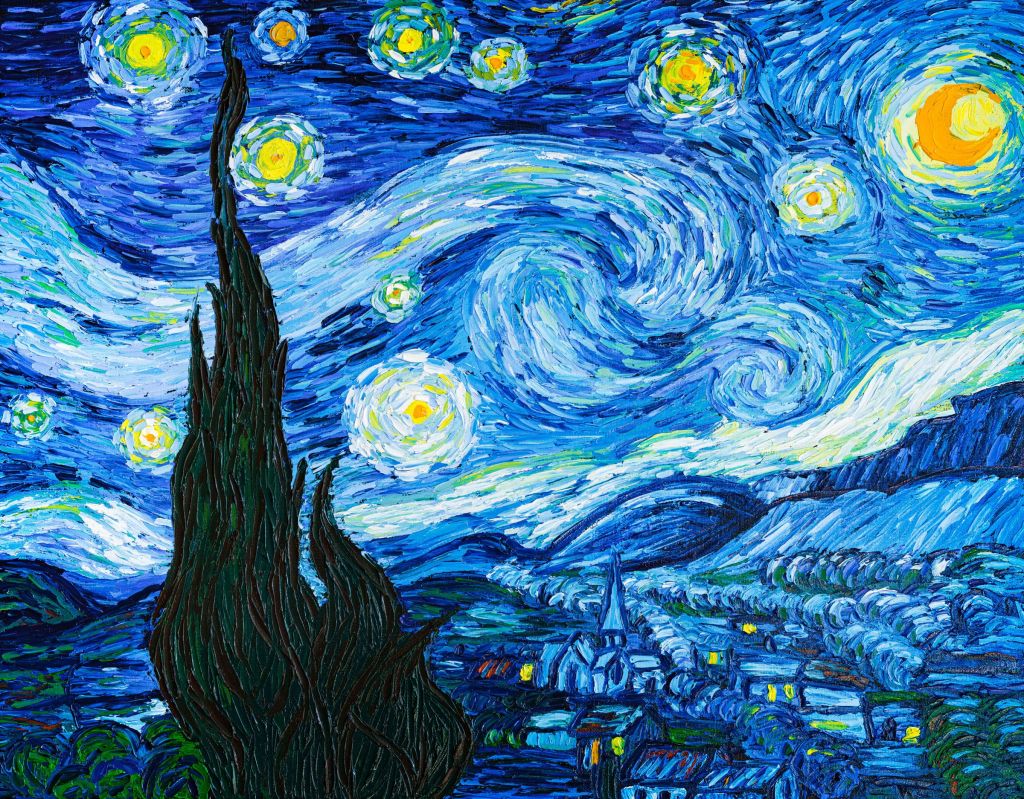
When I first saw Starry Night by Vincent Van Gogh, I thought Mr. Van Gogh had stood on our hill in winter time.
History tells us that Starry Night was painted in June and in France, but I don’t buy it.
Mr. Vincent was here.
It is one of those time space continuum things that you understand if you stare at Starry Night long enough.
My Dad liked stars and he liked to point out stars to us kids.
I can hear him say, “That’s not a star, that’s Venus.”
I say it the same way to my Grandkidz
I listened enough to my Dad to know that the big cluster of bright starts over head was the Constellation Orion.
At some point in a night of sledding, you would get tired and lay back on the snow and look up at all those stars.
The feeling of insignificance in this world was overwhelming while at the same time you felt close to God and his creative genius.
This was deep snow for a ten year old.
It was welcome to stand up and look across the Grand River Valley to the heights on the other side of the river where a giant red K glowed in the dark marking the K Mart store on Alpine to bring you back into civilization.
Now I live in the south.
When I lived in Atlanta there was too much light to see the stars much.
Now that I live along the Atlantic Coast, I am getting reacquainted with the stars.
But there is something wrong down here.
I can’t find Orion.
I did find a couple of really cool websites that allow you to follow the night sky for your location.
My Dad would have loved that.
And from what I can learn, Orion can be seen down here, but it isn’t right up overhead but low on the horizon.
The problem there is that living in the low country, there are few places where you can get the elevation to see the horizon.
I can, of course, go over to the beach, but horizon goes off to the east and I think Orion is to the southwest.
And that got me thinking, am I far enough south to see the Southern Cross.
Always wanted to, maybe just because it is on both the Australian and New Zealand flag and maybe because of the song that was popular when I was in High School.
So into the google goes Can I see the southern cross in South Carolina.
The answer is no, but the discussion on the Wikipedia page was fascinating.
According to Wikipedia:
The bright stars in Crux [the Southern Cross] were known to the Ancient Greeks, where Ptolemy regarded them as part of the constellation Centaurus. They were entirely visible as far north as Britain in the fourth millennium BC. However, the precession of the equinoxes gradually lowered the stars below the European horizon, and they were eventually forgotten by the inhabitants of northern latitudes.
Saw that last line over.
However, the precession of the equinoxes gradually lowered the stars below the European horizon, and they were eventually forgotten by the inhabitants of northern latitudes.
Again.
The stars were eventually forgotten by the inhabitants of northern latitudes.
I don’t know why I didn’t know that.
That the stars themselves are in motion.
Well, no that’s not it, but that the earth relationship to the stars is in motion.
In another 4,000 years the Southern Cross will be back up here.
To convict the parents of involuntary manslaughter, the state will have to prove that the parents were “grossly negligent” in allowing their son access to a firearm, and that their gross negligence caused the deaths of the students.
Gross negligence means more than just carelessness. It means willfully disregarding the results to others from the failure to act.
Thursday night in the NFL, the Dallas Cowboys beat the New Orleans Saints without their head coach due to Covid 19 Protocols.
Defensive Coach and one time Atlanta Falcons Head Coach Dan Quinn took over for the game.
Asked about the win, Coach Quinn said this.
“I think it’s really an example of leadership from Mike and to say what happens when the leader is not here.”
“Everybody had to chip it in and say, ‘No job is not your job right now. By any means necessary, we’ve got to get this job done.'”
Thinking back to the legal analyst and the sentence, It means willfully disregarding the results to others from the failure to act.
Thinking hard about the failure to act.
Thinking hard about the failure to act, I want to say, “No job is not your job right now. By any means necessary, we’ve got to get this job done.”