Belle Riviere – the french named it – a woman easy to look at
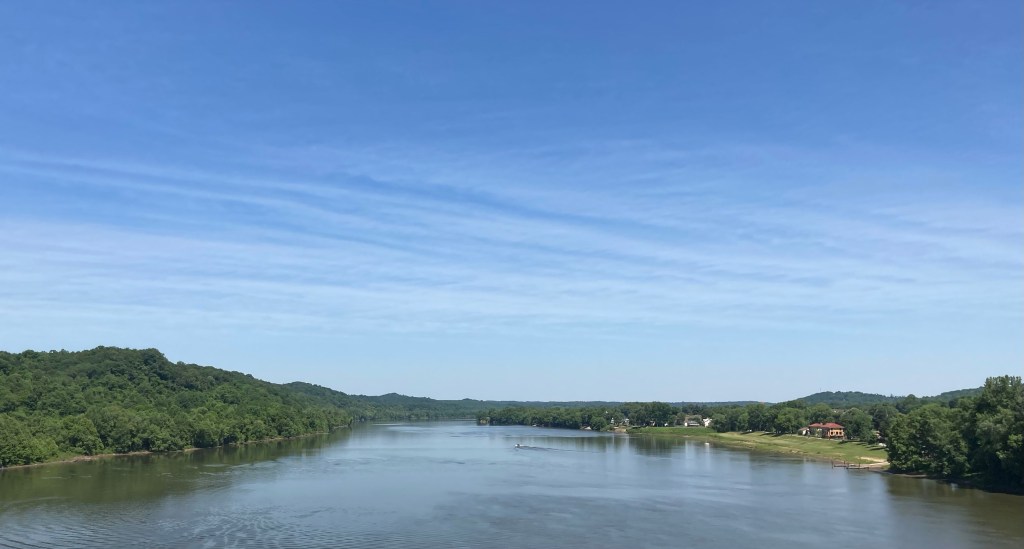
We crossed the Ohio River again recently.
I was reminded of the poem, Whiffs of the Ohio River at Cincinnati, by Carl Sandburg from the collection, Good Morning, America.
The part in particular that goes:
When I asked for fish in the restaurant facing the Ohio river, with fish signs and fish pictures all over the wooden, crooked frame of the fish shack, the young man said, ‘Come around next Friday — the fish is all gone today’
So, I took eggs, fried, straight up, one side, and he murmured, humming, looking out at the shining breast of the Ohio river, ‘And the next IS something else, and the next is something else’
The customer next was a hoarse roustabout, handling nail kegs on a steamboat all day, asking for three eggs, sunny side up, three, nothing less, shake us a mean pan of eggs
And while we sat eating eggs, looking at the shining breast of the Ohio river in the evening lights, he had his thoughts and I had mine thinking how the French who found the Ohio river named it La Belle Riviere meaning a woman easy to look at.
as mysterious as great the perpetual rhythm of the tides
In “Notes for a Preface“, an essay written by Carl Sandburg for the the book “Complete Poems of Carl Sandburg“, Mr. Sandburg wrote, “The Spanish poet Lorca saw one plain apple infinite as the sea. “The life of an apple when it is a delicate flower to the moment when, golden russet, it drops from the tree into the grass is as mysterious and as great as the perpetual rhythm of the tides . . .“
According to Wikipedia: Federico del Sagrado Corazón de Jesús García Lorca (5 June 1898 – 19 August 1936), known as Federico García Lorca was a Spanish poet, playwright, and theatre director.
García Lorca achieved international recognition as an emblematic member of the Generation of ’27, a group consisting of mostly poets who introduced the tenets of European movements (such as symbolism, futurism, and surrealism) into Spanish literature. He was murdered by Nationalist forces at the beginning of the Spanish Civil War. His remains have never been found.
In the poem, Ballad of the Water of the Sea, Lorca writes:
The sea smiles from far off. Teeth of foam, lips of sky.
Folly Field Beach at high tide – Hilton Head Island May 30, 2022
Murdered by the nationalistic or Franco’s forces during the Spanish Civil War, those types of fellers have always had it for the poets and artists and such.
The smart people I guess.
I am reminded of the story of the Pol Pot regime in Cambodia.
When they took over Cambodia they knew they had to cut off opposition and the best way to do that was get rid of the smart people, the people who could think, the people who would ask questions and start other people asking questions.
And so they did.
They soldiers of Pol Pot went from town to town and executed all the smart people.
piece of cloth, a sound make something not cloth nor sound totems of love, hate
Adapted from the passage:
A flag is a piece of cloth and a word is a sound, But we make them something neither cloth nor a sound, Totems of love and hate
From the poem, John Brown’s Body by Stephen Vincent Benét.
According to Wikipedia
, John Brown’s Body (1928) is an epic American poem written by Stephen Vincent Benét. Its title references the radical abolitionist John Brown, who raided the federal armory at Harpers Ferry in Virginia in October 1859. He was captured and hanged later that year. Benét’s poem covers the history of the American Civil War. It won the Pulitzer Prize for Poetry in 1929.
The photo is of my Great Great Grand Fathers grave.
When he was 18, he joined the 16th Michigan Volunteer Infantry and later fought in Virginia and wounded in action at the Battle of Gaines Mill on June 27, 1862.
Here is a larger extract from the poem.
One cannot balance tragedy in the scales Unless one weighs it with the tragic heart. The other man’s tragedy was the greater one Since the blind fury tore the huger heart, But this man’s tragedy is the more pitiful. Thus the Eastern board and the two defended kings. But why is the game so ordered, what crowns the kings? They are cities of streets and houses like other cities. Baltimore might be taken, and war go on, Atlanta will be taken and war go on, Why should these two near cities be otherwise? We do not fight for the real but for shadows we make. A flag is a piece of cloth and a word is a sound, But we make them something neither cloth nor a sound, Totems of love and hate, black sorcery-stones, So with these cities.
Even today, We do not fight for the real but for shadows we make.
A flag is a piece of cloth and a word is a sound.
But we make them something neither cloth nor a sound, Totems of love and hate.
I can find my name tell me who I am, it don’t tell me where I am
Sorry but I am all over the place this morning and find it difficult to focus on just any one thing.
The haiku is adapted from Robert Frost’s poem, “Snow”
I guess I know my way, I guess I know where I can find my name Carved in the shed to tell me who I am If it don’t tell me where I am. I used To play”
Through everything and all the news, one question does seem to cut through the clutter.
What the hell is going on here?
Where are we?
Where are we going?
In conversation with one of my brothers last year, he pointed out that when he was just out of college, the late 60’s and into the early 70’s, the hippie era, students were shot on a college campus. drug use was rampant, a US President resigned in disgrace and the war in Vietnam went on and on and the end of the world was predicted every other day.
To tell the truth, I was releived.
The current year, I guess, has always looked worse than last year.
And next year will probably be worse than this year.
Of late though I have to reconsider.
Nope, these past years have been really, significantly worse.
I would point to the turn of the century.
I would point to the internet and the world wide web.
I would point to the focus of the world on the word I.
My news is catered to me.
My day is curated by my actions and my phone to me.
I used an Ipod and an Imac.
I use an Iphone and an Ipad.
I can carry a gun if I want to.
I can wear a mask if I want to.
I won’t wear a mask if I don’t want to.
I watch what I want to when I want to on TV.
I listen to the music I want to when I want to.
(I am reminded of the story that when the manuscript of “The Autobiography of Theodore Roosevelt” arrived at the publisher, Scribner had to send out for more boxes of Upper Case I’s)
I want to do what I want to do when I want to do it and nobody BUT nobody is going to to tell me I can not do what I want to do when I want to do it!
I am in control.
I AM the master of my fate, I AM the captain of my soul!
I grew up on the University of Michigan football team under Bo Schembecler.
Schembecler had a saying about the three most important things in sport.
“The Team, The Team, The Team.”
Michael Jordan was told by his coach, “There is no I in Team.”
Jordon replied, “There is in win.”
I think back to another era or trial and tribulation.
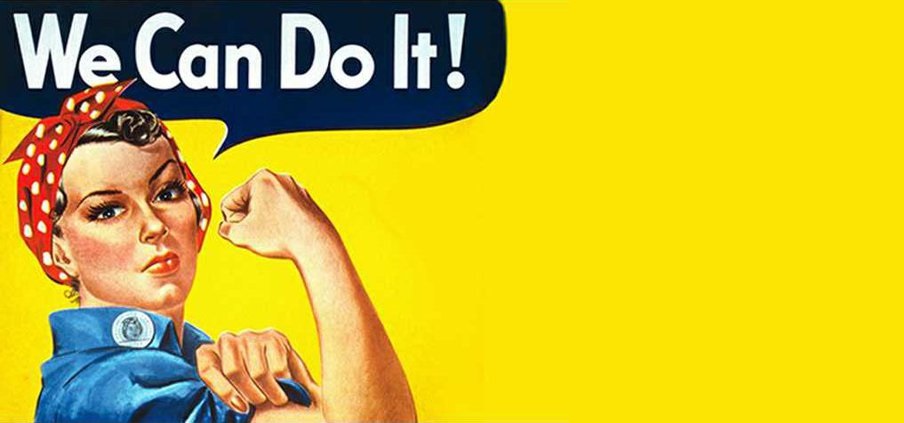
I think of this poster of Rosie the Riverter.
Notice there is no I in WE.
Still don’t know where we are but it’s not a good place.
time of shame, sorrow some senseless act of bloodshed, yet it goes on … why?
Back on April 5, 1968, then Senator Bobby Kennedy said in a speech at the Cleveland Club:
This is a time of shame and sorrow. It is not a day for politics. I have saved this one opportunity to speak briefly to you about this mindless menace of violence in America which again stains our land and every one of our lives.
It is not the concern of any one race. The victims of the violence are black and white, rich and poor, young and old, famous and unknown. They are, most important of all, human beings whom other human beings loved and needed. No one – no matter where he lives or what he does – can be certain who will suffer from some senseless act of bloodshed. And yet it goes on and on.
Then the Senator asked a question.
Why?
He then asked, “What has violence ever accomplished? What has it ever created?“
Whenever any American’s life is taken by another American unnecessarily – whether it is done in the name of the law or in the defiance of law, by one man or a gang, in cold blood or in passion, in an attack of violence or in response to violence – whenever we tear at the fabric of life which another man has painfully and clumsily woven for himself and his children, the whole nation is degraded.
Yet we seemingly tolerate a rising level of violence that ignores our common humanity and our claims to civilization alike. We calmly accept newspaper reports of civilian slaughter in far off lands. We glorify killing on movie and television screens and call it entertainment. We make it easy for men of all shades of sanity to acquire weapons and ammunition they desire.
Two months later on June 6, 1968, Senator Kennedy was gunned down in Los Angeles.
Whenever we tear at the fabric of life the whole nation is degraded.
It would be great to think that since we created this mess, we can fix this mess.
Too many people with too many guns.
I am reminded of the story of the founding of the Royal Canadian Mounted Police.
In the 1870’s, as the Canadian Pacific Railroad was being built, the folks who ran Canada were aware of the colorful stories of the lawless American west.
Dodge City and Tombstone.
Wyatt Earp and Wild Bill Hickcock.
Billy the Kid and Jesse James.
The folks saw the possibility of such an environment taking root as the the Canadian West began to be populated once the CPR was in service.
Their answer was to beat lawlessness with the law and the RCMP was created and in place once the railroad was completed.
When the trains started to run and the desperadoes showed up to rob the trains and the banks and fight in the barrooms, they found that in the trains and in the banks and in the barrooms the Mounties were already there.
For us?
No one – no matter where he lives or what he does – can be certain who will suffer from some senseless act of bloodshed.
Why?
Too many people with too many guns and it is too late.