higher than wisdom the soil in which the spirit lives, thinks and invents
From the quote, Music is a higher revelation than all wisdom and philosophy. Music is the electrical soil in which the spirit lives, thinks and invents, which is credited to Ludwig van Beethoven (1770-1827) by Bettina von Arnim in a letter to Johann Wolfgang von Goethe, May 28, 1810.
SO did he say it?
Maybe.
Can I prove he did through a letter that purports to quote him?
Maybe.
Does it matter?
Nope.
Once more …
Music is a higher revelation than all wisdom and philosophy.
Music is the electrical soil in which the spirit lives, thinks and invents.
And as Fran Leibowitz says, “Music makes people happier, and it doesn’t harm them. Most things that make you feel better are harmful. It’s very unusual. It’s like a drug, that doesn’t kill you.“
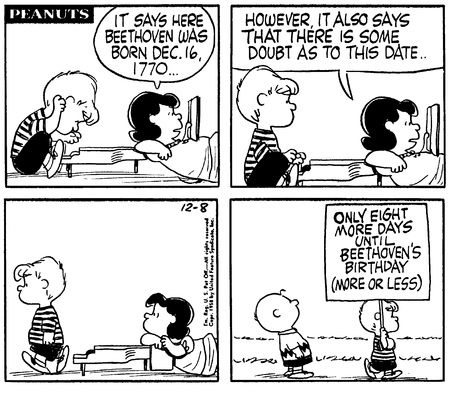
Regardless, Happy Birthday Mr. Beethoven.
And to return to your words from other people’s letters, as you said on your death bed, Applaud, my friends, the comedy is over.
she was perfectly with commonplace sobriety in getting dinner
When she went downstairs again, the kitchen was full of savory smells, the pot was boiling, and Mother, with a perfectly commonplace sobriety of interest in her household deeds, was getting dinner.
From Mistletoe — A Christmas Eve Love Story by Alice Brown (1856-1948)
quirky cartoons and upbeat music rote learning euphonious fun
George R. Newall, an advertising executive who was the last surviving creator of “Schoolhouse Rock,” the animated musical snippets that taught young Generation X television viewers grammar, math, civics and science for a few moments during otherwise vacuous Saturday-morning commercial programming, died on Nov. 30 at a hospital near his home in Hastings-on-Hudson, N.Y. He was 88.
The cause was cardiopulmonary arrest, his wife, Lisa Maxwell, said.
“Schoolhouse Rock,” series, which ran from 1973 to 1984 and was revived in the 1990s, used quirky cartoons and upbeat music to furtively transform rote learning into euphonious fun during regular programming and before the government, in the 1990s, mandated that stations broadcast a modicum of educational and informative fare.
From the obit, George Newall, a Creator of ‘Schoolhouse Rock,’ Dies at 88, written by Sam Roberts, in the New York Times, Dec. 7, 2022.
Who among us who grew up in this era in front of our TVs, cannot sing “Conjunction Junction” (What’s your function? I got And But and Or … they can take you pretty far.)
Who can’t sing this song?
Well, besides my wife who grew up without a TV in the house so she did not experience Saturday morning cartoons.
My Saturday morning, growing up in the late 1960’s (which I realize are farther away from me today then the world of Little House in the Big Woods was from Laura Ingalls Wilder when she wrote, or her daughter wrote, her remembrances of time past) began with getting out of bed, coming downstairs and pouring my breakfast.
I had my choice of Kellogg’s products that included Sugar Smacks, Frosted Flakes and Cocoa Krispies along with the single General Foods representative, Cheerios.
We were a Kellogg’s family.
There were no Post Cereal’s in our house.
During the week, when we watched Captain Kangaroo and they ran the commercial of the Captain with his electric train set that had a flat car with a cereal bowl on it that stopped at the water tower and the spout unfolded and poured milk on the cereal and the Captain announced that this segment was brought to you by Kellogg’s of Battle Creek, Michigan, I thought that the Captain and Mr. Greenjeans WERE IN Battle Creek.
That kind of made both the Captain and Kellogg’s the home town team.
I know that Post was also located in Battle Creek but there was something about Post Cereal and the connection with Marjorie Merriweather Post and Cary Grant or something that kept Post cereals out of our kitchen.
It also may have had something to do with my Dad as one of his death sentences on any food was to say, ‘It reminds me of Postum!’
Whether it was a beverage or something to eat, if it reminded my Dad of Postum, it never showed up again.
I am not sure what Postum was but my Dad’s word was good enough for me.
As might be noticed from the brand names of the cereal, the cereal was focused without shame, on SUGAR.
Cheerios were not sweetened with sugar or honey coated back then, and when I chose Cheerios, I poured milk on them and coated them with several spoonful’s of white sugar to that point that there was a thick sludge at the bottom of the bowl to be slurped up after the Cheerios had been eaten.
There was a long running battle whenever my Grandma Hendrickson happened to around as she would make us put the sugar on BEFORE the milk though we would argue it wouldn’t stick to the Cheerios.
Whenever my Mom had a baby, Grandma would stay with us and run the kitchen.
She also limited us to something like one spoonful of sugar and barely enough milk to float the Cheerios.
Grandma was also UP on a Saturday morning when most other adults wanted no part of us early on weekends.
Once the sugar was in our systems and our brain were pushed into near cationic activity of overdrive, we headed for the TV and Saturday Morning kids shows.
The earlier you were up, the odder these Saturday morning shows were.
There might be some old black and white TV shows.
I remember something called Sky King where a cowboy flew around the modern (1960 era) American west and solved peoples problems with his plane.
Also the Japanese cartoons were on early.
Those were cartoons where only the mouths were animated.
I feel like there were several cartoons like Speed Racer that really had about 3 episodes but the story could be changed by changing the recorded voices so there were 100’s of versions of these cartoons but they all looked the same.
Then the kids shows would start and there would be a mix of shows and cartoons produced for kids.
Some of the great shows include Lancelot Link Secret Chimp, really chimps dressed up in clothes with human voices and George of the Jungle.
On a sugar high that would not have been able to be recorded with any medical device available at the time, we watched them all.
Glued to the TV set was not an exaggeration.
This continued until near noon when the Bugs Bunny cartoons would start.
By this time, my older brothers and sister would be up and they might join the circle to watch a few minutes of Looney Tunes.
My memory tells me that my brother Jack had a standing request to be notified whenever the Bugs Bunny / Yosemite Sam Fearless Freep cartoon was on.
To this day, Jack’s endorsement has kept this cartoon in my Top 10 Canon of Bugs Bunny cartoons.
Noon also meant it was close to lunch time and lunch time on Saturday meant Swanson’s Frozen Chicken pies and it was a job that my brother Bobby took on.
He would get out this round, bent baking sheet that we had forever, set the oven to 425 degrees and then walk around and ask everybody, ‘who wants a chicken pie?’
Then back to to the kitchen, he would open up to 9 or 10, depending on who was up or home from college, small boxed chicken pies out of the freezer and arrange them on that round baking sheet and put the pies in the oven with the timer set so the pies would be ready about the same time as when the Bugs Bunny show was over.
I admired my brother’s role in all this and was awed by his mastery of this important job and I would daydream about the day that I might take over this job.
Grandma Hendrickson comes in this part of the story as well.
On those Saturdays when she was with us, once the breakfast was over, Grandma would make us all a nice lunch, unaware of our set Saturday schedule.
There was this one famous time when she created a spread of sandwiches and fruit and chips and glasses of milk all set for us and Bobby came into the kitchen without seeing anything Grandma had set out and turned on the oven and opened up a stack of chicken pies before Grandma caught him and asked him just what was he doing?
Through out all these TV shows and cartoons, there was a reoccurring theme, like the bass note in a Bach Fugue.
Saturday morning commercials.
Commercials that extolled the life long benefits of heavily sugar coated cereals and other such things that most American’s kids of that time begged to be provided with because of these commercials.
The Federal Government and its TV arm, the FCC had long been aware of the power of TV and in an effort to do something, anything positive with TV, mandated, in the words of writer, Sam Roberts, that stations broadcast a modicum of educational and informative fare.
This mandate led to Schoolhouse Rock.
Again the words of Mr. Roberts, Schoolhouse Rock was animated musical snippets that taught young television viewers grammar, math, civics and science for a few moments during otherwise vacuous Saturday-morning commercial programming.
These were shorts that ran on Saturday mornings between the shows.
And they ran for years.
I never thought about the people who made these.
And last week I saw that George R. Newall had died and he was the last surviving creator of “Schoolhouse Rock.”
I read about Mr. Newall and learned that “Schoolhouse Rock,” series, which ran from 1973 to 1984 and was revived in the 1990s, used quirky cartoons and upbeat music to furtively transform rote learning into euphonious fun during regular programming and before the government, in the 1990s, mandated that stations broadcast a modicum of educational and informative fare.
The show won four Emmy Awards.
The series spawned books, recordings, live singalong shows and a nostalgia cult that will mark the show’s 50th anniversary next year when the Walt Disney Company presents a prime-time television special; rereleases “The Official Schoolhouse Rock Guide,” written by Mr. Newall and Tom Yohe; and publishes an adult coloring book featuring all of the program’s characters.”
I love that line, furtively transform rote learning into euphonious fun.
Rote learning when I must have seen each of these clips about a million times.
Mr. Roberts wrote that: Schoolhouse Rock” originated in the early 1970s when David McCall, president of the McCaffrey & McCall advertising agency, complained to Mr. Newall, a creative director there, that his young sons couldn’t multiply, “but they can sing along with Jimi Hendrix and the Rolling Stones.”
Could Mr. Newall put the multiplication tables to music? he asked. Mr. Newall’s search for a quirky musician who might help led him to Ben Tucker, who played bass at the Hickory House in New York, which Mr. Newall frequented regularly.
“I asked Ben, and he said, ‘Oh yeah, my partner, Bob Dorough — he can put anything to music!’”
And they did.
And I watched.
And today, ask me how a bill becomes a law or the function of a conjunction and I can tell you.
ever returning all streams flow into the sea yet sea never full
The sun rises and the sun sets, and hurries back to where it rises. The wind blows to the south and turns to the north; round and round it goes, ever returning on its course. All streams flow into the sea, yet the sea is never full. To the place the streams come from, there they return again.
Rounding up friends or business contacts into a pen in your online profile for possible future use was never a healthy way to understand social relationships. It was just as common to obsess over having 500-plus connections on LinkedIn in 2003 as it is to covet Instagram followers today. But when social networking evolved into social media, user expectations escalated. Driven by venture capitalists’ expectations and then Wall Street’s demands, the tech companies – Google and Facebook and all the rest – became addicted to massive scale. And the values associated with scale – reaching a lot of people easily and cheaply, and reaping the benefits – became appealing to everyone: a journalist earning reputational capital on Twitter; a 20-something seeking sponsorship on Instagram; a dissident spreading word of their cause on YouTube; an insurrectionist sowing rebellion on Facebook; an autopornographer selling sex, or its image, on OnlyFans; a self-styled guru hawking advice on LinkedIn. Social media showed that everyone has the potential to reach a massive audience at low cost and high gain – and that potential gave many people the impression that they deserve such an audience.
The flip side of that coin also shines. On social media, everyone believes that anyone to whom they have access owes them an audience: a writer who posted a take, a celebrity who announced a project, a pretty girl just trying to live her life, that anon who said something afflictive. When network connections become activated for any reason or no reason, then every connection seems worthy of traversing.
That was a terrible idea. As I’ve written before on this subject, people just aren’t meant to talk to one another this much. They shouldn’t have that much to say, they shouldn’t expect to receive such a large audience for that expression, and they shouldn’t suppose a right to comment or rejoinder for every thought or notion either. From being asked to review every product you buy to believing that every tweet or Instagram image warrants likes or comments or follows, social media produced a positively unhinged, sociopathic rendition of human sociality. That’s no surprise, I guess, given that the model was forged in the fires of Big Tech companies such as Facebook, where sociopathy is a design philosophy.
To revisit some of the key phrasing here:
Social media showed that everyone has the potential to reach a massive audience at low cost and high gain – and that potential gave many people the impression that they deserve such an audience.
On social media, everyone believes that anyone to whom they have access owes them an audience.
… media produced a positively unhinged, sociopathic rendition of human sociality.
… the model was forged in the fires of Big Tech companies such as Facebook, where sociopathy is a design philosophy.
People just aren’t meant to talk to one another this much.



 No Haiku For You