stacked against what we think we are: impossible to surprise ourselves
From:
The days are stacked against what we think we are: it is nearly impossible to surprise ourselves I will never wake up and be able to play the piano.
In the poem The Theory & Practice of Rivers as it appears in the book, The Theory & Practice of Rivers and New Poems by Jim Harrison, (1937-2016), Clark City Press, Livingston, Mont 1989.
While I have to agree with Mr. Harrison, I still wake up and hope to play the piano and I don’t even have a piano.
almost wondered devious, subconscious means could settle down safe
Adapted from the passage:
Macon leaned back in his chair with his coffee mug cupped in both hands.
The sun was warming the breakfast table, and the kitchen smelled of toast.
He almost wondered whether, by some devious, subconscious means, he had engineered this injury — every elaborate step leading up to it—just so he could settle down safe among the people he’d started out with.
As Mr. Thurber wrote, Nowadays most men lead lives of noisy desperation.
The Grizzly and the Gadgets
A grizzly bear who had been on a bender for several weeks following a Christmas party in his home at which his brother-in-law had set the Christmas tree on fire, his children had driven the family car through the front door and out the back, and all the attractive female bears had gone into hibernation before sunset returned home prepared to forgive, and live and let live. He found, to his mild annoyance, that the doorbell had been replaced by an ornamental knocker. When he lifted the knocker, he was startled to hear it play two bars of “Silent Night.”
When nobody answered his knock, he turned the doorknob, which said “Happy New Year” in a metallic voice, and a two-tone gong rang “Hello” somewhere deep within the house.
He called to his mate, who was always the first to lay the old aside, as well as the first by whom the new was tried, and got no answer. This was because the walls of his house had been soundproofed by a sound proofer who had soundproofed them so well nobody could hear anybody say anything six feet away. Inside the living room the grizzly bear turned on the light switch, and the lights went on all right, but the turning of the switch had also released an odor of pine cones, which this particular bear had always found offensive. The head of the house, now becoming almost as angry as he had been on Christmas Day, sank into an easy chair and began bouncing up and down and up and down, for it was a brand-new contraption called “Sitpretty” which made you bounce up and down and up and down when you sat on it. Now thoroughly exasperated, the bear jumped up from the chair and began searching for a cigarette. He found a cigarette box, a new-fangled cigarette box he had never seen before, which was made of metal and plastic in the shape of a castle, complete with portal and drawbridge and tower. The trouble was that the bear couldn’t get the thing open. Then he made out, in tiny raised letters on the portal, a legend in rhyme: “You can have a cigarette on me If you can find the castle key.” The bear could not find the castle key, and he threw the trick cigarette box through a windowpane out into the front yard, letting in a blast of cold air, and he howled when it hit the back of his neck. He was a little mollified when he found that he had a cigar in his pocket, but no matches, and so he began looking around the living room for a matchbox. At last he saw one on a shelf. There were matches in it, all right, but no scratching surface on which to scratch them. On the bottom of the box, however, there was a neat legend explaining this lack. The message on the box read: “Safety safety matches are doubly safe because there is no dangerous dangerous sandpaper surface to scratch them on. Strike them on a windowpane or on the seat of your pants.”
Enraged, infuriated, beside himself, seeing red and thinking black, the grizzly bear began taking the living room apart. He pounded the matchbox into splinters, knocked over lamps, pulled pictures off the wall, threw rugs out of the broken window, swept vases and a clock off the mantelpiece, and overturned chairs and tables, growling and howling and roaring, shouting and bawling and cursing, until his wife was aroused from a deep dream of marrying a panda, neighbors appeared from blocks around, and the attractive female bears who had gone into hibernation began coming out of it to see what was going on.
The bear, deaf to the pleas of his mate, heedless of his neighbors’ advice, and unafraid of the police, kicked over whatever was still standing in the house, and went roaring away for good, taking the most attractive of the attractive female bears, one named Honey, with him.
MORAL: Nowadays most men lead lives of noisy desperation.
fundamentally flawed conception of our selves language, knowledge
Adapted from:
Today our supposedly revolutionary advancements in artificial intelligence are indeed cause for both concern and optimism. Optimism because intelligence is the means by which we solve problems. Concern because we fear that the most popular and fashionable strain of A.I. — machine learning — will degrade our science and debase our ethics by incorporating into our technology a fundamentally flawed conception of language and knowledge.
It is at once comic and tragic, that so much money and attention should be concentrated on so little a thing — something so trivial when contrasted with the human mind, which by dint of language, in the words of Wilhelm von Humboldt, can make “infinite use of finite means,” creating ideas and theories with universal reach.
Mr. Chomsky’s global standing as THE expert on language leaves me little room to argue, not that I would, as I was happy to read his opinions on the latest computer generated textual content craze that has a place in the current news cycle.
For me, the concept is as old as the Infinite Monkey Theory which states that if an infinite number of monkeys were left to bang on an infinite number of typewriters, sooner or later they would accidentally reproduce the complete works of William Shakespeare.
It goes back to 1913 and Félix Édouard Justin Émile Borel a French mathematician, who wrote:
.. Concevons qu’on ait dressé un million de singes à frapper au hasard sur les touches d’une machine à écrire et que, sous la surveillance de contremaîtres illettrés, ces singes dactylographes travaillent avec ardeur dix heures par jour avec un million de machines à écrire de types variés. Les contremaîtres illettrés rassembleraient les feuilles noircies et les relieraient en volumes. Et au bout d’un an, ces volumes se trouveraient renfermer la copie exacte des livres de toute nature et de toutes langues conservés dans les plus riches bibliothèques du monde. Telle est la probabilité pour qu’il se produise pendant un instant très court, dans un espace de quelque étendue, un écart notable de ce que la mécanique statistique considère comme la phénomène le plus probable…*
I remembered it more from Bob Newhart who told the joke about the typing monkey’s, “Hey, Harry! This one looks a little famous: ‘To be or not to be – that is the gggzornonplatt.”
To be sure of the date, I did the google and read the article on Wikipedia.
BOY HOWDY!
So much on so little that for some reason caught the attention of so many people including a ‘famous’ study by some fellers named, Hoffmann and Hofmann!
It seems that the image of an infinite number of typing monkeys is just the thing to get stuck in a lot of people’s brain.
And, for the record, my family name is Hofman, but my Grandpa thought it looked unbalanced and changed it to Hoffman.
I think to get four spellings of the same last name into 2 sentences is pretty good for a non monkey!
To return to Mr. Chomsky and his something so trivial when contrasted with the human mind.
I used to try to observe objectively my mind in action as it worked to process all the information coming into my brain as I drove into Atlanta.
I was pretty much left in awe everytime.
In his books, C.S. Forester has several scenes where the hero is in a situation surrounded by activity and is called on to make decision after decision.
In these scenes, one of the sources of activity is either a beeping clock or someone else calling off the time in 5 second intervals or some such thing that marks the time in the background and the hero begins to contemplate how in the world the brain can process all the data let alone arrive at a conclusion, let alone a successful conclusion, in the time allowed for the situation.
Infinite use of finite means, creating ideas and theories with universal reach.
It is, the mind, an incredible thing.
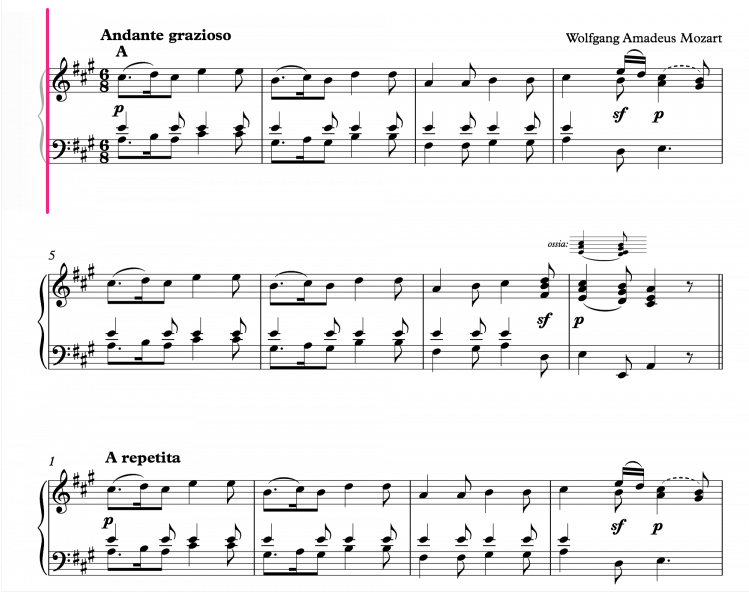
click on image to watch music and listen
To shift from text to music, I have long said that I had been allowed to compose the first 8 bars or so of Mozart’s Piano Concerto #11, I could die a happy person.
When Artificial Intelligence can compose this music, then email me a note.
When Artificial Intelligence can compose this music and KNOW what it did, then text me.
When Artificial Intelligence can LISTEN to this and feel it and know it is special and also know that if the computer was unplugged today, that computer would be happy that it has composed such a piece, then call me.
*.. Let us imagine that a million monkeys have been trained to type at random on the keys of a typewriter and that, under the supervision of illiterate foremen, these typing monkeys work with ardor ten hours a day with a million machines to write of various types. Illiterate foremen would collect the blackened sheets and bind them into volumes. And at the end of a year, these volumes would be found to contain the exact copy of the books of all kinds and all languages preserved in the richest libraries of the world. Such is the probability that there will occur for a very short instant, in a space of some extent, a notable deviation from what statistical mechanics considers to be the most probable phenomenon… (Yes I used a computer generated translation)
learning to pedal colossal load cerebral coordination
Learning to pedal is no easy feat. But forgetting is harder.
For most people, even after decades-long hiatuses, cruising still feels like a breeze.
The key is how the brain remembers the task.
Mastering cycling requires a ton of higher-level thinking: Your noggin’s motor cortices plan and execute precise muscle control, the cerebellum helps you balance and time your pedal strokes, and the basal ganglia keep these movements fluid rather than jerky.
It’s precisely this colossal load of cerebral coordination that ensures the skill sticks around, says Jürgen Konczak, a neuroscientist and biomechanics expert at the University of Minnesota.
We use every muscle movement and subsequent brain connection involved in bike riding during other activities, like dancing, playing sports, and walking — just not all at the same time.
When the time comes to hop back on the saddle, all the necessary moving parts are already tuned and oiled.
There’s never a bad time to start pedaling again.
It’s truly a skill that lasts a lifetime.
From Why you never forget how to ride a bike – A once-in-a-lifetime lesson by Hannah Seo
This story appears in the Winter 2020, Transformation issue of Popular Science.
sound, like the tone of that bell – then passing away … a thing that was not
THERE are certain half-dreaming moods of mind, in which we naturally steal away from noise and glare, and seek some quiet haunt, where we may indulge our reveries and build our air castles undisturbed.
In such a mood I was loitering about the old gray cloisters of Westminster Abbey, enjoying that luxury of wandering thought which one is apt to dignify with the name of reflection.
I sought to take refuge from their noise by penetrating still deeper into the solitudes of the pile, and applied to one of the vergers for admission to the library.
How much, thought I, has each of these volumes, now thrust aside with such indifference, cost some aching head!
How many weary days!
How many sleepless nights!
How have their authors buried themselves in the solitude of cells and cloisters; shut themselves up from the face of man, and the still more blessed face of nature; and devoted themselves to painful research and intense reflection!
And all for what?
To occupy an inch of dusty shelf — to have the title of their works read now and then in a future age, by some drowsy churchman or casual straggler like myself; and in another age to be lost, even to remembrance.
Such is the amount of this boasted immortality.
A mere temporary rumor, a local sound; like the tone of that bell which has just tolled among these towers, filling the ear for a moment—lingering transiently in echo — and then passing away like a thing that was not.
FromThe Mutability of Literature – A colloquy in Westminster Abbey by Washington Irving (1783-1859) in The Oxford Book of American Essays (NEW YORK, OXFORD UNIVERSITY PRESS, 1914).
Mr. Irving wrote this out after looking through the bookcase upon bookcase of books in the library at Westminster Abbey.
It came to mind as I walked through the aisle upon aisle of books at the Bookstore on the Hill in Richmond Hill, GA.
I met the owner but did not think to ask if the Bookstore on the Hill was in reference to the town of Richmond Hill or to the sermon of John Winthrop.
All those books.
To occupy an inch of dusty shelf — to have the title of their works read now and then in a future age, by some drowsy churchman or casual straggler like myself; and in another age to be lost, even to remembrance.



 No Haiku For You