Schmidt, Karras, Barney Sanders, Charlie and Barry Bussey, Hill, Moore, Sims
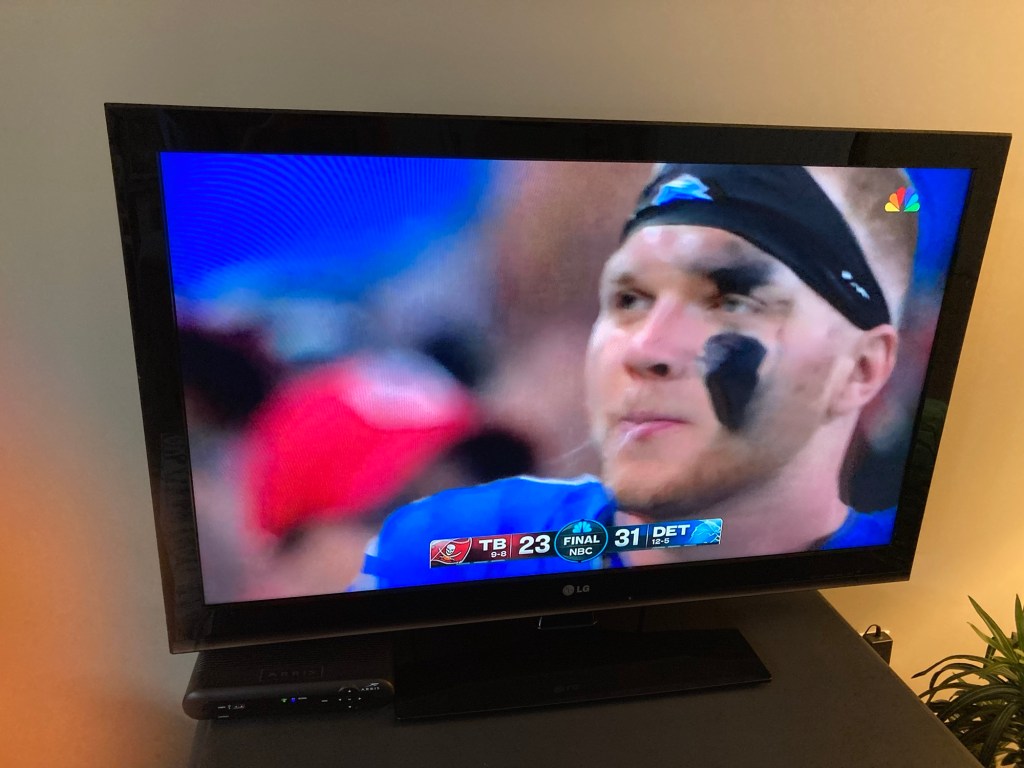
The Lions have won two playoff games in the same season for the first time since 1957, the last time they won an NFL championship. They play the 1-seed San Francisco 49ers in the NFC title game at 6:30 p.m. next Sunday at Levi’s Stadium for the right to go to the Super Bowl. It’s the second time the Lions are one win from a Super Bowl, losing 41-10 to Washington in the 1991 season in the NFC title game.
From Detroit Lions one win from first Super Bowl after beating Tampa Bay Bucs, 31-23 by Dave Birkett in the Detroit Free Press, 1/21/2024
Old men forget: yet all shall be forgot, But he’ll remember with advantages What feats he did that day: then shall our names. Familiar in his mouth as household words Harry the king, Bedford and Exeter, Warwick and Talbot, Salisbury and Gloucester, Be in their flowing cups freshly remember’d. This story shall the good man teach his son; And Crispin Crispian shall ne’er go by, From this day to the ending of the world, But we in it shall be rememberèd— We few, we happy few, we band of brothers;
those who watch rainbows gather a reputation as rainbow chasers
Adapted from Moments of Dawn Riders by Carl Sandburg in “The People, Yes: Sky Talk” (Harcourt, Brace & Company, 1936).
Those who straddle foaming sea-horses and ride into the sunrise do so with no instrument board, no timetables Those who watch one rainbow after another dissolve in seven prisms they seem to gather reputations for being rainbow chasers — they also choose bright mornings of clear weather and fading daystars to study the organization of the sprockets of the bursting dawn …
Life is filled with talk of the path not taken and the road less traveled and the sounds of different drummers and the grass being greener over there on the other side of the fence.
Sometimes you get to look down those other paths, hear the different drums, look over that fence.
The past weekend, the Wife and I watched the movie, “The Holdovers.“
Charming film, though a bit disconcerting when the era of your childhood is the subject of what is called a “Period Piece”, where the look and feel of a by gone era is ‘historically accurate’ as recreated on screen.
Not wanting to become a movie review, the focus of the story is a teacher who is teaching at same small private school that he attended.
The teacher left the school for college and came back and never left.
As far as we know he moved into his ‘rooms’ and stayed there the rest of his life.
In those rooms he accumulated books, school papers to be graded and dust.
Here is my point.
The life of that teacher as portrayed in the movie, was a life I could easily imagine to have been mine and consider, more or less, one my paths not taken.
As the credits rolled over the screen at the end of the movie, I said to my wife, “That could have been my life.“
My Wife said, “Yes, it could have.“
I said, and full transparency here – spoiler alert, “I would have been fired.“
My Wife said, “Yes, you would have.”
I was thinking about that this morning as I drove to work.
I thought of a singular, solitary life, surrounded by books and a school schedule and dust.
And I thought of my life and jobs and kids and meetings and car problems and taxes and bills and grand kids and kids.
And I thought of the path not taken.
And I looked at the path I was on.
I was driving over the bridge to the island and I thought of George Bailey.
And I said, “Thank you, God.“
I would write more but I have to go chase some rainbows and study the sprockets of the bursting dawn.
the meals in your life are numbered and the number is diminishing
Food.
Jim Harrison.
Guilt.
Great way to start the day.
I live in a country that is somewhat obsessed with cooking, eating, weight and weight loss while at the same time unthinkable numbers of people, children, unthinkably go to bed hungry.
I read and enjoy the author, Jim Harrison but of late I have been listening to his work while I drive to work.
Audio versions of a book make sure you hear every word.
I think I have developed a mental screen that allows me to read Jim Harrison and filter out the worst of Mr. Harrison’s … earthy soliloquies* … while focusing on his word play, sentence structure and word painting observations on life that make him one of my favorite authors.
When I LISTEN to his work, read out loud and mispronounced (If I hear MACK-i-NACK one more time …) you cannot ignore those earthy soliloquies and gee whiz but he can get to the edge of social ridiculousness and go over.
And starting my day thinking about food and Mr. Harrison leaves me with a feeling of guilt.
So what to do?
Should I feed the hungry?
Should I make an apology for Mr. Harrison?
And I have only been up and about for 30 minutes.
So I heave a sigh and I say out loud a line from the Savannah based movie, Midnight in the Garden of Good and Evil.
The line that goes … “Two tears in bucket … mother f*ck it.”
(Okay so I faded on spelling it out … but it’s a word we have all heard)
And I am going to comment on the dinner my wife made last night.
And I going to quote Jim Harrison without apology.
Last night my wife slow cooked a pork tenderloin in barbecue sauce and made pan fried sweet potatoes with Parmesan cheese and served it with rice.
There are meals where I can lose myself in the food, the flavors.
I look up, mists clear from my eyes and time has passed and my plate is empty.
I think of that Ben Franklin quote, “Behold the rain which descends from heaven upon our vineyards, and which incorporates itself with the grapes to be changed into wine; a constant proof that God loves us, and loves to see us happy.“
There are times when I feel that way about food.
I remember the place in the Bible where the picnic cloth filled with food comes down in front of Peter and God says, “don’t say anything I made is bad.“
There were no man made food additives or improvements included in that spread.
Nothing ‘fat free.’
Nothing ‘reduced calorie.’
Take and eat, said God.
I enjoyed my dinner.
I was reminded of other good, great meals, both simple and extravagant in my life.
I wondered how many have I had?
How many good, great meals does one get to eat in life?
I thought of a line from Clarence Day’s Life with Father where Mr. Day writes, “I adjusted my cap and walked on, thinking over this future. The more I thought about it, the less I wanted to be a civilized man. After all, I had had a very light lunch, and I was tired and hungry. What with fingernails and improving books and dancing school, and sermons on Sundays, the few chocolate éclairs that a civilized man got to eat were not worth it.“
Then I thought … How many good, great meals do I have left to eat?
And I thought of this passage from the 2011 essay, Chef English Major, by Jim Harrison that is reprinted in A really big lunch(New York, Grove, 2017)
Cooking becomes an inextricable part of life and the morale it takes to thrive in our sodden times.
A good start, and I have given away dozens of copies, is Bob Sloan’s Dad’s Own Cookbook. There is no condescension in the primer.
Glue yourself to any fine cooks you meet.
They’ll generally put up with you if you bring good wine. Don’t be a tightwad.
Owning an expensive car or home and buying cheap groceries and wine is utterly stupid.
As a matter of simple fact you can live indefinitely on peanut butter and jelly or fruit, nuts, and yogurt, but then food is one of our few primary aesthetic expenses, and what you choose to eat directly reflects the quality of your days.
Your meals in life are numbered and the number is diminishing.
Get at it.
Have to admit food is not the part of my life that it once was.
Sorry and sad to say that since moving to the south and its pollens and mud flats, my nose is not what it was and flavors are not what they were.
Oddly I get the subtle flavors of seafoods like shrimp and scallops over the blunt heavy flavors of a good steak.
Lucky for me I live near the sea.
Nevertheless, I appreciate food and the good foods and flavors that God has packed into that picnic cloth.
Again, I thought of a Jim Harrison passage.
It is a from one of the first essay’s of Mr. Harrison that I read and one that got me into the Harrison’s camp.
This is from the 1989 essay, Hunger, Real and Unreal that was reprinted in Just before dark : collected nonfiction, (Boston, Houghton Mifflin, 1991)
.. one day at lunch I told some plumpish but kindly ladies what I thought was a charming story of simple food. One August, years ago, I was wandering around the spacious property of a chateau up in Normandy, trying to work up a proper appetite for lunch.
Two old men I hadn’t seen laughed beneath a tree. I walked over and sat with them around a small fire. They were gardeners and it was their lunch hour, and on a flat stone they had made a small circle of hot coals. They had cored a half-dozen big red tomatoes, stuffed them with softened cloves of garlic, and added a sprig of thyme, a basil leaf, and a couple of tablespoons of soft cheese. They roasted the tomatoes until they softened and the cheese melted. I ate one with a chunk of bread and healthy-sized swigs from a jug of red wine. When we finished eating, and since this was Normandy, we had a sip or two of calvados from a flask.
A simple snack but indescribably delicious.
I waited only a moment for the ladies’ reaction. Cheese, two of them hissed, cheese, as if I had puked on their sprouts, and wine! The upshot was that cheese is loaded with cholesterol and wine has an adverse effect on blood sugar. I allowed myself to fog over as one does while reading bad reviews of one’s own work.
I read this bit to my Mother and she laughed and laughed and laughed, shaking her head the way she could.
Let me circle back and sum it all up.
Food is a constant proof that God loves us, and loves to see us happy, but the few chocolate éclairs that a civilized man gets to eat may not be worth it.
So?
Quoting Mr. Harrison again, “Eat the delicious fat and take a ten-mile walk. Reach into your memory and look for what has restored you, what helps you recover from the sheer hellishness of life, what food actually regenerates your system, not so you can leap tall buildings but so you can turn off the alarm clock with vigor.”
Hoffman Family Picnic – 1964
*scenes of a sexual nature that may or may not have anything to do with the plot …
The Elfstedentocht nonmaterial losses commemorated
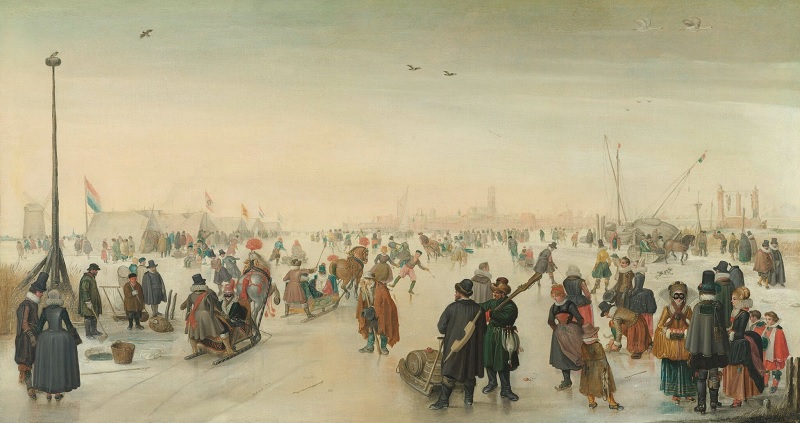
These scenes were so iconic, so Dutch, that I felt a bit bereaved, when I moved to the Netherlands more than 20 years ago, to realize that the world they showed was gone — and that thanks to climate change, it wouldn’t be coming back. Even the Elfstedentocht, the skating race through the 11 historic cities of Friesland that is one of the country’s most beloved national traditions and has been held 15 times since 1909, was passing from memory. The ice has to reach a certain thickness for it to be safely held, and the ice no longer reaches that thickness. What I found, in place of the sparkling white winters of the old paintings, was month after month of tepid drizzle.
How can such nonmaterial losses be commemorated? As long as we are unable to see them as losses, we can keep refusing to see what has caused them and keep hoping that they still, someday, might be reversed. The Elfstedentocht is like a relative whose small plane went missing a few years ago and whose loved ones still hope that he could, one day, stumble into town. They all know he’s dead, of course. But it feels too cruel to be the first to say it — too painful to erect a gravestone without so much as a corpse.
From the Guest Opinion piece, Waiting for Snow in the Netherlands, by Benjamin Moser, the author of “The Upside-Down World: Meetings With the Dutch Masters.”
Sure.
I just wanted to use the word, Elfstedentocht.
Aside from that I am forming a theory that every generation feels like they just missed out on something because of when they born and also because of how old they are getting, they are starting to lose out on something as well.
That I even typed this statement out reminds of the story that Secretary of State John Hay (a man who made a career out of having been Abraham Lincoln’s 2nd personal secretary) once said to Theodore Roosevelt, “There is one thing I admire about you, Theodore, it‘s your original discovery of the Ten Commandments.”
Anyway, so I regret that I missed out on what I never had and I regret what I perceive is being lost.
Welcome to the old age club I guess.
The old ways are changing.
And Mr. Churchill did say, “To improve is to change, so to be perfect is to have changed often.”*
2024 will be a year of changes.
People will disagree on what should be changed.
People will disagree on why things should be changed.
People will disagree on whether or not the changes are good or bad.
People all agree 2024 will be a year of changes.
I am prepared to regret what I missed out on that I never had and to regret what I perceive is being lost.
Because I will remember the line before Mr. Churchill said, “To improve is to change, so to be perfect is to have changed often.“
Before Mr. Churchill said, “To improve is to change, so to be perfect is to have changed often,” he said this.
“There is nothing wrong in change, if it is in the right direction.”
*The quote was traced by Jonah Triebwasser to The Wit and Wisdom of Winston Churchill, by James C. Humes, but no further. It appears to be part of an exchange in the House of Commons with Philip Snowden when Churchill defended his first budget in 1924, cf. “Ephesian” [Bechover Roberts], Winston Churchill, second edition, p. 288.
are those miracles you affirm wrought formerly, wrought no longer? Why?
Why, they say, are those miracles, which you affirm were wrought formerly, wrought no longer?
I might, indeed, reply that miracles were necessary before the world believed, in order that it might believe.
And whoever now-a-days demands to see prodigies that he may believe, is himself a great prodigy, because he does not believe, though the whole world does.
From City of God by Augustine (XXII.8-Page_488)
Why are there no more miracles?
Are there no more miracles?
Maybe I should ask, what is a miracle?
The online dictionary says it means, “… a surprising and welcome event that is not explicable by natural or scientific laws and is therefore considered to be the work of a divine agency.”
I am not God.
That isn’t much of headline but worth noting.
Because if I were God it would be miracle that I didn’t revisit the Noah story with the idea of looking for a way around the promise of the rainbow.
If I were God and read that there had been a promise along with the rainbow that the world would never again be destroyed … in this way (by a flood), I would figure I had a whole lot of other ways at my command.
That I didn’t call up something to destroy the world every day for the disappointments the people of the world caused me, THAT would be a miracle.
… maybe it is.
God holds back and everyday the sun comes up.
Maybe that is the miracle, the surprising and welcome event that is not explicable by natural or scientific laws and must therefore considered to be the work of a divine agency, behind the sunrise.




 No Haiku For You