punishment that brought us peace was on him, by his wounds, we are healed
But he was pierced for our transgressions,
he was crushed for our iniquities;
the punishment that brought us peace was on him, and by his wounds we are healed.
We all,
like sheep,
have gone astray,
each of us has turned to our own way;
and the Lord has laid on him the iniquity of us all.
Isaiah 53:5-6 (New International Version)
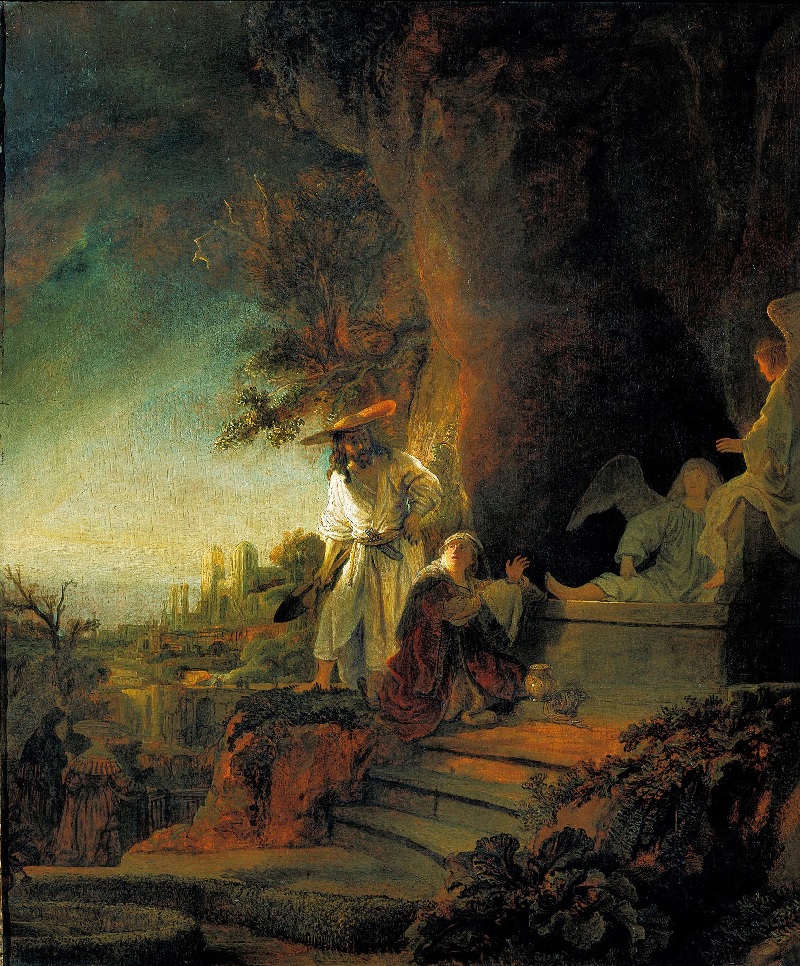
The painting, is in the Royal Collection now owned by Charles III though the web page I found it on still credits his Mother.
The blurb on the page from The Royal Collection states: The day after the Crucifixion, Mary Magdalene found Christ’s tomb empty. Two angels spoke to her as she wept, and when she turned she saw a man she thought was a gardener. Rembrandt sticks closely to the passage in the Gospel of John, which poses the question of the risen Christ’s appearance, because Mary Magdalene recognizes neither his face nor his voice. The figure of Christ eludes understanding, and the rising sun symbolizes the dawn of a new era for mankind.
Jesus as a gardener, ready to go work as the sun rises.
gives himself again with all his gifts, door opens this is judgment day
Adapted from the Stations of the Cross: I Jesus is condemned to death, which is found in the book Sounding the Seasons by Malcolm Guite and are intended to be read on Good Friday.
I am reminded of the legends told about Pilate.
One that he was sent to Switzerland after his term in Judea and while up in the alps, would walk down to nearby stream and daily, wash his hands.
Another myth is that the ghost of Pilate comes out on Good Friday to wash hands.
If you look up the idea of symbolically washing your hands of guilt, there are a few other instances of such a thing be mentioned in the old books but with the access of search provided by the google, you have to think that this was not all that common.
The word painting of that moment in the Gospels leave no doubt of its impact on that moment and over the centuries.
Jesus is condemned to death
The very air that Pilate breathes, the voice With which he speaks in judgment, all his powers Of perception and discrimination, choice, Decision, all his years, his days and hours, His consciousness of self, his every sense, Are given by this prisoner, freely given. The man who stands there making no defence, Is God. His hands are tied, His heart is open. And he bears Pilate’s heart in his and feels That crushing weight of wasted life. He lifts It up in silent love. He lifts and heals. He gives himself again with all his gifts Into our hands. As Pilate turns away A door swings open. This is judgment day.
Christ Presented to the People, also known as Ostentatio Christi or Ecce Homo by Rembrandt van Rijn
And I wrote an essay about the worries I created for myself by my need to always have something to read and always seeming to worry that there was some new fact I might be missing by not reading.
I find it interesting that I use the phrase, ‘Bound Box of Moonlight” but I don’t credit the source of the thought.
My wife and I had just watched the odd movie Box of Moonlight where the hero or anti-hero if you will, brings home a bound box of moonlight.
Not sure what I was thinking that morning back four years ago.
It was a Saturday and I would have just finished a week of commuting back and forth into the city of Atlanta.
An election was coming up in 9 months.
We were looking at the 1st Spring of Covid but the March 13 lockdowns were unimaginable.
The affects of Covid overall could not have been taken seriously.
My daughter was expecting a baby at any moment.
But what was I thinking?
I can tell what I wasn’t thinking.
I wasn’t thinking that in October my job would be made redundant.
I wasn’t thinking that I would be living in South Carolina.
I would never have ever ever thought that on a regular basis I would be walking on the beach along the Atlantic Ocean.
And once again, a daughter is expecting a baby at any moment.
Here is the point.
This day, leap day, won’t come again for another 4 years.
What will change in those 4 years.
What will I be thinking in 4 years from today.
I might be retired and not going into work every day.
I might be a lot of things.
But this I do know.
There will be 1,461 days until February 29, 2028.
The sun will rise, Lord willing of course, 1,461 times and set 1,460 times.
Here on the island, the tide will come in 2,932 times and sweep everything away and go out 2,931 times, leaving a clean tides wept beachscape behind.
See you in four years.
As Bette Davis said in All About Eve, “fasten your seat belts, it’s going to be a bumpy night.”
PS: Those stories about the millennial who showed up for meeting at 10:25 because they were told the meeting was a quarter past 10 must be true. I explained leap year to a coworker who fits that demographic. She asked what happened to the extra day everyone was talking about and when I said there wasn’t a February 29th last year or next year, she didn’t believe me and had to look it up but then looked very satisfied that she now knew what leap year and leap day meant.
twice two makes four is an excellent thing, makes five is sometimes charming too
But man is a frivolous and incongruous creature,
and perhaps, like a chess player,
loves the process of the game,
not the end of it.
And who knows (there is no saying with certainty),
perhaps the only goal on earth to which mankind is striving lies in this incessant process of attaining,
in other words,
in life itself, and not in the thing to be attained, which must always be expressed as a formula,
as positive as twice two makes four,
and such positiveness is not life, gentlemen,
but is the beginning of death.
Anyway,
man has always been afraid of this mathematical certainty,
and I am afraid of it now.
Granted that man does nothing but seek that mathematical certainty,
he traverses oceans,
sacrifices his life in the quest,
but to succeed,
really to find it,
he dreads, I assure you.
He feels that when he has found it there will be nothing for him to look for.
When workmen have finished their work they do at least receive their pay,
they go to the tavern,
then they are taken to the police-station —
and there is occupation for a week.
But where can man go?
Anyway,
one can observe a certain awkwardness about him when he has attained such objects.
He loves the process of attaining,
but does not quite like to have attained,
and that,
of course,
is very absurd.
In fact, man is a comical creature;
there seems to be a kind of jest in it all.
But yet mathematical certainty is after all,
something insufferable.
Twice two makes four seems to me simply a piece of insolence.
Twice two makes four is a pert coxcomb who stands with arms akimbo barring your path and spitting.
I admit that twice two makes four is an excellent thing,
but if we are to give everything its due,
twice two makes five is sometimes a very charming thing too.
From Notes from the Underground by Fyodor Dostoevsky, first published in the journal Epoch in 1864.
It is well documented that when Winston Churchill spoke publicly in the House of Commons, he would have his speeches on paper 8 by 4 inches with a hole punched in the upper corner and a string through the holes to keep the speech in order.
The words would be typed out in short phrases that lent the words to pausing, hesitation and emphasis as Mr. Churchill delivered the speech.
Insiders referred to this style as Churchill’s Psalm form and once you know about it, you cannot help picture the prepared text as you hear the words.
Unconsciously or sub consciously as well as by design, I have adapted this style into my writing of short phrases and sentences.
I don’t know that I could write a paragraph if I had too.
The short staccato AP style of one line, one thought also lurks in my background especially as the news writing I did the most were with stories that were meant to be READ out loud by a reporter or presenter.
So ends my confessional.
Considering all that, I think this bit of Mr. Dostoevsky’s writing works quite well when read out loud in the fashion in which I present it.
But what is Mr. Dostoevsky saying?
And I ask this in a the latest edition of ‘In a World Gone Crazy’.
And I put it to you that as now, so little makes sense from what it used to mean that truly, twice two makes four is the beginning of death.
And that twice two makes five is sometimes a very charming thing.
But beware of those who tell you twice two makes five.
In the end, it always comes out four.
Boy, Howdy! but man is one frivolous and incongruous creature.



 No Haiku For You