April 19 – embattled farmers

by the rude bridge stood
embattled farmers, fired
shot heard round the world

As Mr . Lincoln said at Gettysburg, ” our fathers brought forth, on this continent, a new nation, conceived in liberty, and dedicated to the proposition that all men are created equal.”

This country, when you get right down to it, is still an experiment and we continue to work our way through rough patches.

Sometimes, this is more evident than others.

Sometimes, we deal with problems that are thrown at us.

Sometimes we make our own problems.

Regardless, it all started at Lexington and Concord on April 19th.

Concord Hymn

BY RALPH WALDO EMERSON

Sung at the Completion of the Battle Monument, July 4, 1837

By the rude bridge that arched the flood,
Their flag to April’s breeze unfurled,
Here once the embattled farmers stood
And fired the shot heard round the world.

The foe long since in silence slept;
Alike the conqueror silent sleeps;
And Time the ruined bridge has swept
Down the dark stream which seaward creeps.

On this green bank, by this soft stream,
We set today a votive stone;
That memory may their deed redeem,
When, like our sires, our sons are gone.

Spirit, that made those heroes dare
To die, and leave their children free,
Bid Time and Nature gently spare
The shaft we raise to them and thee.
April 18 – To love, be loved,

To love, be loved,
strive, be better tomorrow,
than we are today.

Intellectuals don’t help their cause when they are dismissive of pop culture and sports, by demeaning their great achievements. Neither high culture nor pop culture are a measure of intelligence, just of past exposure. Any attempt to use either as a means to imply superiority demonstrates a complete lack of understanding of what art strives to do: bring us closer together by showing that we are all equal in our needs to love, be loved, and strive to be better tomorrow than we are today. We accomplish this by understanding that the elegant idea is as uplifting as the slam dunk. And that a triple play is as graceful as a balletic arabesque. To disparage either the athlete or the intellect indicates someone not worthy of either.

The way Americans regard sports heroes versus intellectuals speaks volumes
Kareem Abdul-Jabbar The Guardian, 15 Apr 2019

April 17 – Words of the World

Words of the world
They are the life of the world
Building blocks of thought

Loosely based on this excerpt:

and I perceived then and there and once and for all what my Hartford neighbor, Wallace Stevens, was soon to be setting down as the truth that all writers should live by, to wit: “Words of the world are the life of the world.”

Brendan Gill in A New York Life, Poseidon Press, 1990

April 16 – Everyone, today,

Everyone, today,
Lets hope we are astonished.
by I don’t know what

Adapted from: TOMORROW by Jim Harrison, published in
IN SEARCH OF SMALL GODS, Copper Canyon Press, 2010

I’m hoping to be astonished tomorrow
by I don’t know what:
not the usual undiscovered bird in the cold
snowy willows, garishly green and yellow,
and not my usual death, which I’ve done
before with Borodin’s music
used in Kismet, and angels singing
“Stranger in Paradise,” that sort of thing,
and not the thousand naked women
running a marathon in circles around me
while I swivel on a writerly chair
keeping an eye on my favorites.
What could it be, this astonishment,
but falling into a liquid mirror
to finally understand that the purpose
of earth is earth? It’s plain as night.
She’s willing to sleep with us a little while.

Oddly enough, this was set to be posted yesterday until I realized it was the anniversary of the death if Abraham Lincoln.

I was astonished by the news from Paris about the fire at Notre Dame.
And in a real goofy way, I was relieved, if not comforted that calamitous events involving national icons can still happen by chance instead of by targeted action.

As Mr. Harrison writes:
“to finally understand that the purpose
of earth is earth? It’s plain as night.”

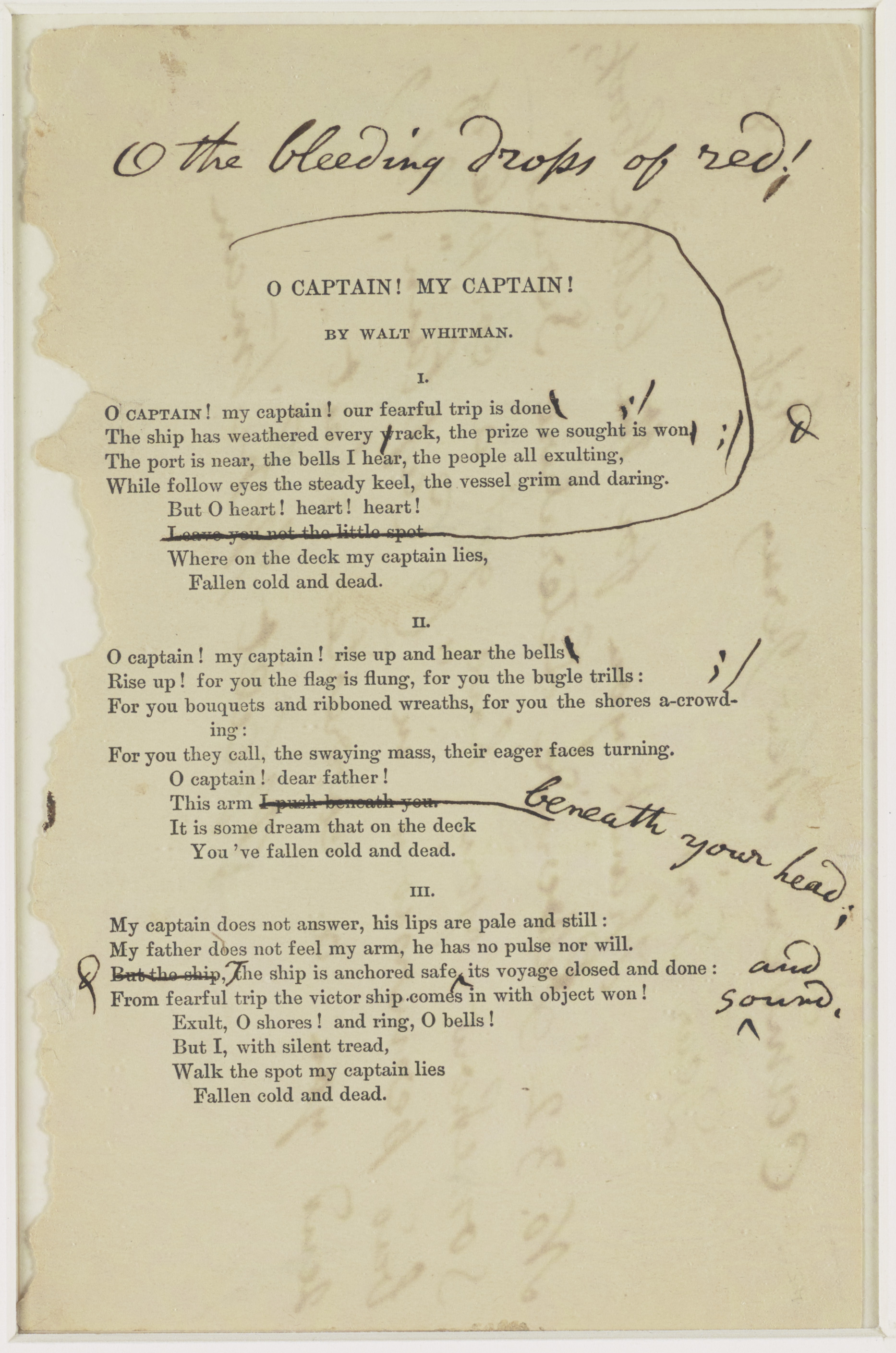
April 15 – Captain! My Captain!

Captain! My Captain!
My Captain does not answer.
Fallen cold and dead.

Abraham Lincoln

February 12, 1809 – April 15, 1865

O Captain! My Captain!
BY WALT WHITMAN

O Captain! my Captain! our fearful trip is done,
The ship has weather’d every rack, the prize we sought is won,
The port is near, the bells I hear, the people all exulting,
While follow eyes the steady keel, the vessel grim and daring;
But O heart! heart! heart!
O the bleeding drops of red,
Where on the deck my Captain lies,
Fallen cold and dead.

O Captain! my Captain! rise up and hear the bells;
Rise up—for you the flag is flung—for you the bugle trills,
For you bouquets and ribbon’d wreaths—for you the shores a-crowding,
For you they call, the swaying mass, their eager faces turning;
Here Captain! dear father!
This arm beneath your head!
It is some dream that on the deck,
You’ve fallen cold and dead.

My Captain does not answer, his lips are pale and still,
My father does not feel my arm, he has no pulse nor will,
The ship is anchor’d safe and sound, its voyage closed and done,
From fearful trip the victor ship comes in with object won;
Exult O shores, and ring O bells!
But I with mournful tread,
Walk the deck my Captain lies,
Fallen cold and dead.

Source: Leaves of Grass (David McKay, 1891)

Walt Whitman composed the poem “O Captain! My Captain!” after Abraham Lincoln’s assassination in 1865. The poem is classified as an elegy or mourning poem, and was written to honor Abraham Lincoln, the 16th president of the United States. Walt Whitman was born in 1819 and died in 1892, and the American Civil War was the central event of his life. Whitman was a staunch Unionist during the Civil War. He was initially indifferent to Lincoln, but as the war pressed on, Whitman came to love the president, though the two men never met.

“O Captain! My Captain!” became one of Whitman’s most famous poems, one that he would read at the end of his famous lecture about the Lincoln assassination. Whitman became so identified with the poem that late in life he remarked, “Damn My Captain…I’m almost sorry I ever wrote the poem.” (Wikipedia)