2.12.2026 – way is plain, peaceful

way is plain, peaceful,
generous, just – if followed
God forever bless

According to Wikipedia, The 1862 State of the Union Address was written by the 16th president of the United States, Abraham Lincoln, and delivered to the 37th United States Congress, on Monday, December 1, 1862, amid the ongoing American Civil War.

This address was Lincoln’s longest State of the Union Address, consisting of 8,385 words.

In the closing paragraphs of this address, Lincoln penned words which have been remembered and quoted frequently by presidents and other American political figures. Lincoln’s concluding remarks were as follows:

The dogmas of the quiet past are inadequate to the stormy present.

The occasion is piled high with difficulty, and we must rise with the occasion.

As our case is new, so we must think anew and act anew. We must disenthrall ourselves, and then we shall save our country.

Fellow-citizens, we can not escape history.

We of this Congress and this Administration will be remembered in spite of ourselves.

No personal significance or insignificance can spare one or another of us.

The fiery trial through which we pass will light us down in honor or dishonor to the latest generation.

We say we are for the Union.

The world will not forget that we say this.

We know how to save the Union.

The world knows we do know how to save it.

We, even we here, hold the power and bear the responsibility.

In giving freedom to the slave we assure freedom to the free — honorable alike in what we give and what we preserve. We shall nobly save or meanly lose the last best hope of earth.

Other means may succeed; this could not fail.

The way is plain, peaceful, generous, just — a way which if followed the world will forever applaud and God must forever bless.

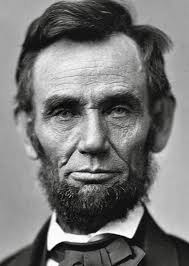
Can’t pass by Mr. Lincoln on his birthday.

It used to be a big day.

Probably still should be.

More so not that other people have elevated the office of President of the United States.

But that other people have demonstrated the depths to which the office can sink.

I think of what Alistair Cooke wrote about Mr. Lincoln in his book, America:

“It is difficult, and in some quarters thought to be almost tasteless, to talk sense about Lincoln.

But we must try.

For the holy image and the living man were very far apart, and keeping them so does no service either to Lincoln or to the art of government.

Like all strong characters, he was well hated, and like most frontiersmen who have come to high office—like Harry Truman and Lyndon Johnson—he was ridiculed for his directness and country manners.

The London Times called him “the Baboon.”

Lincoln had a gangling gait, a disturbing fondness for rough stories, and a maddening habit of being, in a kind of tooth-sucking way, wiser and sharper than you. (To make it worse, most of the time he was.)”

On the 100th anniversary of Mr. Lincoln’s birth, biographer Ida Tarbell spoke at the University of Michigan on the topic, “Abraham Lincoln : an address the Centennial anniversary of Lincoln’s birth.”

Ms. Tarbell’s address was part of 1908-1909 schedule of speakers arranged by the Students’ Lecture Association of the University of Michigan.

I was fascinated to see the Hon. W. Bourke Cockran also on the list.

He is the Bourke Cockran in this oft told story of Mr. Churchill … “Adlai Stevenson, himself a notable speaker, often reminisced about his last meeting with Churchill. I asked him on whom or what he had based his oratorical style. Churchill replied, “It was an American statesman who inspired me and taught me how to use every note of the human voice like an organ.” Winston then to my amazement started to quote long excerpts from Bourke Cockran’s speeches of 60 years before. “He was my model,” Churchill said. “I learned from him how to hold thousands in thrall.”

It must have been an interesting lecture to attend.

Ms. Tarbell spoke in University Hall, a hall that held 2500 people in a building that stood where Angell Hall now stands on the UofM campus.

She was introduced by the President of the University, James Angell and gave a lecture that, as stated in The Michigan Daily account, was made by the “probably the best informed person living in regard to Lincoln.”

Her final words on the subject?

It is doubtful if this country, if any country, has produced a man so worthy of our study and our following as is Abraham Lincoln.

Who indeed is there so fit to guide us in that highest of tasks – the giving of service?

Whoever saturated himself so with his subject?

Whoever trusted more utterly to the integrity of his logic, and to the appeal for the sense of human justice?

​Whoever put aside with more contempt all the tricks of his trade – appeals to emotion simply to stir emotion, wit simply to arouse a laugh, subterfuges and evasion to escape valid objection?

Whoever handled with more honesty and respect his tasks?

Whoever struggled harder to understand not only with his head but with his heart and understanding, wrestled more to make others understand?

​Whoever looked more deeply, more gently, into the hearts of men, and having looked, put into more moving words what he had seen?

He has no parallel.

He stands in a towering lonely figure – a man who, by the persistent and reverential following of his own highest instincts, unaided, raised himself from the soil to place of the First American.

Now, 217 years after Mr. Lincoln’s birth … well, its beyond belief isn’t it.

2.3.2026 – ethical demand

ethical demand
must resonate in our hearts
revealed in our lives

These issues are fundamental to the disciple of Jesus Christ.

“What we do to the least among us, we do to Him” is an ethical demand that must resonate in our hearts and be revealed in our lives.

I ask the faithful to join with people of good will everywhere and to stand with those who are afraid to leave their homes, afraid to go to the hospital, afraid to take their children to school, afraid to buy groceries — those who are forced to live in fear every moment of every day.

These are the ways we stand with Jesus Christ.

And between our voices and our always respectful, nonviolent witness, we might just reveal that the soul of our great nation is alive and well in us.

Archbishop Weisenburger of Detroit wrote these thoughts as the closing lines to an Opinion Piece titled, ICE violence, child separations put America’s soul in crisis that was published in the Detroit Free Press on Feb. 1, 2026.

Read that line again, “What we do to the least among us, we do to Him” is an ethical demand that must resonate in our hearts and be revealed in our lives.

How can any Christian any where read that and not feel called upon to act, to do something.

Anything but support what is happening and if not openly support, say nothing.

Again, “What we do to the least among us, we do to Him” is an ethical demand that must resonate in our hearts and be revealed in our lives.

It might also be good to remember the warning.

What warning?

I point you back to Bible to the Book of Matthew, Chapter 7.

I’ll quote the verse in the King James English as it seems to resonate in my heart.

Chapter 7, verse 21 says, “Wherefore by their fruits ye shall know them.”

And in verse 23 …

Verse 23 reads, “And then will I profess unto them, I never knew you.”

These issues are fundamental to the disciple of Jesus Christ.

Who willingly runs that risk?

Read the complete essay below the photo.

In the light of recent and tragic immigration enforcement incidents, a great many individuals have asked my opinion of our nation’s immigration procedures.

Actually, they are among the issues that keep me awake at night.

Before I address the question, please allow me to recount a portion of my personal history which — along with the Gospel and Catholic teachings — has profoundly affected my understanding of the situation.

‘What you do to the least among you, you do to me’

When I served as the Bishop of Tucson, Arizona, my diocese contained the entire Arizona-Mexico border. Working with government entities, Tucson’s Catholic Charities coordinated the reception of thousands of immigrants during my tenure.

While it was usually a far lesser number, at its peak our Catholic Charities processed 1,400 asylum-seekers and immigrants per day. While Catholic theology makes no distinction between assisting immigrations with or without documents, I would note that every person we assisted was brought to us by the U.S. Border Patrol or other federal agents, and each was in possession of valid immigration documents.

In my own interactions with these immigrants, I knew I was on holy ground as I would hear their stories. I would also witness the traumatic wounds of those who had seen relatives killed or did all they could to find food for starving children. I am forever changed by that experience, and when I couple it with Our Lord’s teaching, “What you do to the least among you, you do to me,” I am compelled to speak on their behalf.

Fatal and toxic

In the last few weeks, we have witnessed a 5-year-old child, Liam Conejo Ramos, separated from his mother and quickly sent with his father from Minnesota to a detention center in Texas. This fast relocation of detainees seems to be a policy that seeks to separate the detained from family, community or any local legal assistance.

As this family entered the U.S. as legal asylum-seekers and committed no crimes, many are left to wonder, why focus on them? Having largely failed to detain and deport the large numbers of violent criminals as promised, is Immigrations and Customs Enforcement now rounding up legal asylum seekers for the sake of an optic of success?

We then witnessed the killing of Renee Good, whose death at the hands of ICE agents was ruled a homicide by the local medical examiner’s office. Rather than allowing for a transparent and independent investigation of the death, our federal government is uncooperative, and insisting on doing only the equivalent of an internal investigation.

More recently, we have the tragic death of Alex Pretti, a Veterans Affairs Hospital nurse. A common concern in both deaths is that they appear to have been fatal over-uses of violent force on the part of federal agents. The matter is made further toxic by leadership vilifying Good and Pretti within hours of their killings, despite having no substantial knowledge of the facts at that time.

America’s soul is at risk

I must admit that when I look at the totality of this situation, I am dumbfounded and deeply disturbed.

As a proud American, I have always lived by the belief that we are a nation of guiding values, a nation of noble virtues, a nation established on the rule of law and respectful of human rights. Increasingly, I find myself asking if our nation is losing its very soul.

For this reason, I join my voice to the growing number of those who have expressed grave concern for what is happening in our midst.

I also reject any notion of an internal investigation of these incidents, and instead call for an independent and transparent review of these actions.

Lastly, I call for a restoration of entirely innocent small children who have been separated from their mothers. Are we not better than that?

We must acknowledge that a substantial degree of responsibility for this catastrophe flows from the failure of our federal government to craft reasonable immigration reform.

Missing that federal leadership, we should not be surprised at the humanitarian and moral crisis that has resulted.

It seems that Americans can only envision two options: Either open borders with no restraint, or closed borders with no immigration of any kind.

That dichotomy is a lie. It is quite possible to acknowledge, respect and defend our borders, while also creating a path for the same kind of immigration that brought many of our ancestors to this nation.

I believe that our elected legislators are intelligent and capable. What is lacking is unified resolve to create this critical immigration reform. While admitting that it is a daunting task, I nevertheless urge our legislators to address what is truly a life-or-death issue, even if it entails braving the onslaught of criticism from those entrenched on one side or the other of this crisis.

Christ’s ethical demand

Without substantial immigration reform that balances legitimately maintained borders with the mercy that has always been at the root of our nation, I fear we will continue to see 5-year-olds separated from mothers, American citizens killed while protesting or exercising their right to free speech and documented immigrants who arrived in this nation via the correct channels rounded up for deportation.

Again, these issues are fundamental to the disciple of Jesus Christ. “What we do to the least among us, we do to Him” is an ethical demand that must resonate in our hearts and be revealed in our lives.

I ask the faithful to join with people of good will everywhere and to stand with those who are afraid to leave their homes, afraid to go to the hospital, afraid to take their children to school, afraid to buy groceries — those who are forced to live in fear every moment of every day.

These are the ways we stand with Jesus Christ. And between our voices and our always respectful, nonviolent witness, we might just reveal that the soul of our great nation is alive and well in us.

May God bless you, may God bless those at risk and may God bless our great nation.

Edward J. Weisenburger is the Archbishop of Detroit.

1.19.206 – unpalatable

unpalatable
abhorrent nauseating
and contemptible

Yesterday, January 18th, was National Thesaurus Day and it honors Peter Mark Roget, the author of Roget’s Thesaurus, who was born on this day in 1779.

According to The National Day Calendar website:

In 1840, Roget retired from a successful career in medicine and spent the rest of his life working on Roget’s Thesaurus of English Words and Phrases. The work was the result of decades of collecting lists of words and categorizing them, much like a scientist would collect specimens. In Roget’s case, he collected words. He first published his thesaurus in 1852. And it was more than a book of synonyms – it was a complete categorization and organization of each word by meaning. 

Since then, poets and writers have used the thesaurus to help make their writing come to life. However, the thesaurus also has its detractors. Some say the thesaurus weakens language and destroys it. 

Whether you are looking for a more accurate word or trying to improve your writing, the thesaurus can be your best friend. Expanding your vocabulary increases both written and spoken communication skills, creative writing abilities, and can be helpful in advancing your career.

I have to mention that on their official BlueSky account, those good folks at Merriam Webster posted:

Today is National Thesaurus Day.

Personally, we find these made-up holidays contemptible, abhorrent, nauseating, repugnant, and unpalatable.

I loved that.

My only question?

Did those good folks at Merriam Webster use a thesaurus to find the words, contemptible, abhorrent, nauseating, repugnant, and unpalatable?

Peter Mark Roget

1.18.2026 – experience taught

experience taught
auxiliary precautions
a necessity

Adapted from the New York Times Opinion Piece, An Old Theory Helps Explain What Happened to Renee Good, by David French where Mr. French writes:

We trusted that presidents would impose accountability on the executive branch. We trusted that presidents wouldn’t abuse their pardon power — or, if they did, then Congress could impeach and convict any offenders. And so we manufactured doctrine after doctrine, year after year, that insulated the executive branch from legal accountability.

It’s hard to overstate how much this web of immunities — combined with the failure of Congress to step up and fulfill its powerful constitutional role — has made the United States vulnerable to authoritarian abuse.

In Federalist No. 51, James Madison wrote some of the most famous words of the American founding. “If men were angels, no government would be necessary,” Madison wrote. “If angels were to govern men, neither external nor internal controls on government would be necessary. In framing a government which is to be administered by men over men, the great difficulty lies in this: You must first enable the government to control the governed; and in the next place oblige it to control itself.”

This is a version of the ancient question: Who will watch the watchers?

Madison’s next words were crucial. “A dependence on the people is, no doubt, the primary control on the government; but experience has taught mankind the necessity of auxiliary precautions.”

I want to take just a moment to comment on the line, “… the failure of Congress to step up and fulfill its powerful constitutional role.”

My study of US History has been filled with the jealous, selfish and defiant protection of the power of Congress BY CONGRESS.

The question, “How will this play on the Hill?” has been asked by every Executive administration since 1787.

Jimmy Carter realized it was pretty much over for him when a Democratic Congress over road on his vetos.

Nixon claimed his loss of a congressional legislative base made it impossible to stay on as President.

Theodore Roosevelt said something along the lines of, “If I could only be President AND CONGRESS for 10 minutes.”

Today we watch the worst example of Congressional action and leadership in the history of this nation and the worst dreams of the founders are not dreams but fact.

We depended on Congress as representatives of the people.

We depended on congress because a dependence on the people is, no doubt, the primary control on the government.

But experience has taught mankind the necessity of auxiliary precautions.

Sad to think about.

Sad to watch.

Sadder to live through.

Mr. French writes:

In the Trump era, those auxiliary precautions have utterly failed.

They’ve been undermined to the point where the reverse is now true.

Rather than providing additional precautions against the rise of authoritarian rule, American law and precedent seem to presume that angels govern men, and those angels would be free to do even more good if only they possessed a free hand.

We are witnesses to what authoritarian rule looks like.

James Madison

1.15.2025 – age is an issue

age is an issue …
mind over matter – don’t mind …
it doesn’t matter

Check the world wide web and ask who said, Age is an issue of mind over matter. If you don’t mind, it doesn’t matter, and you will find lots of those meme graphics that attribute the saying to Mr. Mark Twain.

But ask for a citation and you go down that rabbit hole that conveys the information super highway to nether regions of obscurity.

I turned to my favorite website for attribution, Quote Investigator, to learn that the first recorded use of “Age is an issue of mind over matter. If you don’t mind, it doesn’t matter” was in in 1968 and Mark Twain, died in 1910.

According to Quote Investigator, the earliest evidence appeared in an article about aging that was published in multiple newspapers in 1968. The saying was attributed to an anonymous scientific researcher. The prefatory phrase was somewhat shorter:

As one government researcher puts it: “Aging is a matter of mind. If you don’t mind, it doesn’t matter.”

That line, according to QI appeared in the June 28 1968 , Statesville Record and Landmark, in a story headlined Facts Listed On Aging (Quote Page 7-A, Statesville, North Carolina).

Once, said, the line took on a life of its own and it appeared in print over and over through the years, attributed to Jack Benny, Satchel Paige and Muhammad Ali as well as Mr. Twain.

Just think of what you could get away back when attribution of almost anything wasn’t a few clicks away.

Regardless or iregardless* of who said it, I say it again, Age is an issue of mind over matter. If you don’t mind, it doesn’t matter and I am saying it to say, Happy Birthday today to my wife.

I hope you don’t mind and it doesn’t matter to me as we battle that issue of mind over matter together.

Love you!

*Use regardless, as irregardless is a nonstandard, redundant word considered incorrect in formal writing, though dictionaries acknowledge its usage to mean the same as “regardless” (despite everything) due to a double negative (ir- + -less) and confusion with “irrespective”. While some find “irregardless” acceptable in very informal speech, sticking to “regardless” avoids criticism and ensures clarity in professional or academic settings, as it’s the universally accepted, standard term, but I digress.