Night drew attention to facets, effects that were submerged in the day
Adapted from the book, The Art of Travel (2002, Vintage Books) by Alain de Botton, and the passage:
I began word-painting.
Descriptive passages came most readily: the offices were tall; the top of one tower was like a pyramid; it had ruby-red lights on its side; the sky was not black but an orangey-yellow.
But because such a factual description seemed of little help to me in pinning down why I found the scene so impressive, I attempted to analyse its beauty in more psychological terms.
The power of the scene appeared to be located in the effect of the night and of the fog on the towers.
Night drew attention to facets of the offices that were submerged in the day.
Lit by the sun, the offices could seem normal, repelling questions as effectively as their windows repelled glances.
But night upset this claim to normality, it allowed one to see inside and wonder at how strange, frightening and admirable they were.
The offices embodied order and cooperation among thousands, and at the same time regimentation and tedium.
A bureaucratic vision of seriousness was undermined, or at least questioned, by the night.
One wondered in the darkness what the flipcharts and office terminals were for: not that they were redundant, just that they might be stranger and more dubitable than daylight had allowed us to think.
Adapted from the book, The Art of Travel (2002, Vintage Books) by Alain de Botton.
According to the website, GOOD READS, Any Baedeker will tell us where we ought to travel, but only Alain de Botton will tell us how and why.
As I said in the section on Architecture , what I find irresistible in reading Mr. de Botton is his use of language.
I get the feeling that if you made a spread sheet of all the words, adverbs and adjectives used by Mr. de Botton, you just might find that he used each word just once.
matter of making conscious effort to notice understand elements
Adapted from the book, The Art of Travel (2002, Vintage Books) by Alain de Botton, and the passage:
True possession of a scene is a matter of making a conscious effort to notice elements and understand their construction.
We can see beauty well enough just by opening our eyes, but how long this beauty will survive in memory depends on how intentionally we have apprehended it.
The camera blurs the distinction between looking and noticing, between seeing and possessing; it may give us the option of true knowledge, but it may also unwittingly make the effort of acquiring that knowledge seem superfluous.
Adapted from the book, The Art of Travel (2002, Vintage Books) by Alain de Botton.
According to the website, GOOD READS, Any Baedeker will tell us where we ought to travel, but only Alain de Botton will tell us how and why.
As I said in the section on Architecture , what I find irresistible in reading Mr. de Botton is his use of language.
I get the feeling that if you made a spread sheet of all the words, adverbs and adjectives used by Mr. de Botton, you just might find that he used each word just once.
there is a corpus, congenital attitudes, found in everyone
a way of thinking of ineradicable doctrines determine
one’s reactions to persons ideational lone environment
In fact, primary attitudes will constitute essential person
understanding of place, function as member of human society
Part of the Mencken Project.
From THE AMERICAN CREDO: A Contribution Toward the Interpretation of the National Mind
By George Jean Nathan and HL Mencken, 1920
From the line: “deep down in every man there is a body of congenital attitudes, a corpus of ineradicable doctrines and ways of thinking, that determines his reactions to his ideational environment as surely as his physical activity is determined by the length of his tibiæ and the capacity of his lungs. These primary attitudes, in fact, constitute the essential man. It is by recognition of them that one arrives at an accurate understanding of his place and function as a member of human society;”
The first multi stanza haiku I ever wrote.
The question then, what are these primary attitudes?
That is what this Mr. Mencken and Mr. Nathan attempted to gather together in this book.
Mencken writes, “Well, here is an attempt to assemble in convenient form, without comment or interpretation, some of the fundamental beliefs of the largest body of human beings now under one flag in Christendom. It is but a beginning. The field is barely platted. It must be explored to the last furlong and all its fantastic and fascinating treasures unearthed and examined before ever there can be any accurate understanding of the mind of the American people.”
Then they two list some 488 odd things that back in 1920 may have been what we call ‘accepted wisdom.’
#411 – That if one’s ear itches it is a sign that some one is talking of one.
Many have not passed the test of time.
#384 – That all Japanese butlers are lieutenants in the Japanese Navy and that they read and copy all letters received by the folks they work for.
Some of these ‘fundamental beliefs’ that are beyond acceptability today I will attribute Mr. Nathan.
Why should I give Mr. Mencken a pass and not Mr. Nathan on some of their comments?
Mr. Nathan seems to be that brilliant man who would have been mad and angry and prejudiced in any era.
She was writing about living with the recent turmoil in the Middle East through phone calls home.
When she closed call she asked, “What can I do?”
The response was “Can you postpone nightfall, that is when the bombs fall.”
Not taking sides here.
I have read a lot of history and a lot of history is military.
A lot of history is war.
War is ‘politics by other means’.
But that seems too simple.
In the grand scope of world history, what great invention, what great increase in knowledge and machines did not find an almost instant application in war.
At one time the greatest military weapon that separated the winners from losers was the stirrup.
A Knight with stirrups could keep his balance and use a sword effectively without falling off.
Few inventions have been so simple as the stirrup, but few have had so catalytic an influence on history, so says Wikipedia.
Gunpowder.
Telescopes.
Sailing Ships.
Motors.
The Wright Brothers first flew in 1903.
By World War 1, 1914, planes were part of the battlefield.
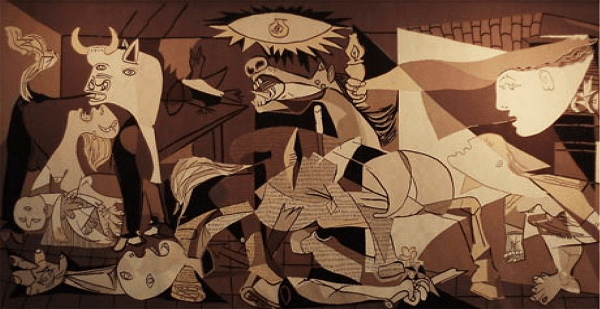
Still when the Hermann Goering’s Nazi Air Force bombed the city of Guernica as part of the Spanish Civil War in 1937 (it’s complicated) the world was shaken, but maybe, not surprised.
Without Picasso’s painting of Guernica, the world would have forgotten about this a long time ago.
A digression but maybe this is what art is all about as it doesn’t let us forget.
I recently finished a good read titled The Last Bookshop in London.
A fictionalized account of life in London during the blitz of World War 2.
What came across for me was the utter randomness with which the bombs fell.
We have been flying around dropping bombs on each other ever since the plane was invented.
Reading the articles about the Middle East again I am struck by the utter randomness of the destruction.
I can think of a lot of words that describe a world where this happens.
Civilized is not one of them.
I think of the saying that the number one proof of intelligent life in the universe is that no one has wanted to contact us.
Glad! If I had known that at 20, I wouldn’t have done anything!
I am not a ‘huge’ William Shatner fan.
I like Star Trek but when I say that, as when I say, “Star Wars’, I mean the original.
I never could figure out the other shows.
There is that one where one feller is light blue/green and is really a computer.
I understand he was supposed to be the modern counter part to Spock
This character was treated as someone with feelings.
But in the original series, Spock was at least half human and could display feeling.
The light blue/green guy WAS A MACHINE.
HELLO.
Would a computer made to look like a human be any less than a machine?
If he got too annoying you could smash him with a baseball bat because he was A MACHINE.
But I digress.
I WILL SAY this though.
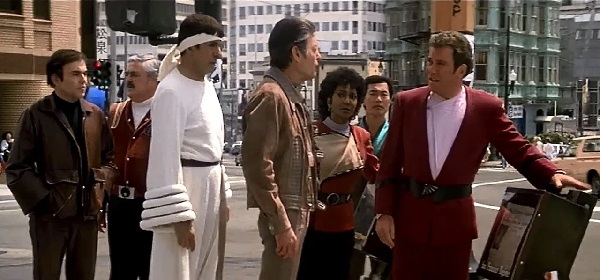
The Whale Movie where the Original Team goes back in time to San Francisco was pretty good.
There is that scene where they all stare at a USAToday Newspaper vending machine and read the news above the fold and wait.
Kirk hits the box a few times, but the view of the front page doesn’t change of course.
“Must be broke,” says Kirk and shrugs.
OH SURE I said to myself.
Read a newspaper off a screen.
Like that will happen someday.
Again, I digress.
I remember one teacher at GRJC telling me that the original Star Trek was as close to a play of the genre of the classic Greek Tragedy that our generation would ever produce.
He felt Spock and Dr. McCoy were the pitch-perfect representation of the Greek Chorus whose role in the play, one webpage states, was “to offer important background and summary information that facilitates an audience’s ability to follow the live performance; to offer commentary about and underline main themes animating the action; and to model an ideal audiences response to the unfolding drama. Nietzsche suggests that it was the rhythmic dance and chants of the chorus, positioned always to mediate the physical space separating audience and actor, that evoked the visionary experience that was the very essence of tragedy.“
Can’t argue with that.
But back to Captain Kirk, I mean, William Shatner.
I can never figure him out.
Is Mr. Shatner really dumb but acting smart?
Or is Mr. Shatner really smart and acting dumb?
What cannot be denied is that in a life of 90 years, Mr. Shatner has embraced life.
He has been up.
He has been down.
And when he has been down, he dusts himself off, and gets back up.
About all that he has done, Mr. Shatner said, “I didn’t know what I wanted to do. I just drifted with the currents of happenstance.“
It was how he ended that struck me.
So many times we all hear and we all say, “If only I knew then what I know now.”
At the end of the interview, the question is asked, “what he wishes he had known at 20 that he knows at 90.”
His response?
“Here’s an interesting answer!” he says perkily. “I’m glad I didn’t know because what you know at 90 is: take it easy, nothing matters in the end, what goes up must come down. If I’d known that at 20, I wouldn’t have done anything!”
If I’d known that at 20, I wouldn’t have done anything!
I really can’t account for how I ended up living on the Atlantic Coast of South Carolina or that I have seven kids or almost anything else that has happened to me.
I didn’t just drift with the currents but I thought I was taking in active part in the direction of my life.
Any decision that I made over the last 60 years would have changed how this all came about.
I am pretty sure though that had I started out with this as a goal, I would have screwed it up.
So I got to agree with Mr. Shatner.
I think that by the time you get to this age, the thing that matters is to take it easy.
Don’t sweat the petty stuff.
Don’t pet the sweaty stuff.
What goes up, must come down.
BUT boy am I glad I DID NOT know that back when I was 20.
Had I known that, really known that, I would not have done anything.