hail victors valiant raise next generation right sing to the colors
I am pretty sure that I have related the story of the night I got a phone call from my brother Paul that opened without a hello or greeting, but the words, I AM INCENSED.
This was kinda startling for two reasons.
One was that my brother Paul, so far as I know, never called anyone in his life.
And, Two, my brother Paul, so far as I know, had never been incensed about anything in his life.
Paul had just paged through the latest Michigan Today Alumni Magazine and found an article that recognized some family that had 6 siblings who had all earned degrees from the University of Michigan.
This was not right, Paul, declared and he called me and he told I had to do something about it.
So I got in touch with the Alumni Association and let them know that the Hoffman Family had a little bit more history to recognize.
Started with Grandpa Robert Karl Hoffman, the 1st Hofman born in the US and the 1st to change his last name to Hoffman, he was the 1st one to graduate from Michigan with a DDS in 1911.
Then our Dad, Robert Paul Hoffman, who graduated with a DDS in 1942.
Then the siblings.
Paul, Jack, Mary, Janet, Tim, Lisa, Me, Steve and Al graduated from Michigan stretching out over the 1960s. 70s and 80s.
Growing up, I knew there was only one college for me and I was so focused on accomplishing graduating from Michigan that when I finally DID graduate, I was at a bit of loss of what to do next and maybe still am.
My roommates knew the story of me getting into Michigan and they all agreed that the school changed the rules so it would never happen again.
And there were more graduates to come.
The spouses of Paul, Janet, Lisa and Al who graduated from Michigan.
Then the nieces and nephews of the 4th Generation who graduated from Michigan.
A couple of editions later, the Alumni Magazine ran an article that stated simply, they didn’t know what they were getting into when they recognized that family with 6 graduate siblings.
They didn’t know what they were getting into as they heard from so many other families, who I guess, were incensed.
The heard from several families also with 6 sibling graduates.
The heard from several families with 7 sibling graduates.
The heard from a couple of families with 8 sibling graduates.
But they only heard from 1 family, the Hoffman Family of Grand Rapids, with 9 sibling graduates.
If we act like we own it, at least we are acting honestly.
Work is starting on that 5th generation.
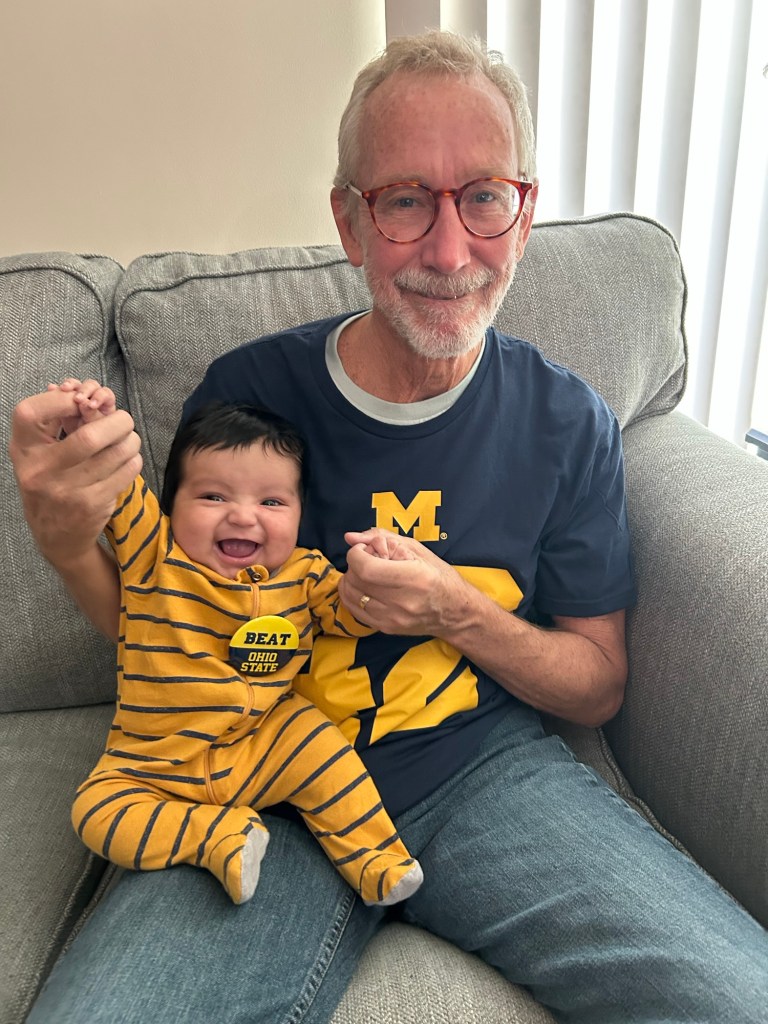
Me and grandson Ian – it’s his 1st time for the game with that team … class of 2047?
If you been to a game in Ann Arbor and listened to the crowd sing The Yellow and Blue with the band you know that 95% of the crowd knows one word, HAIL!.
We had a family tradition of singing The Yellow and Blue at family gatherings if the mood was right and by unspoken agreement, we would all drop out and let Dad sing the HAIL by himself.
With that memory in mind:
Sing to the colors that float in the light; Hurrah for the Yellow and Blue! Yellow the stars as they ride through the night And reel in a rollicking crew; Yellow the field where ripens the grain And yellow the moon on the harvest wain; -Hail! Hail to the colors that float in the light Hurrah for the Yellow and Blue!
Win or lose today, Hurrah for the Yellow and Blue!
stuff in The kitchen … My kitchen, where treasure is … heart will be also
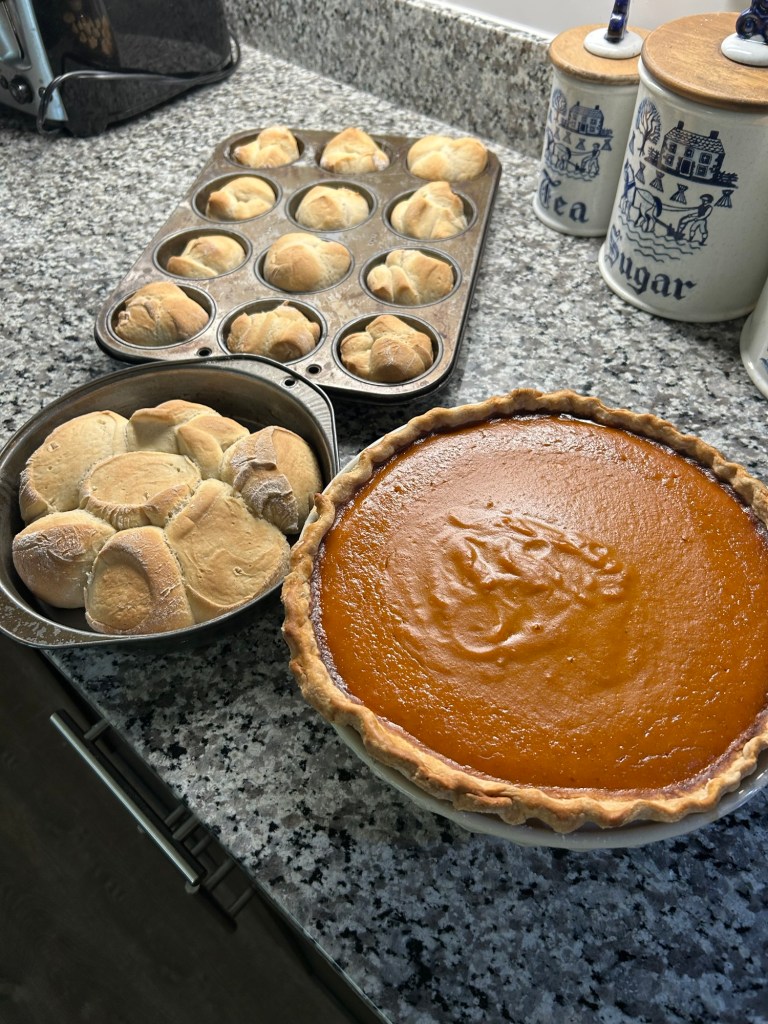
Got up this morning to make a pie and I got to thinking.
I was using my rolling pin that I have had for years and I posted a photo it on facebook with the question, “Name something in my kitchen that hasn’t been washed in 35 years.”
What did I mean actually by saying ‘my kitchen’?
Did anyone in literature every write a better sentence on kitchen’s than EB White did in Charlotte’s Web when he wrote, “The kitchen table was set for breakfast, and the room smelled of coffee, bacon, damp plaster, and wood smoke from the stove.”
And I thought about kitchen’s in time past for myself.
My Mom lived in the same house in Grand Rapids, Michigan for over 50 years.
I can still say the phone number that started 363 (or if you are really old, EM3 when the city used ‘exchanges’).
There was a kitchen that was the heart and soul of a family.
As there were 11 kids in our family, the kitchen was huge.
Had a island with a 4 electric burners AND a metal surfaced prep counter that by itself was a big as most kitchen islands today.
They was a butcher block ‘sandwich’ counter at one end of this vast wrap around counter that turned into a breakfast area with kitchen stools on one side and then the dining room table that you could land a plane on.
Mom’s kitchen was quirky.
Mom had wooden bread box and the side that opened had a hair trigger.
If it slipped when you opened it, or sometimes all on its on, that side would fall fast and smack the counter with a band like a gun shot and made everyone jump.
The oven, somehow, gave off a AM Radio signal.
If you were in the car and someone was listening to a ball game on the radio, when you pulled into the garage, the radio would start giving off this low buzz buzz buzz and you know something was in the overn.
In her later years when she got a little forgetful, I would often drive over to see her and hear that sound and know that I should go in to turn the oven off for her.
Not hard to visualize Mom on an almost daily basis (Wednesday was prayer meeting so to give my a break that was night we went to McDonalds. Back then we ate in the car and two of the older boys would walk to the window to place the order. They would come back with a tray of drinks and hand to Mom who would then take a sip and say Coke Coke Root beer and pass them out. My brother Pete and I got out this by ordering the Orange Drink.)
She would take a break from the never ending laundry and walk into the kitchen and start frying up pans and pans of pork chops or stir and giant kettle of spaghetti sauce or peel the 10lbs of potatoes she would need for the evening meal.
In one corner of the kitchen was a tall under the counter cabinet.
It was in there that Mom kept the 10 different kinds of cereal we demanded.
Cheerios, Frosted Flakes, Sugar Crisp and Cap’n Crunch.
The Cap’n Crunch was for Dad who liked to sprinkle a handful on his vanilla ice cream.
Then over under the butcher block counter top was a giant two drawer cabinet known as the ‘cookie drawer’ where every kind of cracker, cookie and snack anyone ever heard of was kept.
As we were Dutch, there was always a box of Rusk.
An old friend of mine named Gordon Olson once said he never doubted the business acumen of the Dutch as there were able to sell boxes of stale bread by calling it rusk.
Almost more than the contents of the cookie drawer, what I remember was how the Grand kids eyes would go big whenever they discover Grandma’s Cookies.
They would stand there and almost cry as it was so hard to make a choice of ‘just one’.
Come Thanksgiving Day, Mom and the kitchen when into high gear and enough food to last Laura Ingalls Wilder’s family in their little house in the big woods through the entire winter.
Pots and pans and baking sheets piled up.
Food piled up.
Plates and glasses piled up.
That, folks, was a kitchen!
I realized that there is a big difference between ‘the kitchen’ where you live and ‘my kitchen’ which means more, ‘What’ not ‘Where’.
In the short story, “The Man Who Gave Up His Name”, Jim Harrison writes that the man in question had “In the trunk there was one suitcase, one box of books, and one box of assorted cooking equipment he could not bear to part with in his urge to travel light.”
One box of assorted cooking equipment he could not bear to part with.
That, for me, up what I mean when I say, My Kitchen.
I am happy to say that my box of cooking equipment includes utensils from my Mom’s kitchen.
We have lived in a dozen different homes since getting married and the The Kitchen always changes.
But in that kitchen, I will spread out the one box of assorted cooking equipment I could not bear to part with and once again, I am in my kitchen.
I am reminded of the Bible verse at Matthew 6:21, that says, “For where your treasure is, there your heart will be also.”
For me, where my rolling pin in, there MY kitchen will be also.
could help symptoms of functional dyspepsia excessive fullness
Writing for the New York Times column, ASK: We Put it to The Experts, to the question, ” … is ginger really effective at soothing various stomach ailments?”, Ms. Melinda Wenner Moyer writes:
There is little research on how ginger may help with more acute cases of nausea, such as those from stomach bugs, hangovers or motion sickness. And little is known about ginger’s effectiveness with other stomach ailments like indigestion or irritable bowel syndrome.
One small study from 2023 did conclude, however, that it could help with symptoms of functional dyspepsia, a type of chronic indigestion. Participants reported improved heartburn, upper abdominal pain and burning, and excessive fullness after eating.
I can only say that Ms. Moyer is not from Michigan nor is she dutch or she would have heard Vernor’s (AKA Dutch Alka Seltzer) and included it in her column on whether or not ginger helps in cases of excessive fullness after eating.
I do have to ask, what is excessive fullness after eating?
Excessive fullness?
Only in America.
Long a staple in my family’s medical arsenal when I was growing up in Grand Rapids, Michigan, it was a remedy I introduced my kids to as well.
For the winter vomiting or stomach flu or after big meals, ‘a small glass of Vernor’s please’ was the prescription.
For a long time, Vernor’s, like Cheerwine here in South Carolina where I now live, was only available in Michigan and for a long time only in the Detroit area.
My Dad remember driving to Detroit with his Dad so this must have in the 1920s and 30s, and stopping at the Vernor’s plant on Woodward Drive.
At that time, the company maintained a soda fountain in the front lobby of their building and my Grandfather enjoyed stopping for a ‘Boston Cooler’ which was a float with Vernor’s and Vanilla Ice Cream.
The recipe for a Boston Cooler is one of those IYKYK things.
I once found myself on the “entertainment” committee of a company I worked for and was asked for a different way to celebrate birthday day (where once a month all birthdays were celebrated) and I suggested making Boston Coolers.
I interject, but HOW do people get on these ‘entertainment’ committees? In my case it was punishment because the email request had gone out for volunteers to be on the committee and as I walked around the company, if I found a computer at an empty desk where the owner had forgot to close out their computer, I used their email to volunteer that person for the committee. Had I been satisfied with one or two, I might have got away with it but after about the 10th time, I got caught and I was told I was now on the committee forever. And a memo went out reminding folks to log out of their computer if they left their desk. But I digress.
The Boston Cooler idea was adopted but the person in charge of getting the supplies was clueless and came back with Canadian Dry Ginger Ale and then got snippy when I got snippy.
They were awful by the way.
Vernor’s once produced a commercial with Detroit’s own Mystery Novel Man of Letters, Elmore Leonard playing himself.
He sat at his typewriter, typing out a typical Elmore Leonard descriptive scene.
Next to the typewrite on the table is an empty glass and a can of Vernors.
He narrates in his mind has he types and it goes something like this …
“They sat at the table. He looked at her. She reached over and poured a glass of Vernor’s. He reached and drank. It tasted like ….”
And Leonard stops.
He can’t think how to describe it …
He takes the can, opens it, pours, drinks, looks off to the side and thinks ….
Then he sets the glass down and types, “It tasted like Vernor’s.”
Then the tagline came up in text over the picture “… It’s what we drink around here.”
To this day my kids love to introduce new users to Vernor’s.
They open a bottle, pour out a glass and slide it over to the newbie and we all laugh and laugh as the newbie experiences their first ‘Vernor’s Wheeze’ as the pungent ginger bubbles go up the newbie’s nose.
When planning Thanksgiving Dinners, my kids all know to make sure Vernor’s is on hand.
I am happy to say that global trading and container shipping and what not has made Vernor’s readily available here in the southland.
Ms. Moyer goes on to write:
Although ginger in any form is generally considered to be safe, Dr. Crichton said, people who take medications including blood thinners, immunosuppressants and blood pressure or diabetes drugs should check with a doctor before consuming ginger regularly. Although serious side effects are rare, people may find that they burp more after consuming it.
Burp after a slug of Vernor’s?
That’s part of the fun, isn’t it?
Ms. Moyer closes with:
That said, ginger has few side effects and is supported by some science, Dr. Forman said — it’s “a valuable arrow to keep in the therapeutic quiver.”
Vernor’s.
A valuable arrow to keep in the therapeutic quiver.
We knew that a long time ago.
It’s what we drink around here.
Here is another commercial from the series. (I can’t find the Elmore Leonard one 😦 ).
BTW: Petr Klima was famous as the Detroit Req Wings coaching staff snuck him out over/under the wire from behind the Iron Curtain back in the day.
any reader knows unique delight of settling down with a good book
When I was in college, most of my classes were in the field of history and came with extensive reading lists.
One in particular landed with a thump on the table when it was passed out by the Professor. (I think it was a class on Imperial Russian History and it listed War and Peace with the note YES – ALL OF IT).
I was always reading.
My roommates were in The School of Engineering and they had other forms of homework but I was always just reading.
One of my roommates finally said to me, “Are you reading for class … or for fun?”
“What’s the difference?“, I replied.
As long as I can remember, I have been a reader.
I have abibliophobia or the anxious feeling that I might run out of books or other things to read.
So it was with some interest that I read the New York Times article, “Fewer People Are Reading for Fun, Study Finds” by Maggie Astor who says that she, “… covers the intersection of health and politics, including the effects of public policies and of climate change.”
Ms. Astor writes, “Researchers from University College London and the University of Florida examined national data from 2003 to 2023 and found that the share of people who reported reading for pleasure on a given day fell to 16 percent in 2023 from a peak of 28 percent in 2004 — a drop of about 40 percent. It declined around 3 percent each year over those two decades.
There is evidence that reading for pleasure has been declining since the 1940s, the researchers said, but they called the size of the latest decrease “surprising,” given that the study defined reading broadly, encompassing books, magazines and newspapers in print, electronic or audio form.”
Lets do some diagnostics here.
From Gutenberg to the invention of the radio … there was reading.
Then came TV.
Then came the World Wide Web.
Then came hand held phones.
And there is evidence that reading for pleasure has been declining since the 1940s.
Well knock me over with a feather!
Who pays for these studies?
99% of green freeway information signage has a green background?
99% of orange highway cones are orange?
I gotta get one of these research grants.
Still, as Ms. Astor opens her article, any reader knows the unique delight of settling down with a good book.
Here is the point.
Any READER.
Any reader or anyone, really, can tell you, not everyone is a reader.
Who might turn out to be a reader can’t be determined at birth or by DNA or by any test known to mankind.
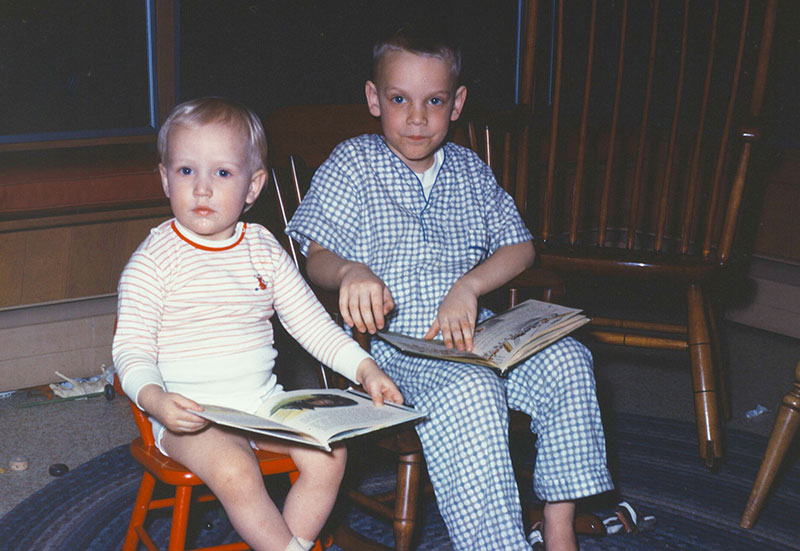
In the picture below is me and my brother Tim, probably about 1964.
We both have books open on our laps.
We had the same parents, grew up in the same home but for some reason, I was a reader and Tim was not.
I went on to career in books and news and Tim went on to a be a very successful engineer.
As for the family gene pool, many of my brothers and sisters won the Math Award given to the best Math Student at Creston High School.
Me?
Someday I plan to get a book about Trigonometry and find out what that was all about.
I have worked in Bookstores and Libraries for a good part of my life.
Over those years I formed the opinion that about 10 to 15% of the American public could be classed as readers.
That matches up with where the ‘Scientific Data’ says we are now.
I had no scientific evidence to back that up, it was just a personal feeling I came up with over the years.
Still I am happy to report that a new bookstore opened up here the low country of South Carolina.
Newspaper coverage of the opening started with the line, “In the era of Amazon and e-books, who would have imagined that a brick-and-mortar, ink-on-paper bookstore would open on Hilton Head Island in summer 2025?”
Emily [the new owner/operater] said she was inspired by online discussions of third spaces, which means a place other than home or work and school that people can go to spend time such as cafes, libraries or community centers. “I also felt the need for, being someone who is in the younger generation living in the area, I felt that we had a lack of spaces to hang out or to socialize that’s not a restaurant or a bar or the beach,” Emily said.
Happy to say we were there yesterday and enjoyed the atmosphere and hope for their future.
Any reader knows the unique delight of settling down with a good book.
I can’t tell you when I started reading because I don’t remember a time when I wasn’t.
Something I attribute to my parents having books all over our house.
My Dad was a Dentist and he subscribed to all sorts of magazines for his office waiting room, and he would bring those magazines home for us to look at before they ended up being read by his nervous patients.
One the magazines he subscribed to was Reader’s Digest so all those Reader’s Digest digested books books were all over the house.
Along with the digested books, Reader’s Digest published anthologies like America’s Best Sports Stories and Reader’s Digest True Crime: Tales of Murder & Mayhem and those were laying around the house as well.
At some point in my young life, I took down Reader’s Digest True Crime: Tales of Murder & Mayhem, it had a big read thumb print on the cover and read through it.
There were stories titled, A killer is Loose and Life and Death of a Twisted Genius.
Just right for a 10 year old.
I read them all but it was a story titled, The Trial that Rocked the Nation that stuck with me.
It was a 10 page article the told the story of the Scopes Trial in Dayton, TN.
I remember asking my Dad about it and he said, “The Monkey Trial!”
With that my lifelong admiration for Clarence Darrow was born.
I wanted to learn more about Mr. Darrow and snuck into the grown up section of my local library and took home the book, Clarence Darrow for the Defense by Irving Stone.
Lots and lots of great Darrow stuff in that book (including the case he took that was heard in a Grand Rapids, Michigan courtroom – A courtroom I was in several times for wedding receptions when the building was turned into the local art museum).*
But the story that RESONATED with me was an story told about the time Mr. Darrow’s father, Amirus Darrow (A man who took young Clarence along for midnight wagon rides to bring people along the underground railroad in Ohio), visited his son in Chicago.
The narrative by Mr. Stone picks up with:
Amirus Darrow had decided to spend a week in Kinsman visiting old friends. Clarence had slipped several greenbacks into his father’s pocket, and Jessie put up a lunch for her father-in-law for the train. Amirus ieft early in the morning, riding the streetcar downtown from 4219 Vincennes Avenue. When he found that he had a half-hour before train time he descended a flight of stairs into a basement secondhand bookstore.
At ten o’clock that night the bell rang at the Darrow home. Clarence opened the door to find his father glaze-eyed, hugging a huge bundle under each arm. Amirus had found so many books for which he had always yearned that he had not emerged from the bookshop until twelve hours later, his railroad and vacation money spent. He had come home to read his precious literary treasures, all desire to visit Kinsman gone. Seeing his father standing before him on the porch, his eyes dreamy and withdrawn and beautiful, the son realized that the older man had always missed his train because he had found something more interesting in a book than would be waiting for him at the end of a journey.
Boy Howdy, Yessir!
Did I read that maybe at the wrong time in my life?
Or maybe not.
I have to say that as a guiding star in my life, I always felt that I might find something more interesting in a book than would be waiting for me at the end of a journey.
Any reader knows the unique delight of settling down with a good book.
Me and my granddaughter on a lazy Sunday front porch reading afternoon
*(Gee whiz, but when will I get to the point … authors note)
swell letter from you snapshots and small packet of Lake Michigan beach
In a letter my Dad wrote to his then girlfriend, later wife and later still, my Mom, on August 15, 1945, he opened with:
My Darling Lorraine, Well, the war is finally over and now all we have to do is until the time comes when I can come home.
It was VJ Day.
Victory over Japan.
Dad was in Europe and Germany had surrendered that spring and the US Army in Europe was waiting to see if it would be needed in the war against Japan.
Dad had entered the army in the spring of 1942, spent the next 2 years in South Carolina and in 1944, was shipped over to England.
Since 1942, getting out of the army and home was first and foremost on his mind.
He would mention Cubs baseball games and that he was looking forward to going to a game when he got home.
He would mention Michigan football games and that he was looking forward to going to a game when he got home.
He would write about the food and mention that he was looking forward to my Mom’s cooking for him when he got home.
Homesick in a major sort of way.
Mom would send off packages of candies and nuts from his favorite stores.
And she sent pictures, snapshots she took and studio photographs she had taken.
Dad loved the photos and always mentioned them and always asked for more.
And he would mention how much he missed home.
Mom must have sensed this, I mean who couldn’t and she thought up things she could send.
Things that were small enough to send in the mail and still be meaningful to Dad.
Things that would say, I miss you too.
Things that would say, someday.
After remarking on the end of World War 2, Dad to turned to the last letter he got from Mom.
Dad wrote:
I received a swell letter from you dated the 6th of August which contained a couple of snapshots and a little packet of Lake Michigan Beach.
A little packet of Lake Michigan Beach.
Lake Michigan Beach.
A little packet of Lake Michigan Beach sand in a packet mailed to Europe at the end of World War 2.
Mom had recently had a beach day with her younger brother Carol and other friends and as nice a trip to the beach in August sounds, Mom’s thoughts were in Europe and she put some of the sand away to send to Dad.
Some thing that was small enough to send in the mail and still be meaningful to Dad.
Some thing that would say, I miss you too.
Some thing that would say, someday.
Dad wrote:
Maybe next year we can be there together.
He then wrote, I think it was the longest letter that I have ever received from you … and it was wonderful.
He was over in Germany.
Japan had surrendered.
The war was over.
And he had a little packet of Lake Michigan Beach.
And it was wonderful.
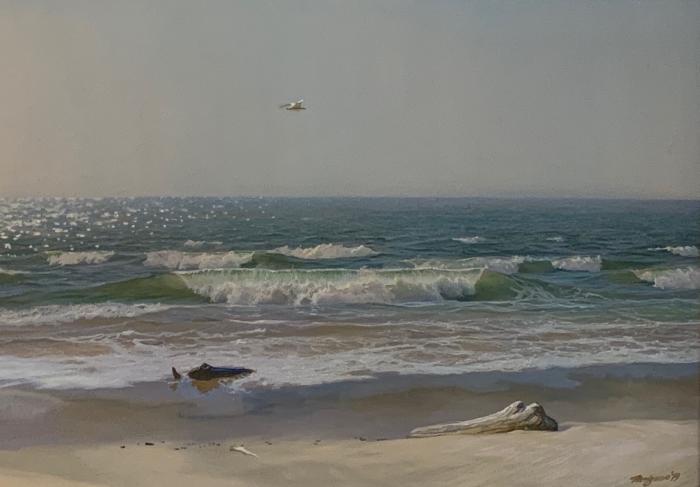
Lake Michigan Beach (1972) by Armond Merizon (My Dad’s favorite artist)




 No Haiku For You