7.27.2025 – let young come, says sea

let young come, says sea
let them kiss my face, tell where
storms and stars come from

The sea is never still.
It pounds on the shore
Restless as a young heart,
Hunting.

The sea speaks
And only the stormy hearts
Know what it says:
It is the face
of a rough mother speaking.

The sea is young.
One storm cleans all the hoar
And loosens the age of it.
I hear it laughing, reckless.

They love the sea,
Men who ride on it
And know they will die
Under the salt of it.

Let only the young come,
Says the sea.
Let them kiss my face
And hear me.
I am the last word
And I tell
Where storms and stars come from.

Young Sea by Carl Sandburg as published in The Complete Poems of Carl Sandburg, by Carl Sandburg, Harcourt, Brace, New York, 1950.

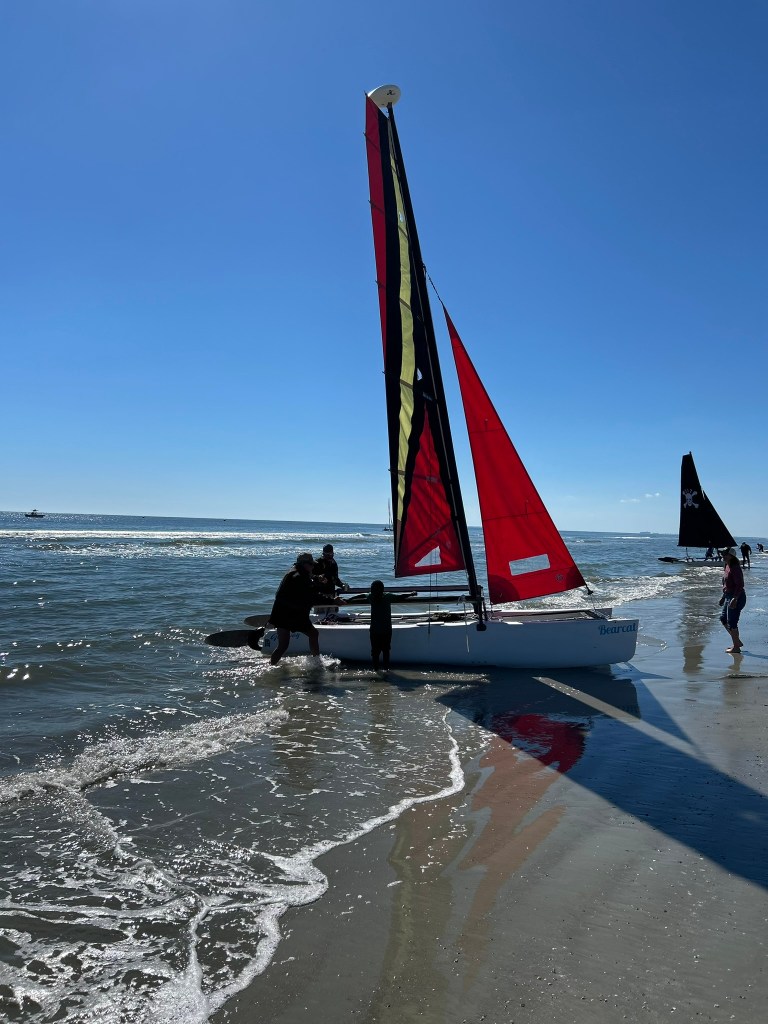
Spent the day at the beach with Grandkidz Jaxon, Stefano, Essence and Kendra.

I was lifeguard, activities director and caterer but it was really just an excuse for me to have a play date at the beach.

7.23.2025 – unforgettable

unforgettable
fury of light climbing in
the fabric of dawn

Sunrise from New and Selected Poems, by Mary Oliver

You can
die for it–
an idea,
or the world. People

have done so,
brilliantly,
letting
their small bodies be bound

to the stake,
creating
an unforgettable
fury of light. But

this morning,
climbing the familiar hills
in the familiar
fabric of dawn, I thought

of China,
and India
and Europe, and I thought
how the sun

blazes
for everyone just
so joyfully
as it rises

under the lashes
of my own eyes, and I thought
I am so many!
What is my name?

What is the name
of the deep breath I would take
over and over
for all of us? Call it

whatever you want, it is
happiness, it is another one
of the ways to enter
fire.

7.19.2025 – by law of nature

by law of nature
things are common to mankind
the shores of the sea

According to Wikipedia, The Code of Justinian is one part of the Corpus Juris Civilis, the codification of Roman law ordered early in the 6th century AD by Justinian I, who was Eastern Roman emperor in Constantinople.

The Code of Justinian went into effect in 529 AD.

According to the article, An Ancient Law Could Shape the Modern Future of America’s Beaches. Here’s How by Cornelia Dean, science writer and former science editor of The New York Times, public access to beaches is based on …

“… a legal concept from the sixth century A.D., when Emperor Justinian ordered the codification of Roman laws. The resulting code declared that features of nature like the air, running water, the sea and “the shores of the sea” must be held in trust for the use of the public. That idea passed into English common law, and then to the United States.

Today, most states define the beach below the high-tide line as public trust property, meaning members of the public have free access.

The Code of Justinian, Book II. Of Things, I. Divisions of Things, states:

  1. By the law of nature these things are common to mankind, the air, running water, the sea, and consequently the shores of the sea. No one, therefore, is forbidden to approach the seashore, provided that he respects habitationes, monuments, and buildings which are not, like the sea, subject only to the law of nations.
  2. All rivers and ports are public; hence the right of fishing in a port, or in rivers, is common to all men.
  3. The seashore extends as far as the greatest winter flood runs up.
  4. The public use of the seashore, too, is part of the law of nations, as is that of the sea itself; and, therefore, any person is at liberty to place on it a cottage, to which he may retreat, or to dry his nets there, and haul them from the sea; for the shores may be said to be the property of no man, but are subject to the same law as the sea itself, and the sand or ground beneath it.

WOW.

Since 529 AD, we have all had access to the shore as the public use of the seashore, too, is part of the law of nations, as is that of the sea itself!

Much like the fact that Thomas Jefferson was the 1sr President to serve Ice Cream in the White House is enough to list Mr. Jefferson among the Great Presidents so does the statement No one, therefore, is forbidden to approach the seashore makes ol’ Justinian my favorite Roman Emperor.

According to Wikipedia:

Justinian is regarded as one of the most prominent and influential Roman emperors, and historians have often characterized him as a workaholic who worked tirelessly to expand the Byzantine Empire. One of the most enduring aspects of his legacy was the uniform rewriting of Roman law, the Corpus Juris Civilis, which was first applied throughout Continental Europe and is still the basis of civil law in many modern states. His reign also marked a blossoming of Byzantine culture, and his building program yielded works such as the Hagia Sophia.

Boy howdy, it may well be that one of the most enduring aspects of his legacy was the uniform rewriting of Roman law, the Corpus Juris Civilis but against beach access for all, all other forms of human endeavor become insignificant.

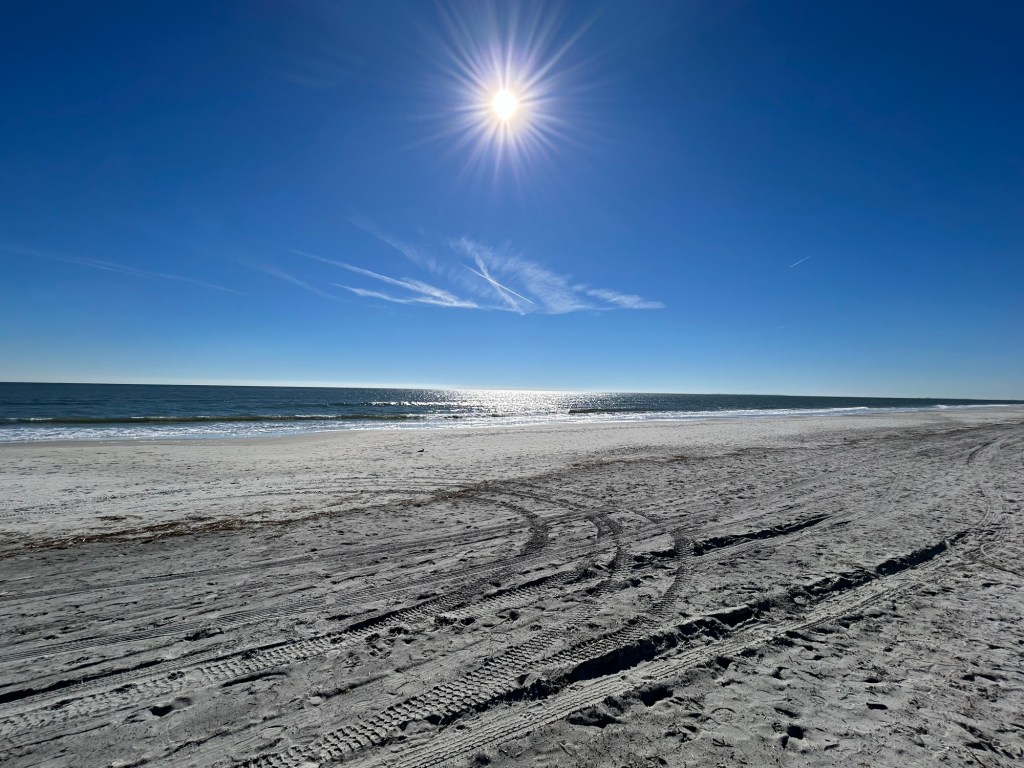
PS: This is what the public access beach on Hilton Head Island on a July Saturday can look like … provided you have son who works security at the resort behind the beach and he can provide you with a parking a pass. It also helps if the resort is typical of HHI and its guests are based on a weekly stay with a 10am Saturday check out and a 4pm check in so we get a beach to ourselves.

6.28.2025 – eyes of those who fight and

eyes of those who fight and
starve for bread – there is doom, change,
silence, denying

Adapted from the poem, Sea Music, by Babette Deutsch.

There is a place of bitter memories
Dreary and wide and lonely as the sea,
Foaming and moaning; there they come to me
Like wild gulls crying sea-taught monodies:
Iron-winged hours, heavy, heavy with dread;
Dawn after death; the sound of a shut door;
And shining love that has a withered core;
The eyes of those who fight and starve for bread.
There is doom, and change, and silence, and denying;
Memories of these pluck at the heart of me.
And over the bitter roar of the old dumb sea
The air is filled with the noise of wild gulls crying.

I started this morning still at a loss for words.

Wanting, if for the sake of self discipline if nothing else, to write something today I turned to my other project for inspiration.

Over the last year I worked to gather digital versions of every known published James Thurber Cartoon.

When I am at a loss for word, I will go to my Thurber archive and see if there might be a drawing and caption suitable to be adapted to a haiku.

Searching the archive for June 28th, I found that on June 28, 1941, the New Yorker published a drawing with the caption, Miss Gorce is in the embalming game.

That didn’t do much for a haiku.

But when I created my archive, I also did a screen grab of the two page spread of the New Yorker so users could see how New Yorker readers first saw the Thurber drawing.

I found this necessary to show that all Thurber drawings DID NOT just magically appear in books, one after another, but were part of the fabric of the magazine.

Looking at the spread of pages 14 and 15 for June 28th, 1941 edition of the New Yorker, I saw opposite the Thurber drawing a poem by Babette Deutsch.

Never heard of her but liked her poem and thought would do so I search for an online version I could copy and paste into this post and when doing so, came across this poem, Sea Music.

Just yesterday I was bemoaning the fact that I had no words in me to describe how I felt after the highest court in this country decided that the feller in office was a better judge of Justice then they were and here was a poem that described how I felt.

Iron-winged hours, heavy, heavy with dread;
Dawn after death; the sound of a shut door;
And shining love that has a withered core;

Wikipedia reports that: Babette Deutsch was born on September 22, 1895, in New York City. Her parents were of Michael Deutsch and Melanie Fisher Deutsch. She matriculated from the Ethical Culture School and Barnard College, graduating in 1917 with a B.A. She published poems in magazines such as the North American Review and the New Republic while she was still a student at Barnard.

The Poetry Foundation website states: Aligned with the Imagist movement, Deutsch typically composed compact, lyrical pieces using crisp visual imagery. Many of her poems are ekphrastic responses to paintings or other pieces of visual art.

Many of her poems are ekphrastic responses to paintings or other pieces of visual art.

I like that.

Re reading again the lines,

Iron-winged hours, heavy, heavy with dread;
Dawn after death; the sound of a shut door;
And shining love that has a withered core;

All I can say is what a perfect ekphrastic response to our current states of affairs.

6.25.2025 – seen Sun emerge from

seen Sun emerge from
his amazing house and leave a
day at every door

Adapted from the poem When I have seen the Sun emerge, by Emily Dickenson written in 1864 and published in The Complete poems of Emily Dickinson. Edited by Thomas H. Johnson (Little, Brown and Company, Boston, 1960).

Sunrise over Skull Creek – Sun has emerged out of the Atlantic Ocean about 30 minutes earlier and just starting his day

When I have seen the Sun emerge

When I have seen the Sun emerge
From His amazing House —
And leave a Day at every Door
A Deed, in every place —

Without the incident of Fame
Or accident of Noise —
The Earth has seemed to me a Drum,
Pursued of little Boys

Recently I was driving over this bridge with this view with my daughter who was visiting along with her kids.

As she drove, she looked out the the window and then said to me …

“Do you ever get used to it being so beautiful here?”

I looked up from my hand held where I was checking something important like the current high tide or weather report or latest update on Michigan football.

I looked out the window at what I see every time I drive to work.

Well, I said …