Some of these beach haiku were written by random trips to beach.
Most of these are part of a series based on afternoons spent at the beach on Hilton Head Island with my pad out ( a real paper note pad), hoping for words with my iPhone camera handy to add illustration to my thoughts.
I wanted to see if I would be ‘inspired’ by what I saw, by what I heard, by what I smelled, by what I tasted, what I felt emotionally and what I felt tactilely.
Some turned out okay.
Some were too forced.
Some were just bad.
Some did involve some or all of those feelings.
As far as it goes, I guess I was inspired by by what I saw, by what I heard, by what I smelled, by what I tasted, what I felt emotionally and what I felt tactilely.
Please aware that most of these haiku were NOT WRITTEN on the date in the title – for an explanation of this please see The Series link in the navigation table.
it’s an urge to say I was here, I saw this and it mattered to me
Adapted from the book, The Art of Travel (2002, Vintage Books) by Alain de Botton, and the passage:
A dominant impulse on encountering beauty is to wish to hold on to it, to possess it and give it weight in one’s life. There is an urge to say, ‘I was here, I saw this and it mattered to me.’
But beauty is fugitive, being frequently found in places to which we may never return or else resulting from rare conjunctions of season, light and weather.
How then to possess it, how to hold on to the floating train, the halvalike bricks or the English valley?
The camera provides one option. Taking photographs can assuage the itch for possession sparked by the beauty of a place; our anxiety over losing a precious scene can decline with every click of the shutter.
According to the website, GOOD READS, Any Baedeker will tell us where we ought to travel, but only Alain de Botton will tell us how and why.
As I said in the section on Architecture , what I find irresistible in reading Mr. de Botton is his use of language.
I get the feeling that if you made a spread sheet of all the words, adverbs and adjectives used by Mr. de Botton, you just might find that he used each word just once.
falls the rain each day each night under the rain the sore the gold are as one
Adapted from the poem Still Falls the Rain by Edith Stilwell (1887-1964) in the section:
Still falls the Rain At the feet of the Starved Man hung upon the Cross. Christ that each day, each night, nails there, have mercy on us — On Dives and on Lazarus: Under the Rain the sore and the gold are as one
I heard the voice of Jesus say, ‘Come unto Me and rest; Lay down, thou weary one, lay down, Thy head upon My breast.’ I came to Jesus as I was, So weary, worn, and sad; I found in Him a resting-place, And He has made me glad.
I heard the voice of Jesus say, ‘Behold, I freely give The living water; thirsty one, Stoop down and drink and live.’ I came to Jesus, and I drank Of that life-giving stream. My thirst was quenched, my soul revived, And now I live in Him.
I heard the voice of Jesus say, ‘I am this dark world’s Light. Look unto Me; thy morn shall rise And all thy day be bright.’ I looked to Jesus, and I found In Him my Star, my Sun; And in that Light of Life I’ll walk Till traveling days are done.
It all started here.
Luke 16:19-31 New International Version The Rich Man and Lazarus
There was a rich man who was dressed in purple and fine linen and lived in luxury every day. At his gate was laid a beggar named Lazarus, covered with sores and longing to eat what fell from the rich man’s table. Even the dogs came and licked his sores. The time came when the beggar died and the angels carried him to Abraham’s side. The rich man also died and was buried. In Hades, where he was in torment, he looked up and saw Abraham far away, with Lazarus by his side. So he called to him, ‘Father Abraham, have pity on me and send Lazarus to dip the tip of his finger in water and cool my tongue, because I am in agony in this fire.’ But Abraham replied, ‘Son, remember that in your lifetime you received your good things, while Lazarus received bad things, but now he is comforted here and you are in agony. And besides all this, between us and you a great chasm has been set in place, so that those who want to go from here to you cannot, nor can anyone cross over from there to us.’ He answered, ‘Then I beg you, father, send Lazarus to my family, for I have five brothers. Let him warn them, so that they will not also come to this place of torment.’ Abraham replied, ‘They have Moses and the Prophets; let them listen to them.’ ‘No, father Abraham,’ he said, ‘but if someone from the dead goes to them, they will repent.’ He said to him, ‘If they do not listen to Moses and the Prophets, they will not be convinced even if someone rises from the dead.’
He said to him, ‘If they do not listen to Moses and the Prophets, they will not be convinced even if someone rises from the dead.’
I looked to Jesus, and I found In Him my Star, my Sun;
I like how many of the words in this haiku were thrown out by spell check.
Listen to the sound of waves.
What words do you here?
I had to make mine up as the words didn’t exist.
On the one, I am sure most readers or wave listeners would agree with me that the words just aren’t there.
On the other, time, tide and waves have been around since day 1 on the schedule and we haven’t come up with words yet?
There is an old Jewish fable or midrash I think there were called when God and Satan are arguing in the Garden of Eden about how smart Adam might be.
God says to prove it, he will ask Adam if he can identify all these new animals.
God calls up Adam and says to him, “Adam, what do think this rabbit is?”
And Adam says, “That is a rabbit.”
Another version has an Angel whispering the animal names to Adam.
My point is if we, the human race, got some help describing animals, why not with waves?
Where are the words?
What are the words?
I certainly hear the sounds.
Part of a series based on an afternoon spent at the beach on Hilton Head Island.
I wanted to see if I would be ‘inspired’ by what I saw, by what I heard, by what I smelled, by what I tasted, what I felt emotionally and what I felt tactilely.
Some turned out okay.
Some were too forced.
Some were just bad.
Some did involve some or all of those feelings.
As far as it goes, I guess I was inspired by by what I saw, by what I heard, by what I smelled, by what I tasted, what I felt emotionally and what I felt tactilely.
wrote her name upon the strand, but came the waves and washed it away
Adapted from the sonnet, Amoretti LXXV, by Edmund Spenser.
This is one of several haiku I got from this sonnet.
Edmund Spenser (1553-1559), according to wikipedia, was an English poet best known for The Faerie Queene, an epic poem and fantastical allegory celebrating the Tudor dynasty and Elizabeth I. He is recognized as one of the premier craftsmen of nascent Modern English verse and is often considered one of the greatest poets in the English language.
In 1595, Spenser published Amoretti and Epithalamion. This volume contains eighty-eight sonnets commemorating his courtship of Elizabeth Boyle. In Amoretti, Spenser uses subtle humour and parody while praising his beloved, reworking Petrarchism in his treatment of longing for a woman.
Spenser used a distinctive verse form, called the Spenserian stanza. The stanza’s main meter is iambic pentameter with a final line in iambic hexameter (having six feet or stresses, known as an Alexandrine), and the rhyme scheme is ababbcbcc. He also used his own rhyme scheme for the sonnet. In a Spenserian sonnet, the last line of every quatrain is linked with the first line of the next one, yielding the rhyme scheme ababbcbccdcdee.
But you knew that.
Here is the full sonnet.
One day I wrote her name upon the strand, But came the waves and washed it away: Again I wrote it with a second hand, But came the tide, and made my pains his prey. ‘Vain man,’ said she, ‘that dost in vain assay, A mortal thing so to immortalize; For I myself shall like to this decay, And eke my name be wiped out likewise.’ ‘Not so,’ (quod I); ‘let baser things devise To die in dust, but you shall live by fame: My verse your vertues rare shall eternize, And in the heavens write your glorious name: Where whenas death shall all the world subdue, Our love shall live, and later life renew.
and yet nothing is done blindly, hastily, or indifferently
I am getting into the history of the low country where I now find myself living.
The low country is the southern point of the State of South Carolina where the elevation above sea level is 20 feet or less, hence the name, low country.
You don’t have to be here very long to learn that the greatest natural disaster to hit the area was the Sea Islands Hurricane of 1893.
I had never heard about.
Not too many people outside of the area have heard about it.
That was also one of the major problems that the surviving residents of the hurricane experienced.
No one knew about it.
Few people outside of the area were aware of the impact of the storm in this part of the country.
Savannah was the point of landfall and Savannah had some damage but Savannah is somewhat inland.
The barrier or Sea Islands were almost wiped off the map.
Modern interpretation of data shows that the storm surge along the South Carolina-Georgia Coast may have been as high as 30 feet.
And there was little in the way of communication with the area to get the word out.
Most of what historical information there is are estimates.
There were an estimated 30,000 people living on the Sea Islands.
After the Civil War, this area was also over 90% black and former slaves.
Over 2,000 people may have died, most by drowning.
That makes the Sea Islands Hurricane the 4th most deadly hurricane in recorded US history.
For the most part, the surviving 28,000 people were left homeless.
That is 100% folks.
On top of no shelter there was no food, no supplies and all fresh water sources of inland lakes, ponds and springs had been filled with salt water.
And few people knew.
There were no cell phones, no CNN, no power boats, no bridges, no national guard, no communication of any kind.
Word did not get for days.
Relief did not reach the area for weeks
Real relief did not reach the area for months.
Took time to get the word out.
When national relief came it came from the 10 year old American Red Cross.
The American Red Cross was set up in 1881 by Clarissa Harlowe Barton.
Better known just Clara Barton, she worked to establish the Red Cross as a non-profit humanitarian organization that provided emergency assistance, disaster relief, and disaster preparedness education in the United States. (wikipedia)
Ms. Barton first entered the national stage during the Civil War where she was active in providing clothing, food, and supplies for the sick and wounded soldiers.
Now she was boss of the Red Cross and she took her new organization down to the low country.
How in the world did this happen?
Turns out the during the Civil War years, Ms. Barton had stationed herself on Hilton Head for a while.
Her brother David had alerted her to the fact that the Union Army was building up forces on Hilton Head of an attack on the Charleston, SC area.
Some of those efforts are portrayed in the movie, Glory.
David Barton himself was stationed here.
From April, 1863 to January, 1864, Ms. Barton was here.
Ms. Barton was involved with sick and wounded solders as well as educating and working with the black islanders who lived here.
Something about this area gets into your blood.
When Ms. Barton heard of the devastation, she moved her office to Beaufort, SC and set up to provide relief in the way of food and medicine the best they could.
The Red Cross stayed here and handed out food and other supplies to survivors.
Folks had heard about this new American Red Cross and weren’t quite sure what is was or what it could do.
The Atlanta Newspapers sent reporters to cover the story.
Back then, Newspaper folks knew that the story was more than names, dates and facts and that the story might require something more than just a reporter.
So Joel Chandler Harris was sent down to write the story.
This is not the place to get into a Joel Chandler Harris discussion but suffice to say, the feller could write.
His efforts were published in two parts in Scribner’s Magazine.
Scribner’s Magazine in the 1890’s was Time, Newsweek, Life and the New Yorker all rolled into one.
The stories were “The Devastation” published in February, 1894 (5 months after the storm) and “The Relief.” published in March, 1894.
At the end of the first story, ‘The Devastation’, Mr. Harris wrote:
I went to the Sea Islands with no prejudice against the Red Cross Society, but certainly with no prepossession in its favor. I had pictured it in my mind as a sort of fussy and contentious affair, running about with a tremendous amount of chatter and flourishing a great deal of red tape — a sort of circumlocution office, situated in the air between individual officiousness and newspaper notoriety.
As a matter of fact, the Red Cross Society as I saw it at Beaufort is something entirely different from any other relief organization that has come under my observation.
Its strongest and most admirable feature is its extreme simplicity. The perfection of its machinery is shown by the apparent absence of all machinery. There are no exhibitions of self-importance. There is no display – no torturous cross examination of applicants – no needless delay. And yet nothing is done blindly, or hastily, or indifferently.
This poor little tribute to Miss Clara Barton I want to pay in heartily seconding her appeal to the benevolence of the whole country carrying out her work on the Sea Islands
Such aid will be more important in the last days of her mission than it was when the sympathies of the public had been touched by the awful story of the disaster that went tingling over the wires on the last days of August.
I guess when and what I have been reading the last year about the bill to save America, the bill to rebuild America and the bill to save our climate the words “here are no exhibitions of self-importance. There is no display – no torturous cross examination of applicants – no needless delay. And yet nothing is done blindly, or hastily, or indifferently” just gets under my skin and make me want to scream.
The fussy and contentious affair, running about with a tremendous amount of chatter and flourishing a great deal of red tape that is Congress makes me want to grab Congress by the throat and bash its head against the wall.
If pro is the opposite of con, what is the opposite of progress?
God help us all.
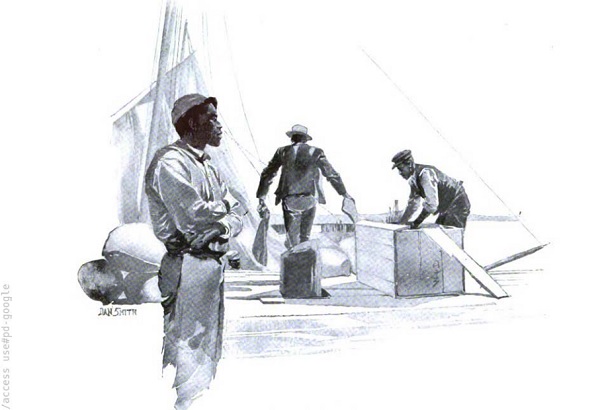
Here are the two articles from Scribner’s Magazine – 1894.


 No Haiku For You