Some of these beach haiku were written by random trips to beach.
Most of these are part of a series based on afternoons spent at the beach on Hilton Head Island with my pad out ( a real paper note pad), hoping for words with my iPhone camera handy to add illustration to my thoughts.
I wanted to see if I would be ‘inspired’ by what I saw, by what I heard, by what I smelled, by what I tasted, what I felt emotionally and what I felt tactilely.
Some turned out okay.
Some were too forced.
Some were just bad.
Some did involve some or all of those feelings.
As far as it goes, I guess I was inspired by by what I saw, by what I heard, by what I smelled, by what I tasted, what I felt emotionally and what I felt tactilely.
Please aware that most of these haiku were NOT WRITTEN on the date in the title – for an explanation of this please see The Series link in the navigation table.
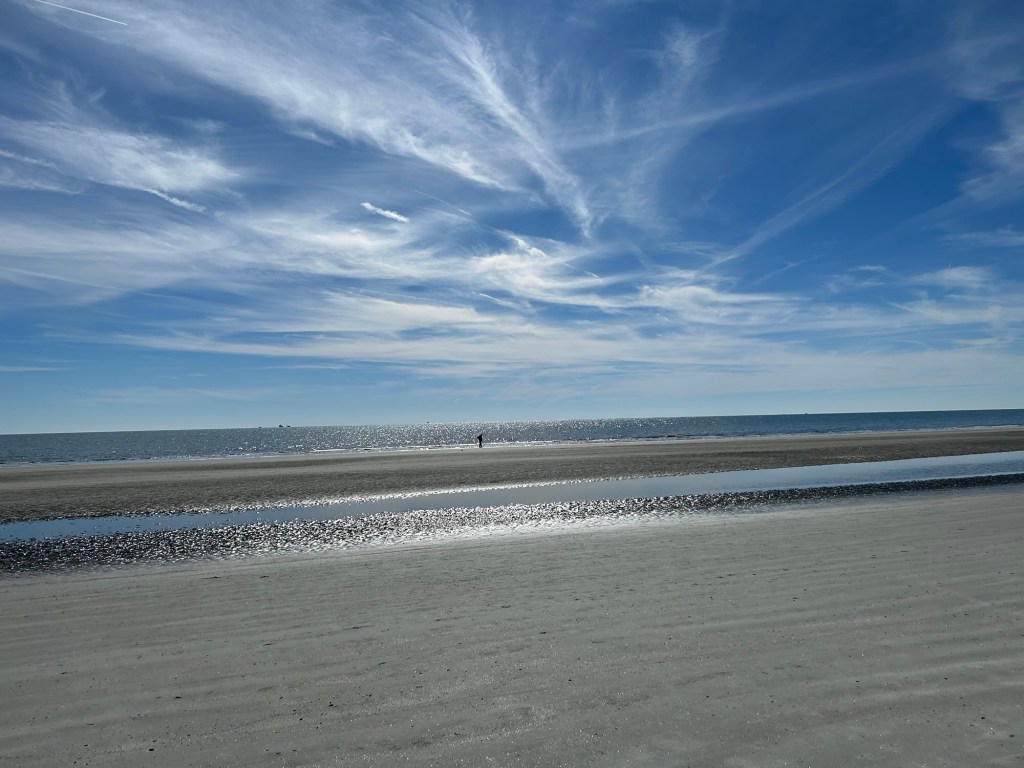
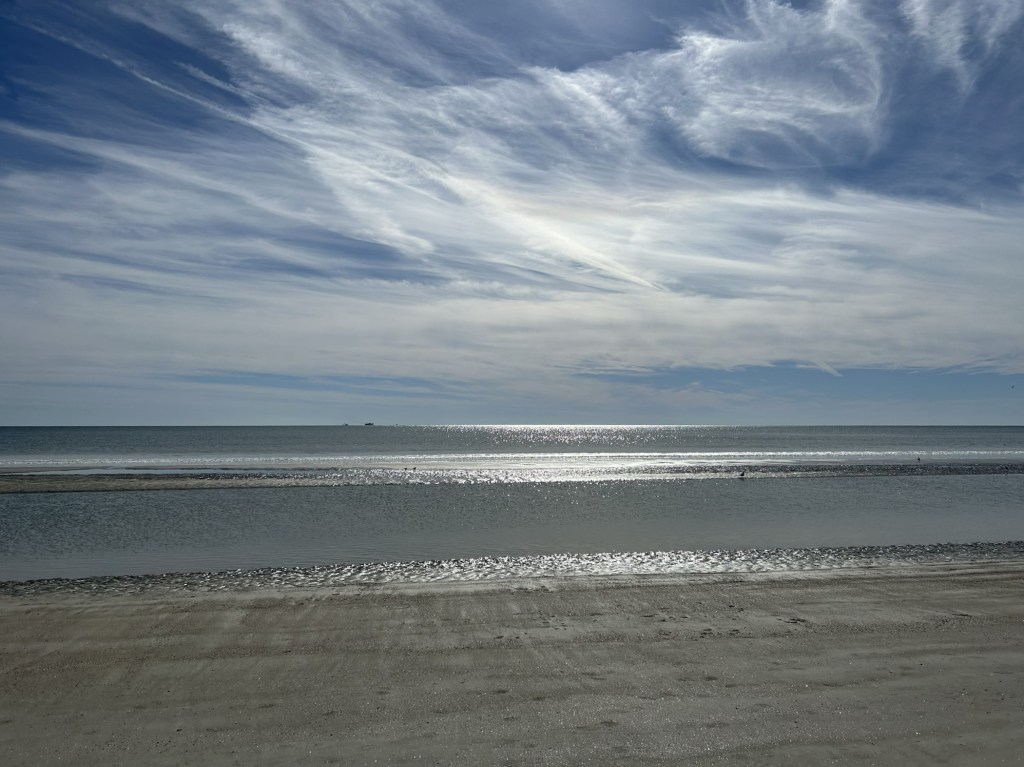
blue waves, green waves swept leaving shallow pools of light here, there on the sand
The sun rose higher. Blue waves, green waves swept a quick fan over the beach, circling the spike of sea-holly and leaving shallow pools of light here and there on the sand. A faint black rim was left behind them. The rocks which had been misty and soft hardened and were marked with red clefts.
Sharp stripes of shadow lay on the grass, and the dew dancing in the tips of the flowers and leaves made the garden like a mosaic of single sparks not yet formed into one whole. The birds, whose breasts were specked canary and rose, now sang a strain or two together, wildly, like skaters rollicking arm-in-arm, and were suddenly silent, breaking asunder.
The sun laid broader blades upon the house. The light touched something green in the window corner and made it a lump of emerald, a cave of pure green like stoneless fruit. It sharpened the edges of chairs and tables and stitched white tablecloths with fine gold wires. As the light increased a bud here and there split asunder and shook out flowers, green veined and quivering, as if the effort of opening had set them rocking, and pealing a faint carillon as they beat their frail clappers against their white walls. Everything became softly amorphous, as if the china of the plate flowed and the steel of the knife were liquid. Meanwhile the concussion of the waves breaking fell with muffled thuds, like logs falling, on the shore.
From The Waves by Virginia Woolf, Hogarth Press, Tavistock Square, London, 1931
being walkers with the sun and morning not afraid days of gloom, darkness
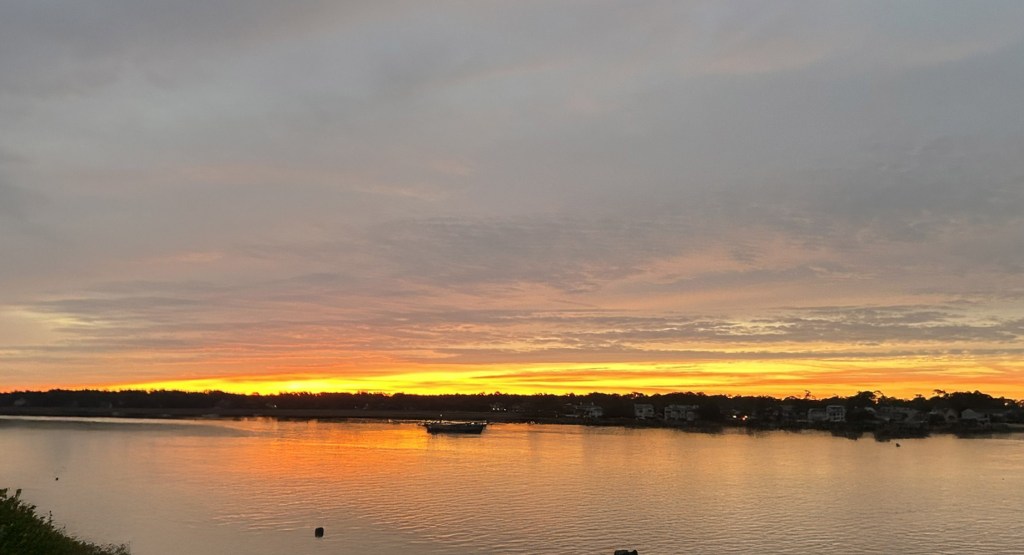
Broad Creek with the Sun about to come out of the Atlantic Ocean just on the other side of those trees – Hilton Head Island, SC 2-4-2026
Being walkers with the dawn and morning, Walkers with the sun and morning, We are not afraid of night, Nor days of gloom, Nor darkness— Being walkers with the sun and morning.
Walkers With The Dawn By Langston Hughes as printed in The collected poems of Langston Hughes by Langston Hughes (Knopf: New York, 1994).
When I was kid going to Grand Rapids Crestview Elementary School, every classroom had a model of the solar system sitting on the shelves that ran along the inside wall of every classroom.
The outside wall was all windows covered in venetian blinds.
The front wall was all chalkboards.
The back wall was all bulletin boards.
Seems like every room at Crestview had the same layout except that the lower elementary rooms had a restroom in the classroom.
The kindergarten room had a restroom in the classroom and for reason unknown, the light switch was on the outside. The switch had a red light under it and if the door was closed and the red light was on you knew someone was inside with the light on. Which proved too much temptation for some kids and by some kids I mean me. Sure we got in trouble but to hear someone yell when all you had to do was hit that switch … well, like I said too much temptation and I, early on started down the path of class cut up. The cost of a talking-to and maybe even a trip to hall was small price for the moment of notoriety I could achieve with that simple act. But I digress.
As I said, each room had this model of the solar system.
It wasn’t much.
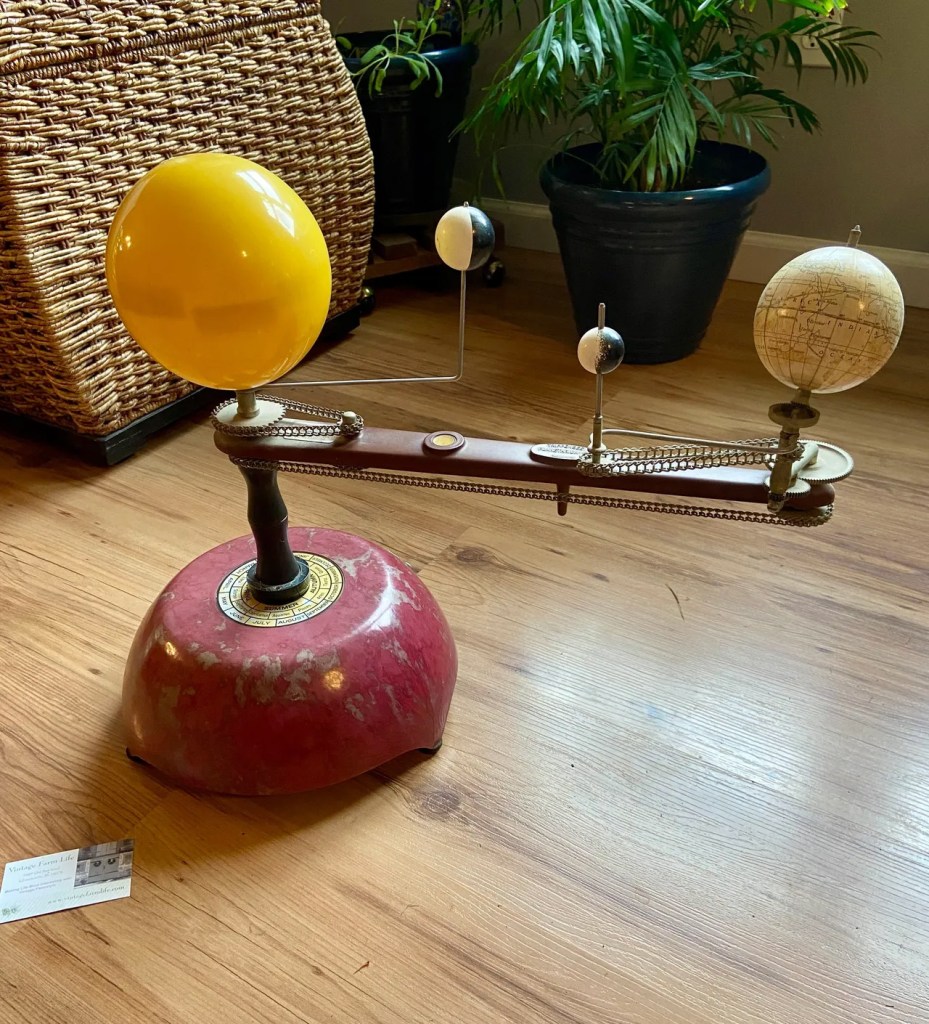
It had a large yellow sun in the center and a small earth that went around the sun and on an extended arm, it had another model of the earth with a little moon that went around the earth.
There was a knob on the arm and you grabbed the knob and spun the arm around the sun and the earth went around the sun and the moon went around the earth.
It took about 25 seconds to get the gist of it and that nothing else was going to happen.
I found this photo of something that looks a lot like what we had, but the one pictured is a little more elaborate that what we had in school and I am pretty sure that the chain drive and gears where all enclosed but this gives you the idea.
But there was this one time.
I want to say it was in 5th grade with Miss Critchell that she really tried to use the model and explain the solar system.
This would have been at the height of the Apollo space program and there was a lot of interest in space and the solar system.
When there was a space launch, Miss Critchell would bring in her personal portable black and white TV and we would have a quiet day to work at our desks while she left the TV on.
I remember sitting at my desk with the lights off so we could see the fuzzy TV picture waiting through one of those ‘MISSION IS ON HOLD’ moments while NASA worked out some problem and I was so bored I asked Miss Critchell if I could go to the library.
“But this IS history,” said Miss Critchell, shaking her head, but she let me go anyway.
Before this space launch, Miss Critchell did her best to explain the solar system and the moon missions.
She had done her home work so that when she got out the model of the solar system and made the earth go around the sun and moon go around the earth she said something that fell through the cracks in my brain and stayed there forever.
“This is just a model,” she said.
“In real life,” she said, “if the Sun was this big, (pointing at the grapefruit sized yellow model of the sun), the earth would really be … somewhere out on the playground.”
I don’t know if the rest of the class heard like I did but it hit me that in the grand scheme of things, earth was pretty insignificant.
Maybe Horton Hears a Who came to mind and I realized that we, the people on earth, could be the that dust speck of boil that dust speck fame.
And what came to me was that, boy howdy, but we were lucky God was in charge of the whole thing as it was all too much for pure chance for me.
As everyone knows who reads these, as I drive to work, I drive out onto a barrier island on the east coast.
Each day that crank is turning and the earth is spinning and everything is going around the Sun.
It did this yesterday.
It will do this today.
It will do this tomorrow.
I still think, BOY HOWDY, but we were lucky God was in charge of the whole thing as it was all too much for pure chance for me.
And I think of the verse from the Bible, Romans 8:31: What shall we then say to these things? If God be for us, who can be against us?
Being walkers with the dawn and morning, Walkers with the sun and morning, We are not afraid of night, Nor days of gloom, Nor darkness— Being walkers with the sun and morning.
Winter Storm Warning Including the cities of Hilton Head Island
URGENT – WINTER WEATHER MESSAGE National Weather Service Charleston SC 1236 PM EST Sat Jan 31 2026
GAZ087-088-SCZ040-042-043-049-010145- /O.CON.KCHS.WS.W.0001.000000T0000Z-260201T1800Z/ Jenkins-Screven-Allendale-Hampton-Inland Colleton-Coastal Colleton- Including the cities of Sylvania, Yemassee, Hampton, Allendale, Millen, Edisto Beach, and Walterboro 1236 PM EST Sat Jan 31 2026
…WINTER STORM WARNING REMAINS IN EFFECT UNTIL 1 PM EST SUNDAY…
WHAT…Heavy snow expected. Total snow accumulations between 2 and 4 inches.
WHERE…In Georgia, Jenkins and Screven Counties. In South Carolina, Allendale, Coastal Colleton, Hampton, and Inland Colleton Counties.
WHEN…Until 1 PM EST Sunday.
IMPACTS…Travel could be very difficult.
PRECAUTIONARY/PREPAREDNESS ACTIONS…
If you must travel, keep an extra flashlight, food, and water in your vehicle in case of an emergency. The latest road conditions for the state you are calling from can be obtained by calling 5 1 1.
&&
$$
GAZ099>101-SCZ047-048-051-010145- /O.CON.KCHS.WS.W.0001.000000T0000Z-260201T1800Z/ Candler-Bulloch-Effingham-Inland Jasper-Beaufort-Coastal Jasper- Including the cities of Hilton Head Island, Chelsea, Ridgeland, Jasper, Springfield, Beaufort, Levy, Rincon, Metter, and Statesboro 1236 PM EST Sat Jan 31 2026
…WINTER STORM WARNING REMAINS IN EFFECT UNTIL 1 PM EST SUNDAY…
WHAT…Heavy snow expected. Total snow accumulations up to two inches.
WHERE…In Georgia, Bulloch, Candler, and Effingham Counties. In South Carolina, Beaufort, Coastal Jasper, and Inland Jasper Counties.
WHEN…Until 1 PM EST Sunday.
IMPACTS…Travel could be very difficult.
PRECAUTIONARY/PREPAREDNESS ACTIONS…
If you must travel, keep an extra flashlight, food, and water in your vehicle in case of an emergency. The latest road conditions for the state you are calling from can be obtained by calling 5 1 1.
&&
$$
SCZ044-045-050-052-010145- /O.CON.KCHS.WS.W.0001.000000T0000Z-260201T1800Z/ Dorchester-Inland Berkeley-Charleston-Tidal Berkeley- Including the cities of Moncks Corner, Daniel Island, Charleston, Saint George, North Charleston, Goose Creek, Mount Pleasant, and Summerville 1236 PM EST Sat Jan 31 2026
…WINTER STORM WARNING REMAINS IN EFFECT UNTIL 1 PM EST SUNDAY…
WHAT…Heavy snow expected. Total snow accumulations between 3 and 6 inches. Winds gusting as high as 35 mph.
WHERE…Charleston, Dorchester, Inland Berkeley, and Tidal Berkeley Counties.
WHEN…Until 1 PM EST Sunday.
IMPACTS…Travel could be very difficult to impossible.
PRECAUTIONARY/PREPAREDNESS ACTIONS…
If you must travel, keep an extra flashlight, food, and water in your vehicle in case of an emergency. The latest road conditions for the state you are calling from can be obtained by calling 5 1 1.
crises happening contemporaneously their effects pile up
Reading the Guardian this morning, I came across this headline, “We are living in a time of polycrisis. If you feel trapped – you’re not alone” and the article written by Theresa MacPhail, a science writer, medical anthropologist and associate professor of Science, Technology & Society at Stevens Institute of Technology.
The article had the sub headline, “I hadn’t fully grasped how the idea of a better future sustained me – now I, like many others, find it difficult to be productive”
Ms. MacPhail quotes a Dr Hal Hershfield, a psychologist and professor of marketing and behavioral decision-making at UCLA.
“What feels very different in the present moment,” Hershfield said, “is that it feels like it’s coming from multiple fronts. It’s everything from political uncertainty in the US and elsewhere, health insecurity from the very fresh memory of a global pandemic, job insecurity from AI, geopolitical insecurity, to environmental insecurity.”
And Ms. MacPhail writes:
All these crises are happening contemporaneously, and because they interact with each other, their effects pile up. Social scientists refer to these stacked crises as a polycrisis. During a polycrisis, radical uncertainty becomes rife.
The lack of predictability creates more doubt about the future, which blocks our ability to imagine ourselves in it. In a recent study, participants were asked to write down as many future possible events for themselves as they could. Those who were reminded that the future is uncertain produced 25% fewer possible events than control subjects and took much longer on the task. They also rated their thoughts as less reliable. Just thinking about uncertainty made it more difficult for them to remember all their hopes and plans.
Just thinking about uncertainty made it more difficult for them to remember all their hopes and plans.
All these crises are happening contemporaneously, and because they interact with each other, their effects pile up.
Social scientists refer to these stacked crises as a polycrisis.
During a polycrisis, radical uncertainty becomes rife.
Radical uncertainty.
Created by leadership based on buffoonery.
NO KIDDING.
For me, the good news is that I AM NOT ALONE.
Even for those who somehow find it in themselves to support this administration the radical uncertainty is no less real.
For all of us, all these crises are happening contemporaneously, and because they interact with each other, their effects pile up.
To hold out a ray of hope, Ms. MacPhail closes with:
As a new year begins, it’s good to remember that we are more resilient than we think.
“People are not the fragile flowers that a century of psychologists have made us out to be,” Gilbert said. “People who suffer real tragedy and trauma typically recover more quickly than they expect to and often return to their original level of happiness, or something close to it. That’s the good news – we are a hardy species, even though we don’t know this about ourselves.
For myself …
I stand on the beach and I am remined of Mr. Thoreau when the essay Cape Cod, he wrote:
The sea-shore is a sort of neutral ground, a most advantageous point from which to contemplate this world.
Thinking of that, watching the tide come in, all the polycrises in the world cannot stop it.
Twice a day that tide is coming and anything in its path will be wiped away.
It happened the day after creation, twice a day.
It will happen twice today.
And it will happen on the last day when ever that is.

 No Haiku For You