4.29.2025 – I believe all the

I believe all the
church teaches – makes a poor fit
for either party

Adapted from the paragraph:

Devout Catholics have historically been difficult to place in the American political binary. They were often anti-abortion but in favor of immigration and a social safety net. “I believe all the church teaches,” Leah Libresco Sargeant, the author of two books on her Catholic faith, told me. “I try to live up to it. And obviously that makes me a poor fit for either political party.”

In the article, ‘Maga Catholics’ are gaining ground in the US. Now their sight is set on the Vatican by J Oliver Conroy in the Guardian on April 29, 2025.

There was a time when the same could have been said about Evangelical Christians in America.

You know what word stands out for me in that passage?

It’s that word there, obviously.

Like … DUH.

Like … OF COURSE.

I am reminded of the old question …

Are you a Christian by conviction … or by convenience?

As Garrison Keillor once wrote, or as close as I can remember, “They didn’t learn anything new to the day they died. The next day, though, they learned an awful lot.”

4.28.2025 – far ends of the lake

far ends of the lake
where no one lives or visits
no roads to get there

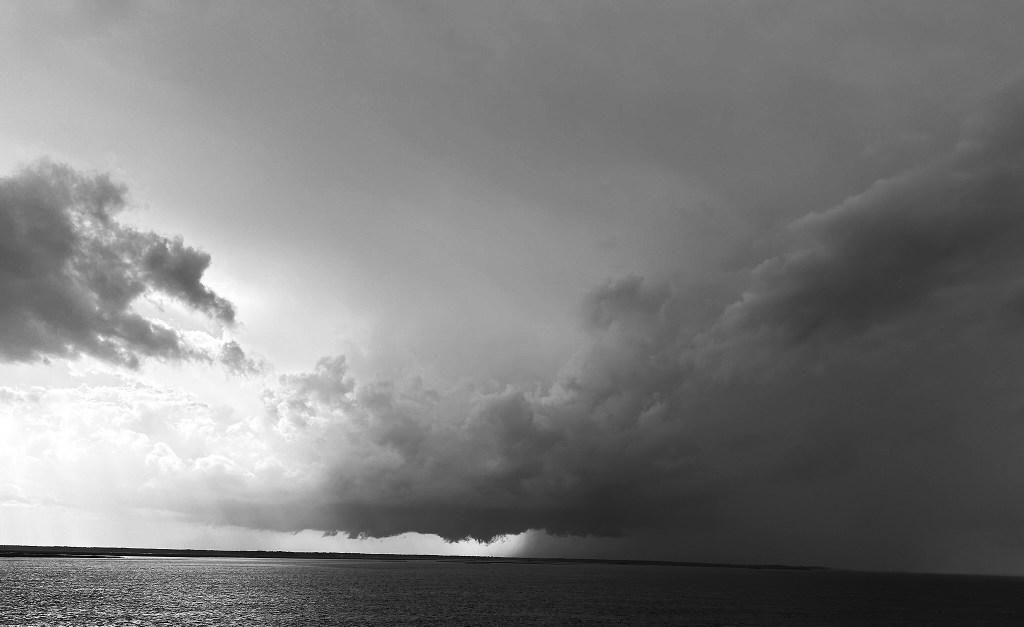
Storm clouds over Broad Creek from the Robert Smalls Bridge in Beaufort County, SC

I just heard a loon-call on a TV ad
and my body gave itself
a quite voluntary shudder,
as in the night in East Africa
I heard the immense barking cough
of a lion, so foreign and indifferent.

But the lion drifts away
and the loon stays close,
calling, as she did in my childhood,
in the cold rain a song
that tells the world of men
to keep its distance.

It isn’t the signal of another life
or the reminder of anything
except her call: still,
at this quiet point past midnight
the rain is the same rain
that fell so long ago, and the loon
says I’m seven years old again.

At the far ends of the lake
where no one lives or visits —
there are no roads to get there;
you take the watercourse way,
the quiet drip and drizzle
of oars, slight squeak of oarlock,
the bare feet can feel the cold water
move beneath the old wood boat.

At one end the lordly great blue herons
nest at the top of the white pine;
at the other end the loons,
just after daylight in cream-colored mist,
drifting with wails that begin as querulous,
rising then into the spheres in volume,
with lost or doomed angels imprisoned
within their breasts.

THE IDEA OF BALANCE IS TO BE FOUND IN HERONS AND LOONS, by JAMES HARRISON  

4.27.2025 – doesn’t matter that’s

doesn’t matter that’s
lying – people want the lie …
that’s the crucial point

In the article, How did Hitler’s film-maker hide her complicity from the world? by Eliza Apperly about a new documentary delves into controversial German film-maker Leni Riefenstahl’s private archive to uncover a director who spent a lifetime covering up her central role in the Nazi propaganda machine. Ms. Apperly closes her article with this paragraph.

Ultimately, however, Riefenstahl impresses most in attesting to the seductiveness of evasion. Veiel hopes that the film will above all foster a deeper understanding of “the structure and necessity of legends” and the breeding ground of untruths. Even when the gaps and inconsistencies in her storytelling seem flagrant, she still finds her advocates and supporters. “It doesn’t matter that she is obviously lying,” Veiel says. “People want the lie. That’s the crucial point.”

Read that last line again out loud.

“It doesn’t matter that she is obviously lying,” Veiel says. “People want the lie. That’s the crucial point.”

Not sure what to say about Ms. Riefenstahl as my jury has always been out on her anyway (I am reminded of the story of told when Fran Lebowitz one time was invited to a very small, intimate dinner party for Leni Riefenstahl and she replied, “Are you out of your mind?”, but for a comment for today.

For an answer to the question, How does HE get away with it?

It doesn’t matter that he is obviously lying.

People want the lie.

That’s the crucial point.

4.26.2025 – wondered why should be …

wondered why should be …
we are made for a bright world
but live in a dark one

He didn’t know it, but by then he was the very last knight of the Round Table still alive.

All the others were gone.

And when at last his time came, too, he lay down on a hot dry hill in the shade of an ancient silvery-leafed olive tree, alone except for his horse, and a single tiny perching bird that almost seemed to glow from within, as if it had swallowed a star, though it could just as easily have been a trick of the light. He looked up at the empty clouds, and as he died he wondered, not for the first time but for the very last, why it should be that we are made for a bright world, but live in a dark one.

The closing sentences of The Bright Sword : a Novel of King Arthur by Lev Grossman, New York] : Viking, 2024.

I love Arthur books.

Not so much the movies as no one really gets Arthur right because of the timing of it all.

As Mr. Grossman write in a note a the end of his book: “But the Arthur of our collective popular imagination comes primarily from versions of the story written a thousand years after that, in the high medieval period, by authors who weren’t much interested in historical rigor. A historically accurate sixth-century Briton wouldn’t have fought in plate armor, because there wasn’t any in Britain at that time. He wouldn’t have lived in England, because England didn’t exist yet—England is named after the Angles, one of those Germanic tribes Arthur was fighting so hard to keep out. Likewise he wouldn’t have competed in tournaments or lived in a castle, and if he did it definitely wouldn’t have been Camelot, which was also made up by Chrétien de Troyes in the twelfth century. He couldn’t have known Sir Palomides, because Palomides is a Muslim, and Muhammad wasn’t born till around the year 570. This Arthur—the Arthur of Malory and Tennyson, of T. H. White’s The Once and Future King and the musical Camelot—is a loose mash-up of a thousand-odd years of British history.

So Knights of the Round Table but no suits of armor …

Luckily its all fiction and disbelief is suspended anyway.

But I do enjoy the Arthur stories.

I especially like the ones were Lancelot comes off as a royal pain in the arse.

I like a little redemption of Guinevere and more mystery to Merlin.

And I have always liked a Nimue who is independent and can show the way home.

And I enjoy how writers stuggle to get Morgan le Fey into the story line.

From A Connecticut Yankee in King Arthur’s Court to Bernard Cornwell’s Arthur Trilogy, I read them all.

Of all them however, its Mr. Grossman’s Bright Sword that got me to think the most.

Not want to so too much as maybe some one will read it on there own.

If you do, let me know ur thoughts.

4.25.2025 – die with empty hands

die with empty hands
and empty pockets, but with
a very full heart

40 years ago, when I went through orientation as a new student in college, my advisor asked me what classes I planned to take outside of my major, US History.

I told him I hadn’t thought much about what else to take and that I didn’t really care.

He stared at me for a second and then kind of exploded, YOU ARE AT THE UNIVERSITY OF MICHIGAN – YOU HAVE THE OPPORTUNITY TO STUDY WITH ANY NUMBER OF GREAT SCHOLARS AND WORLD TOPICS … DON’T YOU DARE NOT CARE.

We sat for a minute in silence.

Me, I was scared to death.

He was most likely bored but he kept looking me in the eye.

He tried again and asked what I liked and somehow we got on the subject of art and I ended up with a minor in History of Art of the Renaissance.

And I have never regretted it.

The Professors and the lectures and even my co students in this field were all wonderful and they really loved what they were studying.

The lectures on the high Renaissance, when I would put away my pencil and just listen, were love stories.

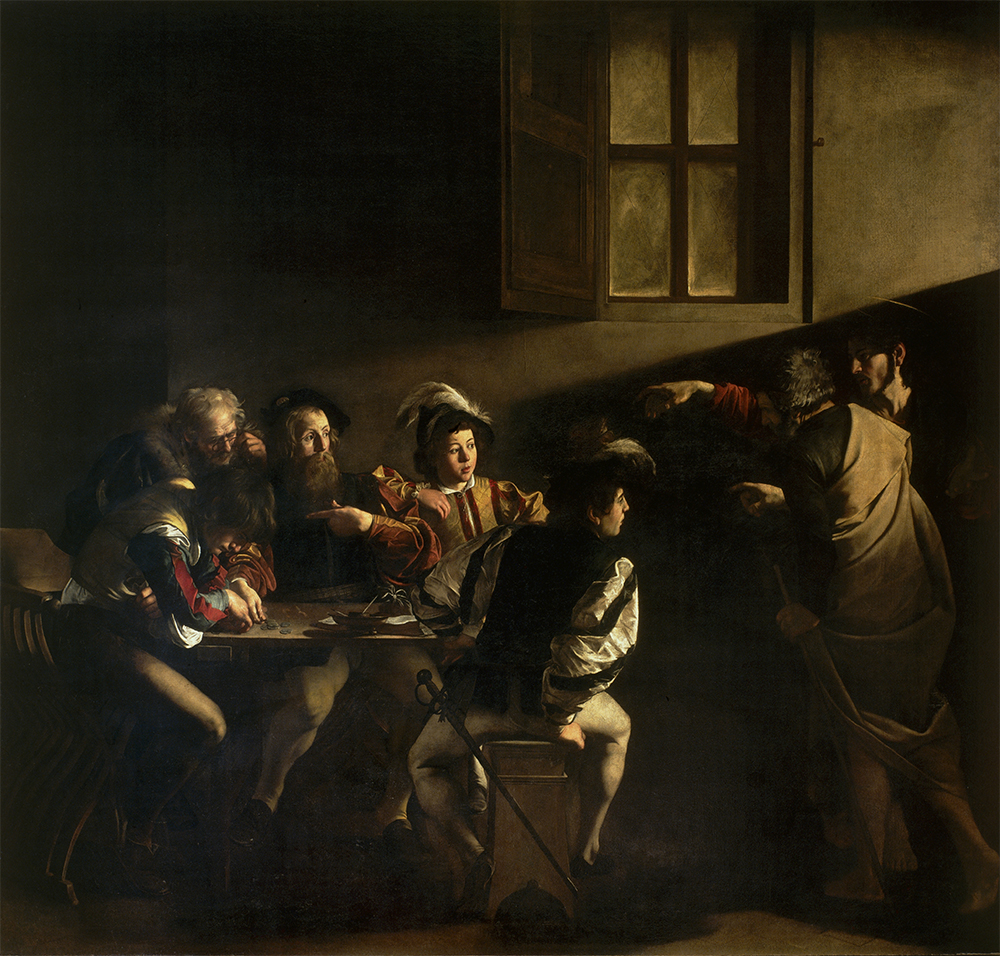
One professor spent a few weeks on the life and work of one Michelangelo Merisi da Caravaggio and the passion of the artist came through in the passion of the professor.

So it was with both some joy and some understanding that I came across the article, Piercing the Shadows of the Pope’s Favorite Painting by Jason Farago (April 24, 2025 – NYT).

Mr. Farago touched on the passion of the art of writing: In some of the grandest churches, Caravaggio endeavored to bring the saints and the angels down from the heavens to earth. But the naturalism had a function that went beyond popular accessibility. Because what matters, what makes Caravaggio so much more than an illustrator, is less the realism of the sacred image than its translation — through the bodies and faces of ordinary people — from the time of the Gospels to now. Into Caravaggio’s time. Into ours.

You could not study the art of Caravaggio with people who understood it and not have it all sink into your core.

Because, some how, it all mattered.

Mr. Farago then writes, quoting Pope Francis:

“Among the great painters, I admire Caravaggio; his paintings speak to me,” Francis said shortly after his election as pope.

During his trips to Rome when he was still the archbishop of Buenos Aires, Francis favored lodgings right near San Luigi dei Francesi. “Every time I came to Rome,” he later said during an address at St. Peter’s, he would seek out one painting in particular. It was the “Calling of St. Matthew,” in the church’s Contarelli Chapel.

“It is the gesture of Matthew that strikes me,” Francis said shortly after his elevation to the papacy. The instinctive lunge for the coins was one he saw in himself. “He holds on to his money as if to say, ‘No, not me! No, this money is mine.’”

You are comfortable, you’re not looking for it, but the calling comes just the same. “Here, this is me, a sinner on whom the Lord has turned his gaze,” the pope continued. “And this is what I said when they asked me if I would accept my election as pontiff.”

Lets say that again.

“It is the gesture of Matthew that strikes me,” Francis said shortly after his elevation to the papacy.

The instinctive lunge for the coins was one he saw in himself.

He holds on to his money as if to say, ‘No, not me! No, this money is mine.’

You are comfortable.

You’re not looking for it.

But the calling comes just the same.

I found this comment on another website and it fits in nicely.

Pope Francis on Matthew’s conversion story: “That day, when Matthew left his home, said goodbye to his wife, he never thought he was going to come back without money, and concerned about how to have such a big feast to prepare … for him who had loved him first, who had surprised Matthew with something very special, more important than all the money that he had.”

As God surprised Matthew, so would God’s surprises “shake the ground from under your feet and make you unsure. But they move us forward in the right direction. Real love leads you to spend yourself … even at the risk of having your hands empty.

He referred to St. Francis, his namesake, who “died with empty hands, empty pockets, but with a very full heart … Think well, feel well, do well. Be wise, allow yourselves to be surprised by the love of God.”

Die with empty hands.

Die with empty pockets, but die with with a very full heart …

Think well.

Feel well.

Do well.

Be wise.

Allow yourselves to be surprised by the love of God.