5.4.2025 – black hats tilted down

black hats tilted down
the rifle barrels sparkling
in the morning sun
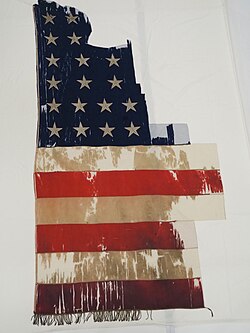
Flag of the 24th Michigan of the Iron Brigade – Regiment had 82% casualty rate at Gettysburg

As this brigade approached Gettysburg, Meredith or someone else ordered the flags uncased and set the fife-and-drum corps playing at the head of the column, and the Westerners fell into step and came swinging up the road, their black hats tilted down over their eyes, rifle barrels sparkling in the morning sun. There were eighteen hundred fighting men in this brigade, and the men were cocky. Officially they were the 1st Brigade of the 1st Division of the I Army Corps, and they figured that if the army were ever drawn up in one long line for inspection they would stand at the extreme right of it, which somehow was cause for pride. On the ridge to the west there was a crackle of small-arms fire and a steady crashing of cannon, with a long soiled cloud of smoke drifting up in the still morning air, and at the head of the column the drums and the fifes were loud—playing “The Girl I Left Behind Me,” probably, that perennial theme song of the Army of the Potomac, playing the Iron Brigade into its last great fight.

From The Army of the Potomac: Glory Road by Bruce Catton Doubleday & Company, New York, 1962

Like that master storyteller of Lincoln biography, Carl Sandburg, historian Bruce Catton passed his boyhood in a small Midwestern town, where he was entranced by the hypnotic yarns spun by elderly veterans of the Civil War. These men transfixed Catton, who listened as stories “out of the history books” came alive in the “flower-bed of Civil War veterans,” as he called his Northern Michigan home. Catton exulted: “They had been there”—and their reminiscences made him feel “as if the whole affair had taken place in the next county just a few years ago.” As a historian, Catton made his readers feel the same. Harold Holzer in the Wall Street Journal Book Reviews (Oct. 21, 2022).


5.3.2025 – be joyful in hope

be joyful in hope,
patient in affliction and
faithful in prayer

When you start your day with your tablet on the online Bible Gateway and the verse of the day is Romans 12:12, “Be joyful in hope, patient in affliction, faithful in prayer” and all I have to do is add the word ‘and’ to get to a 5 – 7- 5 syllable ratio (which I know is not the true definition of a haiku – see my section on ‘What is …’ ) it was too good to not use.

Be joyful in hope.

Patient in affliction.

Faithful in prayer.

In a time of oh-what-can-i-do-oh-what-can-i-do, it kind of sums it up.

As I already added an ‘and’ might I suggest to add a snippet from the Psalms?

Be joyful in hope.

Patient in affliction.

Faithful in prayer.

Be still, and know that I am God.

5.2.2025 – it is an earth song,

it is an earth song,
a body song, a spring song,
have been waiting long

It’s an earth song,—
And I’ve been waiting long for an earth song.
It’s a spring song,—
And I’ve been waiting long for a spring song.

Strong as the shoots of a new plant
Strong as the bursting of new buds
Strong as the coming of the first child from its mother’s womb.

It’s an earth song,
A body song,
A spring song,
I have been waiting long for this spring song.

Earth Song as printed in The collected poems of Langston Hughes by Langston Hughes (Knopf, News York, 1994).

Another sign of spring is kite guy on Hilton Head Island.

Shows up the first 2 weeks of May and spends his morning getting these kites into the air and then spends his afternoons taking them down and winding up the cords.

I used to wonder about kite guy’s outlook on life.

Who would spend their vacation flying kites?

I decided that when someone flies kites with the flag of The United States of America AND the flag of the Republic of Ukraine … and a flag with the peace symbol from the Vietnam War era … you can make some assumptions.

I am reminded of the spring concerts at my elementary school back in Grand Rapids, Michigan.

One year must of raised the level of conversation between school and parents when we sang songs like Bob Dylan’s Blowing in the Wind, John Denver’s Leaving on a Jet Plane and S&G’s 59th Street Bridge Song and If I Could (El cóndor pasa).

This would have at the height of the Hippie / Anti War era in America when several of my older brothers and sisters were off in college in Ann Arbor.

Not sure what was said and by who or to who.

But the next spring we sang nothing but songs from Disney and Let’s Go Fly a Kite sticks out as the song my class sang,

For the haiku, I had to edit Mr. Hughes and change it’s to it is to get my 5 – 7 – 5.

Such cheek on my part.

I should go fly a kite.

5.1.2025 – changes in our lives

changes in our lives
accidents, happenstances
the slightest pushes

It was the first truly important night of my life.

Despite my aching bones and blistered feet I sensed a possibility of strength, of a mission that drew solace and the chance of success or victory from the fire, from the dog, from my fellow human Fred, the night, the bright moon and stars, even the owl we were hearing intermittently.

This sounds vaguely absurd now but then so many changes in the direction of our lives come as a result of accidents, happenstances, the slightest pushes in any direction, and on the more negative side the girl you met at a gathering you didn’t want to attend who infected your life to the extent that the scar tissue will follow you into old age.

but then so many changes in the direction of our lives come as a result of accidents, happenstances, the slightest pushes in any direction

From True North by Jim Harrison ( Grove/Atlantic, New York, 2004)

So many changes in the direction of our lives come as a result of accidents, happenstances, the slightest pushes in any direction.

Then toss in the forward march of time.

Like the tide that twice a day comes in and sweeps the beach clean and leaves a clean slate wide open for accidents, happenstances or the slightest pushes in any direction.

All blank and wide open for changes that will infect your life to the extent that the scar tissue will follow you into old age.

Maybe this is where Jesus was going when mounted up on that hill side and sermonized saying, “Therefore do not worry about tomorrow, for tomorrow will worry about itself. Each day has enough trouble of its own.”

Trouble enough for each day that will infect your life to the extent that the scar tissue will follow you into old age.

4.30.2025 – parents had hard time

parents had hard time
convincing me he was no
kin whatsoever

I can remember that on the shelves at home there were these books by Thomas Wolfe.

Look Homeward Angel and Of Time and the River. Of Time and the River had just come out when I was aware of his name.

My parents had a hard time convincing me that he was no kin whatsoever.

My attitude was, Well, what’s he doing on the shelf then?

But as soon as I was old enough I became a tremendous fan of Thomas Wolfe and remain so to this day.

I ignore his fluctuations on the literary stock market.

From Tom Wolfe, The Art of Fiction No. 123 as Interviewed by George Plimpton, The Paris Review, Issue 118, Spring 1991.

Myself, I long confused Thomas Wolfe and Tom Wolfe.

I always thought is was the guy who wrote The Right Stuff who said you can’t go home again.

And I am not sure when it was that I got straightened out.

Even when I started working in a bookstore I wasn’t completely sure until I shelved The Right Stuff in New Releases and Look Homeward Angel in classics.

Then I got Thomas Wolfe mixed up with Thomas Mann and I seem to be forever paying for not taking a 100 best books class in college.

I always enjoyed Tom Wolfe’s writing.

I was always a bit amazed listening to his interviews and wondering how he survived long enough to write.