Down and out semi poet who is down and out in the Low Country of South Carolina after living in Atlanta which is not to be confused with the south, the old south or the new south. Atlanta was a global metropolis with all the pluses and minuses that comes with that. The low country, low because it is low, 8 feet above sea level, is not Podunk but once you get to Podunk, turn left. I try to chronicle a small part of all that through my daily haiku for you.
seemed to me those times been infinitely precious summers worth saving
It seemed to me, as I kept remembering all this, that those times and those summers had been infinitely precious and worth saving. There had been jollity and peace and goodness. — “
Once More to the Lake,” August 1941; Essays of E. B. White, p. 200.
people determined correct what perceive to be injustice, error
Now, some 180-odd years later, we can say that the proof of the pudding is in the eating.
We’ve made it.
And not because we have not come through some rough, indeed perilous, times.
The history of each of the amendments to the Constitution, including the first ten, our Bill of Rights, is invariably the story of a self-governing people determined to correct what they perceive to be injustice and error.
In fact, one might say that each amendment added to the Constitution was an attempt of the American people to expand and extend the blessings of self-government and its manifold benefits to an ever-wider circle of our citizenry.
John Henry Faulk wrote that back during the Watergate Era.
He wrote:
“… the office is invariably bigger, more important, and a lot more permanent than the officeholder.
The powers that go with the highest office in the land, the presidency, are awesome indeed.
But they belong to the people, all the people, still.
The man who holds that office and forgets whom those powers really belong to does so at his own peril.
As we have seen.”
What Mr. Faulk would have made of what is going on now is interesting to ponder.
Yet all I can come up with is that I understand why the Children of Israel “By the rivers of Babylon, there we sat down, yea, we wept, When we remembered Zion.“
During Watergate, Mr. Faulk wrote, “Now what’s causing all the confusion?
Why, the fact that we’ve got a prominent citizen, a man that has held the highest office in the land, suspected of some felony crimes.
But, he’s so prominent and held such a respected office, that we don’t know whether he even ought to be indicted, let alone made to stand trial.
More than that, it’s going to hurt a lot of people’s feelings if he is put through the wringer.
It’s going to hurt a lot of folks’ feelings if he ain’t.”
And that was all based on Watergate.
As Former President Obama said of Mr. Trump and the battle of the birth certificate, “Remember when we thought that was as crazy as he would get?”
It all reminds of something else Mr. Faulk wrote in his Pear Orchard series:
… you know, that there worries me a heap. By God, it seems that people don’t quite know what it’s all about no more. Them that talks loudest is the ones that seem to know the least.
All quotes from The uncensored John Henry Faulk by John Henry Faulk, 1985, Austin, Tex., Texas Monthly Press.
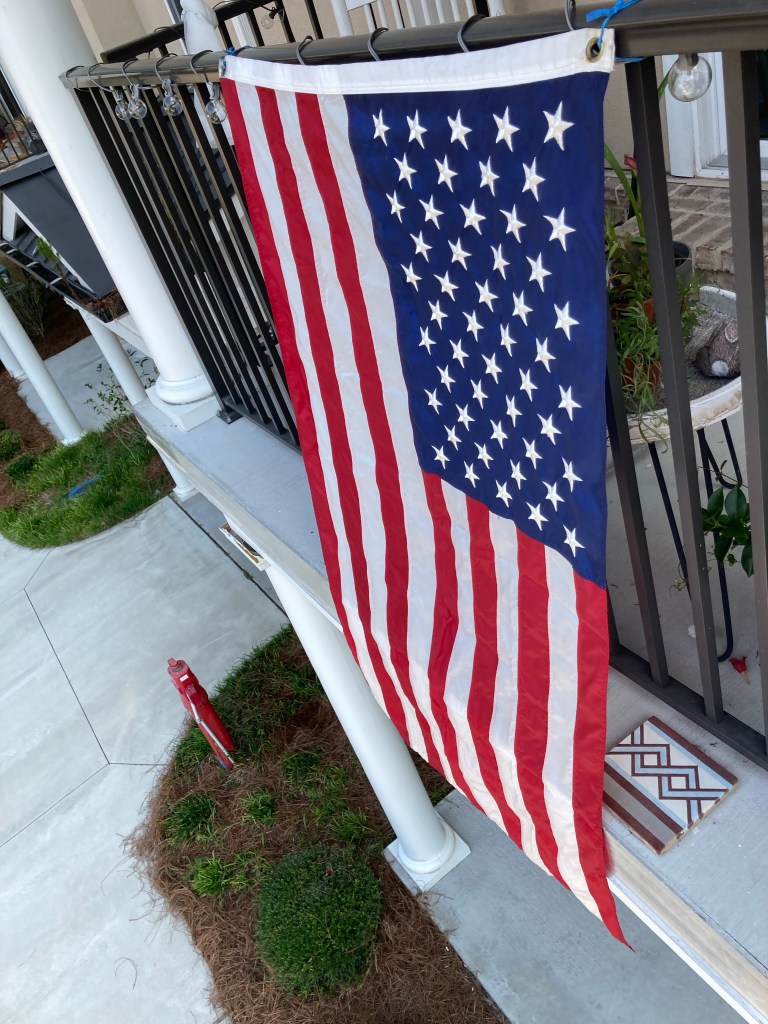
This is the flag I ordered through the office of Congressman John Lewis before he died.
I have a certificate that the flag once flew over the Capitol Building of the United States of America.
It used to mean a lot around the world.
… used to.
It used to stand for an American people eager to expand and extend the blessings of self-government and its manifold benefits to an ever-wider circle of our citizenry.
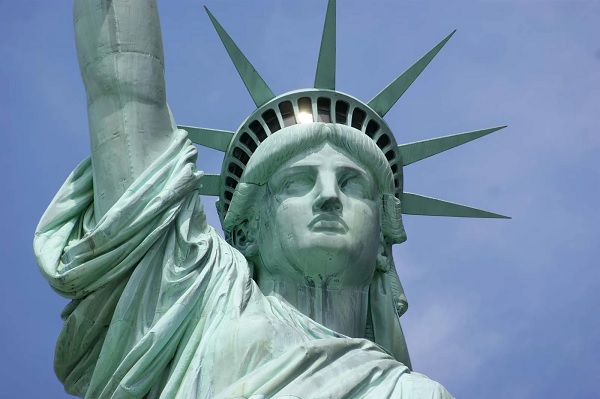
send these, the homeless, tempest-tost to me, lift lamp beside golden door
Not like the brazen giant of Greek fame, With conquering limbs astride from land to land; Here at our sea-washed, sunset gates shall stand A mighty woman with a torch, whose flame Is the imprisoned lightning, and her name Mother of Exiles. From her beacon-hand Glows world-wide welcome; her mild eyes command The air-bridged harbor that twin cities frame. “Keep, ancient lands, your storied pomp!” cries she With silent lips. “Give me your tired, your poor, Your huddled masses yearning to breathe free, The wretched refuse of your teeming shore. Send these, the homeless, tempest-tost to me, I lift my lamp beside the golden door
Emma Lazarus (July 22, 1849 – November 19, 1887) was an American author of poetry, prose, and translations, as well as an activist for Jewish and Georgist causes. She is remembered for writing the sonnet “The New Colossus”, which was inspired by the Statue of Liberty, in 1883.
The above is from Wikipedia.
The words are still a part of the mythology of America.
I hope this myth dies hard but so many seem to want it.
That’s the whole point of this blog and these haiku.
To point out the wonderful word combinations that real writers accomplish in print and bring to the attention of my vast audience.
I don’t like to change the original word order of anyone’s work.
I especially don’t like to change the original word order just to make in my American grammar school haiku rhythm of 5 – 7 – 5 syllables (and yes I have read all the arguments about this and that Japanese sound patterns and English syllables are not necessarily equivalent but its my blog my rules and my rules say a haiku, for the purpose of this blog, follows the 5 -7 -5 pattern so there) but I did in this case and the change made quite the impact.
Mr. Harrison wrote: Of course we are loaned this life, then suddenly one day it’s overdue.
Which, due to the 5 – 7 – 5 rule, I hammered into:
of course we are loaned this life then suddenly it’s one day overdue
In a way, I liked that.
I like that a lot.
Suddenly, it’s one day overdue.
Overdue or just one day overdue, when we are talking about the loan of life is the same and yet it isn’t.
Just one day …
Can I have just one day more …
One more day …
Just one day or not, life has no amnesty day or forgiveness policy.
I have to wonder if Mr. Harrison would have liked and I can say, with pretty much solid confidence, he would NOT.
Famously he refused to talk to an editor for years who dared edit something he wrote.
With that in mind, I stayed with the phrase and worked it into:
Of course we are loaned this life, suddenly one day it is overdue
gaudiness, humor the fiery delectations bursting in the sky
Chairman Bunsen loved the Fourth, he relished it, the booming, the chatter, the smell of cooking fires, the gaudiness, the good humor, the fiery delectations bursting in the sky, and he was happy to expand on this if you questioned the lavishness of it.
From Liberty by Garrison Keillor, Viking, (September 16, 2008),

 No Haiku For You