8.19.2023 – but cannot in good

but cannot in good
conscience support candidate
unworthy unfit

I shall continue to affiliate with the Republican Party, but I cannot in good conscience support for President a candidate who was not the real choice of his party and whom I regard as unworthy and unfit to be the Chief Executive of this nation by the tests of ability, public policies, official record and independence of character.”

The above quote from Illinois Politician Harold Ickes appeared in the New York Times today, but 103 years ago in the article, H.L. ICKES DESERTS HARDING AS ‘UNFIT’. (NYT, August 19, 1920)

103 years ago, political parties were pushing candidates unworthy and unfit to be the Chief Executive.

Mr. Ickes was talking about Warren Gamaliel Harding, who had just been nominated by the Republican party for their candidate for President of the United States at the 1920 convention.

Mr. Ickes would later go one to serve as United States Secretary of the Interior for nearly 13 years from 1933 to 1946 under Franklin Roosevelt and Harry S Truman.

The 1920 Republican convention was the one that made the term ‘smoke filled rooms’ famous.

The convention took 10 ballots to nominate Mr. Harding, who according to legend, was called into a meeting with the Party Bosses, in a smoke filled room and the Party Bosses asked Mr. Harding if there was anything … ANYTHING … in his background that might cause problems if he was nominated.

Mr. Harding, according to that legend, asked for 1 hour to think about it and came back and said nope, nothing in my background.

About Mr. Harding’s acceptance speech, Mr. Ickes said, “He proclaims himself a reactionary. He would turn back the hands of the clock and satisfy the aspirations of men’s souls by talking of a full stomach. No more uninspired and uninspiring utterance from a public man is on record in American political history.”

You remember Mr. Harding?

Even he himself felt the he was in over his head as President.

President Harding once said, “Somewhere there must be a book that tells all about it, where I could go to straighten it out in my mind.

But I don’t know where the book is, and maybe I couldn’t read it if I found it!

There must be a man in the country somewhere who could weigh both sides and know the truth. Probably he is in some college or other.

But I don’t know where to find him. I don’t know who he is, and I don’t know how to get him.

My God, this is a hell of a place for a man like me to be!”
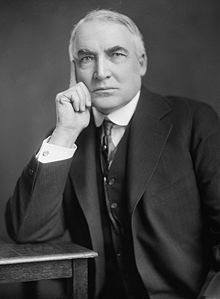
According to Wikipedia, “In 1923, Harding died of a heart attack in San Francisco while on a western tour, and was succeeded by Vice President Calvin Coolidge.

Harding died as one of the most popular presidents in history, but the subsequent exposure of scandals eroded his popular regard, as did revelations of extramarital affairs. Harding’s interior secretary, Albert B. Fall, and his attorney general, Harry Daugherty, were each later tried for corruption in office. Fall was convicted though Daugherty was not. These trials greatly damaged Harding’s posthumous reputation. In historical rankings of the U.S. presidents during the decades after his term in office, Harding was often rated among the worst.

We, as a country, are once again in a cycle where the election mantra might be I cannot in good conscience support for President a candidate whom I regard as unworthy and unfit to be the Chief Executive.

Seems like folks who should be saying this, are not saying this.

For us and this country, my God, this is a hell of a place for us to be!

8.18.2023 – it looks so easy

it looks so easy
have to remind self that they
make it look easy

I betcha that readers think I am going to tell some sort of sports based story along the lines of one Sunday afternoon in a park in Ann Arbor back when I was in college, I was playing in a pick up football game with my buddies and with the sun setting behind us as we ran a play, I looked back to the quarterback only to lose everything in the sun EXCEPT for the football, which he threw to me in a straight line with the Sun so that all I saw was a bright orange backdrop with black dot of the ball perfectly eclipsing the Sun coming right at me and I held out my arms and the ball literally slid into my hands as I was running at top speed and I turned and ran all in the same motion and scored a touchdown.

It was the best pass-catch play of my life.

It was so good, that everyone on the field had to stop and watch and then applaud.

I was pretty proud of it myself.

I made it look easy.

Walking home we cut across the athletic campus and out on one of the practice fields was a couple of Michigan football players.

We were tossing our ball around and it got away and rolled out on the field and I raised my arm and called out, l’il help??

One those players nodded, picked up our ball and with a flick of his wrist, tossed it back to me.

I mean, that’s what it looked like but somehow it was like he fired a bullet at me.

The ball came at in a blur and I held out my hands, not to catch it, but to fend it off.

It smacked my hand and it felt like it took my arm off at the shoulder.

Ouch, Ouch, OUCH! I thought but at loud I yelled “THANKS” as best I could.

Any thought of my great play faded in the light of this one little toss.

This one little toss at the major college sports level.

They make it look so easy.

But I am not going to tell you that story.

What reminded me of how folks can make things look so easy was an odd video clip I found online.

I was searching for a piece of music by Mr. Johann Sebastian Bach and very much by accident clicked on this other link.

Before I go any further we have to enter the world of suspended disbelief.

Now safely within those confines, this video is kind of the old MTV music videos that tells a story around the playing of a piece of rock and roll music.

In this case though, the piece of music is the the aria Kommt, ihr angefocht’nen Sünder from Mr. Bach’s Cantata No.30 “Freue dich, erlöste Schar.

The story told by the video, there is no dialogue, is that Mr. Back planned for the aria to be song by his 11 year old son, Wilhelm Friedemann Bach.

Wilhelm discovers that the Bach family maid has an incredible voice and he knows that women are not allowed to sing in Church at time.

Young Willie fakes a sore throat and talks the maid into singing behind him in the choir while he lip syncs knowing full well that his Dad (Mr. Bach) will see through the charade and find out who is singing.

Got it?

Remember we are in the world of suspended disbelief.

And I watched this unfold with a mixture of disbelief and unadulterated pleasure.

First off the movie making itself of this little bit of movie, the camera work, the lighting, the pacing is all really really good.

I mean really really good.

Then the piece of music selected, the aria, which I have never heard of, the music itself, is so effortlessly effortless as are the musicians.

Then there is the voice of the soloist.

Turns out she is a mezzo-soprano named Magdalena Kožená.

Never heard of her.

Wish I had.

Remember we are in the world of suspended disbelief.

The video of her of her singing in character as the maid, again so effortlessly effortless is charming.

In the magic of the world we are in, she just lets the music out as if she wasn’t singing, but as if these sounds were captured inside her.

All in all, this little clip gives a 5 minute escape from the real world to the world of suspended disbelief.

There are days when I would call this gift priceless.

Taken together, the whole package, the music, the performance, the video, all in 5 minutes, all looks so easy, as if any one could have produced it.

They made it all look so easy.

And here is my mystery?

Where did it come from?

Is a clip from another, longer movie?

Is this the entire piece?

I began searching the World Wide Web.

The clip itself is on YouTube in at least three versions.

It is in the Youtube comments that I have been able to get any information.

One comment from 2016 said, “Skvělý režijní nápad Ondřeje Havelky propojil Bachovu kantátu s uvěřitelným příběhem o tom, jak ženy pronikly na kostelní kůry. Výborný představitel J.S. Bacha, životní role 🙂 A samozřejmě úžasná Magdalena – a to má ten klip už skoro dvacet let …”

Thank goodness the GOOGLE TRANSLATE now comes with Language Detection and the Google detected Czech and translated this as:

Ondřej Havelka’s brilliant directorial idea connected Bach’s cantata with a believable story about how women infiltrated church choirs. The excellent representative of J.S. Wow, the role of a lifetime 🙂 And of course the wonderful Magdalena – and that clip has been around for almost twenty years…

So this clip was made maybe back in 1996?

It was in another comment that I came across this information.

If anyone wants to own this video on a DVD, or if you wonder if this is a part of a larger video or movie, it seems that this is simply a short ‘music video’ that is available (officially) only as an ‘Easter egg’ on the 2-CD set titled, “Magdelena Kozena – Enchantment”, Deutsche Grammophon #00289 477 6153. It is a hidden MPEG video file on the first of the two CDs, and in order to access it, you must use your computer (not a regular CD or DVD player).

No kidding.

So …

All that work.

All that effortlessly effortless effort to create, produce and record this little video was all … just for … fun.

It all looks so easy.

What was going through folks head when at a production meeting, someone raised their hand and said, You know what would be neat? If we …

I am not so stupid as to think that this video was not created with a purpose in mind but in the end …

Still …

If you bought this CD, then put the CD in your computer to play and instead of playing the cd, but looked at the files in Windows File Manager and you saw this video file and you clicked on it, all by chance, you got to see this video.

There is something widely satisfying about that.

Charming.

I think Mr. Bach would have loved this.

I have to ask.

What else is out there.

(If the player below doesn’t work – click here.)

8.17.2023 – cooking is something

cooking is something
that we human beings are
uniquely good at

I was refreshed to read the article, ‘AI cannot taste the way a chef can’: are chatbots a threat to fine dining? in the Guardian on Aug 16, 2023.

The article quotes tech entrepreneur Nikhil Abraham as saying, “AI will always be playing catch-up with human creativity, and the humans who are at the edge of creativity will always outsmart AI and have experiences that are more valuable.”

I don’t worry so much about AI so long as I can unplug my computer.

I hold that at least once a week you should unplug you computer and wave the end of the cord in front of your monitor.

To enlarge the scale on this theme, I bring up the story of the small town in North Carolina that lost power for several days when some nut put a bullet through some piece of equipment at a substation.

I hope AI remembers this story.

Maybe it does.

Maybe it does and someday it will design its own computer housing to be indestructible.

There is this story from back in the ’60s when some University Professors toured the at-that-time leader in computers for public use, Texas Instruments.

The Professors were looking for computers for their schools and they were shown the latest developments in machines that most likely had about 5000 bytes (5k) of memory and were cutting edge for their time.

According to the story, one of the Professors noticed this giant stainless steal box in a corner and asked what that was for?

The company tour guide said that was the computer housing they were developing for the Navy.

It had to be able to survive a missile attack the tour guide pointed out.

The Professors looked at the steel box then said, “That’s what we want!”

The tour guide looked at them and asked if they were expecting a missile attack?

“No”, said the Professors, “… grad students!”

And so was born the idea that any computer housing had to have at least 17 screws in it until Apple came along with their twist-and-pull to open box around 2005.

The point here is the human competent.

Those darn grad students wanted to get in there to see how the darn thing worked.

Those darn humans who, at the edge of creativity, will always outsmart AI and have experiences that are more valuable.

And cooking is where AI will lose.

As the article says:

“… robots and software can’t replicate what a chef does, even if you can codify a recipe. Like, an eggplant is smaller or larger than before, the fire is a smidge hotter than the last time I cooked.” When chefs create and execute a dish, they’re using all their senses, plus intuition. And as of now, AI doesn’t have senses of its own.

I guess I could be worried about that … as of now … but, as of now, I am not.

The article ends with this line.

AI cannot taste in the way a chef can.

Even if you’re repeatedly using the same ingredient, let’s say a piece of fruit, AI cannot account for ripeness, sweetness, texture.

Thinking of the human competent and the role of the chef in the statement AI cannot taste in the way a chef can, I though to that wonderful George Orwell book, Down and Out in Paris and London.

Mr. Orwell, needing employment, worked in the kitchens of Hotel X though tradition has it that he worked at Maxim’s, a landmark restaurant to THIS DAY in Paris..

Back in 1933, Mr. Orwell wrote this about Chefs and dining in a restaurant.

It is not a figure of speech, it is a mere statement of fact to say that a French cook will spit in the soup — that is, if he is not going to drink it himself.

He is an artist, but his art is not cleanliness.

To a certain extent he is even dirty because he is an artist, for food, to look smart, needs dirty treatment.

When a steak, for instance, is brought up for the head cook’s inspection, he does not handle it with a fork.

He picks it up in his fingers and slaps it down, runs his thumb round the dish and licks it to taste the gravy, runs it round and licks it again, then steps back and contemplates the piece of meat like an artist judging a picture, then presses it lovingly into place with his fat, pink fingers, every one of which he has licked a hundred times that morning.

When he is satisfied, he takes a cloth and wipes his fingerprints from the dish, and hands it to the waiter.

And the waiter, of course, dips his fingers into the gravy — his nasty, greasy fingers which he is for ever running through his brilliantined hair.

Whenever one pays more than, say, ten francs for a dish of meat in Paris, one may be certain that it has been fingered in this manner.

In very cheap restaurants it is different; there, the same trouble is not taken over the food, and it is just forked out of the pan and flung onto a plate, without handling.

Roughly speaking, the more one pays for food, the more sweat and spittle one is obliged to eat with it.

Hmmmmmmmmmmmmmmm.

Maybe this AI in the kitchen deserves a second look.

Post Script: Pictured above is Chef Paul Bocuse, named tje best chef of the Century in the 1900s, renowned for recipes like Poularde de Bresse au riz sauce supréme or Rable de liévre a la créme and Oeufs durs aux oignons dits a la tripe. I ran across an interview with him on YouTube where he was asked when was the best time to be a chef?

1946 – 1947!” he answered, “Right after the war …. People ate everything!

8.16.2023 – the country wants a

the country wants a
candidate can’t be injured
by past history

Adapted from the line:

What the country wants is a candidate who cannot be injured by investigation of his past history, so that the enemies of the party will be unable to rake up anything against him that nobody ever heard of before. If you know the worst about a candidate, to begin with, every attempt to spring things on him will be checkmated.

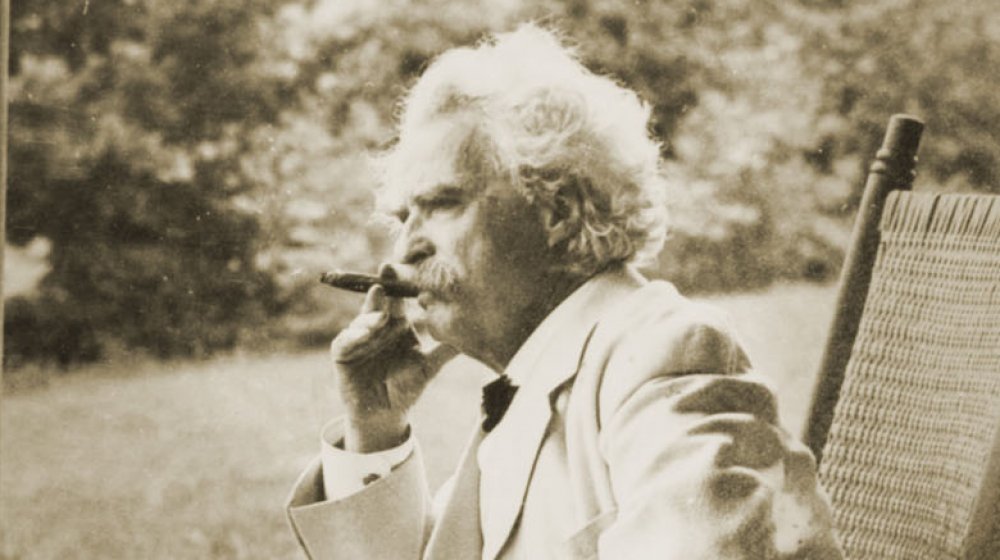
In the short story, Mark Twain as a Presidential Candidate, by Mark Twain.

Mr. Twain ends with this, “But I recommend myself as a safe man — a man who starts from the basis of total depravity and proposes to be fiendish to the last.”

Here is the short short story, first published in 1879.

Mark Twain as a Presidential Candidate.

I have pretty much made up my mind to run for President. What the country wants is a candidate who cannot be injured by investigation of his past history, so that the enemies of the party will be unable to rake up anything against him that nobody ever heard of before. If you know the worst about a candidate, to begin with, every attempt to spring things on him will be checkmated.

Now I am going to enter the field with an open record. I am going to own up in advance to all the wickedness I have done, and if any Congressional committee is disposed to prowl around my biography in the hope of discovering any dark and deadly deed that I have secreted, why — let it prowl.

In the first place, I admit that I treed a rheumatic grandfather of mine in the winter of 1850. He was old and inexpert in climbing trees, but with the heartless brutality that is characteristic of me I ran him out of the front door in his night shirt at the point of a shotgun, and caused him to bowl up a maple tree, where he remained all night, while I emptied shot into his legs. I did this because he snored. I will do it again if I ever have another grandfather. I am as inhuman now as I was in 1850.

I candidly acknowledge that I ran away at the battle of Gettysburg. My friends have tried to smooth over this fact by asserting that I did so for the purpose of imitating Washington, who went into the woods at Valley Forge for the purpose of saying his prayers. It was a miserable subterfuge. I struck out in a straight line for the Tropic of Cancer because I was scared. I wanted my country saved, but I preferred to have somebody else save it. I entertain that preference yet. If the bubble reputation can be obtained only at the cannon’s mouth, I am willing to go there for it, provided the cannon is empty. If it is loaded my immortal and inflexible purpose is to get over the fence and go home. My invariable practice in war has been to bring out of every fight two-thirds more men than when I went in. This seems to me to be Napoleonic in its grandeur.

My financial views are of the most decided character, but they are not likely, perhaps, to increase my popularity with the advocates of inflation. I do not insist upon the special supremacy of rag money or hard money. The great fundamental principle of my life is to take any kind I can get.

The rumor that I buried a dead aunt under my grapevine was correct. The vine needed fertilizing, my aunt had to be buried, and I dedicated her to this high purpose. Does that unfit me for the Presidency? The Constitution of our country does not say so. No other citizen was ever considered unworthy of this office because he enriched his grapevines with his dead relatives. Why should I be selected as the first victim of an absurd prejudice?

I admit also that I am not a friend of the poor man. I regard the poor man, in his present condition, as so much wasted raw material. Cut up and properly canned, he might be made useful to fatten the natives of the cannibal islands and to improve our export trade with that region. I shall recommend legislation upon the subject in my first message. My campaign cry will be: “Desiccate the poor workingman; stuff him into sausages.”

These are about the worst parts of my record. On them I come before the country. If my country don’t want me, I will go back again. But I recommend myself as a safe man—a man who starts from the basis of total depravity and proposes to be fiendish to the last.

What would Mr. Twain made of the political scene of today?

As he put it, in a conversation between the King and the Duke in the book, The Adventures of Huckleberry Finn … “Hain’t we got all the fools in town on our side? And ain’t that a big enough majority in any town?

That more or less sum’s up us voters and the government we elect.

As for the folks who run for office?

As Huckleberry Finn said, “… I wouldn’t approve of it, nor I wouldn’t stand by and see the rules broke — because right is right, and wrong is wrong, and a body ain’t got no business doing wrong when he ain’t ignorant and knows better.”

I am reminded of a Saturday Night Live bit with Will Ferrell as George W. Bush who summed up finding the right person to be President saying, “Running a government is kind of like driving a school bus: 

You don’t want a crazy person driving that bus.

You want a simple, underachieving, not very educated but reliable guy behind that wheel.

Someone with a steady hand who will be on time and get into one or two but no more than four accidents a year,”

Sounds about right.

But who wants to be a school bus driver these days?

8.15.2023 – matters not only

matters not only
what you see, but how and with
what eyes you see it

Non tantum quid videas, sed quemadmodum, refert; animus noster ad vera perspicienda caligat.

So wrote Lucius Annaeus Seneca the Younger, usually known mononymously as Seneca, who was, according to wikipedia, a Stoic philosopher of Ancient Rome, a statesman, dramatist, and in one work, satirist, from the post-Augustan age of Latin literature.

Neither here nor there but one day I am going to establish a mononymous hall of fame for all those folks known for just their first name. I digress but I have to point out that having a really good first name gets you off to good start. I mean Elvis means Elvis and he left the building a long time ago but does Michael mean Michael Jackson or Michael Jordan.

Anyway, back to Non tantum quid videas, sed quemadmodum, refert; animus noster ad vera perspicienda caligat.

This is a line from the Ad Lucilium epistulae morales also known as the Moral Epistles and Letters from a Stoic, a collection of 124 letters that Mr. Seneca wrote at the end of his life.

Seneca was one of those fellers who was motivated to write down things that could be repeated as maxims or rules for one self to make one self a better person.

I think it is too much to say that he was writing the Hallmark Cards of his era and I don’t want to say that but once I thought it, I had to say it.

Maybe its because so many thoughtful quotes from Seneca end up on T shirts and coffee mugs though no one has a clue to why it was said or who said it in the first place.

I mean if someone touched a hot stove and then said, once burned twice shy, you would understand how that someone came to understand that once touching a hot stove and getting burned, you would think twice about touching a hot stove.

Unless, like the feller in the story told by Minnie Pearl who dropped a red hot horseshoe.

Ms. Pearl quoted the blacksmith as saying to the feller, ‘Burned you! Didn’t it!

“No,” says the feller, “It don’t take me long to look at a horseshoe.”

But Non tantum quid videas, sed quemadmodum, refert; animus noster ad vera perspicienda caligat?

According to the  1930 Harvard University Press translation of the Epistulae Morales, it means:

It matters not only what you see,

but with what eyes you see it;

our souls are too dull of vision to perceive the truth.”

Which is good.

However I put that Latin into the google translator and I got, It matters not so much what you see, but how; our mind is clouded to see the truth.

I like that.

It matters not so much what you see, but how.

Our mind is clouded to see the truth.

On the one hand, this can touch on what I wrote about yesterday that most folks have already made up their mind and what they see is what they want to see.

Maybe that is the why are souls are too dull of vision and our mind is clouded to truth.

On the other hand, maybe this was the point that the teacher character in the movie Dead Poets Society was after (played by Robin Williams) when he had his class stand on their desks just to see something from a different angle.

I thought that was a weird sad movie (less than half the class climbs up on their desks in the final scene) but it had an impact on me.

You want to raise other people’s awareness, try running through an office by jumping from desk to desk.

The times I did that, boy oh boy, did people have a new way how they looked at life, even if just for a minute.

It matters not so much what you see, but how.

One person sees the glass half full.

The other person sees the glass half empty.

I see a glass and I say, ohhhhhhhhhhhhhhhh man, when does it tip over?

The picture above?

It’s a small sculpture just up the street from the original sculpture that is big, bright red and three stories high in downtown Grand Rapids, Michigan, where I grew up.

The big sculpture is known as ‘The Calder.’

The little version has a special name.

It is known as ‘The Calder … for the Blind.

It matters not so much what you see, but how.