Down and out semi poet who is down and out in the Low Country of South Carolina after living in Atlanta which is not to be confused with the south, the old south or the new south. Atlanta was a global metropolis with all the pluses and minuses that comes with that. The low country, low because it is low, 8 feet above sea level, is not Podunk but once you get to Podunk, turn left. I try to chronicle a small part of all that through my daily haiku for you.
will never increase danger zone by giving way … very logical
Deep down, my unspoked but dreamed day-dream is to earn a Commercial Pilot’s license and someday work for a Dolphin Tour Boat company and spend my time out on the water with someone else supplying the boat and the fuel.
To that end, I picked up a copy of the famous Chapmen Piloting book of Seamanship and Boat Handling.
(for $1 at the Friends of the Library Book Sale)
I am enjoying it a lot.
I am intrigued as well as there is a lot of basic commonsense that seems to be assumed to be present in the mind of anyone who is thinking about being out on the water.
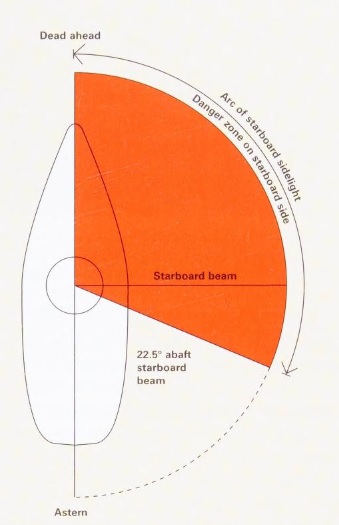
Notice this short section on piloting in the “Danger Zone.”
A power-driven vessel of any size has a so called “danger zone” from dead ahead to 22.5° abaft its starboard beam. It must give way to any crossing vessel that approaches within this zone.
The “danger zone” is a concept implicit in the Navigation Rules and should be firmly understood by every boater.
Note that the danger zone of the give-way vessel has the same arc of visibility as its green sidelight. Thus the stand-on vessel sees a “go” light from the other vessel. Conversely, the give-way vessel sees the red (“stop”) light of the stand-on vessel — a very logical situation!
You have to love the lovely choice of language!
a concept implicit in the Navigation Rules
should be firmly understood by every boater
— a very logical situation!
The Danger Zone Section of the bok is a small quarter page with a red background to make it stand out.
Know the rules!
Know your boat!
It’s a very logical situation that should be should be firmly understood as the concept is implicit in the rules.
Why does this expectation sound so wonderful in A WORLD GONE CRAZY!
So simple and yet so flat out, hey this is the way it is and if you don’t get it, get your butt off the water dumhead!
A simple expectation that you and other people will be using some smart out there in the world.
Yet, the folks who wrote the Chapman Piloting book also live in the REAL WORLD.
In italics at the bottom of the red block information on the Danger Zone is this caveat.
(Remember how in the book Gone With the Wind, Rhett told Scarlett to name her store the CAVEAT EMPTORIAM and Scarlett had the sign all set to go and then Ashely told her what it meant … but I digress)
As I was saying, at the bottom of the section is this little but of advice.
After saying the concept of the Danger Zone was implicit …
After saying the concept of the Danger Zone was fully understood …
After saying the concept of the Danger Zone was very logical …
The authors then state:
There may be situations in which a boat does not have right of way (such as river-crossing and overtaking), but assuming that you have the freedom to maneuver safely, you will never increase the danger of collision by giving way to a boat in this zone.
Even with all that being said, know that person in the other boat may not be logical or fully understand the danger zone.
Remember, no one ever increased the danger of a collision …
BY GETTING OUT OF THE WAY.
Rare advice that can be applied in too many places today.
As John Ronald Reuel Tolkien once wrote, “It does not do to leave a live dragon out of your calculations, if you live near him.”
Dragons, other dumb boaters and, well, just plain folks.
after years almost innocuous desuetude and put in the way
Sorry this is really hammered into place, but I just had to get innocuous desuetude into a haiku.
The words come from a speech by Grover Cleveland in a special message to congress on March 1, 1886, when he said:
And so it happens that after an existence of nearly twenty years of almost innocuous desuetude these laws are brought forth–apparently the repealed as well as the unrepealed–and put in the way of an Executive who is willing, if permitted, to attempt an improvement in the methods of administration.
As I understand President Cleveland was speaking out on the Tenure of Office act that had been passed to make it illegal for a President to fire a Cabinet Officer.
The whole thing had been arranged to get President Andrew Johnson if he dared fire Secretary of War Edwin Stanton (This was the 1st President Johnson having taken office after Mr. Lincoln was shot just as the 2nd President Johnson took office after Mr. Kennedy was shot – Lesson: DO NOT HAVE A VICE PRESIDENT NAMED JOHNSON) and when the 1St Johnson DID fire the Secretary of War, he was impeached under the Tenure of Office act.
The impeachment failed in the Senate by 1 vote.
It wasn’t until Mr. Clinton got caught not-having-sex with an intern in the Oval Office was another President impeached.
And no one ever ever thought any President would be impeached twice but there you go.
So anyway, I guess some folks, 20 years after the 1st President Johnson, came after Mr. Cleveland because of the Tenure of Office act.
A law that Mr. Cleveland said, “… after an existence of nearly twenty years of almost innocuous desuetude …“
Desuetude or the state of being no longer used or practiced.
I kind like that.
Like Democracy in America almost innocuous desuetude .
often rarer word breathes life into old image words weighty enough
From the review, The Iliad by Homer, translated by Emily Wilson review – a bravura feat by Emily Hall, when she writes:
There is a bravura self-confidence in Wilson’s choices. In the first two lines of the poem, Achilles’ wrath, which sent so many heroes to their deaths, is called oulomenēn. This long, vowelly, mouth-filling participle is usually translated by a much slighter English word such as “direful”, “ruinous” or “destructive”. Wilson’s choice of “cataclysmic” proclaims her independence from tradition and the acuity of her ear. The word is weighty enough, both aurally and in import; its association with deluges also prefigures, subtly, Achilles’ fight with the River Scamander that forms the metaphysical climax of the poem. Often a rarer word breathes new life into an old image, such as “canister” for “bucket”. I enjoyed the fresh, contemporary feel of the dialogue, especially army banter: “delusional behaviour”, “I am done with listening to you”; “master strategist”.
Ms. Hall askes and answers the most important question in the line of this paragraph of the review:
New translations also proliferated. There were nearly 50 English-language versions in the 19th century, at least 30 in the 20th, and a dozen or more already in the 21st. Some are outstanding: Richmond Lattimore (1951) brilliantly reproduced Homer’s rolling dactylic hexameters; the trench-traumatised Robert Graves (1959) evoked Achilles’ alienation and brutality; Robert Fitzgerald (1974) grasped the Iliad’s pace and acoustic beauty and Christopher Logue (War Music, 1981) its visceral impact. Robert Fagles’s translation (1990) has relentless forward drive and readability. Do we really need another? If it is this one by Emily Wilson, then we certainly do.
the indefinable creative ability to produce better
I happened to pick up a copy of Life in Nelson’s Navy by Dudley Pope, (Annapolis, Md. : Naval Institute Press, 1981) and read:
Different nations produced different types of fighting ship. Often their needs varied, sometimes they had different geographical problems, occasionally they produced brilliant or uninspired or incompetent designers. Because of their shallow coasts, Dutch designers were given limits on the draught of their designs; Danish and Swedish designers usually had to make provisions for oars, or sweeps, in the smaller ships because, although tideless, the Skagerrak, Kattegat and Baltic could often be windless, and sometimes a current could run in the same direction for days on end so that ships had to be rowed against it.
British designers were left puzzled. French ships were longer — and faster. Spanish ships were shorter, beamier — and faster. Now the French were producing longer and beamier ships which were faster. The fact was the old rules about length and beam were being overturned; frigates particularly would have to be larger.
Designing was at this stage clearly a curious mixture of art and science: the science could be called experience, the art the indefinable creative ability that one man had to produce a ship that was better than that designed by a rival.
I liked that last bit.
A curious mixture of art and science.
The science could be called experience.
The art?
The indefinable creative ability that one man had to produce a ship that was better than that designed by a rival.
The indefinable creative ability that one man had to produce.
I find comfort knowing I will always be able unplug artificial intelligence.
Where are those Von Neumann machines anyway?
By the way, I happen to be aware that 1) The USS Constitution is the oldest ship still in active commission in any navy in the world and 2) It is the only ship in the US Navy to have sunk an enemy ship in action.
shall pay any price bear any burden, meet any hardship, support any friend
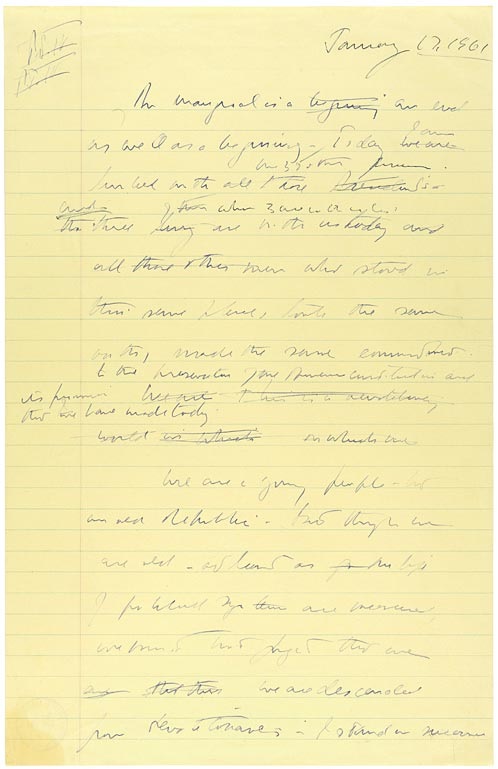
On January 20, 1961, President John F. Kennedy delivered his inaugural address in a message that rings loud and clear for today.
The stunning difference is that President Kenney was speaking to the World at large when today I feel his call for Freedom needs to be heard here in America.
To that end, I am writing a series of Haiku based on that inaugural address.
Also anyone who follows this blog, knows that when I miss a few days, I will create a series of posts based on the same text to catch myself up to date.
This is one of those series.
If you really want to scare yourself or make yourself think in such a way as to scare yourself, read this speech and William Shakespeare’s playJulius Caesar at the same time.
Today’s Haiku is taken from the passage:
We dare not forget today that we are the heirs of that first revolution. Let the word go forth from this time and place, to friend and foe alike, that the torch has been passed to a new generation of Americans–born in this century, tempered by war, disciplined by a hard and bitter peace, proud of our ancient heritage–and unwilling to witness or permit the slow undoing of those human rights to which this nation has always been committed, and to which we are committed today at home and around the world.
Let every nation know, whether it wishes us well or ill, that we shall pay any price, bear any burden, meet any hardship, support any friend, oppose any foe to assure the survival and the success of liberty.
Here is the complete text of from that address on January 20, 1961.
Vice President Johnson, Mr. Speaker, Mr. Chief Justice, President Eisenhower, Vice President Nixon, President Truman, Reverend Clergy, fellow citizens:
We observe today not a victory of party but a celebration of freedom–symbolizing an end as well as a beginning–signifying renewal as well as change. For I have sworn before you and Almighty God the same solemn oath our forbears prescribed nearly a century and three-quarters ago.
The world is very different now. For man holds in his mortal hands the power to abolish all forms of human poverty and all forms of human life. And yet the same revolutionary beliefs for which our forebears fought are still at issue around the globe–the belief that the rights of man come not from the generosity of the state but from the hand of God.
We dare not forget today that we are the heirs of that first revolution. Let the word go forth from this time and place, to friend and foe alike, that the torch has been passed to a new generation of Americans–born in this century, tempered by war, disciplined by a hard and bitter peace, proud of our ancient heritage–and unwilling to witness or permit the slow undoing of those human rights to which this nation has always been committed, and to which we are committed today at home and around the world.
Let every nation know, whether it wishes us well or ill, that we shall pay any price, bear any burden, meet any hardship, support any friend, oppose any foe to assure the survival and the success of liberty.
This much we pledge–and more.
To those old allies whose cultural and spiritual origins we share, we pledge the loyalty of faithful friends. United there is little we cannot do in a host of cooperative ventures. Divided there is little we can do–for we dare not meet a powerful challenge at odds and split asunder.
To those new states whom we welcome to the ranks of the free, we pledge our word that one form of colonial control shall not have passed away merely to be replaced by a far more iron tyranny. We shall not always expect to find them supporting our view. But we shall always hope to find them strongly supporting their own freedom–and to remember that, in the past, those who foolishly sought power by riding the back of the tiger ended up inside.
To those people in the huts and villages of half the globe struggling to break the bonds of mass misery, we pledge our best efforts to help them help themselves, for whatever period is required–not because the communists may be doing it, not because we seek their votes, but because it is right. If a free society cannot help the many who are poor, it cannot save the few who are rich.
To our sister republics south of our border, we offer a special pledge–to convert our good words into good deeds–in a new alliance for progress–to assist free men and free governments in casting off the chains of poverty. But this peaceful revolution of hope cannot become the prey of hostile powers. Let all our neighbors know that we shall join with them to oppose aggression or subversion anywhere in the Americas. And let every other power know that this Hemisphere intends to remain the master of its own house.
To that world assembly of sovereign states, the United Nations, our last best hope in an age where the instruments of war have far outpaced the instruments of peace, we renew our pledge of support–to prevent it from becoming merely a forum for invective–to strengthen its shield of the new and the weak–and to enlarge the area in which its writ may run.
Finally, to those nations who would make themselves our adversary, we offer not a pledge but a request: that both sides begin anew the quest for peace, before the dark powers of destruction unleashed by science engulf all humanity in planned or accidental self-destruction.
We dare not tempt them with weakness. For only when our arms are sufficient beyond doubt can we be certain beyond doubt that they will never be employed.
But neither can two great and powerful groups of nations take comfort from our present course–both sides overburdened by the cost of modern weapons, both rightly alarmed by the steady spread of the deadly atom, yet both racing to alter that uncertain balance of terror that stays the hand of mankind’s final war.
So let us begin anew–remembering on both sides that civility is not a sign of weakness, and sincerity is always subject to proof. Let us never negotiate out of fear. But let us never fear to negotiate.
Let both sides explore what problems unite us instead of belaboring those problems which divide us.
Let both sides, for the first time, formulate serious and precise proposals for the inspection and control of arms–and bring the absolute power to destroy other nations under the absolute control of all nations.
Let both sides seek to invoke the wonders of science instead of its terrors. Together let us explore the stars, conquer the deserts, eradicate disease, tap the ocean depths and encourage the arts and commerce.
Let both sides unite to heed in all corners of the earth the command of Isaiah–to “undo the heavy burdens . . . (and) let the oppressed go free.”
And if a beachhead of cooperation may push back the jungle of suspicion, let both sides join in creating a new endeavor, not a new balance of power, but a new world of law, where the strong are just and the weak secure and the peace preserved.
All this will not be finished in the first one hundred days. Nor will it be finished in the first one thousand days, nor in the life of this Administration, nor even perhaps in our lifetime on this planet. But let us begin.
In your hands, my fellow citizens, more than mine, will rest the final success or failure of our course. Since this country was founded, each generation of Americans has been summoned to give testimony to its national loyalty. The graves of young Americans who answered the call to service surround the globe.
Now the trumpet summons us again–not as a call to bear arms, though arms we need–not as a call to battle, though embattled we are– but a call to bear the burden of a long twilight struggle, year in and year out, “rejoicing in hope, patient in tribulation”–a struggle against the common enemies of man: tyranny, poverty, disease and war itself.
Can we forge against these enemies a grand and global alliance, North and South, East and West, that can assure a more fruitful life for all mankind? Will you join in that historic effort?
In the long history of the world, only a few generations have been granted the role of defending freedom in its hour of maximum danger. I do not shrink from this responsibility–I welcome it. I do not believe that any of us would exchange places with any other people or any other generation. The energy, the faith, the devotion which we bring to this endeavor will light our country and all who serve it–and the glow from that fire can truly light the world.
And so, my fellow Americans: ask not what your country can do for you–ask what you can do for your country.
My fellow citizens of the world: ask not what America will do for you, but what together we can do for the freedom of man.
Finally, whether you are citizens of America or citizens of the world, ask of us here the same high standards of strength and sacrifice which we ask of you. With a good conscience our only sure reward, with history the final judge of our deeds, let us go forth to lead the land we love, asking His blessing and His help, but knowing that here on earth God’s work must truly be our own.


 No Haiku For You