1.14.2024 – whorls, curves, and shiny

whorls, curves, and shiny
iridescent insides are
the remains, the shell

One of the most striking features of our beaches is seashells. Their whorls, curves, and shiny iridescent insides are the remains of animals. Most shells come from soft-bodied mollusks. Snails, clams, oysters, and others need the hard protection of their shells. This tough outer covering protects the tasty body hiding inside. Other animals, such as crabs and lobsters, also make a tough outer covering, but here we focus on mollusk shells.

Where do shells come from? The animals make them. Mollusks have an outermost layer of tissue on their bodies. Called the mantle, this layer connects the animal to its shell. The mantle also creates that shell.

Specialized cells in the mantle build the shell using proteins and minerals. These are secreted—released into the space outside the cells. There, the proteins create a framework that provides support for the growing shell. The proteins in the framework also determine which minerals are used in specific parts of the shell.

Calcium carbonate, the main mineral found in shells (including eggshells), binds to the protein. If you have ever seen construction workers build with concrete, this is similar. The protein is like the steel rebar that gives shape and support. Calcium carbonate is like the cement that fills in all the gaps.

Calcium carbonate can form two different types of crystals. One is called calcite. This incredibly common crystal can be found all over the world. Calcite makes up chalk, marble, coral, limestone—and seashells. The other form is aragonite. This crystal has a different arrangement of calcium carbonate. Both calcite and aragonite are found in seashells.

A mollusk’s shell has three layers. Each is made up of similar materials. But how those materials are arranged gives them each a different look and feel. The outermost layer is mostly protein. It’s often rough and may have bumps or spikes. Proteins in the middle layer cause calcium carbonate to form calcite crystals. These fill in the spaces, making the shell tough to break.

The innermost layer is the one in contact with the mantle. It’s a smooth, iridescent layer called nacre or mother-of-pearl. Nacre is made up of protein and calcium carbonate. But it looks and feels completely different from other parts of the shell. That’s because the mantle secretes different proteins for different layers. Different proteins cause calcium carbonate to crystallize in different ways. Those used in the middle layer create calcite. Those used in the innermost layer create aragonite.

As the animal grows, its shell must grow along with it. This happens along the outer edges. A snail adds to its shell around the opening, where it pokes its head out. For a clam or mussel, it’s the outer edges where the two shells separate. The result is growth rings, like those in a tree, that allow us to measure a mollusk’s age.

When the animal inside dies, its shell is gradually pounded against the rocks and sand. Over time, shells break down. They become part of the sand. White beaches have sand made almost entirely of tiny bits of shells.

From How are seashells made? by the staff at the Woods Hole Oceanographic Institution.
I did not grow up near an ocean beach.

I grew up on a great lakes beach in Michigan.

On the great lakes you don’t have tides.

On the great lakes you don’t have sea water.

One of the favorite sayings of the folks up North is, “Lake Michigan – No Salt Added.”

But you also don’t have sea shells.

And I have fallen in love with them.

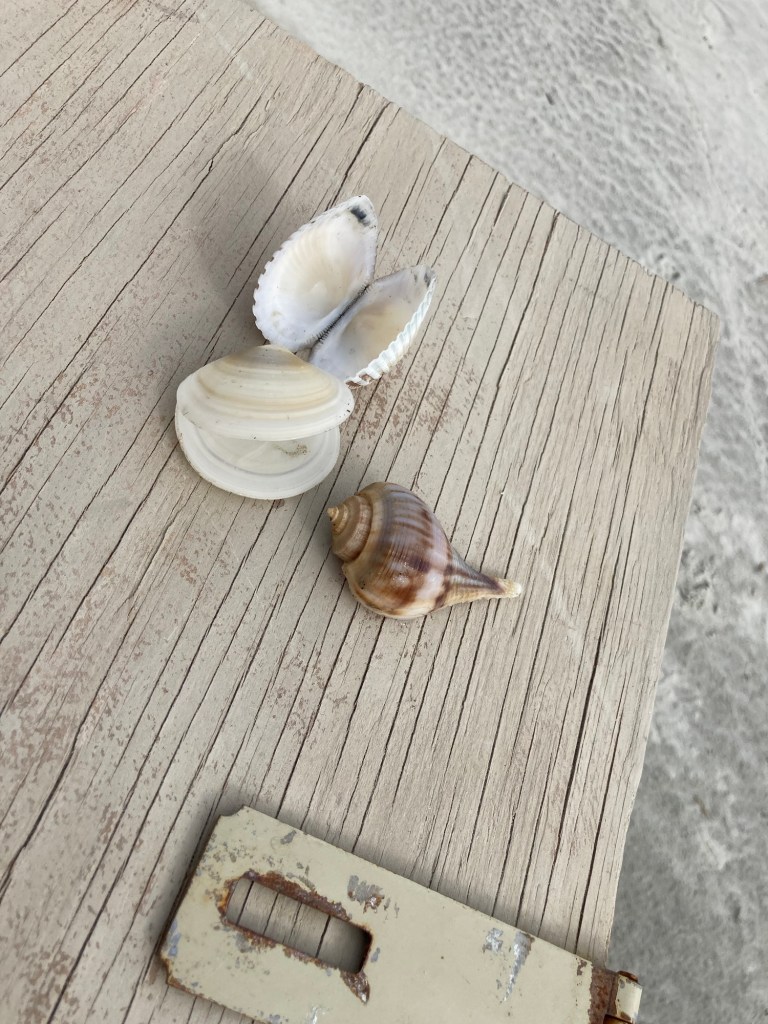
The shells in the picture I found on my lunch time break beach walk last week.

Being January, the number of the people on the beach is close to like … none (though there are always crazies from Wisconsin running around in swimsuits yelling its so warm) and the chances on finding sea shells on the beaches on the southern part of Hilton Head Island are pretty good.

I am learning about sea shells.

Any one should be able to tell you that you can cut down a tree and count the rings to get an age for the tree.

One new ring for each growth cycle in one year of freezing and thawing.

But what about shells.

Clam shells will add a new ring as it grows and these are not always one year apart.

According to the folks at Cornell:

• As they grow, clams add to the edge of their shell to protect
their squishy body inside.
• Each time the clam grows, you see a ring. Clams grow in
seasons when the water is warm (April-October).
• You can count the growth rings like you would age a tree.
• Count the darkest rings, each ring represents 1 year.
• The wider the band, the more the clam grew that year! More
growth suggests warm water and a lot of food that year!

I will never look at sea shells the same.
1.13.2024 – wave-sculpted ripples

wave-sculpted ripples
oscillating flows pick up
sand grains, set them down

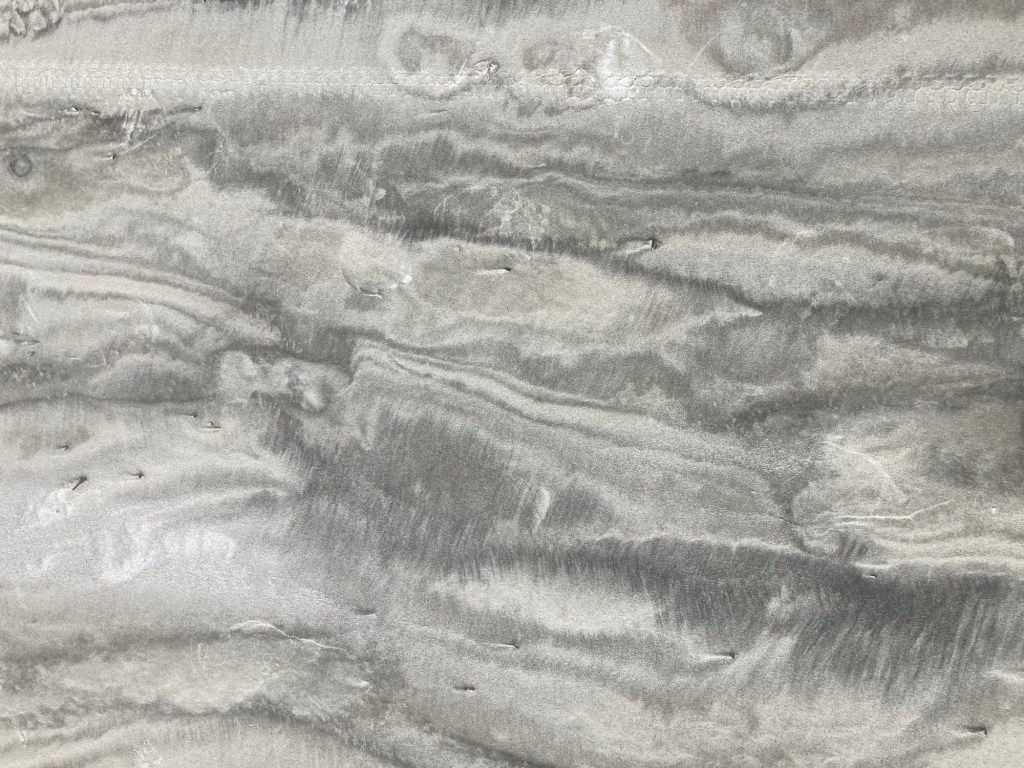
When a coastal tide rolls out, it can reveal beautiful ripples in the temporarily exposed sand. These same undulating patterns can also be seen in ancient, petrified seabeds that have been exposed in various parts of the world and preserved for millions or even billions of years.

Wave-sculpted ripples form as waves travel across the surface of a body of liquid. These waves cause water beneath the surface to circle around and around, generating oscillating flows that pick up sand grains and set them down in a process that eventually carves out troughs and grooves throughout the sandbed.

From Beach sand ripples can be fingerprints for ancient weather conditions by Jennifer Chu in the MIT News.

1.12.2024 – the meals in your life

the meals in your life
are numbered and the number
is diminishing

Food.

Jim Harrison.

Guilt.

Great way to start the day.

I live in a country that is somewhat obsessed with cooking, eating, weight and weight loss while at the same time unthinkable numbers of people, children, unthinkably go to bed hungry.

I read and enjoy the author, Jim Harrison but of late I have been listening to his work while I drive to work.

Audio versions of a book make sure you hear every word.

I think I have developed a mental screen that allows me to read Jim Harrison and filter out the worst of Mr. Harrison’s … earthy soliloquies* … while focusing on his word play, sentence structure and word painting observations on life that make him one of my favorite authors.

When I LISTEN to his work, read out loud and mispronounced (If I hear MACK-i-NACK one more time …) you cannot ignore those earthy soliloquies and gee whiz but he can get to the edge of social ridiculousness and go over.

And starting my day thinking about food and Mr. Harrison leaves me with a feeling of guilt.

So what to do?

Should I feed the hungry?

Should I make an apology for Mr. Harrison?

And I have only been up and about for 30 minutes.

So I heave a sigh and I say out loud a line from the Savannah based movie, Midnight in the Garden of Good and Evil.

The line that goes … “Two tears in bucket … mother f*ck it.

(Okay so I faded on spelling it out … but it’s a word we have all heard)

And I am going to comment on the dinner my wife made last night.

And I going to quote Jim Harrison without apology.

Last night my wife slow cooked a pork tenderloin in barbecue sauce and made pan fried sweet potatoes with Parmesan cheese and served it with rice.

There are meals where I can lose myself in the food, the flavors.

I look up, mists clear from my eyes and time has passed and my plate is empty.

I think of that Ben Franklin quote, “Behold the rain which descends from heaven upon our vineyards, and which incorporates itself with the grapes to be changed into wine; a constant proof that God loves us, and loves to see us happy.

There are times when I feel that way about food.

I remember the place in the Bible where the picnic cloth filled with food comes down in front of Peter and God says, “don’t say anything I made is bad.

There were no man made food additives or improvements included in that spread.

Nothing ‘fat free.’

Nothing ‘reduced calorie.’

Take and eat, said God.

I enjoyed my dinner.

I was reminded of other good, great meals, both simple and extravagant in my life.

I wondered how many have I had?

How many good, great meals does one get to eat in life?

I thought of a line from Clarence Day’s Life with Father where Mr. Day writes, “I adjusted my cap and walked on, thinking over this future. The more I thought about it, the less I wanted to be a civilized man. After all, I had had a very light lunch, and I was tired and hungry. What with fingernails and improving books and dancing school, and sermons on Sundays, the few chocolate éclairs that a civilized man got to eat were not worth it.

Then I thought … How many good, great meals do I have left to eat?

And I thought of this passage from the 2011 essay, Chef English Major, by Jim Harrison that is reprinted in A really big lunch(New York, Grove, 2017)

Cooking becomes an inextricable part of life and the morale it takes to thrive in our sodden times.

A good start, and I have given away dozens of copies, is Bob Sloan’s Dad’s Own Cookbook. There is no condescension in the primer.

Glue yourself to any fine cooks you meet.

They’ll generally put up with you if you bring good wine. Don’t be a tightwad.

Owning an expensive car or home and buying cheap groceries and wine is utterly stupid.

As a matter of simple fact you can live indefinitely on peanut butter and jelly or fruit, nuts, and yogurt, but then food is one of our few primary aesthetic expenses, and what you choose to eat directly reflects the quality of your days.

Your meals in life are numbered and the number is diminishing.

Get at it.

Have to admit food is not the part of my life that it once was.

Sorry and sad to say that since moving to the south and its pollens and mud flats, my nose is not what it was and flavors are not what they were.

Oddly I get the subtle flavors of seafoods like shrimp and scallops over the blunt heavy flavors of a good steak.

Lucky for me I live near the sea.

Nevertheless, I appreciate food and the good foods and flavors that God has packed into that picnic cloth.

Again, I thought of a Jim Harrison passage.

It is a from one of the first essay’s of Mr. Harrison that I read and one that got me into the Harrison’s camp.

This is from the 1989 essay, Hunger, Real and Unreal that was reprinted in Just before dark : collected nonfiction, (Boston, Houghton Mifflin, 1991)

.. one day at lunch I told some plumpish but kindly ladies what I thought was a charming story of simple food. One August, years ago, I was wandering around the spacious property of a chateau up in Normandy, trying to work up a proper appetite for lunch.

Two old men I hadn’t seen laughed beneath a tree. I walked over and sat with them around a small fire. They were gardeners and it was their lunch hour, and on a flat stone they had made a small circle of hot coals. They had cored a half-dozen big red tomatoes, stuffed them with softened cloves of garlic, and added a sprig of thyme, a basil leaf, and a couple of tablespoons of soft cheese. They roasted the tomatoes until they softened and the cheese melted. I ate one with a chunk of bread and healthy-sized swigs from a jug of red wine. When we finished eating, and since this was Normandy, we had a sip or two of calvados from a flask.

A simple snack but indescribably delicious.

I waited only a moment for the ladies’ reaction. Cheese, two of them hissed, cheese, as if I had puked on their sprouts, and wine! The upshot was that cheese is loaded with cholesterol and wine has an adverse effect on blood sugar. I allowed myself to fog over as one does while reading bad reviews of one’s own work.

I read this bit to my Mother and she laughed and laughed and laughed, shaking her head the way she could.

Let me circle back and sum it all up.

Food is a constant proof that God loves us, and loves to see us happy, but the few chocolate éclairs that a civilized man gets to eat may not be worth it.

So?

Quoting Mr. Harrison again, “Eat the delicious fat and take a ten-mile walk. Reach into your memory and look for what has restored you, what helps you recover from the sheer hellishness of life, what food actually regenerates your system, not so you can leap tall buildings but so you can turn off the alarm clock with vigor.”

Hoffman Family Picnic – 1964

*scenes of a sexual nature that may or may not have anything to do with the plot …

1.11.2024 – be glad to get home

be glad to get home
I don’t believe I’ll ever
want to go away

Won’t I be glad to finally get home again.

I don’t believe I’ll ever want to go away again.

By the way did you see the movie “Up in Mabel’s room.”

It was quite funny I thought, but in it was a nice house in the country that was like a house I would like to make into a home with you.

We really want to have a house that we will enjoy living in and not something just to be a show off place.

I like to live in the whole house.

Getting kind of rambling I guess but that is what happens when one is away so long.

This is from a letter my Dad wrote back during World War 2, to his then girlfriend, later wife and my Mom, from the 12th Corps Headquarters unit, based in Luxemburg on January 14, 1945 (click here to read).

(In the letter he writes that his unit had just moved to Luxemburg “… shortly after the German break through“, a break through now known as the Battle of the Bulge.)

I am not sure that there was ever a better description of my Dad’s view on life then what he wrote 60 years ago.

First, “Won’t I be glad to finally get home again. I don’t believe I’ll ever want to go away again.”

My Dad liked to be at home and once home, he never ever really wanted to go away again.

Second, “… want to have a house that we will enjoy living in. I like to live in the whole house.

I got to grow up in that house.

It was a big house but then there were 11 kids in the family and we lived in the whole house.

And we enjoyed living in it.

We were really lucky and we had a summer place out on Lake Michigan.

But it wasn’t a show off place but a house by the lake that was our home away from home and we lived in the whole house.

And BOY HOWDY, did we enjoy living in it.

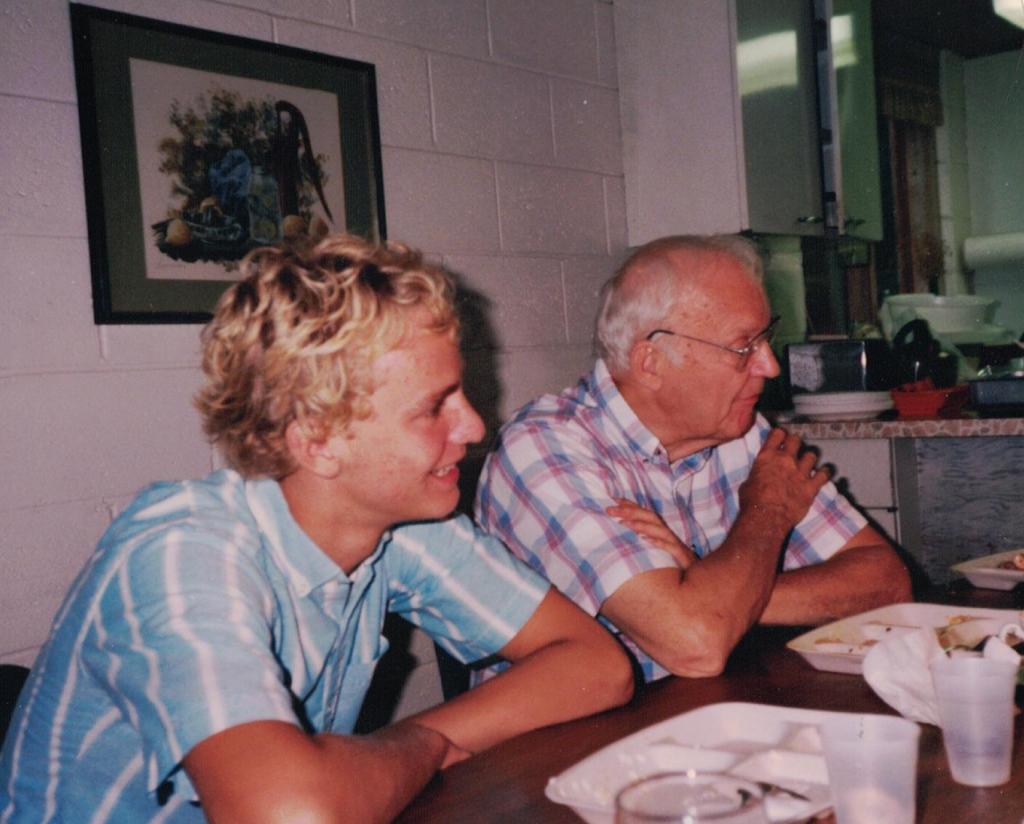
This a snapshot of my Dad and my youngest brother Al sitting together at the summer place.

Cement brick walls and plywood fixtures and tin metal cabinets.

Plastic trays and cups.

Nothing to show off.

There is some art on the wall of a painting of lemonade that my Mom spotted at an art fair in nearby Grand Haven, Michigan.

It now hangs in my home in South Carolina.

It is 1987.

My Dad would been 67.

Al would have been 17.

I would have been 27.

My brother Bobby would have been 37.

That’s how it works when you born in the decade years of 1920, 1950, 1960 and 1970.

This was my Dad’s last summer as he died on January 10, 1988.

For those 68 years that my Dad was around you can say that once he got home, he did not ever want to go away again.

And where ever my Dad lived, he lived his life in the whole house.

That was just the way my Dad liked it.

1.10.2023 – How is the world ruled?

How is the world ruled?
lie to journalists and then …
believe what is read

How is the world ruled and how do wars start?

Diplomats tell lies to journalists and then believe what
they read.

So wrote Karl Kraus in his book, Aphorisms and More Aphorisms back in1909.

An aphorism, not to be confused with aphorismus (from the Greek: ἀφορισμός, aphorismós, “a marking off”, also “rejection, banishment”) is a figure of speech that calls into question if a word is properly used (“How can you call yourself a man?”). It often appears in the form of a rhetorical question which is meant to imply a difference between the present thing being discussed and the general notion of the subject, but an aphorism (from Greek ἀφορισμός: aphorismos, denoting ‘delimitation’, ‘distinction’, and ‘definition’) is a concise, terse, laconic, or memorable expression of a general truth or principle. Aphorisms are often handed down by tradition from generation to generation.

Don’t ask me, I copied that right from Wikipedia.

I copy a lot from Wikipedia but then I site my source, not that that means I am qualified to be the President of an Ivy League School, not that I would want the job if I was and if I was I most likely be remembered by having a building like Haven Hall named after me.

Haven Hall is the ugly brick late Ramada Inn style building BEHIND Angell Hall and its 8 marble columned entrance that is a University of Michigan Landmark.

But I digress.

The subject was aphorisms.

Again, Wikipedia says, aphorisms are distinguished from other short sayings by the need for interpretation to make sense of them.

That is the beauty of “Diplomats tell lies to journalists and then believe what
they read.”

Who needs that interpreted?

Mr. Kraus also said, “The devil is an optimist if he thinks he can make people worse than they are.”

I got no problem understanding that one either.

Mr. Kraus was a social critic for his times and was confined to publishing his own works.

He would, it is said, agonize over the placement of a comma and the use of the correct, best words.

I can only imagine what Mr. Kraus would have made of the world today and the access to the world made possible by social media.

On the other hand maybe it wouldn’t be too hard to imagine what Mr. Kraus would have said today because he said it back then.

Mr. Kraus once wrote, “The secret of the demagogue is to make himself as stupid as his audience so they believe they are clever as he.”

All that is missing today is the twitter, I mean X account.