Down and out semi poet who is down and out in the Low Country of South Carolina after living in Atlanta which is not to be confused with the south, the old south or the new south. Atlanta was a global metropolis with all the pluses and minuses that comes with that. The low country, low because it is low, 8 feet above sea level, is not Podunk but once you get to Podunk, turn left. I try to chronicle a small part of all that through my daily haiku for you.
it was a problem without other solution than that of patience
It was a tantalizing problem that confronted us.
As long as we were vigilant, they could not escape; and as long as they were careful, we would be unable to catch them.
Charley cudgelled his brains continually, but for once his imagination failed him.
It was a problem apparently without other solution than that of patience.
It was a waiting game, and whichever waited the longer was bound to win.
To add to our irritation, friends of the Italians established a code of signals with them from the shore, so that we never dared relax the siege for a moment.
And besides this, there were always one or two suspicious-looking fishermen hanging around the Solano Wharf and keeping watch on our actions.
We could do nothing but “grin and bear it,” as Charley said, while it took up all our time and prevented us from doing other work.
From Tales of the Fish Patrol by Jack London, New York, Macmillan Company, 1905.
I was reminded of today’s political news cycle.
It was a problem apparently without other solution than that of patience
It was a waiting game, and whichever waited the longer was bound to win.
We can do nothing but “grin and bear it,” as Charley said, while it takes up all our time and prevents us from doing other work.
vividly to sense world’s precariousness and the perils ahead
Based on the paragraph:
The subsequent fortnight has, of course, proved a very long time in geopolitics.
The UK has finally elected a grownup government;
France has perhaps temporarily averted the prospect of a far-right administration;
and Trump has dodged that bullet and raced ahead in the polls.
Having Applebaum’s book closely in mind through all those events is vividly to sense the underlying precariousness of our world, the perils immediately ahead.
The article is an interview with Anne Applebaum and a review of her latest book, Autocracy, Inc: The Dictators Who Want to Run the World.
I could comment on the content in the article but I think it speaks for itself.
I could comment on the context of the article but I won’t.
It is the words used to fill up the content that I want to focus on.
The focus of the interview, Ms. Applebaum, is renown for passages like:
“Nowadays autocracies are run not by one bad guy, but by sophisticated networks composed of kleptocratic financial structures, security services (military, police, paramilitary groups, surveillance), and professional propagandists.“
Just on syllable count alone she wins.
But it is the words of Mr. Adams that I like.
First off, anyone who can get fortnight and even more wonderful how he used it the phrase, The subsequent fortnight , well Boy Howdy, I take my hat off to.
Then there was the use of vividly to sense.
With almost 5 years of high school and college Latin in my brain, the only grammatical error left (in the age of tweets and texts) is the dreaded split infinitive.
As Herman Wouk writes in his novel, The Caine Mutiny, “… note that split infinitive in paragraph three. If you want a letter to sound official, split an infinitive.”
How easy would it have been for Mr. Adam to write, ‘to vividly sense.“
Needless to say I was shocked, shocked I tell you, to read in Wikipedia, “In the 19th century, some linguistic prescriptivists sought to disallow the split infinitive, and the resulting conflict had considerable cultural importance. The construction still renders disagreement, but modern English usage guides have largely dropped the objection to it.
The split infinitive terminology is not widely used in modern linguistics. Some linguists question whether a to-infinitive phrase can meaningfully be called a “full infinitive” and, consequently, whether an infinitive can be “split” at all.”
It makes absolutely no difference in the history of the world or the happenings of today but for me and myself, but vividly to sense made my day.
had I not the right dislike dislikable man feeling to this day
“… because it was a portion of the only genius he possessed to make me feel guilty for disliking him. It was a guilt I had no reason to feel — had I not the right to dislike a dislikable man? — and yet I go on unreasonably feeling it to this day. I perceive that even writing about him now, so long after his death, will not diminish my guilt. He has me locked in an embrace that nothing as simple as his death or the passage of time can release me from. It was his gift to gather a person in against his will and then never let go”
From Here at the New Yorker by Brendan Gill, New York, Random House, 1975.
confidence of ignorant youth seeps away nothing takes its place
I felt thoroughly grown-up at twenty-one — more grown-up, indeed, than I have ever succeeded in feeling since. The confidence of ignorant youth seeps slowly, slowly away and to our astonishment no confidence of sapient age comes surging in to take its place.
From Here at the New Yorker by Brendan Gill, New York : Random House, 1975.
As Mark Twain is credited with saying “…when I was seventeen, I could hardly stand it to be with my father because he was was so ignorant, and at twenty I noticed that now and then, my father said a sensible thing, but at twenty-five I was simply amazed to discover how my father had improved in the last eight years.”
Sad to mention that according to the Quote Investigator, “… the earliest known attribution to Twain occurs in 1915 and this is rather late because Twain died in 1910. To date, the saying has not been found in Twain’s writings, notebooks, or letters. Quotation experts and Twain scholars are skeptical of the attribution to Twain.”
Me at 21?
Back in 1981?
Just accepted to continue my studies at an institution of higher learning, I doubted there was anything left for me to learn.
My first lecture, I was seated at a long table in a room that looked out a window through the iconic columns of the landmark building on the campus of this institution.
The bell in the bell tower central to central campus was striking the hour.
I had arrived.
15 minutes into my first lecture with 4 pages of notes, my confidence started to leak out all over the floor of the room.
I was comforted by the looks on the faces on the other students, that they too, were feeling it.
Then a goofy thing happened.
Without raising their hand or waiting to be recognized, the student next to me called out to the Professor, “You really think that?”
The Professor paused and then started a 5 minute dialogue with the student and while the student did give in, the student was not at all convinced and the Professor picked up where he left off.
This was something new to me.
What had I got myself into?
Argue with a Professor?
Maybe even BE EXPECTED to argue with a Professor?
I am not sure how I resolved all my thoughts – most likely I just doubled my note taking speed.
I knew I had to get through this first lecture because being Mr. KNOW-IT-ALL, I had set up my class schedule like I was in high school.
I had three more lectures back to back to back that first morning.
And I was 21.
All grown up.
More grown-up!
More grown-up, indeed, than I have ever succeeded in feeling since.
And you know what?
The confidence of ignorant youth seeps slowly, slowly away and to our astonishment no confidence of sapient age comes surging in to take its place.
what new story heard agreeable for telling in conversation
Back in the day, Benjamin Franklin put together a club known as The Junto.
According to Wikipedia, The Junto, also known as the Leather Apron Club, was a club for mutual improvement established in 1727 by Benjamin Franklin in Philadelphia. The Leather Apron Club’s purpose was to debate questions of morals, politics, and natural philosophy, and to exchange knowledge of business affairs.
They Junto met on Friday nights and to get the debate started, Dr. Franklin put together a list of 24 starter questions.
Question number 2 asked, “What new story have you lately heard agreeable for telling in conversation?”
As this question asked about new stories, it should be no surprise that the Junto members realized they would need access to new books which led to the creation of the The Library Company of Philadelphia and libraries were established in America.
The Library Company of Philadelphia occupied the 2nd floor of what was called Carpenters Hall in Philadelphia.
In a room on the 1st floor of this building, the Continental Congress met and in 1776, signed the Declaration of Independence.
The Library Association is older than the United States.
Libraries and me have had a long association.
At Crestview Elementary School in Grand Rapids, Michigan, where I grew up, the library was where I had to spend ‘time-outs’ when my behavior in class made it desirable for the teacher for me to be someone where else.
In agreement with the Principal, I would spend 15 minutes or so by myself in the library.
Not a punishment and really, a bit of rewarding bad behavior, but it worked out for all those involved.
When I was 6 or so I got my first library card at the Creston Branch of the Grand Rapids Public Library.
But it was the summer of 1970, when I turned 10 that I got a new bike and the main branch of the Grand Rapids Public Library became available to me.
I would ride a route of back streets that required me to cross several busy streets and then navigate downtown Grand Rapids but I made it.
I would park my bike in the bike racks, didn’t need a lock back then and walk to the main entrance of the magnificent Grand Rapids Public Library Main Building.
I didn’t realize it at the time, but this building was pretty much brand new, having been opened in 1967.
Walking into the lobby in 1970, it still had that ‘new building’ smell.
The first thing that would hit was the air conditioning which, after my ride downtown, felt great.
It is hard to describe, but after getting downtown on my own, when I walked into that library I felt it was MY library.
Anyone else in the library was there at my sufferance.
Once in the library, there was a wall of double glass doors with the sign ADULT SECTION.
It would be a couple of years before I dared go through those doors if my Dad wasn’t with me.
When I could badger my Dad enough to take me downtown, he would go through those doors and then head upstairs to the Newspaper Room and read out of town newspapers while I looked at books.
When I had my books from the Youth Section, I felt confident enough to go into the Adult Section as I knew if someone challenged me, I could say I was getting my Dad.
BTW the Newspaper Room was in the original Main Building that had been built in 1904 and despite all their efforts, modern architects were not able to line up the floors of the new and old buildings.
To get to the old building, you took the stairs and then took a door off the landing to another inner kinda secret flight of stairs.
Just to know these stairs were there was pretty cool.
If you took the elevator, you would press the buttons with an R or 2R for the 2nd floor of the Ryerson Building, the original name of the main building and magically the elevator doors would open behind you.
As an aside, Mr. Ryerson of Chicago offered to build the library as a gift to City of Grand Rapids in memory of his pleasant memories of visiting family in Grand Rapids.
No one knows how much the building cost as Mr. Ryerson had all, and I mean ALL, the bills sent direct to him.
The day the Library opened, the Public Schools were closed for the day and all the kids and citizens of the city went to the Library where Mr. and Mrs. Ryerson received guests on the landing of the main marble staircase.
That’s my kind of rich benefactor.
It was always fun to get on the elevator, press 2R and then turn your back to the doors and watch the other patrons wonder what in the world you were doing.
But that was when I was there with my Dad.
It was years before I dared enter the Adult Section on my own and the first time I did, I waited to get nabbed and ordered out.
There was another sign over the doorway that said YOUTH SECTION with an arrow to the right.
That was my world.
I might walk in and start looking at the new titles.
Or I might walk back to the Civil War books to find something I hadn’t read.
I would greet the Librarian on staff who would often recognize and ask about my ride.
I walked through those aisles with seven league boots and took no prisoners and admitted no faults.
And I looked and looked at all those books and I wondered just what new stories they might contain that would be agreeable for telling in conversation.
And I did my best to find them all.
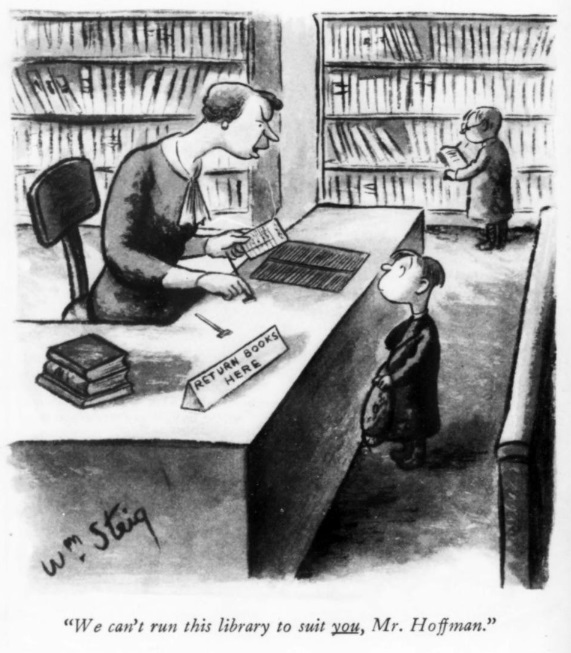
BTW – Was paging through old New Yorker Magazines when I came across this cartoon that appeared on December 12, 1932.

 No Haiku For You