9.14.2024 – a moral duty

a moral duty
maybe … it fails to invoke
a legal duty

“Mr. Arredondo has contended that he was not the incident commander, and his lawyers said it does not matter in the context of the indictment. “Such an allegation may invoke a moral duty to perform his job well, but it fails to invoke a legal duty,” the lawyers argued in their filings.”

From the article, “Former Uvalde School Police Chief Asks Court to Toss Charges” By Edgar Sandoval.

The article sub headline is, “Investigations have singled out Pete Arredondo for the delayed police response to a 2022 school shooting in Texas. He is expected to appear in court for the first time on Monday.”

I hate to say it but I guess I see the point the lawyers are trying to make.

Chief Pete Arredondo MAY have had a moral duty to perform his job well and protect the lives of those little kids in Uvalde but that doesn’t mean he had a legal duty to do anything about it and just because he let a little thing like … a lack of morals I guess … that and the ability to live with himself should not leave him open to legal prosecution for not performing his job well and not protecting those kids.

While I can see their point, those lawyers lose me along the way there somewhere.

But I have to ask, would I have been any different?

Had I been Chief of School District Police … goodness but I hope so.
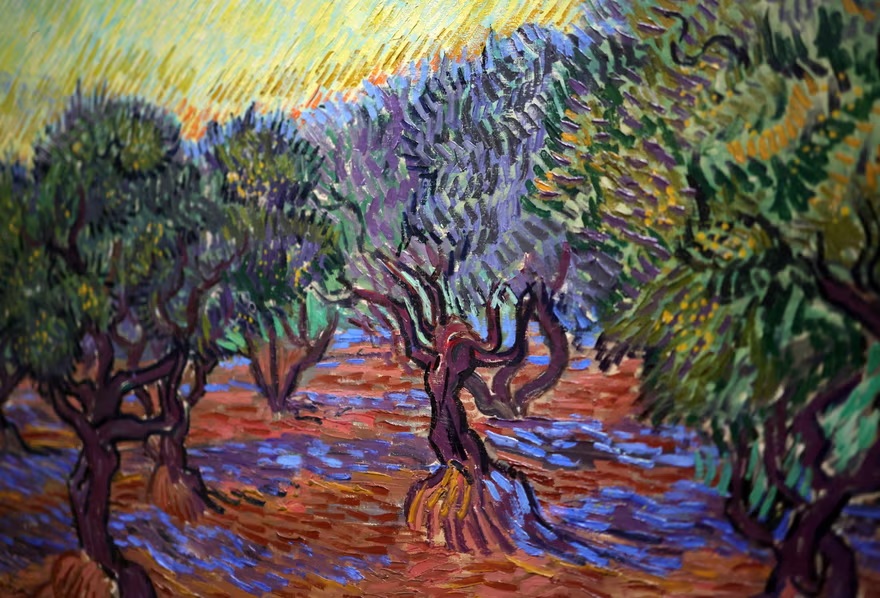
9.13.2024 – many touches but

many touches but
couldn’t care less what the colours
are in reality

From the review, Van Gogh: Poets and Lovers review – a riveting rollercoaster ride from Arles to the stars by Jonathan Jones in the Guardian, September, 10, 2024.

A review of the show, Van Gogh: Poets and Lovers, at the National Gallery, London, that opens September and I will never see.

Mr. Jones writes, “He’d toiled for years doing brown studies of northern life before he met the avant garde in Paris: within weeks of his arrival in Arles, he took the impressionist ideas he’d encountered to the next level. Describing his painting of a man sowing, he wrote in June 1888: “There are many touches of yellow in the soil … but I couldn’t care less what the colours are in reality.”

I have seen so few Van Gogh’s in person but I can testify to the impact of the power of the artist that can be felt standing in front of painting, knowing you have to be in the same space the artist once stood and the world the artist attempted to record on canvas.

As Mr. Jones states: “Reality is not real. The visionary is.”

I like that.

I like that a lot.

Reality is not real.

The visionary is.

When Mr. Jefferson wrote, “We hold these truths to be self-evident, that all men are created equal, that they are endowed by their Creator with certain unalienable Rights, that among these are Life, Liberty and the pursuit of Happiness,” he wasn’t, as we know, describing the world of Colonial America as it then existed.

Not all men, mankind were equal.

It wasn’t the reality.

It was a vision.

A vision we are still too far from after almost 250 years but the vision, for a lot of us, is still there.

Which, I guess, makes us the visionary.

Reality is not real.

The visionary is.

That is the reality of it all.

Mr. Jones closes his review with this.

We all know how badly it ended. The ideals Van Gogh invested in his little home couldn’t withstand the shock of sharing it with Gauguin, and after his ear-cutting and further crises he decided he was better off in an asylum. But here, that never happens. We experience not the sordid facts, but Van Gogh’s dream of The Yellow House. It still exists, always, out there among the painted stars.

It still exists, always, out there among the painted stars.

9.12.2024 – is glittering in

is glittering in
the first rays of the sun, which
has not yet reached us

August 10 – The air at sunrise is clear and pure, and the morning extremely cold, but beautiful.

A lofty snow peak of the mountain is glittering in the first rays of the sun, which has not yet reached us.

The long mountain wall to the east, rising two thousand feet abruptly from the plain, behind which we see the peaks, is still dark, and cuts clear against the glowing sky.

A fog, just risen from the river, lies along the base of the mountain.

A little before sunrise, the thermometer was at 35°, and at sunrise 33°.

Water froze last night, and fires are very comfortable.

The scenery becomes hourly more interesting and grand, and the view here is truly magnificent; but, indeed, it needs something to repay the long prairie journey of a thousand miles.

The sun has just shot above the wall, and makes a magical change.

The whole valley is glowing and bright, and all the mountain peaks are gleaming like silver.

Though these snow mountains are not the Alps, they have their own character of grandeur and magnificence, and will doubtless find pens and pencils to do them justice.

From the Report of the Exploring Expedition to the Rocky Mountains – 1842 by John C. Fremont as reprinted in The American Landscape: A Critical Anthology of Prose and Poetry edited by John Conron, London, Oxford University Press 1973.

9.11.2024 – some page of figures

some page of figures
filed away — till elevators
drop us from our day ..

9-11 Day 2024.

Adapted from an excerpt in the poem, “The Bridge: To Brooklyn Bridge” by Hart Crane as reprinted in The Complete poems of Hart Crane, Doubleday & Company, Garden City, NY, 1933.

How many dawns, chill from his rippling rest
The seagull’s wings shall dip and pivot him,
Shedding white rings of tumult, building high
Over the chained bay waters Liberty—

Then, with inviolate curve, forsake our eyes
As apparitional as sails that cross
Some page of figures to be filed away;
—Till elevators drop us from our day …

I think of cinemas, panoramic sleights
With multitudes bent toward some flashing scene
Never disclosed, but hastened to again,
Foretold to other eyes on the same screen;

9.10.2024 – sang a song they brought …

sang a song they brought …
this tune always reminds me
of these buoyant days …

Winston Churchill wrote a 6 volume auto biography of his time as British Prime Minister during World War 2.

The 2nd volume, Their Finest Hour, covers the year 1940.

The Battle of Britain, the Battle of the Atlantic and the war in the deserts of North Africa.

In describing the success of some Australia units fighting in the desert, Mr. Churchill writes:

To complete this episode of desert victory, I shall intrude upon the New Year. The attack opened early on January 3. One Australian battalion, covered by a strong artillery concentration, seized and held a lodgment in the western perimeter. Behind them engineers filled in the anti-tank ditch. Two Australian brigades carried on the attack and swept east and southeastward. They sang at that time a song they had brought with them from Australia which soon spread to Britain.

Reading this, I am sure you might be thinking of some song of Australian origin, Waltzing Matilda or … or … well, when talking about songs of Australian origin, I guess that’s it.

Doesn’t matter because that is not where Mr. Churchill was going.

And I bet if I offered you $100 and 100 guesses you would not come up with the words Mr. Churchill recorded in his book.

“Have you heard of the wonderful wizard,
  The wonderful Wizard of Oz,
And he is a wonderful wizard,
  If ever a wizard there was.”

So he got the words a little wrong.

I have always heard that the single most influential movie of all time is the Wizard of Oz but this was a new look for me.

Mr. Churchill then goes on to say, “This tune always reminds me of these buoyant days. By the afternoon of the 4th, British tanks “Matildas” as they were named—supported by infantry, entered Bardia, and by the 5th all the defenders had surrendered. Forty-five thousand prisoners and 462 guns were taken.

From what I read, Mr. Churchill ‘wrote’ by dictating to stenographers as he figured out passages of prose.

Also, from what I have read, he like to have an audience as he dictated as it gave him more of a feel for an audience.

Also, he liked to work late at night in his library.

So the scene that comes to mind is the image of Winston Churchill, cigar in hand, singing “We’re of to see the Wizard … The Wonderful Wizard of Oz” as he replays in his mind, the story of World War 2.

Now think of all the songs of World War 2.

Think what songs brought back memories.

For Mr. Churchill?

As he write, “This tune always reminds me of these buoyant days.”