
rapidly changing …
no way to anticipate
these occurrences
Weather, however spectacular to the eye, may present difficult conditions and compositions, especially when working with large cameras.
Setting up the camera takes several minutes during which the first promising aspects of light and cloud may disappear.
I would sometimes wait hopefully for the scene that I could visualize as an exciting image.
It was occasionally realized, but I have always been mindful of Edward Weston’s remark, “If I wait for something here I may lose something better over there.”
I have found that keeping on the move is generally more rewarding. However, it is important to say that I photographed from this particular viewpoint in Yosemite many times over many years, with widely varying results.
Clearing Winter Storm came about on an early December day.
The storm was first of heavy rain, which turned to snow and began to clear about noon.
I drove to the place known as New Inspiration Point, which commands a marvelous vista of Yosemite Valley.
I set up my 8×10 camera with my i2’/4-inch Cooke Series XV lens and made the essential side and bottom compositional decisions.
I first related the trees to the background mountains as well as to the possible camera positions allowed, and I waited for the clouds to form within the top areas of the image.
Rapidly changing situations such as this one can create decision problems for the photographer.
A moment of beauty is revealed and photographed; clouds, snow, or rain then obscure the scene, only to clear in a different way with another inviting prospect.
There is no way to anticipate these occurrences.
From Examples: The making of 40 photographs by Ansel Adams (Boston: Little, Brown Collection, 1983).
I used to be really into photography and cameras and film and a darkroom that my Dad bankrolled for reasons I cannot understand today but maybe that I spent hours down in the basement away from everyone else had something to do with it.
Today I use my iPhone.
I use my iPhone and I think about the work of Ansel Adams.
Maybe it is a bit much for me to think about my camera work and Ansel Adams in the same sentence but I am the guy that edits Langston Hughes and Carl Sandburg in 17 syllables so there you are.
It is evident and important to remember that from his writings and commentary, Ansel Adams saw not just a scene, but the photograph he could make of that scene in his mind before he ever got out a camera.
He was such the master of the tools of his day that he knew just what camera, what lense, what filter, what settings, what film, what developer and what photographic paper he would use to make the final print before he ever snapped the shutter.
His work was getting all of this to produce what he saw in his mind.
I think he would have loved an iPhone.
I think he would have embraced Adobe Photoshop and digital imagery as he worked to interpret what he had on his iPhone to match what he had in his mind when he envisioned a photo.
I think he would have spat on artificially generated images while at the same time, the final prints of this photos may have had a lot more to see that what his camera picked up.
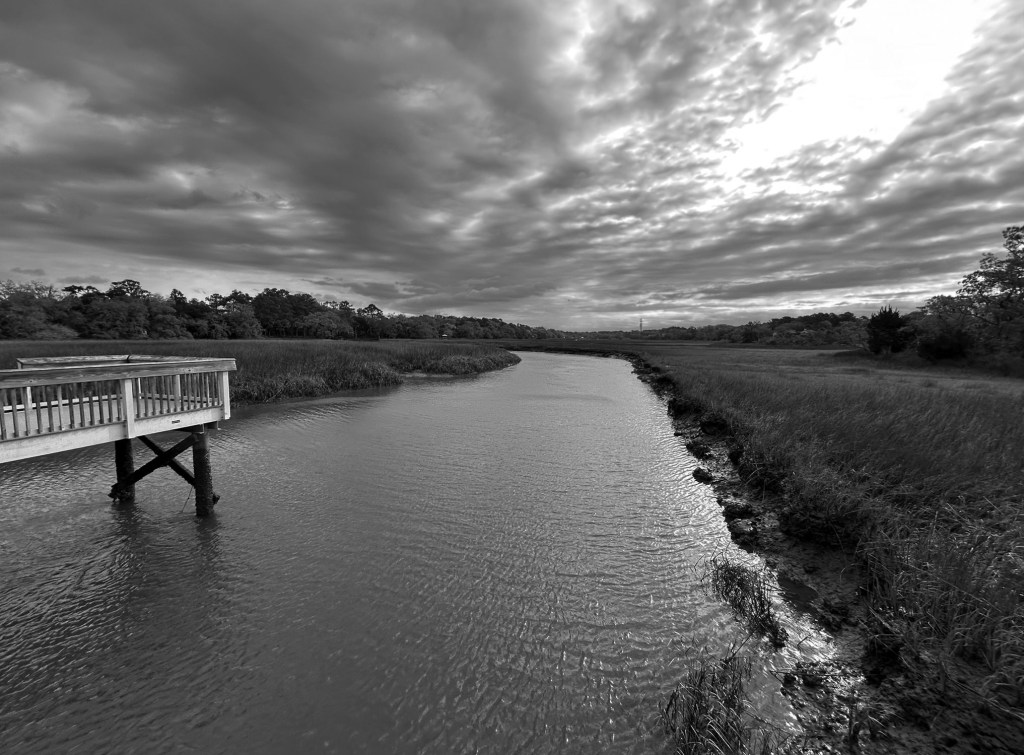
This morning I biked over to Horse Creek Landing Pier on Hilton Head Island.
My guess is that most folks could have been coming to Hilton Head for 40 years and never heard of the place.
I walked out on a narrow fishing/crabbing pier and looked into the heart of the island.
The tide was going out.
A storm front with gale force wind warnings attached to it was coming in.
The sun shone through the clouds.
Rapidly changing situations such as this one can create decision problems for the photographer.
A moment of beauty was revealed and photographed; clouds, sun, or rain then obscure the scene, only to clear in a different way with another inviting prospect.
There is no way to anticipate these occurrences.
 No Haiku For You