
effect doesn’t seem
to have been priced into the
decision making
Adapted from the article, How Trump’s War With Iran Changed the World in a Week, by Jim Tankersley who report on Germany and Europe as Berlin bureau chief for The New York Times where Mr. Tankersley writes:
Mr. Trump’s war, now nearly two weeks old, is already reshaping travel patterns, energy dependencies, living costs, trade routes and strategic partnerships. Countries typically shielded from regional conflict, like Cyprus and the United Arab Emirates, have faced retaliatory Iranian fire. The fallout could disrupt midterm elections in the United States, tilt the war calculus in Ukraine and force China into a major economic pivot.
Those effects may compound if Mr. Trump presses ahead with the war, particularly if Iran escalates its counterattacks and blocks ship traffic through the critical oil passage of the Strait of Hormuz. Some economists are already invoking a dreaded memory for any U.S. president — the specter of oil-shock-induced stagflation, with growth stalling and prices roaring upward.
“I’m old enough to remember the events of the ’70s, and a world in which oil price spikes were a significant issue both economically and for a president who might be facing elections,” said Suzanne Maloney, an Iran expert at the Brookings Institution. “That doesn’t seem to have been priced into the decision making,” she added.
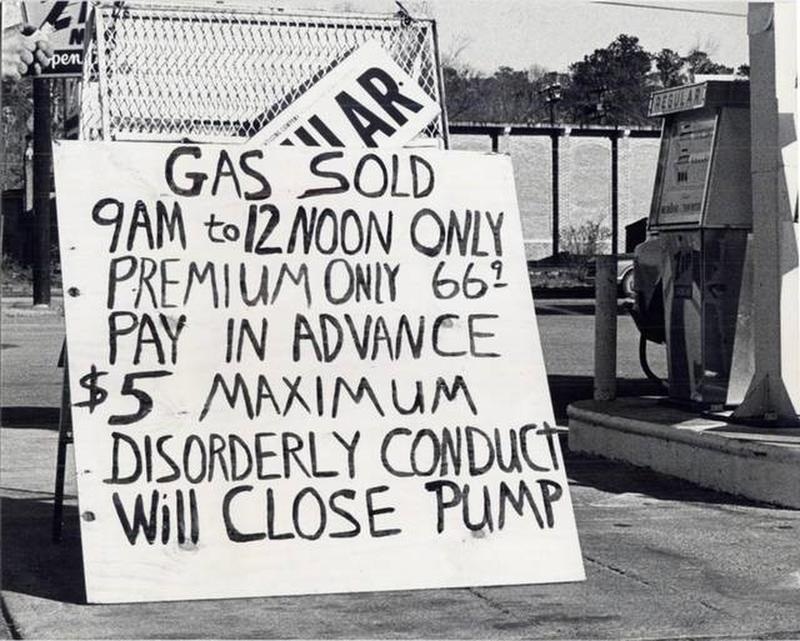
What happened in the ’70s?
Two things.
There was the Oil Crisis of 1973 and the Oil Crisis of 1979.
It’s that first one in 1973 I want to talk about.
I was 13.
Inflation at the grocery store was 14%.
According to Wikipedia:
On 6 October 1973, the Yom Kippur/October War began when Egypt attacked the Bar Lev Line in the Sinai Peninsula and Syria launched an offensive in the Golan Heights.
Israel took heavy losses in men and materiel during the fighting against Egypt and Syria, and on 18 October 1973, Meir requested $850 million worth of American arms and equipment to replace its materiel losses
On the afternoon of 19 October 1973, Faisal was in his office when he learned about the United States sending $2.2 billion worth of weapons to Israel.
The arms lift enraged King Faisal of Saudi Arabia. Faisal was angry that Israel had only asked for $850 million worth of American weapons, and instead received an unsolicited $2.2 billion worth of weapons, which he perceived as a sign of the pro-Israeli slant of American foreign policy.
On 20 October 1973, he retaliated by placing a total embargo on oil shipments to the United States, to be joined by most of the other oil-producing Arab states.
The embargo imposed on the United States led to shortages of oil in the United States, which set an inflationary spiral.
Nixon later boasted in his memoirs that the US Air Force flew more sorties to Israel in October 1973 than it had during the Berlin Airlift of 1948–49, flying in a gargantuan quantity of arms, though he also admitted that by the time the arms lift had begun, the Israelis had already “turned the tide of battle” in their favor, making the arms lift irrelevant to the outcome of the war.
In an interview with the British historian Robert Lacey in 1981, Kissinger later admitted about the arms lift to Israel: “I made a mistake. In retrospect it was not the best considered decision we made”.
Why do I have this feeling that, old as I am, I will live to hear on some documentary or read in some book that someone from this current administration will talk about this current war and say, In retrospect it was not the best considered decision we made.
Why do I have this feeling that this current war won’t be the only topic about which someone from this current administration will talk about and say, In retrospect it was not the best considered decision we made.
Why do I have this feeling that this current administration won’t be the only topic about which someone from this current generation of voters will talk about and say, In retrospect it was not the best considered decision we made.
 No Haiku For You