little time we live learn painfully to practice for eternity
The oaks, how subtle and marine! Bearded, and all the layered light Above them swims; and thus the scene, Recessed, awaits the positive night.
So, waiting, we in the grass now lie Beneath the languorous tread of light; The grassed, kelp-like, satisfy The nameless motions of the air.
Upon the floor of light, and time, Unmurmuring, of polyp made, We rest; we are, as light withdraws, Twin atolls on a shelf of shade.
Ages to our construction went, Dim architecture, hour by hour; And violence, forgot now, lent The present stillness all its power.
The storm of noon above us rolled, Of light the fury, furious gold, The long drag troubling us, the depth: Unrocked is dark, unrippling, still.
Passion and slaughter, ruth, decay Descended, whispered grain by grain, Silted down swaying streams, to lay Foundation for our voicelessness.
All our debate is voiceless here, As all our rage is rage of stone; If hopeless hope, fearless is fear, And history is thus undone.
(Our feet once wrought the hollow street With echo when the lamps were dead All windows; once our headlight glare Disturbed the doe that, leaping fled.)
The caged hearts make iron stroke, I do not love you now the less, Or less that all that light once gave The graduate dark should now revoke
So little time we live in Time, And we learn all so painfully, That we may spare this hour’s term To practice for Eternity.
Bearded Oaks by Robert Penn Warren as published in The collected poems of Robert Penn Warren by Robert Penn Warren (Louisiana State University Press: Baton Rouge, 1998).
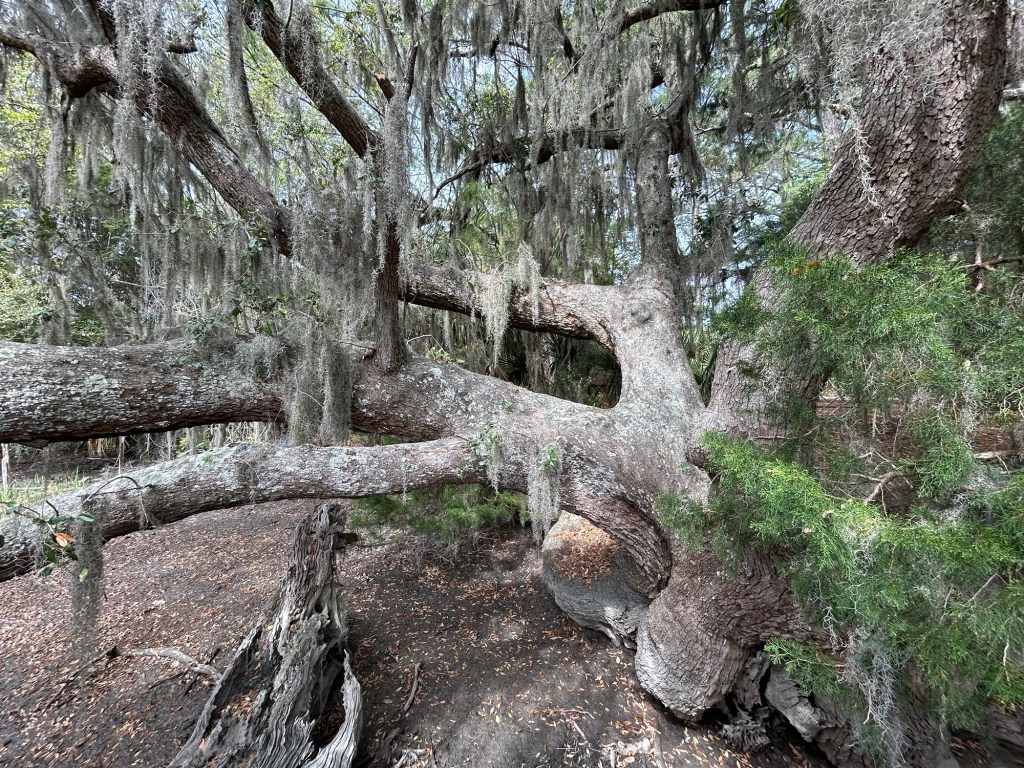
Massive … MASSIVE live oak on the grounds of the Coastal Carolina Museum on Hilton Head Island
The oaks, how subtle and marine!
Bearded, and all the layered light
Above them swims; and thus the scene,
Recessed, awaits the positive night.
The south is different.
It has a lot less snow.
It has a lot less cold.
It has a lot more sun.
It has lot more good smells.
It had lot more bad smells.
And it has live oaks.
Ages to our construction went,
Dim architecture, hour by hour;
And violence, forgot now, lent
The present stillness all its power.
Here before we were born.
Here after we will die.
The present stillness all its power.
So little time we live in Time,
And we learn all so painfully,
That we may spare this hour’s term
To practice for Eternity.
According to Wikipedia, Robert Penn Warren (April 24, 1905 – September 15, 1989) was an American poet, novelist, literary critic and professor at Yale University. He was one of the founders of New Criticism. He was also a charter member of the Fellowship of Southern Writers. He founded the literary journal The Southern Review with Cleanth Brooks in 1935. He received the 1947 Pulitzer Prize for the Novel for All the King’s Men (1946) and the Pulitzer Prize for Poetry in 1958 and 1979. He is the only person to have won Pulitzer Prizes for both fiction and poetry. Yale awarded Warren an honorary Doctor of Letters degree in 1973.
but immigrants built this country, we should admire them and respect them
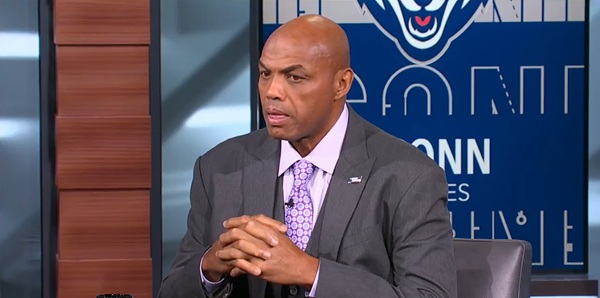
Auburn basketball legend Charles Barkley sounded off about immigrant treatment in America during Sunday’s March Madness broadcast on CBS. Discussing UConn’s Alex Karaban and his family’s journey to the U.S., Barkley spoke out about current immigration practices in the country.
“I wanna be very careful with my words right now,” Barkley began. “Cause this is a really touchy subject for me. I love that kid (Karaban) and his family. But the way some of these other immigrants are getting treated in our country right now is a travesty and a disgrace.”
“I think there is a difference between amazing immigrants and criminal immigrants.
And I think what’s going on in our country — I think what we’re doing to some of these amazing immigrants is really unfortunate and it’s really sad.
That’s a great immigrant story, we have a lot of great immigrant stories out there who — they stories need to be told but some of the stuff that’s happening to immigrants in our country is really unfortunate and its really unfair.
But immigrants built this country, we should admire them and respect them.”
Zacchaeus was a wee little man, and a wee little man was he
Jesus entered Jericho and was passing through. A man was there by the name of Zacchaeus; he was a chief tax collector and was wealthy.
He wanted to see who Jesus was, but because he was short he could not see over the crowd. So he ran ahead and climbed a sycamore-fig tree to see him, since Jesus was coming that way.
When Jesus reached the spot, he looked up and said to him, “Zacchaeus, come down immediately. I must stay at your house today.” So he came down at once and welcomed him gladly.
All the people saw this and began to mutter, “He has gone to be the guest of a sinner.”
But Zacchaeus stood up and said to the Lord, “Look, Lord! Here and now I give half of my possessions to the poor, and if I have cheated anybody out of anything, I will pay back four times the amount.”
Jesus said to him, “Today salvation has come to this house, because this man, too, is a son of Abraham. For the Son of Man came to seek and to save the lost.”
Luke 19:1-10 (NIV)
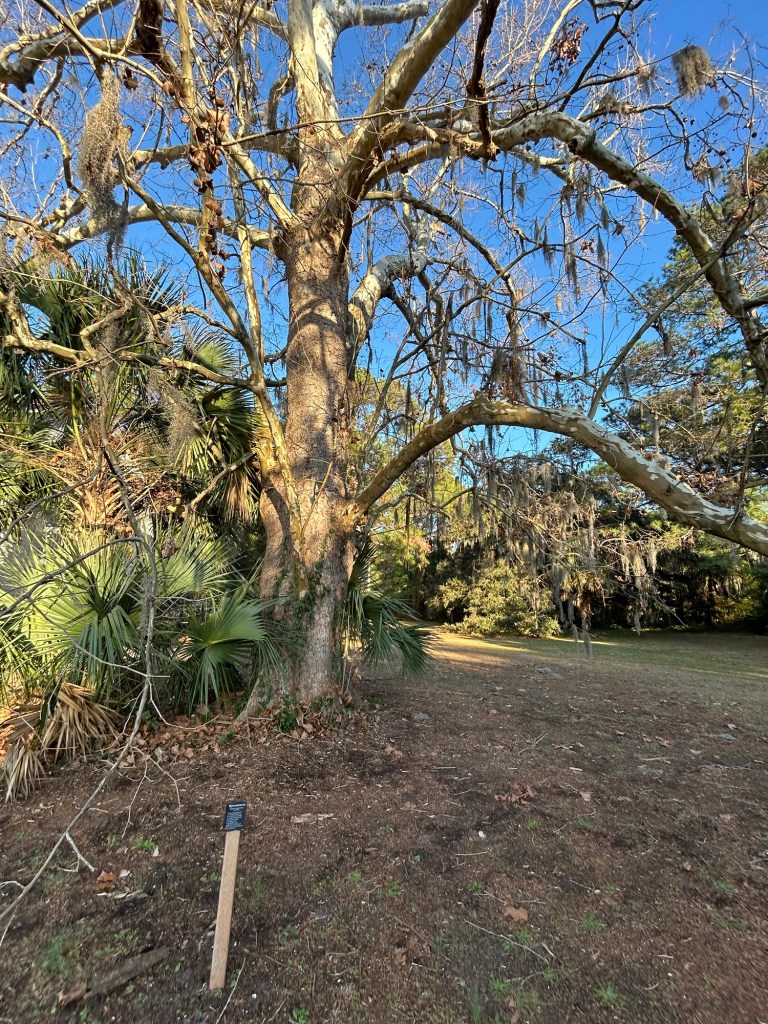
This tree is on the grounds of the Carolina Coastal Museum on Hilton Head Island.
Thanks to the handy little markers, I can tell you it is a Sycamore.
Who doesn’t remember the Sycamore Tree?
If you grew up with me in West Michigan church circles, at some point in your life didn’t you sang the Sunday School song about Zacchaeus that goes:
Zacchaeus Was A Wee Little Man, And A Wee Little Man Was He. He Climbed Up In A Sycamore Tree, For The Lord He Wanted To See. And As The Savior Passed Him By, He Looked Up In The Tree, And He Said, “Zacchaeus, You Come Down; For I’m Going To Your House Today, For I’m Going To Your House Today”
By some misguided judgement, for a couple years of my life, I was the summer replacement, emergency go-to-guy for the 4 Year Old Sunday School class at my Church and this song was a staple of my time with the 4 year olds.
I sang it as I only I could and slowed the 5th verse down so that me and all the kids held out one finger and pointed and said each word slowly so that it came out Zacchaeus! (Pause-Point) You (Pause-Point)Come (Pause-Point)Downnnnnnnnnnnnnnnnnnnn!
Then I changed the last word so that we sang, For I’m Going To Your House To Play, For I’m Going To Your House To Play.
When I went home after church, I took the phone off the hook so calls from parents went answered.
Can’t explain it, but week after week, I got asked to come back …
Anyway, back on the Island, when I read the little marker in front of the tree, I thought that for the first time in my life I was looking at a Sycamore Tree and I sang the song over and over until I was told to please shut up.
But I was happy.
I was standing in front of a Sycamore and it was easy to see with the low branches and the number of branches how wee little Zacchaeus was able to climb up in the tree.
I could picture the wee little man in his purple robes, just like in the flannel graph song sheets we had in Sunday School, hanging from the branches.
So, it was with no little sadness to learn that there are sycamore trees and then there are sycamore trees.
Turns out, what I was looking at was a Platanus occidentalis, also known as the American Sycamore.
According to Wikipedia, it is a species of Platanus native to the eastern and central United States, the mountains of northeastern Mexico, extreme southern Ontario, and extreme southern Quebec.
The sycamore tree is often divided near the ground into several secondary trunks, very free from branches. Spreading limbs at the top make an irregular, open head. Roots are fibrous. The trunks of large trees are often hollow.
If you read the Bible story quoted above in the King James English, it says that Zacchaeus climbed up in a Sycomore tree not a Sycamore.
The New International Version of the Bible that I quote from does say sycamore-fig tree and that is a completely different tree from the Platanus occidentalis, also known as American sycamore.
The Sycamore-fig is the Ficus sycomorus, or the fig-mulberry (because the leaves resemble those of the mulberry), sycamore, or sycomore, is a fig species that has been cultivated since ancient times.
According to wikipedia, Ficus sycomorus is native to Africa south of the Sahel and north of the Tropic of Capricorn, excluding the central-west rainforest areas. It grows naturally in Lebanon; in the southern Arabian Peninsula; in Cyprus; in very localised areas in Madagascar; and in Israel, Palestine and Egypt.
Well.
As Frank Lloyd Wright might say, there you are.
My story for Palm Sunday, 2026.
Me and the Sycamore on Hilton Head, Zacchaeus and Jesus who said, “For the Son of Man came to seek and to save the lost.”
I hear your questions.
Even down here on the Sea Islands of South Carolina, I hear your questions.
You want to know what in the world Zacchaeus has to do with Palm Sunday.
I’ll tell you.
And I wasn’t something I noticed until I looked up these verses when I first saw the Sycamore.
In Chapter 19 of Book of Luke, Jesus looks up and sees that wee little man and tells him to come down.
The Book of Luke says that the crowd listened to Jesus explain why he was going to the House of Zacchaeus, the sinner, for supper.
The Book of Luke of Luke says that Jesus noticed he had the crowd interested so he told the parable of the Rich Man who gave 10 of servants money to invest and then Rich Man examined how the servants responded.
The Book of Luke says that after Jesus had said this, he went on ahead, going up to Jerusalem …
Those who were sent ahead went and found it just as he had told them. As they were untying the colt, its owners asked them, “Why are you untying the colt?”
They replied, “The Lord needs it.”
They brought it to Jesus, threw their cloaks on the colt and put Jesus on it. As he went along, people spread their cloaks on the road.
When he came near the place where the road goes down the Mount of Olives, the whole crowd of disciples began joyfully to praise God in loud voices for all the miracles they had seen:
“Blessed is the king who comes in the name of the Lord!”
“Peace in heaven and glory in the highest!”
So it seems that on the Morning of Palm Sunday, Jesus met Zacchaeus.
I guess he at lunch at his house and then went to ride into Jerusalem.
And we remember this because of that great Palm Sunday song …
Zacchaeus Was A Wee Little Man, And A Wee Little Man Was He. He Climbed Up In A Sycamore Tree, For The Lord He Wanted To See. And As The Savior Passed Him By, He Looked Up In The Tree, And He Said, “Zacchaeus, You Come Down; For I’m Going To Your House Today, For I’m Going To Your House Today”
rapidly changing … no way to anticipate these occurrences
Weather, however spectacular to the eye, may present difficult conditions and compositions, especially when working with large cameras.
Setting up the camera takes several minutes during which the first promising aspects of light and cloud may disappear.
I would sometimes wait hopefully for the scene that I could visualize as an exciting image.
It was occasionally realized, but I have always been mindful of Edward Weston’s remark, “If I wait for something here I may lose something better over there.”
I have found that keeping on the move is generally more rewarding. However, it is important to say that I photographed from this particular viewpoint in Yosemite many times over many years, with widely varying results.
Clearing Winter Storm came about on an early December day.
The storm was first of heavy rain, which turned to snow and began to clear about noon.
I drove to the place known as New Inspiration Point, which commands a marvelous vista of Yosemite Valley.
I set up my 8×10 camera with my i2’/4-inch Cooke Series XV lens and made the essential side and bottom compositional decisions.
I first related the trees to the background mountains as well as to the possible camera positions allowed, and I waited for the clouds to form within the top areas of the image.
Rapidly changing situations such as this one can create decision problems for the photographer.
A moment of beauty is revealed and photographed; clouds, snow, or rain then obscure the scene, only to clear in a different way with another inviting prospect.
There is no way to anticipate these occurrences.
From Examples: The making of 40 photographs by Ansel Adams (Boston: Little, Brown Collection, 1983).
I used to be into photography and cameras and film and a darkroom that my Dad bankrolled for reasons I cannot understand today but maybe that I spent hours down in the basement away from everyone else had something to do with it.
Today I use my iPhone.
I use my iPhone and I think about the work of Ansel Adams.
Maybe it is a bit much for me to think about my camera work and Ansel Adams in the same sentence but I am the guy that edits Langston Hughes and Carl Sandburg into 17 syllables so there you are.
It is evident and important to remember that from his writings and commentary, Ansel Adams saw not just a scene, but the photograph he could make of that scene in his mind before he ever got out a camera.
He was such the master of the tools of his day that he knew just what camera, what lense, what filter, what settings, what film, what developer and what photographic paper he would use to make the final print before he snapped the shutter.
His work was getting all of these things to produce what he saw in his mind in the final print.
I think he would have loved an iPhone.
I think he would have embraced Adobe Photoshop and digital imagery as he worked to interpret what he had on his iPhone to match what he had in his mind when he envisioned a photo.
I think he would have spat on artificially generated images while at the same time, the final prints of his photos may have had a lot more to see that what his camera picked up.
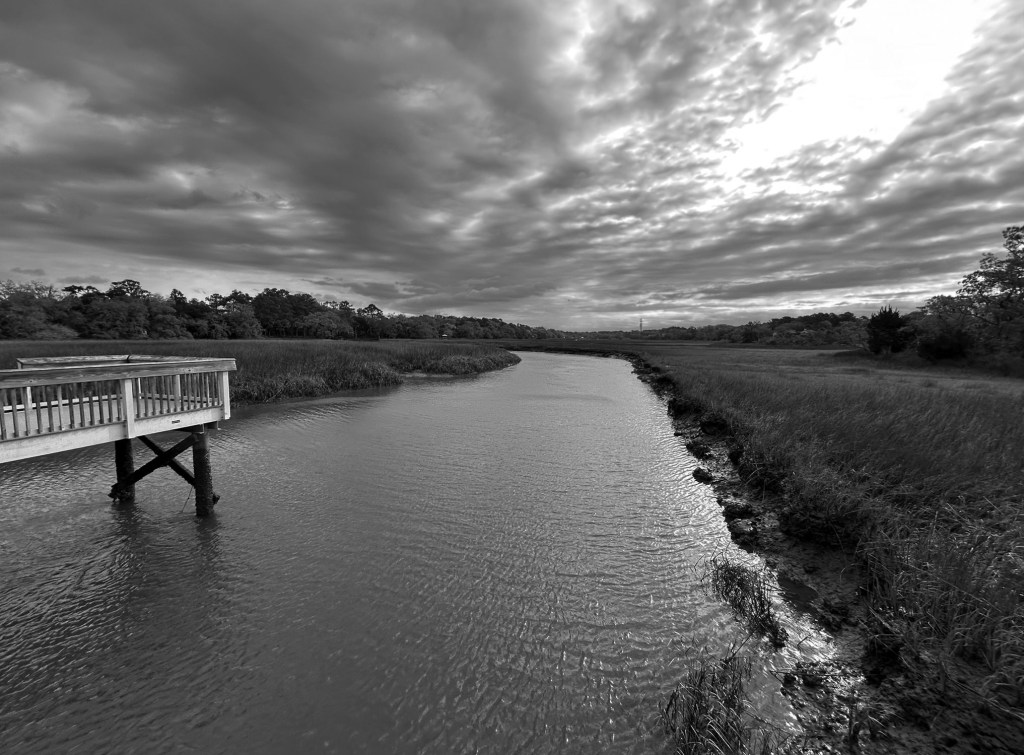
This morning I biked over to Horse Creek Landing Pier on Hilton Head Island.
My guess is that most folks could have been coming to Hilton Head for 40 years and never heard of the place.
I walked out on a narrow fishing/crabbing pier and looked into the heart of the island.
The tide was going out.
A storm front with gale force wind warnings attached to it was coming in.
The sun shone through the clouds.
Rapidly changing situations such as this one can create decision problems for the photographer.
A moment of beauty was revealed and photographed; clouds, sun, or rain then obscure the scene, only to clear in a different way with another inviting prospect.
forget that, when are they going to do statue? one surreal moment …
Adapted from the article, “Flatterers out in force to fill Trump’s head with Venezuelan statue dreams” by David Smith where Mr. Smith writes:
Burgum added that, during his recent trip, the media had been allowed to visit Venezuela’s equivalent of the White House, the Miraflores Palace, for the first time in 20 years. He said there were encouraging signs for US businesses returning and for oil production. But Trump’s mind was still elsewhere.
“Forget that,” the president interjected. “When are they going to do the statue?” The room erupted in laughter.
Trump has long had a special interest in statues. He has railed against protesters who toppled Confederate statues, proposed a National Garden of American Heroes and this week installed a Christopher Columbus statue on the White House grounds. Congresswoman Anna Paulina Luna has proposed carving Trump’s face on Mount Rushmore in South Dakota.
The exchange was just one surreal moment in another weird and wild cabinet meeting, the first since the war in Iran broke out. Trump claimed that Iran has been “beat to shit” and accused British prime minister Keir Starmer of a “shocking” lack of support. He went on a long riff about the merits of Sharpies over what he claimed were the $1,000 pens that presidents typically use to sign bills.
Just one surreal moment in another weird and wild cabinet meeting.
Just one surreal moment.
Another surreal moment was listening to people argue that ‘we’ are safer today now that those folks in Iran no longer have the ability to nuke us.
That those folks in Iran who have been after us since the Carter administration are no longer a threat.
That people in the US feel safer today because of this.
I said to my wife I never felt a threat from Iran.
She agreed and put forward the thought that we had lived most of our lives under the threat of immediate annihilation from the dread Soviet Evil Empire and with that in our background, Iran didn’t seem like much to worry about.
I been thinking about that.
I think she is right.
But a good part of the population today don’t remember the Soviet Union.
But a good part of the population today don’t remember those Olympic Teams of the CCCP.
Just one surreal moment in another weird and wild world that exists due the efforts on one man.
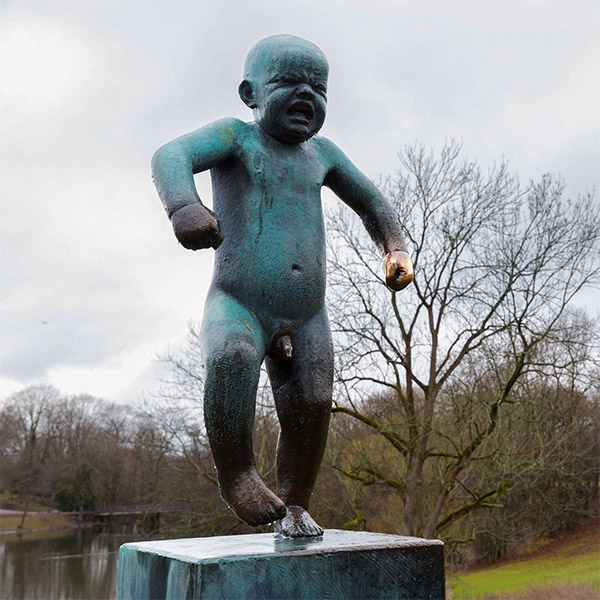
I guess he desrves a statue.
BTW – this is a real statue in Oslo, Norway. The creator, Norwegian sculptor Gustav Vigeland, spent the last two years of his life making the statues in a particular park in Oslo contains 212 bronze and granite sculptures and covers around 80 acres of land. including this mad baby. Here we have a statue of a giant, angry infant throwing a naked tantrum on top of a cube stacked atop a larger cube.

 No Haiku For You