11.10.2024 – America singing

America singing
each singing what belongs to
him or her, none else

I hear America singing, the varied carols I hear,
Those of mechanics, each one singing his as it should be blithe and strong,
The carpenter singing his as he measures his plank or beam,
The mason singing his as he makes ready for work, or leaves off work,
The boatman singing what belongs to him in his boat, the deckhand singing on the steamboat deck,
The shoemaker singing as he sits on his bench, the hatter singing as he stands,
The wood-cutter’s song, the ploughboy’s on his way in the morning, or at noon intermission or at sundown,
The delicious singing of the mother, or of the young wife at work, or of the girl sewing or washing,
Each singing what belongs to him or her and to none else,
The day what belongs to the day — at night the party of young fellows, robust, friendly,
Singing with open mouths their strong melodious songs.

I Hear America Singing by Walt Whitman as published in Leaves of Grass (Garden City, N. Y. : Doubleday, 1919 Edition).

According to Wikipedia, “The book received its strongest praise from Ralph Waldo Emerson, who wrote a flattering five-page letter to Whitman and spoke highly of the book to friends. Emerson called it “the most extraordinary piece of wit and wisdom that America has yet contributed.” Emerson had called for the first truly American poet, saying that aspects of America “are yet unsung. Yet America is a poem in our eyes.”

I like that last part a lot.

Aspects of America “are yet unsung. Yet America is a poem in our eyes.”

And I want to believe that holds through to today.

There are poems yet to be written.

Songs yet to be sung.

Each singing what belongs to him or her and to none else.

I look forward to hearing America singing, the varied carols to hear.

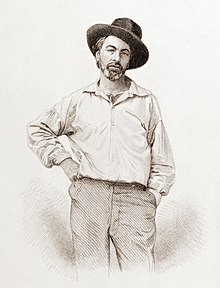
PS: According to Wikipedia this engraving of Mr. Whitman from 1856 was printed in the front piece of the Leave of Grass. Not yet the white haired, bearded old guy that first comes to mind now was he?
11.9.2-24 – did as the man said –

did as the man said –
one does what one is, then one
becomes what one does

It was the Austrian writer, Robert Musil, who said:

One does what one is; one becomes what one does

A lot of people have been explaining to how they voted in the last election.

They didn’t agree with the guy.

They felt the guy was less than perfect or maybe imperfect.

That other lady had so many things wrong with her (this is one that threw me as why did it count against her and not against him?).

But I don’t agree in this case.

I felt that the guy, regardless of any benefits, was unfit for office.

And I could not bend my mind or my standards enough to allow myself to consider voting for him.

A lot of people have tried to explain to me that that was how they voted but it wasn’t who they were.

I couldn’t get there.

You had to get on his train and go where the train was going.

I feel sorry for those people who think otherwise.

You see, one does what one is.

And one becomes what one does.

I hope you can live with yourself.

11.8.2024 – cultivate habit

cultivate habit
not being particular
about little things

Adapted from the essay, Tripping Over Trivia by Damon Runyon as published in Short Takes, Readers’ Choice of the Best Columns of America’s Favorite Newspaperman, Damon Runyon (Constable, Orange Street London, 1948.)

I am trying to cultivate the habit of not being particular about little things. I suppose that after years of being very particular, indeed, I will find it difficult to shake off some of my old exactions, but I must keep struggling. I have come to the conclusion that I have been wasting an enormous amount of time in being particular.

Take the small matter of boiled eggs. I used to be mighty particular about how long my boiled eggs should be boiled. I made a strong point of specifying that they should be boiled three minutes and a half. I had the idea that I could not even look at eggs boiled less than that time or two seconds beyond. The cooks could not fool me, either, though sometimes I suspected they exerted the most diabolical ingenuity in the effort. I could tell to a clock-tick how long they had boiled eggs the instant they were set before me.

One day I sat down and seriously contemplated the economic phases of the boiled egg situation as applied to me. I considered, through careful calculation, the hours I must have wasted in arguing with waiters that those eggs had not been boiled three and a half minutes, but only two and a half, or maybe four, and in sending them back to the kitchen and then waiting for another boiling.

When my figures showed that on being particular about my boiled eggs alone I had wasted fifteen years, I was appalled. It was then I made up my mind to cease being particular. I immediately made some progress on the boiled eggs. I began calling for them scrambled.

Mr. Runyon may be more well known for his musical Guys and Dolls, often thought to be THE American Musical ( up against Oklahoma and the Music Man).

In Guys and Dolls, the Hero Skye Masterson says:

On the day when I left home to make my way in the world, my Daddy took me to one side. ‘Son,’ my Daddy says to me, ‘I am sorry I am not able to bankroll you to a very large start, but not having the necessary lettuce to get you rolling, instead I’m going to stake you to some very valuable advice.

One of these days in your travels, a guy is going to show you a brand-new deck of cards on which the seal is not yet broken. Then this guy is going to offer to bet you that he can make the jack of spades jump out of this brand-new deck of cards and squirt cider in your ear. But, son, you do not accept this bet, because as sure as you stand there, you’re going to wind up with an ear full of cider.

Friends and neighbors, I woke up Wednesday morning and let me tell you friends, I had an ear full of cider!

Time to start calling for scrambled eggs!

11.7.2024 – a grey mist sea’s face,

a grey mist sea’s face,
must go down to the seas, call
of the running tide

I must go down to the seas again, to the lonely sea and the sky,
And all I ask is a tall ship and a star to steer her by;
And the wheel’s kick and the wind’s song and the white sail’s shaking,
And a grey mist on the sea’s face, and a grey dawn breaking.

I must go down to the seas again, for the call of the running tide
Is a wild call and a clear call that may not be denied;
And all I ask is a windy day with the white clouds flying,
And the flung spray and the blown spume, and the sea-gulls crying.

I must go down to the seas again, to the vagrant gypsy life,
To the gull’s way and the whale’s way where the wind’s like a whetted knife;
And all I ask is a merry yarn from a laughing fellow-rover,
And quiet sleep and a sweet dream when the long trick’s over.

Sea-Fever By John Masefield.

This poem is forever in my mind remembered from the original Willy Wonka & the Chocolate Factory movie when everyone gets on board he Wonkatania and Gene Wilder gestures towards the ship and says, “And all I ask is a tall ship and a star to steer her by;

Then the boat goes through what has been considered to one of the most bizarre 3 minutes in movie history.

It has been written that, “ … you can see the abject terror plastered on the faces of children and adults alike in the scene. He didn’t tell any of the performers how Wilder would behave in character for that particular sequence, which led some of the younger actors, like Denise Nickerson (aka Violet Beauregarde), to believe Wilder was suffering a very sincere, very alarming psychotic breakdown.”

I feel like we are all about to start that boat ride.

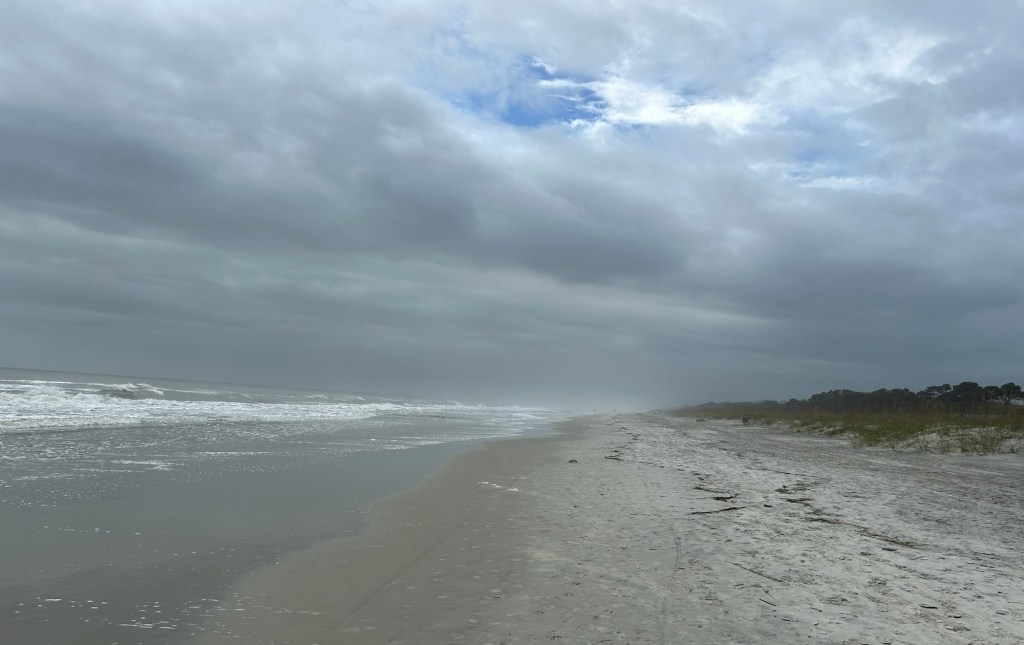
Walking on the beach yesterday the clouds closed in to the south and you couldn’t see far down the beach or across the water to Tybee Island.

The horizon of the water and the horizon of the sky were together.

A light rain fell.

I must go down to the seas again, for the call of the running tide

is a wild call and a clear call that may not be denied.

The mist will clear and we will see the way through.

11.6.2024 – Democracy – the

Democracy – the
recurrent suspicion that
the people are right

In July of 1943, the Writer’s War Board (According to wikipedia, the Writers’ War Board was the main domestic propaganda organization in the United States during World War II. Privately organized and run, it coordinated American writers with government and quasi-government agencies that needed written work to help win the war. It was established in 1942 by author Rex Stout at the request of the United States Department of the Treasury) reached out to E.B. White at the New Yorker Magazine and asked for a statement on the meaning of democracy.

Mr. White started out by writing, “It is presumably our duty to comply with such a request, and it is certainly our pleasure. Surely, the board knows what democracy is.”

Mr. White continued:

It is the line that forms on the right.

It is the don’t, in don’t shove.

It is the hole in the stuffed shirt through which the sawdust slowly trickles; the dent in the high hat.

Democracy is the recurrent suspicion that more than half of the people are right, more than half of the time.

It is the feeling of privacy in the voting booths; the feeling of communion in the libraries; the feeling of vitality everywhere.

Democracy is the letter to the editor.

Democracy is the score at the beginning of the ninth.

It is an idea which hasn’t been disproved yet; a song, the words of which have not gone bad.

It’s the mustard on the hot dog, and the cream in the rationed coffee.

Democracy is a request from a War Board – in the middle of the morning, in the middle of a war – wanting to know what democracy is.

On the one hand, I feel called upon to play my part of good loser.

Fought the good fight and lost but ready to go on.

I want to admit that maybe, just maybe, Democracy is the recurrent suspicion that more than half of the people are right, more than half of the time.

But I can’t.

I feel the picture Mr. White paints of America in World War 2, believe or not, was a much sunnier place, a much more hopeful place than America today.

I wish my feeling for Democracy had the elasticity that the faith of those on other side has that allows them to bend their faith and their beliefs to embrace that guy.

I want the country to feel the feeling of vitality everywhere.

But it sure seems we are, to quote Mr. Churchill, about to enter a new dark age.

I am going to have faith in the Constituion.

And hang on and hold my breath for the next 4 years.

Still thinking about 1943 and the era Mr. White writes about that FDR won again, again and again.

I am reminded of an anecdote that I have written about before.

I like the story, but I cannot recall where I read it or the citation for it but here it is.

This author was a kid during WW2 and grew up in the Republican strong hold of Grosse Pointe, Michigan.

He reminded a spring evening once where all the people in the neighborhood built bonfires and danced in big circles, joining hands around the fires to celebrate.

Looking at a calendar, he puzzled out that this had to have happened in April or May of 1945 and he asked his mother if she remembered and was the celebration for VE, Victory in Europe, Day, the day Germany surrendured.

OH NO,” said his mother, “We danced because Roosevelt was dead.”