12.31.2023 – wasn’t just football

wasn’t just football …
felt bigger than that – We were …
in it together

And it wasn’t just about football. It felt bigger than that — as if joining a massive crowd is novel and embarrassingly spiritual. We were in it together.

From the New York Times Guest Opinion piece, I Was Transformed by the Best Cult Ever: Michigan Football, (Dec. 31, 2023). By Jaime Lowe.

Ms. Lowe is the author of, most recently, “Breathing Fire: Female Inmate Firefighters on the Front Lines of California’s Wildfires” and a Knight-Wallace fellow at Michigan.

I can write that you either get it or you don’t.

You are a part of this or you aren’t.

And I will admit, that you could read this story from the perspective of any college football teams and their alumni/fan following in America today.

… Just not on the front page of the New York Times.

Maybe on some fan blog.

Maybe on the school’s alumni website.

Maybe in the local newspaper from the home town of that college.

… Just not on the front page … of the New York Times.

Ms. Lowe writes:

I entered the Big House again and again, for the rest of the season. For seven home games, I understood more about why I gravitated to the stadium. Something clicked. My mood, upon entering, changed immediately. I was swept up in frenetic joy. It was as if we, the fans, were a superorganism.

Through football, my mental health shifted; I was happy for the first time in a long time. I found strangers who became friends; long-lost friends (die-hard Michigan fans) who re-emerged in my life; relatives and colleagues who were alumni cheering on my cheering from afar.

In 2021, the Stanford literature professor Hans Ulrich Gumbrecht wrote a book about crowds and stadiums as a ritual of intensity. He covered the idea that crowds can open humans up to experiences beyond ourselves.

Since Covid, these gatherings are more pronounced. I realize escape is a privilege, but for me the season pass was cheaper than one session of therapy.

I am now a person who knows that in 1939, a live wolverine in a cage was paraded around the field at halftime. I stormed the field after the win over Ohio State — our last home game — and woke up with a sprained toe, four bruises, no ability to talk because I had been screaming, a sunburn (it was 19 degrees that morning, so who knows how that happened) and a spiritual awakening.

So we stole some signs.

So we ignored the NCAA.

So what!

We get it.

Because at some point in our lives, we have stormed the field after the win over Ohio State.

Woke up with a sprained toe, four bruises.

No ability to talk because we had been screaming.

A sunburn (it was 19 degrees that morning, so who knows how that happened).

And a spiritual awakening.

We are in it, TOGETHER.

You can read all about here.

In the New York Times.

12.30.2023 – Christmas in the air

Christmas in the air,
yet the air seemed too soft to
sustain the treasure

In his January, 1966 essay, What Do Our Hearts Treasure?, EB White laments a Christmas in Florida away from New England, snow and family.

Mr. White writes: The scene was idyllic. Christmas was in the air, yet the air seemed too soft to sustain it.

Mr. White and his wife, Katherine Angell White, receive a box from home with evergreens, gifts and photos and with these items, the White’s restore the feeling’s of the holiday as they remember the question, What do our hearts treasure?

Mr. White does not go one to include the answer to this question that comes from the Bible.

For where your treasure is, there your heart will be also. (Matthew 6:21)

We took a day to drive up to Atlanta to see our kids and our grand kids.

We had presents but seeing those people, I tell you, it wasn’t that the air seemed too soft to sustain it, it was that the air was strong enough to contain it.

Where is my treasure?

It is with my heart … up in Atlanta.

12.29.2023 – All knew… ALL KNEW … that

All knew… ALL KNEW … that
this interest was the cause …
And? And the war came …

Both parties deprecated war but one of them would make war rather than let the nation survive, and the other would accept war rather than let it perish.

And the war came.

One eighth of the whole population were colored slaves not distributed generally over the union but localized in the southern part of it.

These slaves constituted a peculiar and powerful interest.

All knew that this interest was somehow the cause of the war.

To strengthen perpetuate and extend this interest was the object for which the insurgents would rend the Union even by war

Abraham Lincoln, Second Inaugural Address.

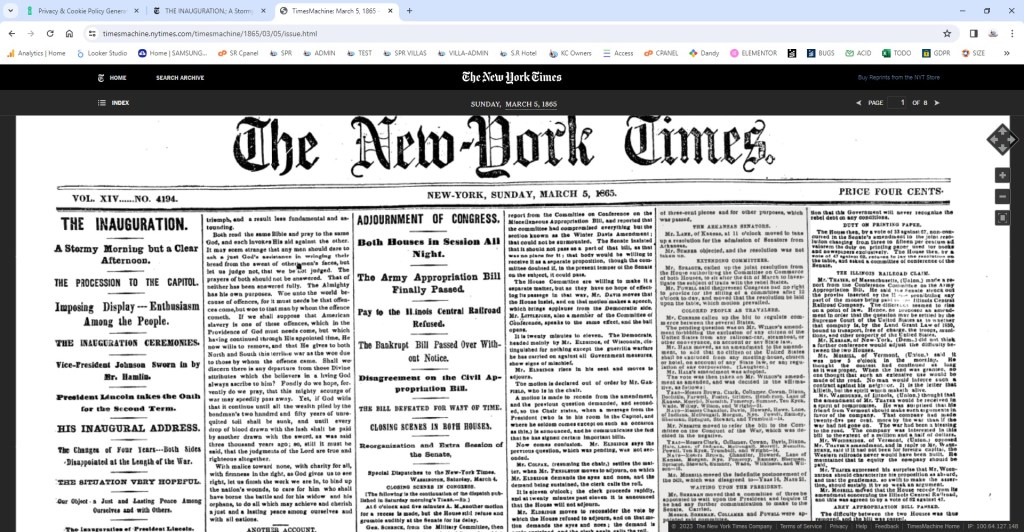
On March 4, 1865, only 41 days before his assassination, President Abraham Lincoln took the oath of office for the second time.

Lincoln’s second inaugural address previewed his plans for healing a once-divided nation.

The speech is engraved on the north interior wall of the Lincoln Memorial.

The war was still going on on March 4, 1865 and Mr. Lincoln had no problem saying “All knew that this interest was somehow the cause of the war.

As far as I can tell, no one disputed this claim at the time.

The New York Times slugged its coverage of the speech stating:

THE INAUGURATION

A Stormy Morning but a Clear Afternoon.

THE PROCESSION TO THE CAPITOL.

Imposing Display–Enthusiasm Among the People.

THE INAUGURATION CEREMONIES.

Vice-president Johnson Sworn in by Mr. Hamlin.

President Lincoln takes the Oath for the Second Term.

HIS INAUGURAL ADDRESS.

The Changes of Four Years–Both Sides Disappointed at the Length of the War.

HE SITUATION VERY HOPEFUL.

Our Object a Just and Lasting Peace Among Ourselves and with Others.

No one said, “PRESIDENT OFFERS NEW REASON FOR WAR.”

No one said, “SLAVERY? REALLY?”

Mr. Lincoln said, ALL KNEW and all seemed to understand what he meant by all and what he meant what it was they knew when he said ALL KNEW.

Mr. Lincoln was the man on scene.

Mr. Lincoln would have been the one to know what he meant when he said ‘all knew’ and he knew what it WAS that ‘all knew’ when he said ‘all knew’.

Over the years since, the question has not changed.

What caused the Civil War.

Back in 1865, Mr. Lincoln said all knew what caused the Civil War.

I mean, at this moment, I am not pointing fingers at who or what was said, but that, today, the newsroom discussions to answer the question are searching searching searching.

Might has well ask what color was George Washington’s White Horse.

OH … ohhhhhhhh. .. oh, gee whiz.

PS That was asked once in a class I was in and the kid next me yelled back, How am I supposed to know that??

Mr. Lincoln .. possibly at the moment he said, “All knew that this interest was somehow the cause of the war.

12.28.2023 – as if woke from nap

as if woke from nap
didn’t mean to take, into world
don’t quite recognize

I grew up with comic books.

A lot of comic books.

Not the Marvel – Super Hero genre, but the Gold Key / Walt Disney comic books of Uncle Scrooge the Billionaire and Moby Duck the Whaler.

Comic books were community property in our house.

There was a built in cabinet along one wall of our family room and in the cabinet were three drawers and all the comic books got tossed in there to be read and re-read by all of us.

With their drawings and balloons of text or bubbles of text to show the text was just a thought, me and my brothers and sisters had no problems reading through the pages of dialogue.

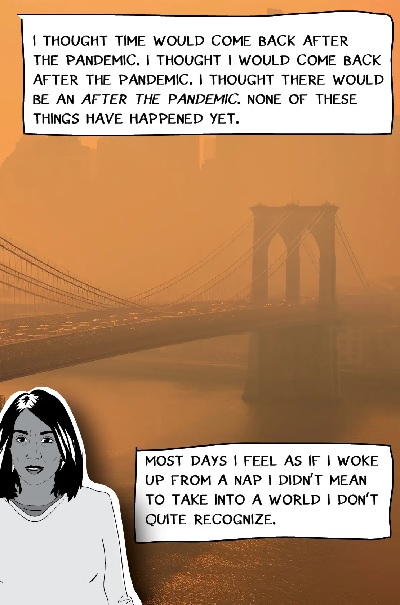
With this in mind, I had no problems navigating the work of Mira Jacob’s OP-ART piece in the New York Times titled, Things I Thought Made Sense Just Don’t Anymore.

Her first panel has the text:

I thought time would come back after the pandemic. I thought I would come back after the pandemic. I thought there would be an AFTER THE PANDMEIC. None of these things have happened yet.

Most days I feel as if I woke from a nap I didn’t mean to take into a world I don’t quite recognize.

Boy howdy but BOY HOWDY do I get it.

Most days I feel as if I woke from a nap I didn’t mean to take into a world I don’t quite recognize.

I thought about that line.

Most days I feel as if I woke from a nap I didn’t mean to take into a world I don’t quite recognize.

I am a champion napper.

I like to say I want napping to be in the Olympics and I am in training to win the gold medal.

I used to be able to take a 15 minute nap.

No matter where and no matter when, I could close my eyes and be asleep and wake up, without fail, in 15 minutes.

Wake up and be ready to go.

Of late, those naps are lasting about 20 to 25 to 30 minutes.

I wake up feeling muzzy (is there a better example of onomatopoeia than muzzy?).

I wake up sometimes in a world I don’t quite recognize.

Then I come back around.

But …

I am reminded of the story of Rip Van Winkle who feel asleep and woke up 20 years later.

Washington Irving wrote that back in 1819.

Not sure but pretty sure there wasn’t a pandemic back in 1819 but something had to motivate Mr. Irving.

Looking for an answer I dove into Wikipedia to learn that the storyline of napping and waking up in a world the hero doesn’t quite recognize goes way back in history.

Along with Mr. Van Winkle there is Honi HaMe’agel, the Seven Sleepers of Ephesus, Uzair Epimenides of Knossos, Peter Klaus, Ranka and a feller named Urashima Tarō.

According to Wikipedia, “Multiple sources have identified the story of Epimenides as the earliest known variant of the “Rip Van Winkle” fairy tale.”

That was back in the 3rd Century AD.

All through the sad and sorry history of this world, there are writers who feel displaced and give voice to their feelings in fables and stories about people who feel as if they woke from a nap they didn’t mean to take into a world they don’t quite recognize.

I sure feel that way today.

Much like Justice Oliver Wendall Holmes who at age 92, feel asleep during an argument in the United States Supreme Court.

When nudged by the Justice next to him, Justice Holmes is reported to opened his eyes and yelled, “Jesus Christ! Where the hell am I?”

Lucky for me I still pick up my tablet in the morning to read my Bible.

This morning I read, “I consider that our present sufferings are not worth comparing with the glory that will be revealed in us.” (Romans 8:18 NIV)

Our present sufferings are not worth comparing with the glory that will be revealed in us.

In his Hornblower series of novels, CS Forester describes how our hero, Horatio Hornblower, is taking his oral examination for promotion to Lieutenant and is about to fail when the proceedings are broken up by an enemy attack.

When things settle down, young Hornblower askes one of his Officers who made up the examining board about his possible promotion.

The Officer askes Hornblower if he remembers that he was about to be failed when the attack ended the exam.

The Officer looks at Hornblower and says, “Then be thankful for small mercies. And even more thankful for big ones.”

I will remember that our present sufferings are not worth comparing with the glory that will be revealed in us.

And I will be thankful for small mercies.

And even more thankful for big ones.

12.27.2023 – little has gone right …

little has gone right,
very little … what’s gone wrong?
multifaceted
!

In his 1965 book, The Hustler’s Handbook, Bill Veeck (as in wreck) writes about the New York Mets:

The Mets established a certain stature from the first. They were, after all, the team that was on its way to losing more games than any other team in the long and meticulously recorded history of baseball. You weren’t just shuffling around rooting for a lousy team — which anyone could do — you were rooting for the most goshawful team ever.

According to the article in the Guardian today, The Pistons’ dismal journey to become the NBA’s worst-ever team” by Alex Kirshner, “The Detroit Pistons finally, formally made history on Tuesday night. Detroit lost their single-season record 27th consecutive game, the latest coming at home by a 118-112 score against the Brooklyn Nets. By falling to 2-28, the Pistons built more cushion in a perhaps inexorable quest to become the worst team in league history.

The City of Detroit has experienced this sort of streak with all its professional sports teams.

The fans of the professional sports teams of the City of Detroit have lived through this before.

There is a word for it.

Infracaninophile.

Infracaninophiliac.

Infracaninophilism.

One who loves and roots for underdogs.

Veeck continues on the Mets, “The beautiful part of it is that once this kind of thing picks up momentum, every failure becomes an asset. Once you’ve got everybody in the frame of mind where they’re expecting something ridiculous to happen, then ridiculous things have a way of happening.”

I don’t understand how any team can manage to lose 27 games in a row.

Once you’ve got everybody in the frame of mind where they’re expecting something ridiculous to happen, then ridiculous things have a way of happening.

Even you tried to lose, it seems you couldn’t lose 27 in a row.

Once you’ve got everybody in the frame of mind where they’re expecting something ridiculous to happen, then ridiculous things have a way of happening.

Mr. Kirshner writes, “The The Pistons are 2-28 because they have been cartoonishly, cataclysmically bad on the margins.”

Cartoonishly, cataclysmically.

Typically, even the worst team in such games wins 25 or 30% of them, but the Pistons cannot buy a victory in crunch time. Arithmetic and spirituality suggest that the Pistons eventually get a break when it matters most, but faith is hard to come by.

Arithmetic and spirituality.

If you could string that all together because once you’ve got everybody in the frame of mind where they’re expecting something ridiculous to happen, then ridiculous things have a way of happening, what would you get?

Cartoonishly, cataclysmically, arithmetic and spirituality what would you get?

Infracaninophile.

But faith is hard to come by.