5.6.2023 – sorry your Highness

sorry your Highness
organised properly for
next coronation

So said Thomas Howard, 2nd Earl of Effingham, to His Majesty King George III when the Earl apologized for all the mishaps at the coronation of the King, Tuesday, 22 September 1761.

The coronation was supposed to be managed by the Earl Marshal, Edward Howard, 9th Duke of Norfolk; however, being a Roman Catholic, he had to step back and dropped the planning into his cousin’s lap, Mr. Howard.

According to Wikipedia, When George III complained about the problems to the Earl, Effingham “ … admitted that there had been “some neglect”, but that he would make sure that the next coronation would be organised properly.

Wikipedia also reports that George was highly amused by the answer and made Effingham repeat it several times.”

The first time I heard this anecdote, the quote given was, more along the lines, Sorry Sir, We will get it right next time.

Oddly enough one of the problems was that a jewel fell off the crown which later had some people saying was a bad omen that predicted the American Revolution.

Watching the ceremonies today and I have to ask what aspects of history of kings and queens and family and such might go through your mind if you were in Charles shoes?

I point out that if look at the Crown that Charles wore when he left the Church there are four pearls that dangle down from the top of the crown over the purple cloth.

Those pearls are reported to be earrings that were worn by Elizabeth I.

When Elizbeth I was Queen, it was known that she always wore a ring that was special to her.

When she died, it was found out that the ring was a locket.

Inside the locket was a miniature painting.

A likeness of Queen Elizabeth’s mother.

Anne Boleyn.

2nd wife of Henry VIII.

Like I asked.

What might go through your mind?

5.5.2023 – a bit of the past

a bit of the past
suddenly appearing in
front of us again

Based on the passage, … it is going to be an incredible thing to see this happen again, just because the sheer antiquity of it is something to marvel at. It is really like a bit of the past suddenly appearing in a time machine in front of us.

From the article, How coronation of King Charles will revive some of oldest British rituals by Esther Addley.

So this feller Charles III will be crowned King of England, the Lord’s anointed one to lead the people of Great Britain.

Chosen mostly because of who his ancestors were back when Queen Anne survived all of her 5 children who survived at birth (she had 12 others who did not) so that when Queen Anne died in 1714, the Brits went looking for King and chose the the Queen’s 2nd cousin, the first of the German George’s of Hanover whose family tree led to, eventually to Charles.

And the Brits get a new King but no choice.

While over here, though it is over a year away, America is facing an election that according to most polling, will offer two choices the no one in America wants to chose from.

So there you are.

Not for me at this time to say which way works out better.

I, for myself, am fascinated by the history.

In the article I quoted from there is this great point.

When King Charles enters Westminster Abbey for the coronation ceremony on Saturday, he will be preceded, among many other items of royal bling, by a short gold rod topped with a small cross, known as St Edward’s staff. Unlike the stone of destiny, the sword of mercy or the bracelets of sincerity and wisdom – all real items of regalia that will play symbolic roles in the ceremony – the staff has no role whatsoever. It is carried in at the start of the service, set on the altar, and then carried out again at the end.

In fact, no one has any idea what St Edward’s staff is meant to represent. When Charles II, restored to the throne in 1660 after the English Civil War, ordered his goldsmiths to remake the crown jewels that had been sold or melted down by parliamentarians, the inventory of items that had been lost included a staff of Saint Edward. And so one was made to replace it – an important symbol of something, even if no one could remember what.

I feel the whole spectacle is an important symbol of something, even if no one could remember what.

I feel there used to be a lot of things here in the United States that USED TO BE important symbols.

Right now, I can’t think of one that hasn’t been cheapened, lessened or just make small in recent years.

I can remember what they used to stand for.

And I miss them.

Take something relatively recent like FDR’s four freedoms.

Freedom of speech, freedom of worship, freedom from want, and freedom from fear.

Freedom of speech is under attack and abused at the same time.

Freedom of worship seems to still be around but the religion itself has been defamed and cheapened by those who use it for things other than to further the Gospel and worship God.

Freedom from want is promised yet in the worlds “Greatest” country yet promised at terms that are near draconian and citizens go hungry.

And as freedom from fear, now that everyone has a weapon, I feel less safe than ever. How this works out as the cost of being free has me at a loss.

This weekend I will sit in front of a time machine and watch a little bit history unfold in front me and think of times past.

5.4.2023 – natural world is

natural world is
engaging and innocent
as it ever was

Adapted from:

If the vexatious world of people were the whole world, I would not enjoy it at all.

But it is only a small, though noisy, part of the whole; and I find the natural world as engaging and as innocent as it ever was.

When I get sick of what men do, I have only to walk a few steps in another direction to see what spiders do.

Or what the weather does.

This sustains me very well indeed and I have no complaints.

Letter to Carrie A. Wilson, May 1, 1951; Letters of E. B. White, Rev. Ed., p. 306.

5.3.2023 – happy memories

happy memories
to be sitting in the rain
making sand castles

Some of the special British details she describes I recognize – afternoon tea, double-decker buses, and so on. Others are more confusing to a colonial. One of the “special British moments” Eggs [Victoria Eggs, a London-based designer] tries to capture is a childhood memory of sitting on the beach in the rain. “We would go on holidays to the seaside, and it would be raining but that didn’t stop us building sand castles and sitting having ice-creams and fish and chips,” she tells me. She remembers “being wrapped in a towel which, if you were in another country, you’d be lying on. We had it wrapped around us in the drizzling rain, eating fish and chips”.

In all honesty, I don’t know what she’s talking about. But it also does sound like the most British thing I ever heard in my life: happy to be sitting in the rain making sand castles. Not only happy. This is one of her happiest memories. Nostalgia compensates for the discomfort, I guess.

From the article, God save us all: Britain is about to get the king it deserves, subtitled, Viewed from Canada, the coronation is especially absurd – and the contradictions of Charles III perfectly suit the moment, by Stephen Marche in The Guardian.

Notice the lower case k in king.

That is all you need to know what this article is about if you don’t want to take the time to read it.

King … with the lower case k.

That and these other sentences.

… it also does sound like the most British thing I ever heard in my life: happy to be sitting in the rain making sand castles.

Not only happy.

This is one of her happiest memories.

Nostalgia compensates for the discomfort, I guess.

I live in a resort town and when I can, I go for a walk on the beach of Atlantic Ocean on my lunch break.

In the early months of the year, even in South Carolina, the beach is the NOT the best place to be even though a bad hour on the beach beats most places.

Still, no matter the weather, the wind, the temperature of the ocean water, there those vacationers are.

They are there.

They are on vacation.

They have paid a lot of money for this.

And they are going to enjoy it, no matter what anyone else says.

As the Activities Director at my Resort once told me, “They are freezing to death, but they will never admit it.”

So there are the Brits.

Stuck with Brexit and no one understands it.

And stuck with Charles.

But, doggone it, they paid for it.

They are going to enjoy it somehow.

I have to love

Just right!

But there was a sadder note in the article when Mr. Marche quoted Jonathan Coe.

For Coe, the lack of enthusiasm for Charles has an obvious source. There is “no enthusiasm for anything”, he says, “The nation is demoralized.”

Boy do I hear that.

Where have you gone, Joe DiMaggio? A nation turns its lonely eyes to you.

There is “no enthusiasm for anything.

This nation is demoralized.

I guess I’ll watch the coronation.

5.2.2023 – expressionistic

expressionistic
or idiosyncratic
Georgia O’Keeffe

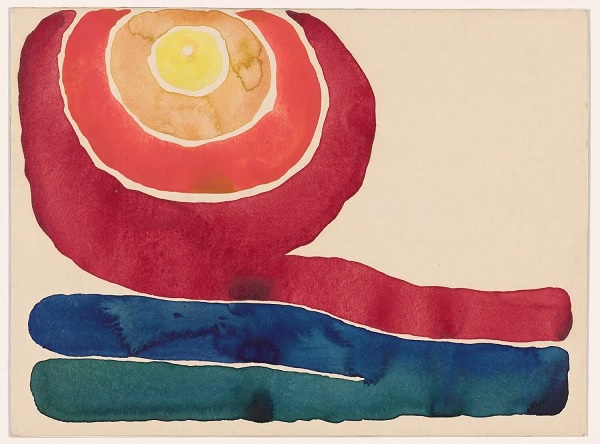
Georgia O’Keeffe’s “Evening Star No.III,” from 1917, in the exhibition “To See Takes Time.”
Credit…Georgia O’Keeffe Museum/Artists Rights Society (ARS), New York; via Museum of Modern Art

The O’Keeffe catalog raisonné, with its staggering wealth of art, makes two opposing points about the MoMA show. One is that there are several works whose inclusion would have shown the evolution in certain groupings, strengthening the curators’ notion of O’Keeffe’s “serial practice.”

The other is that the catalog raisonné presents a more diverse, less restrained and more unsettling O’Keeffe than is generally known — by turn expressionistic, akin to folk art or otherwise idiosyncratic. Some museum should throw caution to the wind and wrestle that O’Keeffe onto its walls. But it would take a degree of nerve, a love of visual impact and a reinvention of connoisseurship that few museums seem able to accommodate these days.

From the review, Georgia O’Keeffe, ‘Modernized’ by MoMA, by Roberta Smith.

And a catalogue raisonné is a comprehensive, annotated listing of all the known works of an artist either in a particular medium or all media.

Yep … I had to look it up.

I have always enjoyed the art of Georgia O’Keeffe.

Folks say that we all SEE the same things but we react or respond differently to what we see,

What I see in Ms. O’Keeffe is the color and the images.

My reaction, my response, is to sense, to feel the utter unbound freedom to feel.

I see her swoops and swirls and color and I can feel something in me gets unlocked.

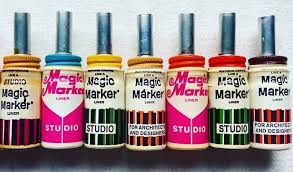
When I was about 4 years old, I went through my sisters desk and found some magic markers.

In those days a magic marker was white and about 3 inches long with a short cap and a wrapper of the color that matched the color of marker.

I don’t know what the were made from but the colors they left defined the word ‘indelible’.

Once you got that marker on paper, or through the many pages of paper that the color leached through, or your fingers or whatever, it was there permanently.

There was also a strong smell, like mimeograph ink, to these markers.

These markers also had their own sound.

When you used one, they made a high pitched squeal or squeak as the tip was moved over the surface of whatever you were magically marking.

I know all this because when I found my sisters magic markers, I took them back to my bedroom that I shared with my two younger brothers and looked at the bedroom walls and saw a blank canvas.

I can still hear the squeal.

I can smell the smell.

I can still feel the utter unbound freedom as I covered the walls of my bedroom with swoops and swirls of magic marker.

I stood in front of that blank painted plaster and swung my short 4 year old arms in full circle after circle after circle.

I have never felt anything like it since but looking at the work of Ms. O’Keeffe, the I can hear the tintinnabulations of this moment.

I call also hear my Mom when she walked into the room.

I think you will understand that seeking to understand if what I did was expressionistic or idiosyncratic was not what went through my Mom’s mind when she saw her walls.

As I remember it, it took many many coats of paint to cover up my swoops and swirls.

That house is still standing and if I know anything about magic markers, those swoops and swirls are still there waiting to be restored.

I wonder about that sometimes.

And I enjoy the work of Georgia O’Keefe.