4.25.2022 – lines of buried bones

lines of buried bones
unpaid waiting debt – sound of
a gentle sobbing

ANZAC Day, 2022.

From the poem, Anzac Cove by Leon Gellert.

He enlisted with the Australian Imperial Forces 10th Battalion within weeks of the outbreak of the Great War and sailed for Cairo on 22 October 1914. He landed at Ari Burnu Beach, Gallipoli on 25 April 1915, was wounded and repatriated as medically unfit in June 1916. He attempted to re-enlist but was soon found out. He returned to teaching at Norwood Public School.

Here is his poem.

There’s a lonely stretch of hillocks:
There’s a beach asleep and drear:
There’s a battered broken fort beside the sea.
There are sunken trampled graves:
And a little rotting pier:
And winding paths that wind unceasingly.
There’s a torn and silent valley;
There’s a tiny rivulet
With some blood upon the stones beside its mouth.
There are lines of buried bones:
There’s an unpaid waiting debt:
There’s a sound of gentle sobbing in the south.
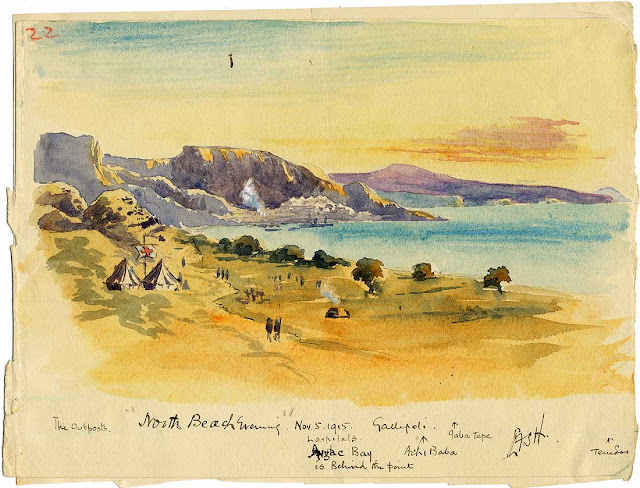
North Beach – Evening Nov 5. 1915 by Leslie Hore

Anzac Day is a national day of remembrance in Australia and New Zealand that broadly commemorates all Australians and New Zealanders “who served and died in all wars, conflicts, and peacekeeping operations” and “the contribution and suffering of all those who have served”. Observed on 25 April each year, Anzac Day was originally devised to honour the members of the Australian and New Zealand Army Corps (ANZAC) who served in the Gallipoli Campaign, their first engagement in the First World War (1914–1918). (from Wikipedia)

4.24.2022 – a calibrated

a calibrated
articulation that can’t
be articulated

I think this is a good thing.

Today’s haiku is based on comment in a story about a change at the New York Times.

The story is Less advocacy, more journalism. Changes at CNN and New York Times may signal push to the centre by Edward Helmore.

Mr. Helmore is reporting on the impression given at CNN and New York Times to focus their news efforts on news.

Jay Rosen, a journalism professor at New York University is quoted saying that the NYT is “… e saying they’re not going to be intimidated by the right wing or congratulated by the left wing into doing what they want.”

Mr. Helmore reports that “Two weeks ago the paper’s outgoing executive editor, Dean Baquet, issued “a reset” in the paper and reporters’ approach to Twitter, long held up as having undue influence over some aspects of the Times’s editorial approach.”

I can’t see anything wrong in any of these points of view.

Time will tell if the NYT follows through.

This is the newspaper that used to say, “All the News that is Fit to Print.”

The NYTs hasn’t actually made an announcement of this change but Mr. Helmore reports:

In February, the Times launched a new advertising campaign: Independent Journalism for an Independent Life. To Rosen, it was the carefully calibrated articulation of a shift that cannot be fully articulated.

“This whole issue has been wrapped up in a bow of independence,” he said. “It’s the language they’re using to announce a shift without articulating any need for a shift.”

Something along the line of trying to explain something that cannot be explained.

I wish them luck and will hope for the best.

If nothing else, I love the combination of the words.

4.23.2022 – past past the image

past past the image
above the waves, sound of waves
a voice voice speaking

Adapted from the poem, The Sound of Waves by William Carlos Williams in the The Collected Later Poems of William Carlos Williams (1950).

A quatrain? Is that

the end I envision?

Rather the pace

which travel chooses.

Female? Rather the end

of giving and receiving

—of love: love surmounted

is the incentive.

Hardly. The incentive

is nothing surmounted,

the challenge lying

                elsewhere.

No end but among words

looking to the past,

plaintive and unschooled,

wanting a discipline

But wanting

more than discipline

a rock to blow upon

as a mist blows

or rain is driven

against some

headland jutting into

a sea – with small boats

perhaps riding under it

while the men fish

there, words blowing in

taking the shape of stone

    . . . . .

Past that, past the image:

a voice!

out of the mist

above the waves and

the sound of waves, a

voice . speaking!

4.21.2022 – each generation

each generation
its past, future determined
by its own problems

Based on essay, On the Charms of History and the Future of the Past by Aldous Huxley, published in Music At Night and other essays, including Vulgarity in Literature, by Chatto & Windus, 1931.

Mr. Huxley writes: The past and the future are functions of the present. Each generation has its private history, its own peculiar brand of prophecy.

What it shall think about past and future is determined by its own immediate problems. It will go to the past for instruction, for sympathy, for justification, for flattery.

It will look into the future for compensation for the present – into the past, too.

For even the past can become a compensatory Utopia, indistinguishable from the earthly paradises of the future, except by the fact that the heroes have historical names and flourished between known dates.

From age to age the past is recreated.

It was curious for me to take in this thought and think that past and present can be generational.

It of course makes sense that each generation sees the past and the present by their problems but by presenting the past and the present as something different for each generation, then these pasts and futures exist for the different generations together.

We live in the parallel universes of generational experience all at the same time.

The seems simplistic and oh-of-course on the surface though below the surface there is something here.

Tempora mutantur.

Times change and we change with the times.

But we don’t.

The times may change, but within our generation, we don’t change.

And our times co-exist and interact with the times of the previous and following generations.

And of course plus ça change, plus c’est la même chose.

The more we change the more we stay the same.

Everyone searching for that compensatory Utopia.

There is more here to be sure but it is too early in the morning and I have to get to work.

I am reminded of a discussion of weather forecasting that I had with my friends when I worked in the world of online television news.

We had developed the rule that the 7th day of the 7 Day forecast was always warm and sunny.

You never actually got to that 7th day …