3.21.2022 – Are you sitting in

are you sitting in
the catbird seat? explain what
the gibberish mean
s

The one and only reason this haiku got written is because it makes me laugh.

Wellllll, maybe not the haiku itself, but the source.

Hopefully someone recognizes that it comes from a short story, Sitting in the Catbird Seat by James Thurber.

Not place dropping, but I was at Thurber’s house this past summer in Columbus, Ohio.

Due to Covid, the museum wasn’t open but Leslie let me run around the outside of the house taking pictures and two little girls came by selling flowers they had just picked from the next door garden so we sat on the front porch, sitting in the catbird seat, and had a nice little chat.

The phrase, sitting in the Catbird Seat, is a quote from Red Barber, the radio announcer of the Brooklyn Dodgers.

In the short story, Thurber writes:

She was constantly shouting these silly questions at him. “Are you lifting the oxcart out of the ditch? Are you tearing up the pea patch? Are you hollering down the rain barrel? Are you scraping around the bottom of the pickle barrel? Are you sitting in the catbird seat?”

It was Joey Hart, one of Mr. Martin’s two assistants, who had explained what the gibberish meant. “She must be a Dodger fan,” he had said. “Red Barber announces the Dodger games over the radio and he uses those expressions–picked ’em up down South.” Joey had gone on to explain one or two. “Tearing up the pea patch” meant going on a rampage; “sitting in the catbird seat” meant sitting pretty, like a batter with three balls and no strikes on him.

The short story was one my mind, and I know what you are thinking, these stories are always on my mind, but that’s not true.

It’s the short story, “One is a Wanderer” that is always on my mind, but that is for another time or an earlier time as I know I must have commented on it a couple of times in this blog.

But why tonight?

When bored and wanting something to read that won’t land me in a war – as an aside I think the last 10 or so books, fiction and non fiction, that I picked up landed me in a war or a refuge crisis or somehow, I am still not sure, in a morgue – I check out what my Canadian Friends have added to the Faded Page.

You will remember that those wonderful people in Canada are finding older books whose authors or copyright holders have allowed the Canadian Copyright’s to expire which puts these books in the public domain.

They are careful to say that if the copyright is enforce in your country, Do Not Download These Books.

So please be aware of that and please don’t throw me in that briar patch.

When I checked tonight, Faded Page had added a half dozen Thurber Books including Thurber Carnival, My Life and Welcome To It and the far-to-little-read The Years with Ross.

These are all there, ready to download for any device or read online.

You can read Sitting in the Catbird Seat here and I hope you do.

The books are here and you read or down epubs or mobi.

Did I tell you how much I love Canadians?

Like Mr. Martin, I will end with, “He went out and shut the door, and his step was light and quick in the hall. When he entered his department he had slowed down to his customary gait, and he walked quietly across the room to the W20 file, wearing a look of studious concentration.

3.20.2022 – imagination

imagination
must paint this – broken hearts can
not be photographed

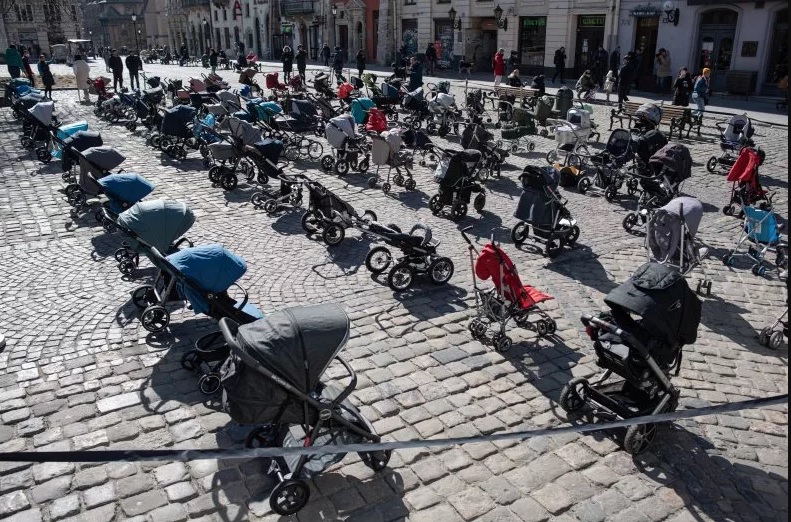
This photograph is from the war in Ukraine where a memorial for the children killed in the war was created by empty strollers and car seats.

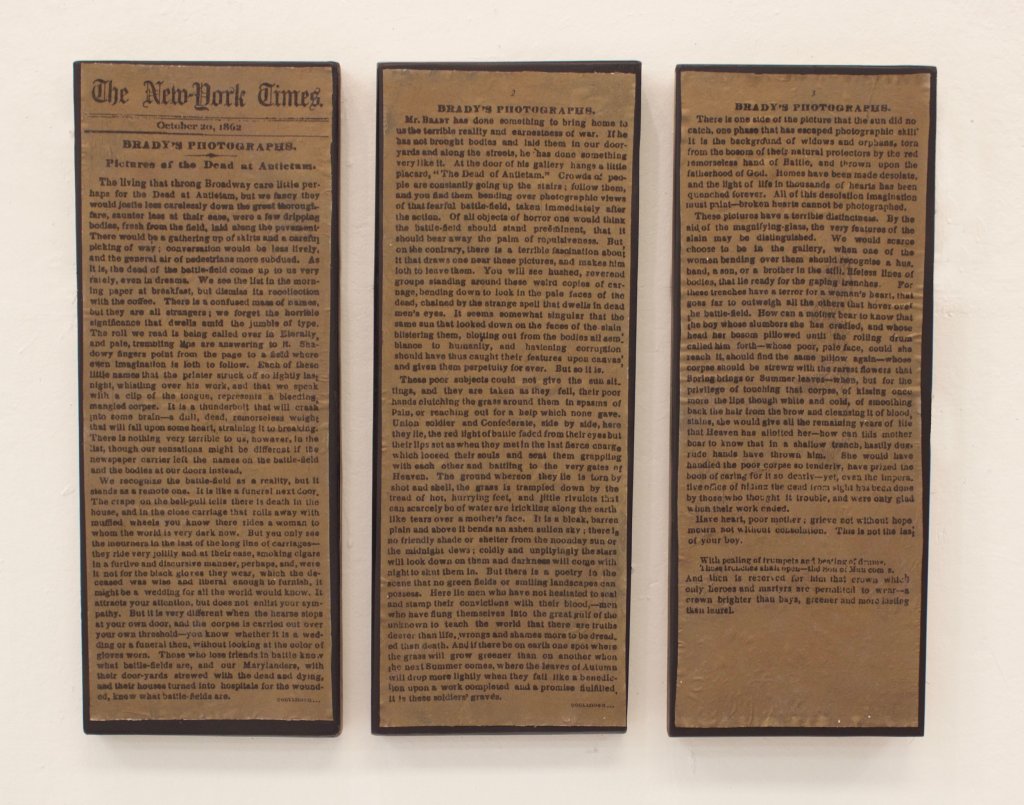
The text of the haiku comes from an article in the New York Times dated October 20, 1862.

The article is a review of the showing at Mathew Brady’s Studio of the first photographs of a battlefield made available to the general public, ever.

The reviewer wrote:

These is one side of the picture that the sun did not catch, one phase that has escaped photographic skill it is the background of widows and orphans, torn from the bosom of their natural protectors by the red remorseless hand of Battle, and thrown upon the brotherhood of God. Homes have been made desolate, and the light of life in thousands of hearts has been quenched forever. All of this desolation imagination must paint — broken hearts cannot be photographed.

This is one the of the photographs that was displayed at Brady’s Studio.

The reviewer stated: Mr. Brady has done something to bring home to us the terrible reality and earnestness of war. If he has not brought bodies and laid them in our dooryards and along the streets, he has done something very like it. At the door of his gallery hangs a little placard, “The Dead of Antietam.” Crowds of people are constantly going up the stairs; follow them, and you find them bending over photographic views of that fearful battle-field, taken immediately after the action. Of all objects of horror one would think the battle-field should stand preeminent, that it should bear away the palm of repulsiveness. But, on the contrary, there is a terrible fascination about it that draws one near these pictures, and makes him loth to leave them. You will see hushed, reverend groups standing around these weird copies of carnage, bending down to look in the pale faces of the dead, chained by the strange spell that dwells in dead men’s eyes. It seems somewhat singular that the same sun that looked down on the faces of the slain, blistering them, blotting out from the bodies all semblance to humanity, and hastening corruption, should have thus caught their features upon canvas, and given them perpetuity for ever. But so it is.

We don’t need to go the gallery on Broadway.

Jut turn on the TV.

Just open a device.

Seems like maybe we should have come up with a solution to this in 160 years.

But so it is.

1862.

Damn.

3.19.2022 -saudade, long lost

saudade, long lost
irretrievable but
the dream of it

” … there is a word in Portuguese called saudade that appeared to represent the farm and our lives, a homesickness or longing for something vital that had been irretrievably lost and only the dream of it could be recovered.”

From “The Road Home” by Jim Harrison.

The online dictionary defines saudade (saa·daydz) as a feeling of longing, melancholy, or nostalgia that is supposedly characteristic of the Portuguese or Brazilian temperament.

Wikipedia says, “Saudade is a deep emotional state of nostalgic or profound melancholic longing for something or someone that one cares for and/or loves. Moreover, it often carries a repressed knowledge that the object of longing might never be had again.”

Then Wikipedia adds this.

Saudade is a word in Portuguese and Galician that claims no direct translation in English.

However, a close translation in English would be “desiderium.”

Desiderium is defined as an ardent desire or longing, especially a feeling of loss or grief for something lost.

Desiderium.

Not a bad word.

Desiderium.

But it smacks of things other than the heart some how.

Desiderium.

No, I will take saudade.

I keep saudade in my head for those moments when there are no words.

Somewhere along the line of my life I came across the singing of Cesaria Evora.

Her song Sodade is a saudade put to music.

I am not sure what it is called when a feeling, an outlook, a word and a song all combine the same way.

Jenny Lawson writes in ‘Furiously Happy” that when there are no words, she has license to make one up.

For me then, when a feeling, an outlook, a word and a song all combine the same way I call in omniaonomatopoeia.

In Portuguese it comes out as saudade.

In English, there is no translation.

3.18.2022 – present perspective

present perspective
creates no absolutely
new situation

In a sermon preached at the invitation of Canon T.R. Milford at Solemn Evensong in the Oxford University Church of St Mary the Virgin on June 8, 1941, C.S. Lewis said this:

I think it important to try to see the present calamity in a true perspective.

The war creates no absolutely new situation: it simply aggravates the permanent human situation so that we can no longer ignore it.

Human life has always been lived on the edge of a precipice.

Human culture has always had to exist under the shadow of something infinitely more important than itself.

Human life has always been lived on the edge of a precipice.

This sermon was after almost two years of war between Great Britain and Germany.

TWO YEARS that we here in America watched and read about the invasion and destruction of Poland.

TWO YEARS that we here in America watched and read about the invasion and destruction of Holland, Belgium and Denmark.

TWO YEARS that we here in America watched and read about the invasion and destruction of France.

TWO YEARS that we here in America watched and read about the invasion and destruction of Norway.

TWO YEARS that we here in America listened to Edward R. Murrow say, This … is London.

TWO Years that we here in America listened to Murrow say, with the sounds of bombs falling and going off, “The lights are swinging over in this general direction now. You’ll hear two explosions. There they are. That was the explosion overhead, not the guns themselves. I should think in a few minutes there may be a bit of shrapnel around here. Coming in–moving a little closer all the while. The plane’s still very high.”

TWO YEARS that we here in America listened to Winston Churchill saying things like “we shall not flag or fail. We shall go on to the end. We shall fight in France, we shall fight on the seas and oceans, we shall fight with growing confidence and growing strength in the air, we shall defend our island, whatever the cost may be. We shall fight on the beaches, we shall fight on the landing grounds, we shall fight in the fields and in the streets, we shall fight in the hills; we shall never surrender.”

And then something happened.

You know what?

The Japanese, on December 7, 1941, bombed Pearl Harbor.

And America was at war with Japan.

Then for reasons historians have debated for last 80 years, wonder of wonders, Hitler declared war on the United States of America.

Had Herr Hitler not done that, it is doubtful that the United States would have got into that European war.

The war creates no absolutely new situation: it simply aggravates the permanent human situation so that we can no longer ignore it.

America has always had to exist under the shadow of something infinitely more important than itself.

And sometimes, that has been very hard for American’s to take.

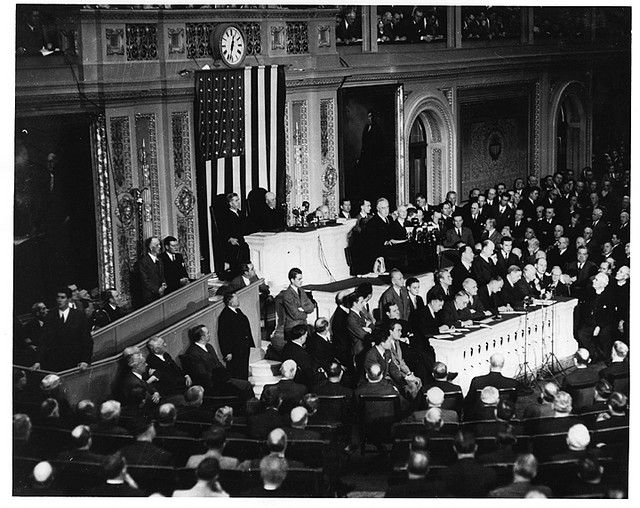
PS: This photo of FDR on Dec 8th is in today’s House of Representatives. The rostrum was completely rebuilt to today’s polished wooden look in the 1950’s. The ceiling was also replaced as when this room was built, in the 1860’s during the Civil War, the ceiling was a vast leaded glass skylight which was being replaced when this photograph was taken.