6.5.2021 – there he came upon

there he came upon
an oyster lying in its
shell upon the sand

My brother Pete says that what is unsaid in a haiku is as important or more important that what IS said.

A digression but why unsaid but not issaid?

I adapted today’s haiku from James Thurber’s The Philosopher and the Oyster in his collection, Further Fables for Our Time.

This Further Fable reads thusly:

By the sea on a lovely morning strolled a philosopher—one who seeks a magnificent explanation for his insignificance—and there he came upon an oyster lying in its shell upon the sand.

It has no mind to be burdened by doubt,” mused the philosopher, “no fingers to work to the bone. It can never say, ‘My feet are killing me.’ It hears no evil, sees no television, speaks no folly. It has no buttons to come off, no zipper to get caught, no hair or teeth to fall out.” The philosopher sighed a deep sigh of envy. “It produces a highly lustrous concretion, of great price or priceless,” he said, “when a morbid condition obtains in its anatomy, if you could call such an antic, anomalous amorphousness anatomy.” The philosopher sighed again and said, “Would that I could wake from delirium with a circlet of diamonds upon my fevered brow. Would, moreover, that my house were my sanctuary, as sound and secure as a safe-deposit vault.”

Just then a screaming sea gull swooped out of the sky, picked up the oyster in its claws, carried it high in the air, and let it drop upon a great wet rock, shattering the shell and splattering its occupant. There was no lustrous concretion, of any price whatever, among the debris, for the late oyster had been a very healthy oyster, and, anyway, no oyster ever profited from its pearl.

MORALS: Count your own blessings, and let your neighbor count his.

Where there is no television, the people also perish.

6.4.2021 – wandered into my

wandered into my
local bookstore, dazed, joyful
touched all the book
s

Taken from The Age of Reopening Anxiety (What if we’re scared to go back to normal life?) by Anna Russel in The New Yorker.

Ms. Russell writes, “In London, the reopening of shops and other nonessential services has been like the lifting of a thick fog. I wandered into my local bookstore, dazed and joyful, and touched all the books, before seeing a sign asking customers not to touch the books.

On the one hand I say I know just how she feels.

On the other hand, I say it is comforting to know there are people like this, besides me, still out there.

(E Shaver Booksellers – Savannah, GA – Just off Madison Square – https://goo.gl/maps/X9EgNBZpsyfv22z78)

6.3.2021 – deal with any subject

deal with any subject
remain both readable and
irresponsible

Part of the Mencken Project.

In 1911, HL Mencken was offered a column in by the owner/publisher of the Baltimore Sun, Charles H. Grasty.

Grasty told him Mencken to write ANYTHING he liked and to deal with ANY SUBJECT just so long as the column was irresponsible and readable.

Do such job offers exist any more?

One commenter writes: “On May 8, 1911, H. L. Mencken began a column in the Baltimore Evening Sun entitled “The World in Review.” The next day he retitled it “The Free Lance”—and continued writing the column six days a week for the next four and a half years. This enormous body of work, totaling about 1200 columns and amounting to 1.5 million words, is an incredibly rich storehouse of Mencken’s opinions on a wide array of topics. In some columns he addresses serious issues: the distressing prevalence of typhoid in the larger American cities, including Baltimore; the pestiferous influence of the Anti-Saloon League in promoting prohibition of alcoholic beverages; and all manner of political malfeasance both locally and nationally. But in most of his columns he displays his pungent satirical wit, lampooning poetasters, self-righteous moralists, and political and literary hacks of every description. In several columns Mencken begins outlining his views of the “American language,” the distinctive slang that Americans have adopted as a departure from formal English; Mencken later wrote a landmark treatise on the subject. Throughout these columns, H. L. Mencken displays the perspicacity and penchant for humor and satire that made him the greatest journalist of his day.”

Such is one of the reasons for the Mencken Project.

6.2.2021 – I grew up with life

I grew up with life
But I never outgrew it
too often forget

To steal from Sir Walter Scott:

Breathes there the man, with soul so dead,
Who never to himself hath said

School year is over.
Summer is here.
Let me stay in bed.

(the last three lines are mine)

I am now old enough to be considered old I guess.

If I get hit by a car crossing the street, the headline will start; “elderly pedestrian …”

Well so what?

Can’t stop the clock.

As for getting old with life, there is only one other alternative unless you happen to have a goofy portrait locked up in the attic.

There are some things though that I hope stir your soul no matter the time of your life.

Sunny days.

Sun on the water.

Snow days.

If I happen to hear that schools are cancelled somewhere, anywhere, due to snow, inwardly, I smile and outwardly I laugh.

AND I want to stop working and take a snow day even though I haven’t measured snow on the ground (Devil’s Dandruff) in years.

End of the school year.

I hear talk of year round school and I have heard all the arguments in favor and against and the history of the development of the ‘school year’ around the farm based economic year and now the pressures to find summer day care.

Yes yes and yes.

NEVERTHELESS!

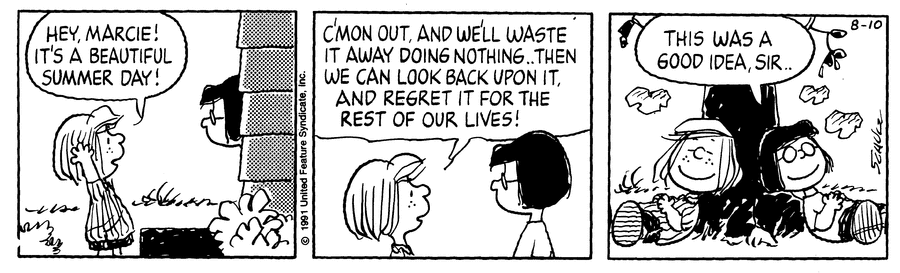
That day.

That morning.

That minute.

When it really sunk in.

To quote Maya Angelou, “singin’ and swingin’ and gettin’ merry like Christmas” deep down in the center of your soul.

The words for today’s Haiku I adapted from President Barack Obama.

Mr. Obama wrote the forward to the “The Complete Peanuts.”

An anthology published in 2016.

Mr. Obama wrote, “Like millions of Americans, I grew up with Peanuts. But I never outgrew it.

Wherever I lived, wherever I travelled, I could find those three or four panels in the paper each morning. And Charlie, Snoopy, Linus, Lucy, Franklin and the gang brought childhood rushing back.

That’s what made Charles Schulz so brilliant – he treated childhood with all the poignant and tender complexity it deserves. He gave voice to all its joys and anxieties – a spectrum of emotions that run from the start of a new baseball season to the anguished “Augh” that comes with losing the big game. He explored the emotions that we too often forget kids feel until we’re reminded that we once felt them ourselves. Hope. Doubt. The exquisite pain of unrequited love. The self-exploration of what it means to be different. The comfortable knowledge that it’s all going to be OK – even if Lucy’s advice isn’t very good.

For decades, Peanuts was our own daily security blanket. That’s what makes it an American treasure.”

Childhood with all the poignant and tender complexity it deserves.

He gave voice to all its joys and anxieties

Summer time.

You don’t have to sign up.

It’s free.

School is out.

I grew up with life.

I hope I never outgrow it.

I hope I do not too often forget the fun of doing nothing.

6.1.2021 – beauty and, as truth

beauty and, as truth
a projection of feeling
in terms of idea

Part of the Mencken Project.

Adapted from the line:

The only permanent values in the world are truth and beauty, and of these it is probable that truth is lasting only in so far as it is a function and manifestation of beauty—a projection of feeling in terms of idea.

From Damn! A Book of Calumny, XXXVII, On Hearing Mozart, by HL Mencken, 1918