Our capacity derive pleasure from aesthetic or material goods
Adapted from the book, A Week at the Airport: A Heathrow Diary (2009, Vintage Books) by Alain de Botton, and the passage:
Yet it was more than a little disingenuous for the airline to deny all knowledge of, and responsibility for, the metaphysical well-being of its customers. Like its many competitors, British Airways, with its fifty-five Boeing 747s and its thirty-seven Airbus A320s, existed in large part to encourage and enable people to go and sit in deckchairs and take up (and usually fail at) the momentous challenge of being content for a few days. The tense atmosphere now prevailing within David’s family was a reminder of the rigid, unforgiving logic to which human moods are subject, and which we ignore at our peril when we see a picture of a beautiful house in a foreign country and imagine that happiness must inevitably accompany such magnificence. Our capacity to derive pleasure from aesthetic or material goods seems critically dependent on our first satisfying a more important range of emotional and psychological needs, among them those for understanding, compassion and respect. We cannot enjoy palm trees and azure pools if a relationship to which we are committed has abruptly revealed itself to be suffused with incomprehension and resentment.
Part of the series of Haiku inspired by from A Week at the Airport: A Heathrow Diary (2009, Vintage Books) by Alain de Botton. I discovered this book entirely by accident. When searching for books online, I will use the term ‘collections’ and see what turns up. I figure that someone who has taken the time to gather together the etexts of any one author to create a collected works folder is enough for me to see what this author might be all about.
In this case I came across the writing of Alain de Botton. I enjoyed his use of language very much. Much of the words he strings together lend themselves to what I do.
As for his book, I recommend it very much though written in 2009, it misses the added layer of travel under covid but still the picture of the modern airport is worth the read.
round and round it goes where traffic stops nobody knows – changes, not progress
I was reading this morning about the feral hog/pig/boar problem in Florida.
I fell in love with a sentence that read, “The hog issue is not thought of as a solvable problem, but one that could only be attenuated.”
I read it over.
I read it outloud.
The hog issue is not thought of as a solvable problem, but one that could only be attenuated.
I wanted to grab and pad and pencil and start making a list of problems, that cannot be thought of as a solvable problems, but ones that could only be attenuated.
I quickly realized that my pad would not be big enough.
What a simple solution to so many issues.
In my mind somewhere is the saying, “If there is no solution, it is not a problem.”
This is a great saying to have handy when there is beach nearby that you can visit easily.
Some problem or issue pops up in your email.
You have no answer.
You have no solution.
No solution, then there is no problem.
No problem, well then, no problem and I am off to the beach.
But if the issue is not thought of as a solvable problem, but one that could only be attenuated, then goodbye going to the beach and get to work.
Get to work on attenuating the problem.
What a great word.
Attenuated.
My pirated desktop Oxford English Dictionary defines attenuated as weakened in intensity, force, effect, value.
I now want to grab my pad and pencil and list all the things in my life that have been weakened in intensity, force, effect, value as I get older.
But I quickly realize I don’t have enough time.
So back to the problems that are not thought of as a solvable problem, but one that could only be attenuated.
Can there be anything higher on the list than traffic?
Put today’s rubrics together and we can create a statement that might read: “Traffic is not thought of as a solvable problem, but one that could only be weakened in intensity, force, effect and value.”
I really like that.
Traffic is not thought of as a solvable problem, but one that could only be weakened in intensity, force, effect and value.
It was Bill Bryson who wrote that traffic engineers cannot fix traffic, but they can spread the problem out over a larger area.
The latest fashion of dealing with traffic here in the south is the traffic circle.
On a drive from my home to the beach I will navigate three of these answers to traffic problems.
According to the Wikipedia, “Compared to stop signs, traffic signals, and earlier forms of roundabouts, modern roundabouts reduce the likelihood and severity of collisions greatly by reducing traffic speeds and minimizing T-bone and head-on collisions.”
So they reduce the likelihood of accidents.
Or do they reduce the likelihood of the T-Bone and head on collisions while increasing the likely hood of side swipes and rear-corner panel collisions.
But do they improve traffic flow?
Wouldn’t that be the main question?
Wouldn’t that be the goal of someone who is trying to weaken in intensity, force, or effect the ‘not thought of as a solvable problem’ traffic?
The other fun part of these traffic circles for me is two of the three circles are on Hilton Head Island here in South Carolina.
The island, like Mackinac Island, has lots of bikes.
Lot and lots of bikes.
The island, unlike Mackinac Island, has lots of cars.
Lots and lots of cars.
Neither of these issues are thought of as a solvable problems for the island.
Neither of these issues seems to have been thought out as forms of transportation that can co-exist on the same overloaded roadways.
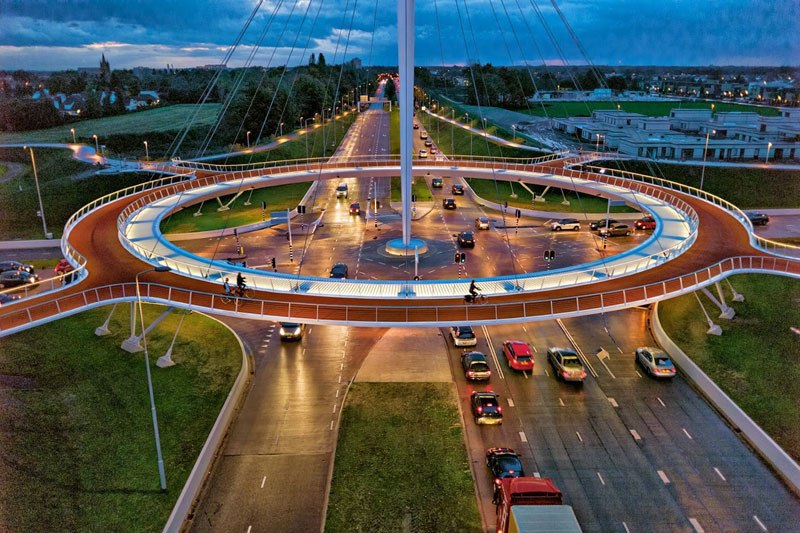
Then I ran across this.
The Hovenring.
An elevated bike traffic circle the floats over the roadway
The hovenring was built in the Netherlands.
The hovenring is perfect for Hilton Head Island.
According to wikipedia, The hovernring was built because, “In order to improve the flow of traffic and improve safety, it was decided to completely separate motorized and bicycle traffic.“
So much for the thinking that this might be not be thought of as solvable problem.
Here is evidence of real change for the better!
Here is evidence of real progress towards a real solution.
The hovenring!
Of course, there is some more to the wikipedia entry.
It goes on to say, “In addition, it was decided to transform the roundabout for cars into a regular crossing of streets, to improve the flow of traffic“
So it goes.
Round and round.
And as we all know, what goes around, comes around.
we are witness to a playful relationship, rendered majestic
Adapted from the book, The Architecture of Happiness (2009, Vintage Books) by Alain de Botton, and the passage:
A bright morning in the Tate Gallery, St Ives, Cornwall. On a plinth sits a marble sculpture by Barbara Hepworth, first exhibited in 1936. Although it is unclear what exactly these three stones might mean or represent – a mystery reflected in their reticent title, Two Segments and a Sphere – they nevertheless manage to arrest and reward our gaze. Their interest centres on the opposition between the ball and the semicircular wedge on which it rests. The ball looks unstable and energetic; we sense how keenly it wants to roll down the segment’s leading edge and bowl across the room. By contrast with this impulsiveness, the accompanying wedge conveys maturity and stability: it seems content to nurse gently from side to side, taming the recklessness of its charge. In viewing the piece, we are witness to a tender and playful relationship, rendered majestic through the primordial medium of polished white marble.
According the The New York Review of Books, this is “A perceptive, thoughtful, original, and richly illustrated exercise in the dramatic personification of buildings of all sorts.”
What I find irrestible in reading Mr. de Botton is his use of language.
I get the feeling that if you made a spread sheet of all the words, adverbs and adjectives used by Mr. de Botton, you just might find that he used each word just once.
in game of inches – somethings wrong? Change the inches! But square sinks won’t drain!
From what I read, some folks are wondering what is wrong with the game of baseball.
What they mean is something is wrong with Major League Baseball and that it doesn’t seem to have the same attraction as it did, the same strangle hold on the national imagination that it did.
What could be wrong with a GAME that is played by multi-millionaire’s ‘playing’ for teams controlled by billionaires funded by an entertainment industry that creates kazillionaires and how could it have lost touch with the little people?
The game itself, as some like to say, is a game of inches.
The bang-bang play at first.
The deep fly ball that becomes a foul ball by less than the width of the ball.
And something is wrong here.
I read where one of the suggested solutions is that there are not enough inches.
I read where it has been suggested that bases, the physical bases, be increased on size by 3 inches.
This will be tried out this year in the minors.
Boy, Howdy!
Smack my head and call me stupid.
Of course!
It is the size of the bases!
I remember reading a long long time ago when the American Basketball Association merged with the National Basketball Association.
One of the major benefits of this was that one Julius Winfield Erving II would now be playing for the Philadelphia 76ers.
That meant that Dr. J would be coming to the Detroit Pistons.
The article I was reading started with the story of a fan in Detorit who read the news, drove to the Pistons Ticket Office, put out his money and said, “Give me two for everything you got with the Doctor!”
I can just imagine reading about all the one time Baseball fans running to the ball park ticket window and asking for more tickets NOW THAT THEY FIXED THE SIZE OF THE BASES.
OH PLEASE.
REALLY!
Can some one, any adult, anyone, any math teacher, any physics teacher, any teacher, ANYONE please tell these geniuses that expanding the base by three inches will only move the bang-bang play three inches further out?
How does this change the game?
How does this improve the game?
In the novel, Shoeless Joe, JD Salinger remarks that, ” … the one constant through all the years had been baseball. America has been erased like a blackboard, only to be rebuilt and erased again. But baseball has marked time while America has rolled by like a procession of steamrollers. It is the same game that Moonlight Graham played in 1905. It is a living part of history.”
In the movie, “Field of Dreams”, this speech is delivered by James Earl Jones (’55-UofM) in the roll of a fictional Terry Mann who wrote a book titled the “Boat Rocker.”
I am not sure why JD Salinger and “Catcher in the Rye” (which plays an integral part of the novel – Ray’s Dad is a Catcher … ) but there it is.
So something is wrong with Baseball.
It must be the game.
Who thinks these things up?
Who thinks these things?
This morning I spent 5 minutes trying to wipe out the kitchen sink.
The sink is a deep, flat cornered, rectangle.
The corners are sqaure.
The silly thing won’t drain.
You wipe one corner of crumbs and they flow to the next corner.
You chase them around and wipe and wipe and wipe.
Then you spray.
No matter what you do, a square sink won’t drain.
SO who came up with this design?
Who thinks these things up?
Who thinks these type of things?
Sinks were rounded and dish shaped, sloping towards the drain for a billion years for one reason.
THEY WORKED.
They really could not be improved on.
SO WHY?
Who makes these decisions?
Some years ago I was told by a plumber that a plumber needed to know just three things.
One, pay day is friday.
Two, don’t chew your nails.
Three, water flows downhill.
Sometimes I tremble for humanity.
I used to have a baseball bat in my office.
I had written on it with a magic marker, COMPUTER REPAIR KIT.
One of the tech guys was in my office and laughed at it, then said, very quietly, “You know, Microsoft does NOT make things to NOT WORK.”
And he stared at me for a bit.
I think about that a lot.
And I think about how true it is.
Of course Microsoft does not makes things to NOT WORK.
So it the computer is not working …
Not wanting to point fingers but then maybe what was wrong was something … I did?
experience this awkward unanswerable be modern question
Adapted from the book, The Architecture of Happiness (2009, Vintage Books) by Alain de Botton, and the passage:
What is a beautiful building? To be modern is to experience this as an awkward and possibly unanswerable question, the very notion of beauty having come to seem like a concept doomed to ignite unfruitful and childish argument. How can anyone claim to know what is attractive? How can anyone adjudicate between the competing claims of different styles or defend a particular choice in the face of the contradictory tastes of others? The creation of beauty, once viewed as the central task of the architect, has quietly evaporated from serious professional discussion and retreated to a confused private imperative.
According the The New York Review of Books, this is “A perceptive, thoughtful, original, and richly illustrated exercise in the dramatic personification of buildings of all sorts.”
What I find irrestible in reading Mr. de Botton is his use of language.
I get the feeling that if you made a spread sheet of all the words, adverbs and adjectives used by Mr. de Botton, you just might find that he used each word just once.

 No Haiku For You