but there they all are, overwhelmed with dread, where there was not a thing to dread
From Psalm 53.
Do all these evildoers know nothing?
They devour my people as though eating bread; they never call on God. But there they are, overwhelmed with dread, where there was nothing to dread. God scattered the bones of those who attacked you; you put them to shame, for God despised them.
Verses 4 and 5.
Of course this the Psalm that opens with:
The fool says in his heart, “There is no God.”
But there I am.
I admit right now I am overwhelmed with dread.
Covid.
Finances.
What might happen in the White House.
But I am not fool enough to say there is no God.
That leaves me to work out that there is not a thing to dread.
basic liberties extensive, equal for all greatest benefit
A joke told by either John Cleese or Bill Bryson goes like this (or was it Julian Fellowes?).
If three Englishmen found themselves alone on a desert island the first thing they would do is form a club that would allow them to exclude any other members.
I was thinking about this as the news cycle on Reagonomics is starting to build.
The idea of ‘Trickle-Down’ is now 40 years old and reports and studies are being released that it just didn’t work.
Rich people got richer.
They kept on to their money.
There was no trickle down.
Just recently, according to one source, since the start of the pandemic, just 651 American billionaires have gained $1tn of wealth.
Okay, truth be told, IF I WERE A RICH MAN, would I handle it any better?
Watching Dick Cavett reruns on YouTube there is a clip where Mr. Cavett is having a conversation with Orson Welles.
Mr. Cavett asks Mr. Welles what he would do if he was suddenly given a very large amount of money.
Mr. Welles thundered immediatly like a fast ball off a bat, “Give it all away of course!”
Then he was quiet for a moment.
“Easy to say when it hasn’t happened,” Mr. Welles said in a slow voice.
“Most likely be different if I truly had the money.”
Reading the articles and discussions I came across the writings of John Rawls.
In 1971 Mr. Rawls published his treatise, A Theory of Justice in which he advanced the concept of the “original position”.
Mr. Rawls suggested, if a society gathered to debate the principles of justice in a kind of town hall meeting, but no one knew anything about themselves. “No one knows his place in society,” wrote Rawls, “his class position or social status, nor does anyone know his fortune in the distribution of natural assets and abilities, his intelligence, strength, and the like.”
IF this could happen, Mr. Rawls stated, “people would adopt two main principles. First, there should be extensive and equal basic liberties. Second, resulting social and economic inequalities should be managed to “the greatest benefit of the disadvantaged”.
Inequality could only be justified to the extent it provided material benefit to the least well-off.
This template, hoped Rawls, would make intuitive sense to everyone who imagined themselves into the “original position”.
Intuitive sense.
Intuitive sense that economic inequalities should be managed to “the greatest benefit of the disadvantaged”.
Mr. Rawls was embraced by many.
Mr. Rawls and this theory was also debunked.
One critic said that Mr. Rawls’ methodology was problematic.
This critic wrote, “Rawls was too trusting in the US constitution and not aware enough of the dark side of politics and power.”
This was back in 1970.
The dark side of politics and power seems to be doing as well today as economic inequalities.
what we learn next week helps understand yesterday look to the future
Carpe Diem so it says now on coffee mugs and T-shirts.
Seize the day.
Carpe diem, quam minimum credula postero!
Seize the day, and put very little trust in the future!
Or as Scarlett O’hara says, “Tomorrow is another day.”
My training is in the field of history.
My wife’s training is in market research.
My wife takes today and projects it 6 months into the future.
I cannot comment on today until tomorrow at the earliest and am more comfortable waiting six months.
We get along famously.
Lots of sparks along the road.
But it struck me today how much the past depends on the future.
The old debate on facts and truth.
I love this quote from today’s reading, “postmodernism was a response to Marxism, not an embrace of it, and in fact has been described as the “cultural logic of late capitalism”. In many ways, the defining condition of post-modernity is neoliberalism, so there is no reason for Conservatives not to embrace it. But for politicians, “postmodernism” has become one of those zombie ideas that cannot be killed by facts, no matter how many times academics explain that it does not in fact mean what they say it does.”
Yup.
For the me the keys phrase was “zombie ideas that cannot be killed by facts.”
I can easily apply that to today but what about any day.
And what are the facts?
What we know we don’t know that is to be known?
Where do we go for the facts?
All can agree that there is only one past and one present and one future.
But why did the one that happened happen.
What could have happened that may have made what did happen different.
Maybe this is all too early on a Saturday morning.
I remember an odd little story from the first atom bomb test in the desert in 1945.
There was much anxiety that after spending $2 Billion Dollars, it wouldn’t work.
According to records, physicist Enrico Fermi said maybe they had just spent $2 Billion dollars proving mankind could not make an atom bomb.
Fermi thought the money would have been well spent.
Each morning, each day, each incoming sweep of the tide (yep, live near the beach now) is a new start.
A new start to understanding what happened yesterday.
I spent the last 20 years of my life the TV news business.
Today I can barely watch it.
Much like the feller who worked in a sausage shop for 20 years and after moving on, refused to eat sausage.
The news lives on the blocks on WHO WHAT WHEN WHY and HOW.
But it runs on GET IT FIRST, GET IT FAST and BE ACCURATE (yes this comes last too often).
The first rough draft of history which is credited to The Washington Post’s owner. Phil Graham.
First into print those stories have a way of lingering around.
Look to tomorrow to understand yestarday.
How much will the narrative be changed?
I am reminded of a profile written by James Thurber of a man named Norman Kuehner, newspaper editor of the Columbus Dispatch and Thurber’s boss for several years.
It was Kuehner who taught Thurber to start his story with a wonderful, wordy introduction and a wonderful wordy conclusion.
Then take a pair of scissors and cut out the introduction and conclusion and you would have “A helluva good story.”
Thurber recounted how once he and Kuehner had an argument over a story.
Kuehner disputed the the story as Thurber wrote it and told to Thurber how he felt it happened and how the story should be written.
Thurber asked what if the competing paper, the Ohio State Journal and their version of the story proved to be true?
Thurber supported this version of the story.
“That,” said Mr. Kuehner, “would make it a Journal re-write.”
sacrifices of personal freedom price pay civilization
“Do you agree with Lenin’s statement that liberty is a bourgeois prejudice ? ”
‘‘Maybe,” Einstein remarked, slightly inclining his silver head, Lenin was right. Complete freedom is incompatible with civilization. If I don’t want other men to tread on my toes, I, too, must submit to rules and regulations, which limit my freedom. The more highly populated a country is, the greater are the sacrifices of personal freedom demanded of the individual. These sacrifices are the price we pay for civilization.
is it time for me? baseball updates their records you can look it up
I have long held that the secret to understanding Ernest Hemingway’s The Old Man and the Sea is baseball.
The Old Man has a special regard for Joe DiMaggio because Joe’s father was also a fisherman.
As a side note, Joe’s dad, Giuseppe DiMaggio was classified as a enemy alien during World War 2 and his fishing boat was seized and he was banned from the San Francisco harbor.
Joe DiMaggio’s Dad?
Marilyn Monroe’s Father-in-law?
Oh geeee whiz.
I also like how the Old Man talks about other teams in the American big leagues.
The Old Man says, “I fear both the Tigers of Detroit and the Indians of Cleveland.”
Somehow in the way Mr. Hemingway gets the conversation down on paper, I get the feeling that the Old Man pictured the Indians of Cleveland as Indians from-the-wild-west Indians.
Maybe that is just me.
Winston Churchill tells the story that while in Chicago on a lecture tour of the United States, one his meetings was broken up when an Indian in full dress stood up to yell at Churchill.
Mr. Churchill related how security went after the Indian who got away by diving through a plate glass window and running off down the streets of Chicago.
I had hard time understanding why an Indian in full dress, which to me meant an outfit out of a John Ford movie, would be in Chicago, heckling Winston Churchill.
It sure was a vivid word picture for me though.
An Indian in Indian Dress yelling at Winston Churchill, diving through a plate glass window like the cowardly lion, and running down the streets of Chicago with Chicago PD, guns blazing, in pursuit.
It was a long time before I figured out that Mr. Churchill was on a lecture tour, which included Grand Rapids, Michigan and an overnight stay at the Pantlind Hotel, and speaking on the topic of keeping India in the British Empire.
The Indian in full dress was a man from India in black tie.
The word picture is still pretty good at that.
So baseball is a theme that runs through The Old Man and the Sea.
At the end of the story, the Old Man ends up with nothing but bones.
Bones of the fish.
Imagine if you will the outlines of the bones of the fish.
The bold spine.
The thin faint ribs.
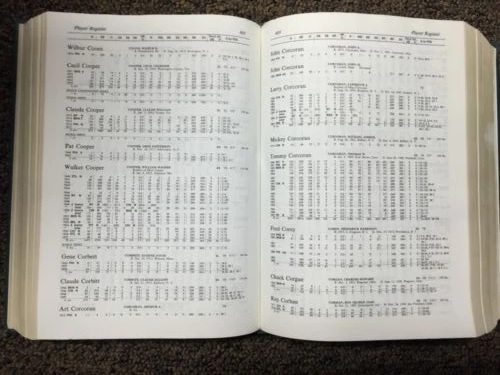
In my odd way, I can make the jump from a bony skeleton of a fish to the way the tiny print looks in the Official Baseball Encyclopedia.
When all is said in done all that remains of baseball are the faint outlines, the bones of a career, in the records.
I used to love baseball.
I came THIS CLOSE to taking a job with the National Baseball Hall of Fame,
The only thing that kept me from moving to Cooperstown was that another guy was offered the job.
At the end of my interview, the guy who interviewed me said he couldn’t offer me the job but he was penciling me into the lineup.
So I have that.
It was the strike of 1994-1995 that ended my love for the game.
I was shocked at the greed of players and owners.
I was disappointed mostly that when the 1994 season did not finish due to the strike, they still gave out awards for MVP, Cy Young and all the golden gloves based on the games played.
There had been no season, how could their be an MVP?
I don’t know why but that really bothered me.
Then the next season started late.
As Wikipedia says, “During the first days of the 1995 season, some fans remained irate at both players and owners.”
That was me.
Irate.
Still am I guess.
I have a fascination for the old game, the game before the strike but nothing like it was.
I think it was Mitch Albom who suggested that what could have been done was make the 1994 and 1995 seasons, one long season.
I think I could have handled that.
As it was, seeing 94 and 95 as separate seasons broke the string of records.
And it was the records to me that mattered.
They were the spine and bones of the game.
And this was messing with the backbone.
The records meant something.
To an extent they still do or at least they did.
At least through to the steroids era.
I have a hard time relating to the home run records of Bobby Bonds and Mark McGwire.
I hate to say it but I am clueless to about half the abbreviations now prevalent in baseball writing.
WAR?
And something called Walk UP Music?
Oh brother.
But the old records and the old names and the old games?
I still find fascinating!
The announcement by Major League Baseball yesterday stirred up a lot of feelings for me.
MLB stated that they were going to recognize the Negro Leagues as an official major baseball league.
The Negro League records will be made part of the official MLB Records.
Not sure why but I also thought they were but I guess I was wrong.
Sometimes I cannot figure MLB out.
I certainly understand and appreciate their Jackie Robinson campaign.
I have a son named Jackie Robinson Hoffman.
I pushed for another son to be named Moses Fleetwood Walker Hoffman.
Moses Fleetwood Walker played baseball at the University of Michigan.
But when Mr. Walker walked out on the field as a player for the Toledo Blue Stockings in a game against the Chicago Cubs, Cap Anson, the Cubs Manager yelled, “GET THE N***** OFF THE FIELD.”
This was in 1884.
It wasn’t until 1947 that another black player got on the field.
My kids voted for the name Ellington over Moses.
Jackie Robinson should be celebrated and remembered.
Maybe more than a lot of players.
But for me, its for a reason that never should have happened.
When Robin Yount reached the same age Jackie Robinson was when Mr. Robinson was rookie of the year, Mr. Yount had been playing for 14 years.
I have a hard time getting my arms around MLB celebrating that it took them 63 years to figure out they had it wrong.
The decision for the color line was a decision made by MLB.
No one forced them to do it.
ANYWAY ….
In spite of all considerations, I cannot think of anything on a sports level that had brought me such internal satisfaction.
Someone somewhere for some reason after way too long time made the right decision.
What does this mean?
There were seven accepted major leagues.
National League American League Federal League American Association Players League Union Association National Association
The record books also included under other headings or tab, Minor Leagues, Negro Leagues, KBO, Japan, Cuban, & Winter Baseball.
As off yesterday, the Negro Leagues considered a major league.
The tab between leagues has been removed.
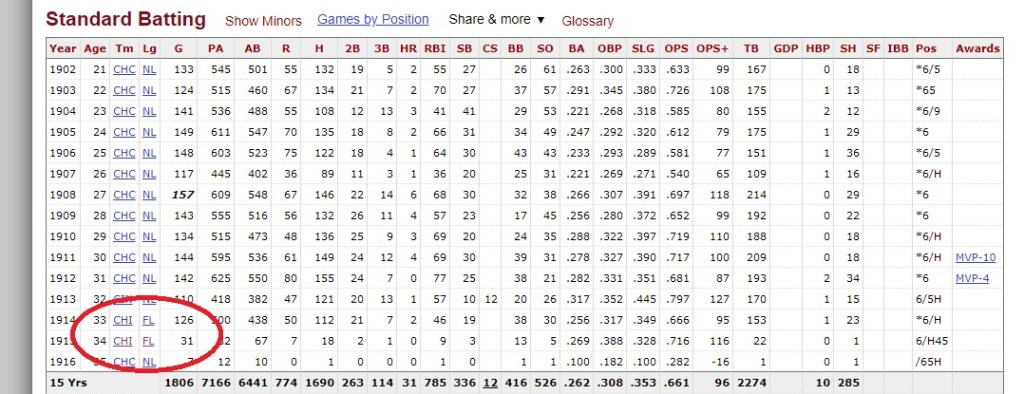
If you look at the records for a player with time in the Federal League, you will see games played in the league along with that players other major league games:
Here is the record of Joe Tinker of Tinkers to Evers to Chance fame.
Notice the two years he played in the Federal League appear along with his other MLB appearances.
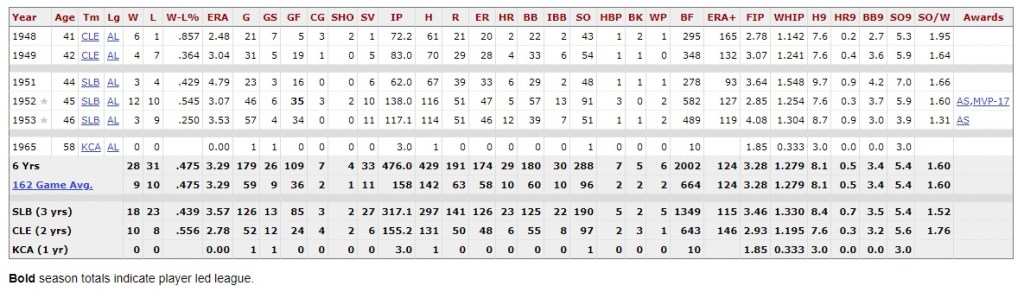
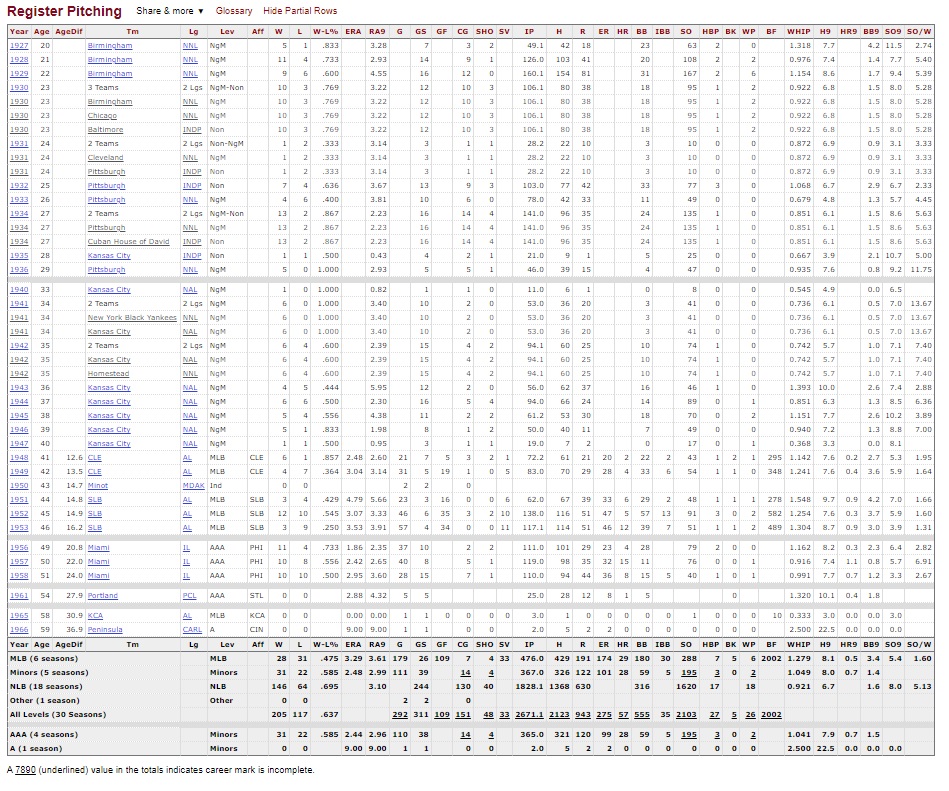
Here is the OLD Major League, as of yesterday, record of Satchel Paige.
NOW here is Mr. Paige’s records from Negro League appearances.
I am thinking that going forward, this record and the first record will now make up the official records.
The records in the books.
Who knows what may change.
I understand as Wikipedia puts it, “The true statistical achievements of Negro league players may be impossible to know as the Negro leagues did not compile complete statistics or game summaries.”
But I still look forward to looking up Josh Gibson when the next Baseball Encyclopedia is released.
However long this took to happen, it took too long.
But it is here now and it makes me happy.
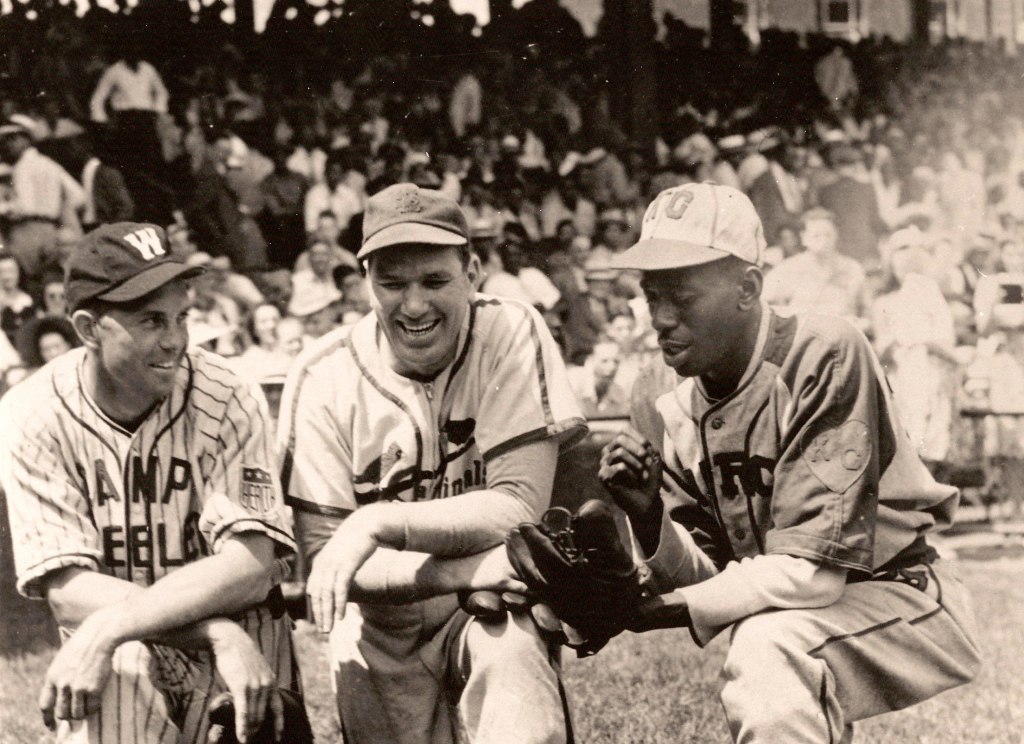
I think of something Bill Veeck wrote about Satchel Paige.
In 1947, Jackie Robinson broke the color line in the National Leage.
In 1948, Larry Doby became the first black player in the American League when Veeck signed him to play for the Cleveland Indians.
Veeck writes in his book, Veeck as in Wreck, “The day after I signed Doby I got a wire from him [Satchel Paige] saying, “IS IT TIME FOR ME TO COME?”


 No Haiku For You