4.10.2020 – all those who knew him,

all those who knew him,
followed him, watched these things
stood a distance

Adapted from the verse; “But all those who knew him, including the women who had followed him from Galilee, stood at a distance, watching these things.” Luke 23:49 (NIV)

I have long held that the book of Luke is the result of what is now called ‘Oral History.’

In other words, not only did Luke go an interview as many eyewitnesses as he could, but he crafted those interviews into the narrative that is the Book of Luke in the New Testament.

Luke himself wrote, “… I myself have carefully investigated everything from the beginning, I too decided to write an orderly account for you … “

I am convinced that included in those who Luke interviewed was Mary.

I am convinced that all the stories told from Mary’s point view are based on 1st person interviews with Mary.

I imagine that Luke did his investigation some 50 or 60 years after the death of Christ.

I imagine that at that time, Mary was living in the city of Ephesus, in the home of the Apostle John.

And I feel in my heart that when it came to Good Friday, 50 or 60 years, it was still too much for Mary to describe.

I doubt I will ever see Michelangelo’s Pieta.

But I remember driving back from the beach at Grand Haven, Michigan.

That well traveled route takes you through Spring Lake, Michigan and past St. Mary’s Catholic Church.

On this time it was getting dark and for the first time I noticed a flood lit statue on the corner of the church property.

I remember thinking, “WHAT???” and making an illegal u turn to double back and pull into the church.

Being me, I was scoffing to beat the band.

“OH RIGHT, SURE”, I said as I got out of the car and walked up to the statue.

There in front of my, in bright white fiberglass, flood lit glory was a full size copy of the Pieta.

I wanted to shake my head.

I wanted to say, ‘”Are you kidding me?”

But, even in fiberglass.

Even all the same shade of white.

Even with the blaze of floodlights.

The power.

The magic.

The feeling.

To an extent, still came through.

I couldn’t do anything but look.

Its power was overwhelming and drew me like a magnet.

I walked up close.

I could see the same passion of love, a love beyond explaining and like no other.

In her face was also a suffering.

Here, as predicted by the Angel, was a picture of a soul pierced by a sword.

And it was just a copy.
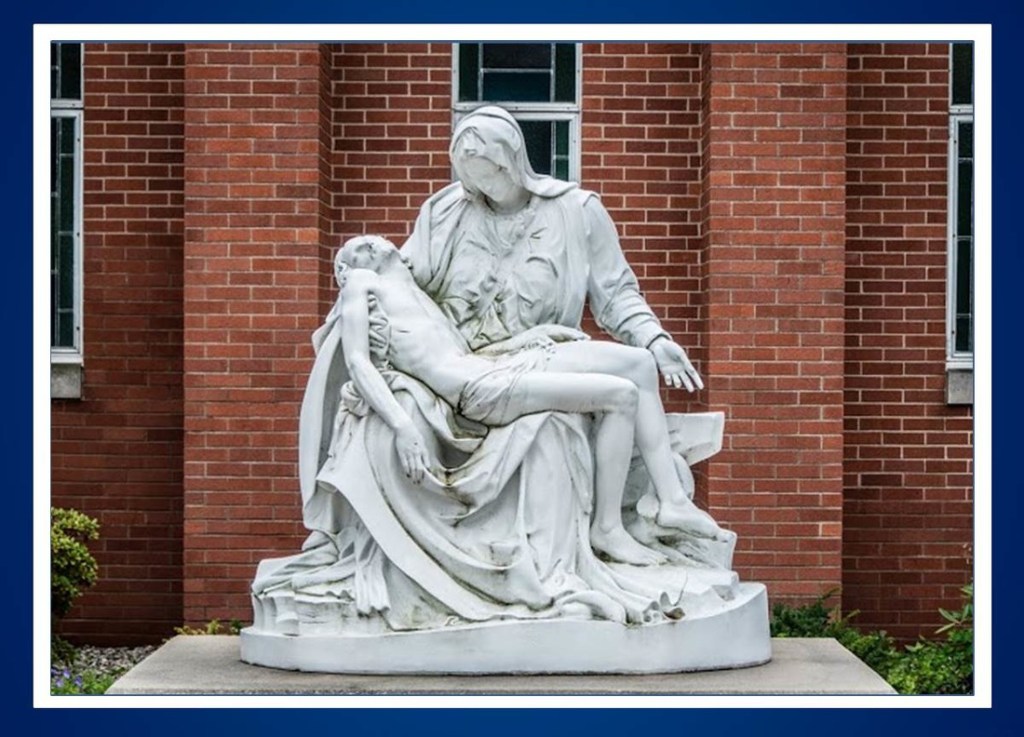
Fiber glass copy of the Pieta by Michelangelo in Spring Lake, Michigan

I cannot fathom what it would be like to see the real thing.

The idea that back in the day (1600-1700) you could walk up to and around the sculpture is more than my poor brain can imagine.

Here is perfect sweetness in the expression of the head, harmony in the joints and attachments of the arms, legs, and trunk, and the pulses and veins so wrought, that in truth Wonder herself must marvel that the hand of a craftsman should have been able to execute so divinely and so perfectly, in so short a time, a work so admirable; and it is certainly a miracle that a stone without any shape at the beginning should ever have been reduced to such perfection as Nature is scarcely able to create in the flesh.“, so wrote Giorgio Vasari in his 1558 book “The Lives of the Most Excellent Painters, Sculptors, and Architects

When asked by Luke, Mary could not put her feelings of Good Friday into words.

Somehow, 1500 years later, Michelangelo found expression for those feelings in stone.

I am not going to ever see it in stone.

I guess I will just enjoy and be happy with the fact that I did see a glimpse of those expressions in fiberglass.

POST SCRIPT: As I wrote this and looked at online photos of the Pieta, the radio was playing Handel’s Eternal Source of Light Divine – It was an unexpected Good Friday moment that caused to stop breathing so I wouldn’t interrupt the music.
4.9.2020 – stay home, staying safe

stay home, staying safe
not covid; cabin fever!
beach calls, can’t answer

Got up this morning to start another day of being home and being safe.

I am up before anyone else so I do get the luxury of some time alone.

Some time in the quiet.

Sitting with my coffee as the four walls of the house move in on me.

Like many American’s I have been ‘at home’ for the longest continuous span of time of my life since leaving home for Ann Arbor and college over 40 years ago.

The more I think about it, if you include leaving the house for school everyday, I can’t remember when I spent so much uninterrupted time in one place.

Since March 14, I have been here at home except for trips to the store or the park.

I am becoming less concerned with covid fever and more concerned with cabin fever.

I sat with my coffee and my ipad reading the same newspapers with the same stories.

The numbers change but the stories are the same.

I don’t need to spend much time with the sports pages.

Sports is nothing but new numbers.

Wins.

Losses.

Points.

Sports is nothing without new numbers.

And there are no new sports numbers.

Unless you count the number of people in sports who have the virus.

I look around the room where I am sitting.

Somehow this room is getting smaller.

I look at the knick knacks.

I look at the family photos.

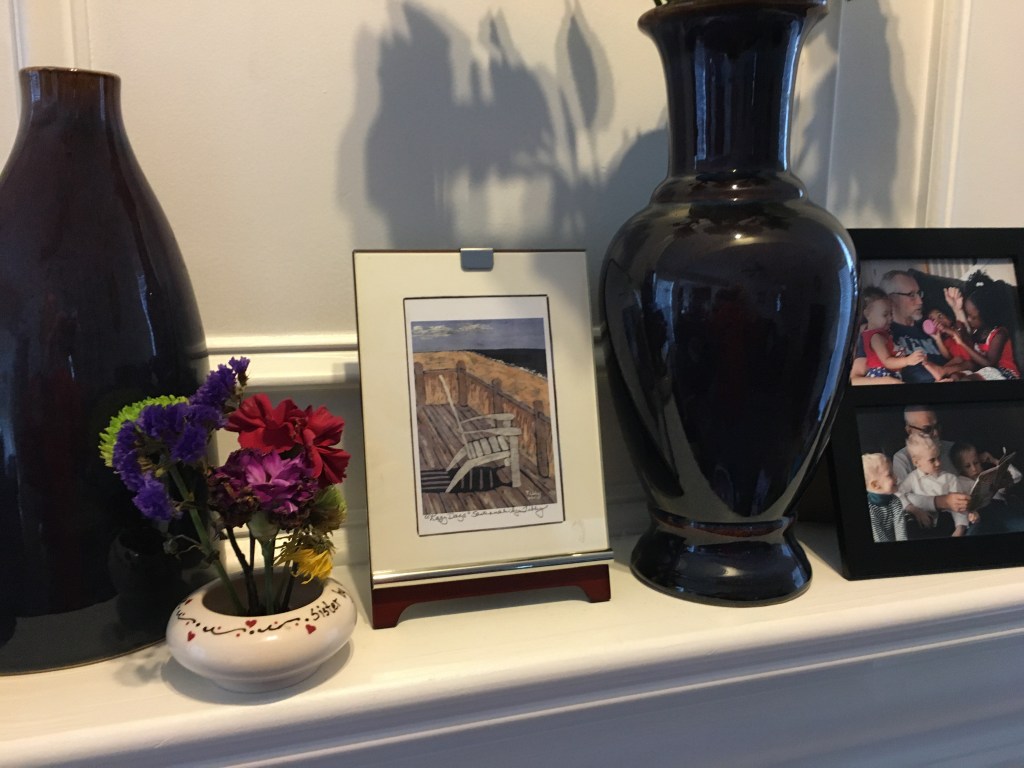
In pride of place on the mantle is a small work of art.

Its a small print that my wife and I picked up in Savannah last August when we were celebrating our 30th wedding anniversary.

It was a present from ourselves to ourselves.

The print captures both our celebration and the hoped for promise of our future.

Its a print by Savannah artist Tibby Llewellyn.

It shows an empty weather beaten Adirondack deck chair facing the ocean.

We had spent the weekend on Tybee.

We left behind empty beach chairs.

We look to retire someday and move to Tybee.

We hope empty beach chairs are waiting for us.

I looked at that little print for a long time.

Lots of memories.

Lots of plans.

The walls of the room moved back.

The beach is calling.

Can’t answer.

Well, not right now anyway.

4.8.2020 – when does workday end

when does workday end
when the office is at home
can’t go home again

In the novel, Great Expectations, Charles Dickens’ describes a night where our hero, Pip, goes to the home of Wemmick, Mr. Jagger’s clerk.

Once arrived at Wemmick’s neat little house, Pip asks Wemmick what Mr. Jaggers thought of the house?

Wemmick replies that Mr. Jaggers have never been there.

Wemmick answers, “No; the office is one thing, and private life is another. When I go into the office, I leave the Castle behind me, and when I come into the Castle, I leave the office behind me. If it’s not in any way disagreeable to you, you’ll oblige me by doing the same. I don’t wish it professionally spoken about.”

I know I am lucky in that my job is portable.

I work in TV stations all across the country and I never ever leave my office.

At the end of the day, I went home.

Sure when I got home I had my computer and would get set up online.

I had my phone.

Anyone of my coworkers could reach out to me.

I was conscious of phone alerts as requests for help came in.

But I was home.

I was away from the office.

Now my office is the room where we keep the grand kids toy’s.

I know my office in downtown Atlanta is filled with knick knacks and memorabilia.

But I have never shared and office with a rocking horse or a bunch of barbie dolls.

And at the end of the day, there is no end of the day.

There is a ‘blurring’ of my time at work into my time at home.

Not the complete cut off that commute created.

Thomas Wolfe wrote, “”You can’t go back home to your family, back home to your childhood … back home to a young man’s dreams of glory and of fame … back home to places in the country, back home to the old forms and systems of things which once seemed everlasting but which are changing all the time – back home to the escapes of Time and Memory.”

In the grand scheme, quoting Mr. Wolfe here is a bit over the top.

I don’t want to return to ‘my home.”

I just want to go home at the end of the day.

Back home.

Home to the escapes of Time and Memory.

4.7.2020 – no baseball today

no baseball today
missing player in right field
he played the game

According to Major League Baseball guidelines for field dimensions for professional baseball, “The rulebook states that parks constructed by professional teams after June 1, 1958, must have a minimum distance of 325 feet between home plate and the nearest fence, stand or other obstruction on the right- and left-field foul lines, and 400 feet between home plate and the nearest fence, stand or other obstruction in center field.”

Notice that these guidelines only list a ‘minimum distance’ between home plate and the nearest fence.

The University of Florida, Institute of Food and Agricultural Sciences released in 2001, a guide baseball field layouts including field dimensions, construction tips, and materials necessary for building a baseball field.

This guide lists ‘recommended placement of outfield fences’ by level of play.

Again, these are just ‘recommendations’.

No where, in any rule book, is the maximum distance or depth of an outfield listed, defined or manadated.

For me, I accept that an outfield wall or fence is just an arbitrary barrier that limits but not defines the field of play.

If a batter playing in Detroit’s Comerica Park, hits a ball into the first row of the bleachers, it is a home run.

If the same batter hit a ball 2 miles away and it landed in the Detroit River, it would be a home run.

The ball would not be declared ‘out of bounds.’

The lines of a baseball field extend to infinity.

Defined only right and left foul lines extending out from homeplate.

These means, to me anyway, that anywhere you stand, anywhere in the world, you are standing in someones outfield.

(I admit this not an original thought for me but one I stole from WP Kinsella. What bugs me is that I can’t find the quote. I am pretty sure it is in Iowa Baseball Confederacy but I can’t find it)

If I am standing in someone’s outfield, there is a good chance I am in someone’s rightfield.

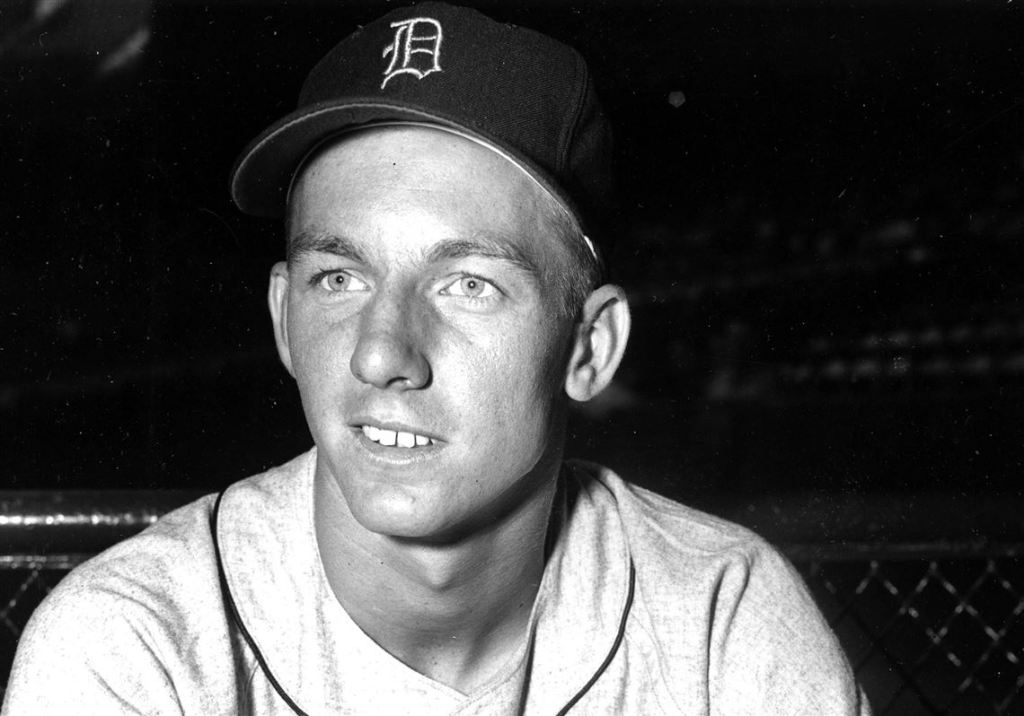
If I am rightfield, there is a good chance I standing near the man who played right field for the Detroit Tigers for 24 years.

If I was, I would be happy just to be there.

That would be enough.

To share right field for a play or two with Al Kaline.

I wouldn’t mind if he said hello.

I wouldn’t expect it though.

Not that Al wouldn’t say hello.

But if there was a game on, that is where his focus would be.

Man meets myth.

This time Man wins.

Al Kaline.

If you know what I mean, you know what I mean.

If you don’t know, that’s okay.

Suffice it to say, there is no joy in Mudville.

4.6.2020 – See with closed eyes

See with closed eyes
Learn to see and to feel life
Learning never ends

Paging through a book of photographic portraits by Henri Cartier-Bresson, I came to a picture of Josef Albers.

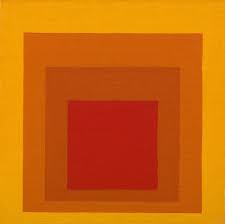
I remember well the first time I was introduced to his series, Homage to the Square.

It was in a lecture on modern art.

A slide of one of his works was displayed on the screen.

It was 4 different colored squares inside each other.

Before the professor could say anything, I sputtered out, “Oh sure, gimme a break.”

Which got a laugh and a smile from the Professor and a titter from a the class.

The Professor went on to describe the work.

To describe Josef Albers.

To describe Josef Albers and his work.

It wasn’t what was portrayed but the colors and the relationship of the colors to each in the square.

That was where the art was if we could see it.

I listened and looked.

And looked some more.

The color in each square was the same.

But where the color touched another color, at the top or the inside edge, the color WAS different.

How was this possible?

Albers’ said, “If one says ‘red’ – the name of color – and there are fifty people listening, it can be expected that there will be fifty reds in their minds. And one can be sure that all these reds will be very different.”

Josef Albers by Henri Cartier-Bresson

But that isn’t what I was seeing.

I was seeing that the same color was different depending on where I was looking.

How to solve this?

Albers’ also said, “Science aims at solving the problems of life, wheras art depends on unsolved problems.”

The best I could do was come away knowing that Albers was right.

I got his art.

I got an appreciation of his art.

An appreciation I hold to this day.

I got to think about seeing new ways.

Seeing with my eyes closed.

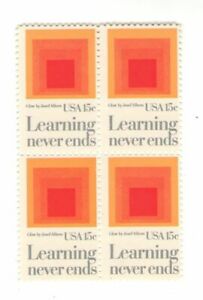
In 1980, the United States Postal Service came out with a Josef Albers stamp.

The stamp was simple.

It was a reproduction of one of his squares, titled ‘Glow.’

And it had text below the square.

“Learning never ends.”