2.4.2020 – Would pay to feel good!

Would pay to feel good!
Good feeling from kind words, acts.
What does that cost me?

One thing I always knew I wanted to avoid when I got older was taking pills.

I think of one episode of Gilligan’s Island where Thurston Howell III was left to manage his day without his wife.

He announced he had figured out his ‘pill schedule’ on his own.

He would just take one of each every hour.

Now I got pills for headaches.

Pills for body aches.

Pills for my heart to work better.

Pills to make my stomach fill better.

Pills to help my gut stop hurting.

Pills to help use the restroom.

Pills to avoid needing to use the restroom.

Pills to fill in the gaps of things I need in my diet that I don’t get in my diet.

And pills to help just feel good because I feel so bad when I think about all the pills I take.

I look in the cupboard and I think, “something went wrong here.”

I don’t expect to feel GREAT.

But, well, better, wouldn’t be bad.

Or just good.

And I realized something.

Recently I have received unexpected complimentary comments on, of all things, my haikus.

I almost find it hard to believe it myself.

One, that anyone might enjoy reading this blog makes me feel, for lack of a better word, good.

That anyone would take time out of their day to tell me just blows me away.

Not a pill, but just a few kind words.

It made me stop and think about the times I have made time to compliment someone.

Recently my wife and I had to be out at Hartsfield.

You know, the local airport here.

The world comes to Atlanta through Hartsfield.

The joke is when you die and go to heaven/hell you still have to change planes at Hartsfield.

One of the odd pleasures of living in Atlanta is that when you travel and you are flying back to Atlanta, you can tell your seatmate’s that you are flying into Hartsfield BECAUSE you live in Atlanta.

ANYWAY, I can’t remember why we were there, dropping someone off or picking someone up and we decided to get some coffee.

The Starbucks was jammed so we walked down the concourse to an IHOP and got coffee and sat at a table near the railing and watched the world walk by.

Several times the IHOP manager stopped by for refills.

He was friendly in a truly friendly way.

Asked why we were there.

Commented on the business and such.

Each time he stopped he had another friendly comment or chatted for a minute.

It wasn’t just us.

This young man WORKED that dining area.

Got extra plates or cups or refills for anyone who needed anything.

He got everyone to smile and if you know Hartsfield, that is one hard crowd.

I finally asked if his boss was around or supervisor or whatever because I wanted that person to know how impressive this guy was.

He laughed and said no, no one, not to worry, he was just doing his job.

But as we left, he approached us.

He apologized and didn’t want to bother us but there was a guy, if I was serious, that I could email.

And he handed me a business card.

I told him of course I would, I would be happy to, and I took the card and his pen and asked him for his name which I wrote on the card.

And we left.

Me wife looks at me with what we call the BERG STARE.

It’s a look that could stop an elephant or cause water to freeze.

All her sisters can do it.

My daughters and grand daughters have learned it as well.

“You better do it”, says my wife.

When we got home I got on my computer and opened up my work email

When I need to sound official I use my work email.

In Atlanta, an email from someone at WXIA TV – 11Alive is a little bit different than an email from mikesox at GMAIL.

And I related the story I just told.

I said I wanted this company to be aware of the great work of the young man at the airport.

I told them that from my point of view, working out there at Hartsfied, they had a great AMBASSADOR for both Atlanta and their company.

I hit send and I felt GOOD.

Better than I could feel from all those pills.

My wife asks me later, “Did you email that guy.”

I said, “YUP” and I felt even better.

Couple of days later I get an email back from the guy on the business card.

He was the VP of the chain that managed most of the restaurants at Hartsfield.

He thanked me.

He said it made him fell good that I would take the time to write such a note.

He said they didn’t get too many positive notes like that.

Now I felt good all over again.

Better than I could feel with all those pills.

A few days later I got an email from the young man.

That company had weekly staff meetings out at the airport and my email had been read out loud and then he was identified as the person in the email.

He thanked me.

He thanked me because we noticed he was doing a great job.

He thanked me for taking the time to write an email.

I felt good for a week.

I felt better than good.

I sure felt better than I could have from taking all those pills.

I wrote an email.

What did that cost me?
2.3.2020 – Lomax and Lomax

Lomax and Lomax
Ruth Crawford Seeger, Copeland
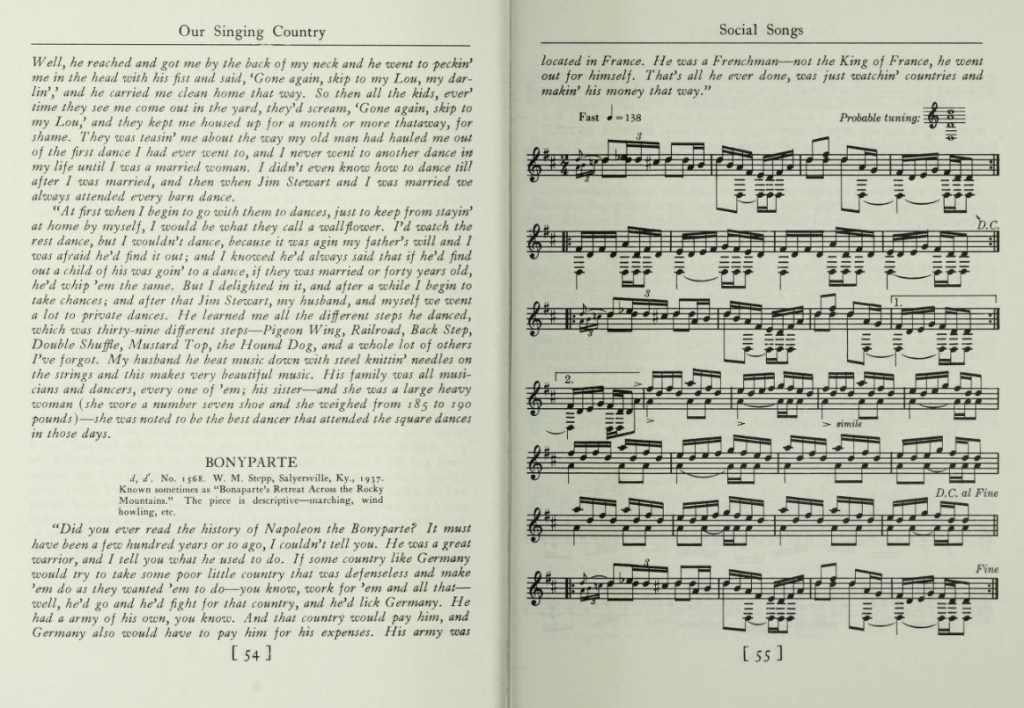
Bonaparte’s Hoedown

Trivia is dangerously close to trivial in the dictionary.

I look at trivia through its roots of tri and via.

Tri means “three” and via means “road” or “path”.

By combining these two roots we discover that the word Trivia actually means “Three Paths”.

The word Trivia itself goes back to the latin, trivium, a place where three roads meet.

I thoroughly enjoy a good tale of Trivia.

A story of how random unknown paths came together to result in something familiar.

The World Wide Web has made it easier to stitch these stories together.

There is so much online.

Maybe all information has just 7 degrees of separation but that is for another time.

Few things I do online make me happier than a navigating the information super highway to find and put together pieces of a puzzle.

Even when there wasn’t a puzzle just five minutes earlier.

An odd fact presented that needs to the next odd fact that leads to the next that results in a fascinating (to me anyway) piece of trivia.

This happened last weekend.

And it happened by accident.

Few pieces of modern American Classical Music have as wide spread recognition as Aaron Copland’s HOEDOWN from the Ballet Rodeo.

I have been familiar with the piece since about as long as I can remember.

While Copland is famous for adapting American Folk Song (Simple Gifts : Appalachian Spring) in my mind I assumed that the music of Hoe Down was all Copland.

It was, for me, his musical signature, if you will.

If you don’t know Copland’s name, you do know this piece of music.

Saturday night I was goofing off online, surfing the world wide web in a stream of conscious random search as new thoughts and questions were presented by whatever I happened to read.

I wanted to hear a piece of music and I opened up YouTube and found the piece and was able to listen to it.

This is a reoccurring theme in this blog that whatever bit of music or song you want to hear, it is just clicks away.

No King or Emperor of Industry Titan ever had command of such resources at their beck and call.

Neither here nor there, but I was thinking of the theme to HBO’s John Adams.

I looked at the YouTube screen as I listened and as YouTube does, several other pieces of music were recommended based on my search.

One fiddle piece caught my eye and I clicked on it.

A trio of two fiddle players and a guitar player were standing around a microphone.

Before any music started, the leader of the trio had to give the life history of the piece they were about to play.

Oh brother.

My attention was called away and I let this video play on as this feller went on and on about this piece called Bonaparte’s Retreat.

The feller related how it had been recorded by Alan Lomax in 1937.

Big Deal.

Who?

The feller related that the sheet music had been transcribed from the recording by Ruth Crawford Seeger.

Big Deal.

Who?

And the feller went on that it was this sheet music that Aaron Copland used when he composed the section, Hoe Down, of his ballet score, Rodeo.

Wait.

What?

The feller went on to say that this original recording was available on YouTube.

Really.

In seconds I am listening to Bonaparte’s Retreat recorded in 1937.

A little bit shocked but for some reason pleased and excited.

Where was this recording from?

Being the smart guy that I am I knew this had to be a part of the WPA’s depression era writer’s or theater project.

WRONG.

It was due to the work of a the Archive of American Folk Song at the Library of Congress.

And mostly due to the work of just three people, Ruth Crawford Seeger, Alan Lomax and his father, John Lomax.

I had never heard of any of these people before.

Ruth Crawford Seeger (July 3, 1901 – November 18, 1953) according to wikipedia, was an American modernist composer active primarily during the 1920s and 1930s and an American folk music specialist from the late 1930s until her death.

Now Ruth Crawford married Charles Seeger and Charles had a step-son named Pete.

Pete Seeger came to be quite a name by himself in the folk music scene but that is another story.

Crawford Seeger worked closely with John and Alan Lomax at the Archive of American Folk Song at the Library of Congress to preserve and teach American folk music.

Alan Lomax comes into the picture through the work of his father John.

Alan Lomax (January 31, 1915 – July 19, 2002) according to Wikipedia, was an American ethnomusicologist, best known for his numerous field recordings of folk music of the 20th century. He was also a musician himself, as well as a folklorist, archivist, writer, scholar, political activist, oral historian, and film-maker.

Few words better than ethnomusicologist to have on your resume.

Alan got his start traveling around with his Dad, John Lomax, helping with the field recording of music and folksongs.

They used a state-of-the-art (for 1933), 315 pound phonograph uncoated-aluminum disk recorder in the trunk of their Ford sedan.

And John Lomax?

According to Wikipedia, John Avery Lomax (September 23, 1867 – January 26, 1948) was an American teacher, a pioneering musicologist, and a folklorist who did much for the preservation of American folk music.

And why did John Lomax get into all this in the first place?

As a kid, John Lomax enjoyed singing … cowboy songs.

I had never heard of these three people.

Pete Seeger of course.

And Mr. Copland.

I Ruth Crawford Seeger and Alan and John Lomax now.

By a chance hearing of a story recorded who knows where and loaded to YouTube who knows when, I was able to find a digital copy of the recording and see a copy of the transcription.

In my era, this would have been grad school level research and resulted in an scholarly article.

Today, in seconds, at the clicks of my fingers, it all came together.

A chance hearing and a new window into an old world is opened up.

I shouldn’t get so much satisfaction out of this, but I do.

An odd but real pleasure.

Sometimes, it all fits together.

Technology CAN BE a wonderful thing and I can still be wowed by it.

Call me Larry Lightbulb, but I think it is marvelously cool.

As a final footnote, the Archive of American Folk Song at the Library of Congress lost Congressional funding in 1942.

Legislation was introduced To provide for the establishment of an American Folklife Center in the Library of Congress, and for other purposes and was signed into law on January 2, 1976, the year of our Bicentennial by then President Gerald R. Ford.

2.2.2020 – Palindrome day!

Palindrome day!
OH! 2 2 2020
Bolton is Notlob

So I had to hammer that 2nd line to get it into place.

Its my blog.

According to Wikipedia, “A palindrome is a word, number, phrase, or other sequence of characters which reads the same backward as forward, such as madam, racecar, or the number 10801. Sentence-length palindromes may be written when allowances are made for adjustments to capital letters, punctuation, and word dividers, such as “A man, a plan, a canal, Panama!”, “Was it a car or a cat I saw?” or “No ‘x’ in Nixon”.

Composing literature in palindromes is an example of constrained writing.

The word palindrome was first published by Henry Peacham in his book, The Truth of Our Times (1638). It is derived from the Greek roots palin (πάλιν; “again”) and dromos (δρóμος; “way, direction”); however, the Greek language uses a different word, i.e. καρκινικός, to refer to letter-by-letter reversible writing.

Such a great word!

Such a great word history.

Such words are the buried foundation blocks of our language.

Two things always come to my mind when I think of palindromes.

The first is that Harry Carey, when he was still with the White Sox, had to point out that Toby Harrah’s name was spelled the same forwards and backwards.

Then Harry would say, “That’s a palindrome!”

The very first time I heard Harry say that, I was impressed with Harry’s erudition.

The next time Harrah was up and I heard it again, I was a little less impressed.

By the end of the game, having heard this now 3 or 4 times, I began to wonder if Harry remembered who Harrah was and if he had every mentioned Palindromes before.

After a season of White Sox games, including 10 or 12 with Cleveland, I no longer wondered.

Neither here no there but much of the fun in listening to Harry Caray was his natural excitement for all things new.

The excitement of a kid at the ballpark.

It suddenly strikes me, that for Harry, each game was new.

He couldn’t remember yesterday if he tried.

Not a comment on his thinking but on his drinking.

But I digress.

The other thing that always, ALWAYS, comes to mind, is that THE PALINDROME OF BOLTON IS NOTLOB.

I had a good friend, actually a friend of my brother Pete.

Sad to say this friend recently passed away.

I would run into him from time to time and he would always start the conversation by disclaiming “THE PALINDROME OF BOLTON IS NOTLOB”

I loved this.

The phrase “THE PALINDROME OF BOLTON IS NOTLOB” had always been one of my favorites.

Often times in meetings that I had long since lost connection with, I would be called on to comment and I would say, “THE PALINDROME OF BOLTON IS NOTLOB.”

Is it any wonder that I found myself locked away up the attic away from other workers who might catch my particular brand of insanity.

It’s almost a code phrase.

THE PALINDROME OF BOLTON IS NOTLOB.

You either know of don’t.

If you know it, you know it.

If you don’t know it, it would take volumes to explain and the effort would be fruitless as it is most likely that after learning what it means and why, you would say, I’don’t get it.

Or worse.

Something like, is that all?

But that is where I cam going to leave you.

But one last time in memory and thanks of the late great Eric Richards, THE PALINDROME OF BOLTON IS NOTLOB.

2.1.2020 – exit strategy

exit strategy
one month into the new year
which way to the door?

February first and I am worn out both the current everlasting news cycle and my personal journey of floating down the river of discovery with no control.

Trump.

Impeachment.

Bernie.

Impeachment.

Coronavirus.

Kobe.

Impeachment.

Make the noise stop.

PLEASE.

I am tired.

Really tired.

Sleep is a friend who no longer wants to stay all night.

My shoulders hurt if I lay on one side too long.

My head always seems to ache.

I am cold all the time except for when I am too hot.

Me and my stomach don’t seem to like each other very much.

My elbows, MY FREAKING ELBOWS hurt.

Look up any of these symptoms and the word stress is lurking somewhere in the discussion.

Sure these next few months are going to change, choice filled.

Other old issues also rise up off the shelf where I thought I had them hidden away.

I cannot be unique in this respect.

I am not the only one feeling like this.

Most likely my issues are pretty minor.

Very minor in the grand scheme of things.

This can’t be new to human kind.

It is old already with me.

Tired of feeling this way.

Tired of hearing this way.

Tired of thinking this way.

Which way to the door?