Based on the New York Times Opinion piece, The Conversation: Tastelessness and Classlessness Are the Least of Our Concerns by Frank Bruni and Bret Stephens.
Frank Bruni is a professor of journalism and public policy at Duke University and Bret Stephens is an Opinion columnist for The Times, writing about foreign policy, domestic politics and cultural issues.
They create a weekly column where they discuss current events where Mr. Bruni takes the ‘left’ side of the discussion while Mr. Stephens takes the ‘Right’ side.
This is what Mr. Stephens, the feller who takes the ‘Right’ side of an argument wrote about the speech the feller in office made last night.
As our readers know, I support the war and think it’s been far more successful — and necessary — than critics acknowledge.
I learned nothing from it that I hadn’t known before it started, except that Trump somehow thinks that the Strait of Hormuz will be reopened by something akin to magic.
It was also a signal to what remains of the Iranian regime that they just need to hold on for another two or three weeks and it will be over.
A reminder that, even if this is the right war, we’ve got the wrong president.
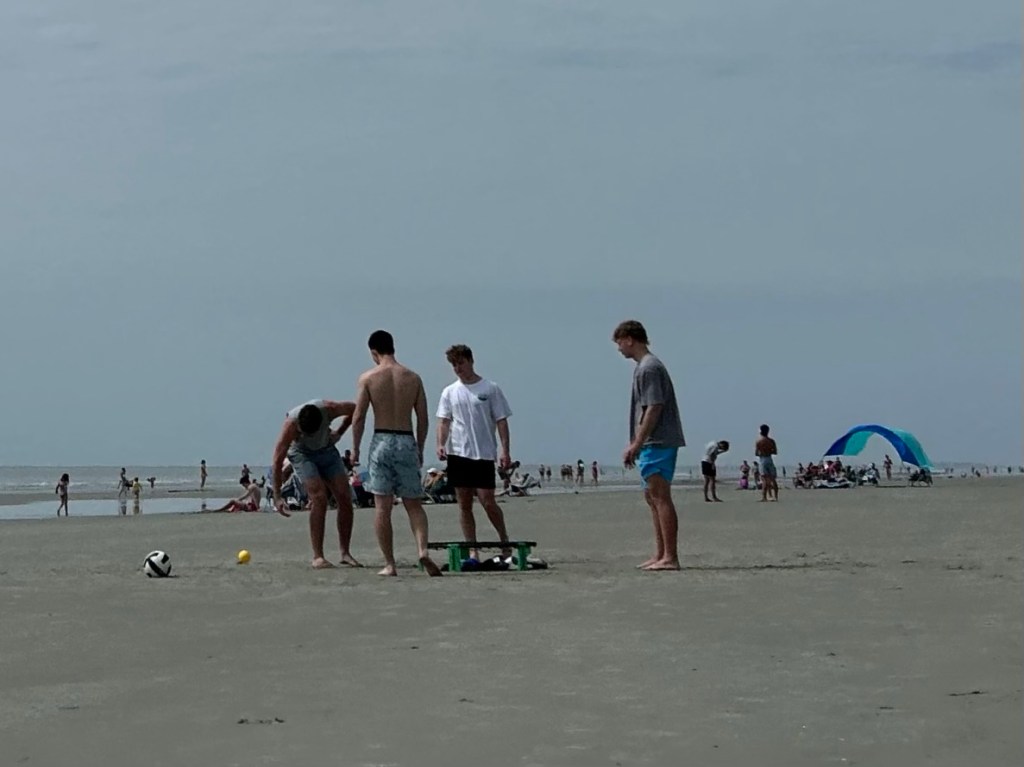
male of the species in spring gather at the beach engage in displays
In the gentle warmth of early spring, we find ourselves along the sandy coastal plains, observing one of nature’s more curious spectacles: the seasonal migration of the adult human male. Drawn by rising temperatures and an instinct as old as time itself, these creatures gather in loose, sunburn-prone clusters along the shoreline.
Now, if you look closely, you will notice the males establishing their territory, usually marked by brightly colored towels, portable coolers, and the faint but persistent aroma of sunscreen applied far too late. Their calls, a mix of laughter, shouted greetings, and questionable attempts at music, echo across the beach.
Our cameraman, of course, did not dare get too close.
As the day progresses, the ritual intensifies. The males engage in displays of athleticism, tossing spherical objects with great enthusiasm, often with no discernible goal beyond the act itself. Observe the proud stance after a successful throw and the subtle nods of approval from nearby males. This is a key component of their social hierarchy.
Hydration, of course, is critical. You will see them frequently returning to their watering vessels, aluminum containers or plastic cups, filled with fermented liquids. Consumption appears to increase confidence, though it has been known to reduce coordination in later stages of the ritual.
And ah, yes, the sunburn. A badge of honor, it seems. Despite clear environmental warnings, many males will forgo adequate protection, resulting in a gradual transformation from pale to crimson. This vivid coloration may, in some circles, be considered a sign of endurance.
As dusk approaches, the energy begins to wane. The throws grow shorter and the calls softer. Some males retreat, while others linger, reluctant to abandon the day’s rituals. It is here, in this golden hour, that we see the species at its most reflective, sun-kissed, slightly unsteady, yet deeply content.
Indeed, the beach in spring offers us a rare and fascinating glimpse into the behavior of the human male, playful, social, and just a little bit ridiculous. They need little in the way of a reminder of what day it is.
little time we live learn painfully to practice for eternity
The oaks, how subtle and marine! Bearded, and all the layered light Above them swims; and thus the scene, Recessed, awaits the positive night.
So, waiting, we in the grass now lie Beneath the languorous tread of light; The grassed, kelp-like, satisfy The nameless motions of the air.
Upon the floor of light, and time, Unmurmuring, of polyp made, We rest; we are, as light withdraws, Twin atolls on a shelf of shade.
Ages to our construction went, Dim architecture, hour by hour; And violence, forgot now, lent The present stillness all its power.
The storm of noon above us rolled, Of light the fury, furious gold, The long drag troubling us, the depth: Unrocked is dark, unrippling, still.
Passion and slaughter, ruth, decay Descended, whispered grain by grain, Silted down swaying streams, to lay Foundation for our voicelessness.
All our debate is voiceless here, As all our rage is rage of stone; If hopeless hope, fearless is fear, And history is thus undone.
(Our feet once wrought the hollow street With echo when the lamps were dead All windows; once our headlight glare Disturbed the doe that, leaping fled.)
The caged hearts make iron stroke, I do not love you now the less, Or less that all that light once gave The graduate dark should now revoke
So little time we live in Time, And we learn all so painfully, That we may spare this hour’s term To practice for Eternity.
Bearded Oaks by Robert Penn Warren as published in The collected poems of Robert Penn Warren by Robert Penn Warren (Louisiana State University Press: Baton Rouge, 1998).
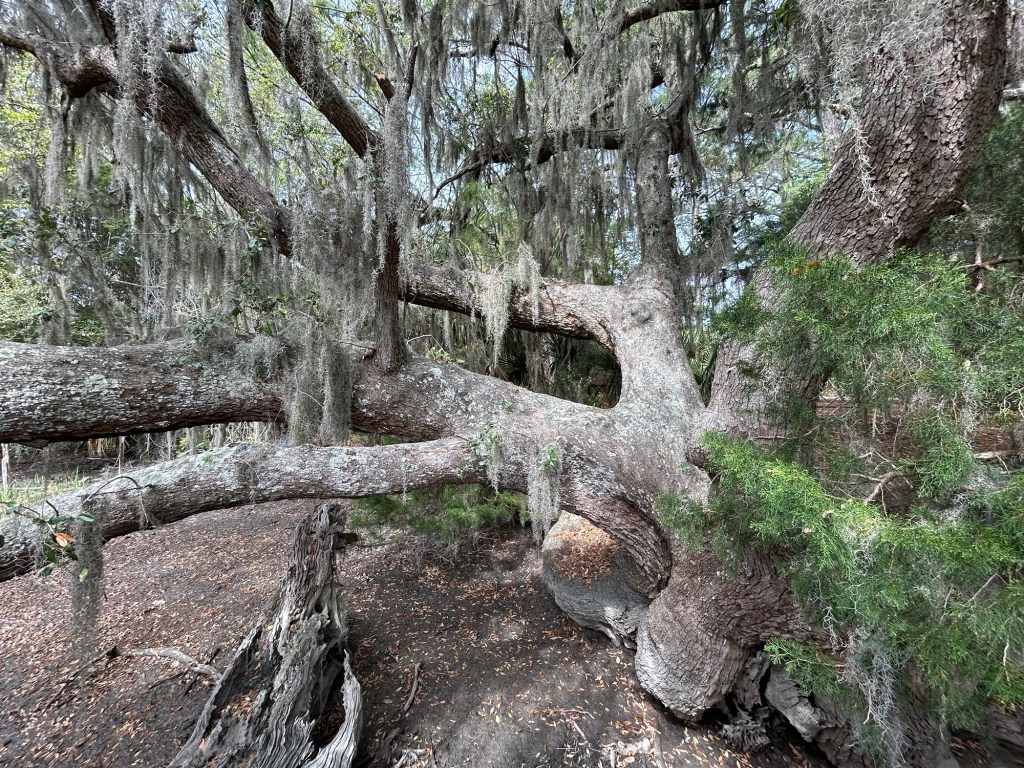
Massive … MASSIVE live oak on the grounds of the Coastal Carolina Museum on Hilton Head Island
The oaks, how subtle and marine!
Bearded, and all the layered light
Above them swims; and thus the scene,
Recessed, awaits the positive night.
The south is different.
It has a lot less snow.
It has a lot less cold.
It has a lot more sun.
It has lot more good smells.
It had lot more bad smells.
And it has live oaks.
Ages to our construction went,
Dim architecture, hour by hour;
And violence, forgot now, lent
The present stillness all its power.
Here before we were born.
Here after we will die.
The present stillness all its power.
So little time we live in Time,
And we learn all so painfully,
That we may spare this hour’s term
To practice for Eternity.
According to Wikipedia, Robert Penn Warren (April 24, 1905 – September 15, 1989) was an American poet, novelist, literary critic and professor at Yale University. He was one of the founders of New Criticism. He was also a charter member of the Fellowship of Southern Writers. He founded the literary journal The Southern Review with Cleanth Brooks in 1935. He received the 1947 Pulitzer Prize for the Novel for All the King’s Men (1946) and the Pulitzer Prize for Poetry in 1958 and 1979. He is the only person to have won Pulitzer Prizes for both fiction and poetry. Yale awarded Warren an honorary Doctor of Letters degree in 1973.
but immigrants built this country, we should admire them and respect them
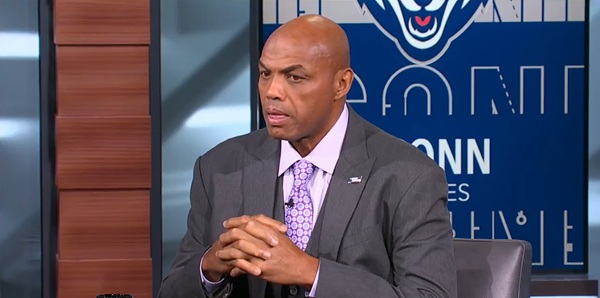
Auburn basketball legend Charles Barkley sounded off about immigrant treatment in America during Sunday’s March Madness broadcast on CBS. Discussing UConn’s Alex Karaban and his family’s journey to the U.S., Barkley spoke out about current immigration practices in the country.
“I wanna be very careful with my words right now,” Barkley began. “Cause this is a really touchy subject for me. I love that kid (Karaban) and his family. But the way some of these other immigrants are getting treated in our country right now is a travesty and a disgrace.”
“I think there is a difference between amazing immigrants and criminal immigrants.
And I think what’s going on in our country — I think what we’re doing to some of these amazing immigrants is really unfortunate and it’s really sad.
That’s a great immigrant story, we have a lot of great immigrant stories out there who — they stories need to be told but some of the stuff that’s happening to immigrants in our country is really unfortunate and its really unfair.
But immigrants built this country, we should admire them and respect them.”
Zacchaeus was a wee little man, and a wee little man was he
Jesus entered Jericho and was passing through. A man was there by the name of Zacchaeus; he was a chief tax collector and was wealthy.
He wanted to see who Jesus was, but because he was short he could not see over the crowd. So he ran ahead and climbed a sycamore-fig tree to see him, since Jesus was coming that way.
When Jesus reached the spot, he looked up and said to him, “Zacchaeus, come down immediately. I must stay at your house today.” So he came down at once and welcomed him gladly.
All the people saw this and began to mutter, “He has gone to be the guest of a sinner.”
But Zacchaeus stood up and said to the Lord, “Look, Lord! Here and now I give half of my possessions to the poor, and if I have cheated anybody out of anything, I will pay back four times the amount.”
Jesus said to him, “Today salvation has come to this house, because this man, too, is a son of Abraham. For the Son of Man came to seek and to save the lost.”
Luke 19:1-10 (NIV)
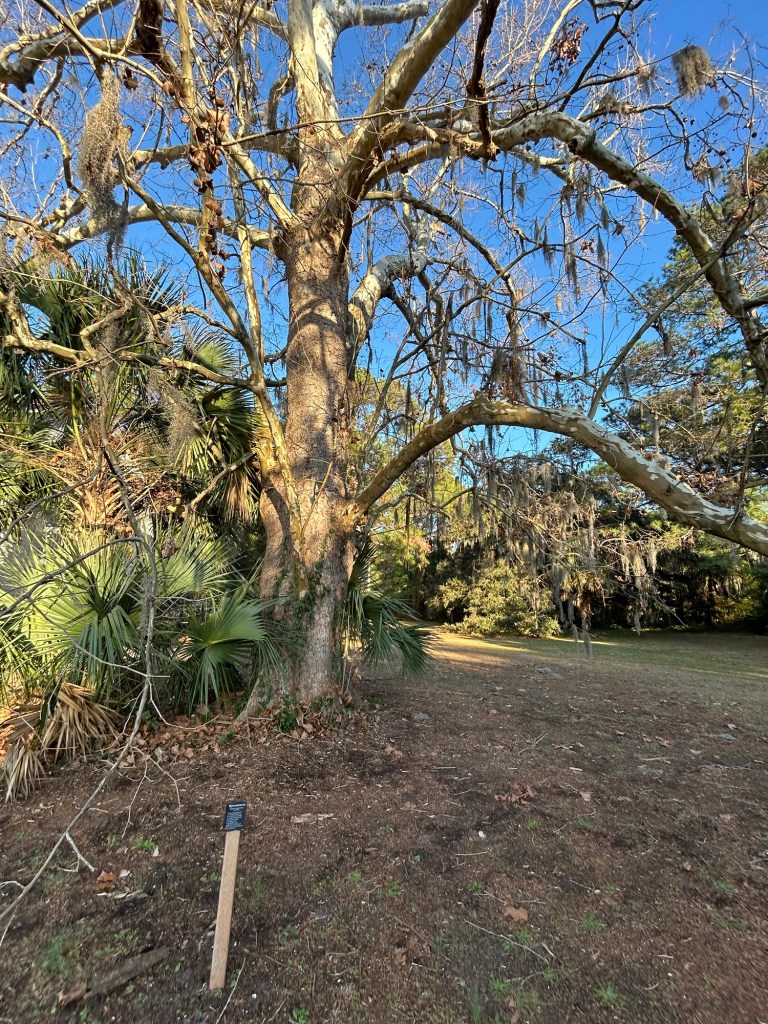
This tree is on the grounds of the Carolina Coastal Museum on Hilton Head Island.
Thanks to the handy little markers, I can tell you it is a Sycamore.
Who doesn’t remember the Sycamore Tree?
If you grew up with me in West Michigan church circles, at some point in your life didn’t you sang the Sunday School song about Zacchaeus that goes:
Zacchaeus Was A Wee Little Man, And A Wee Little Man Was He. He Climbed Up In A Sycamore Tree, For The Lord He Wanted To See. And As The Savior Passed Him By, He Looked Up In The Tree, And He Said, “Zacchaeus, You Come Down; For I’m Going To Your House Today, For I’m Going To Your House Today”
By some misguided judgement, for a couple years of my life, I was the summer replacement, emergency go-to-guy for the 4 Year Old Sunday School class at my Church and this song was a staple of my time with the 4 year olds.
I sang it as I only I could and slowed the 5th verse down so that me and all the kids held out one finger and pointed and said each word slowly so that it came out Zacchaeus! (Pause-Point) You (Pause-Point)Come (Pause-Point)Downnnnnnnnnnnnnnnnnnnn!
Then I changed the last word so that we sang, For I’m Going To Your House To Play, For I’m Going To Your House To Play.
When I went home after church, I took the phone off the hook so calls from parents went answered.
Can’t explain it, but week after week, I got asked to come back …
Anyway, back on the Island, when I read the little marker in front of the tree, I thought that for the first time in my life I was looking at a Sycamore Tree and I sang the song over and over until I was told to please shut up.
But I was happy.
I was standing in front of a Sycamore and it was easy to see with the low branches and the number of branches how wee little Zacchaeus was able to climb up in the tree.
I could picture the wee little man in his purple robes, just like in the flannel graph song sheets we had in Sunday School, hanging from the branches.
So, it was with no little sadness to learn that there are sycamore trees and then there are sycamore trees.
Turns out, what I was looking at was a Platanus occidentalis, also known as the American Sycamore.
According to Wikipedia, it is a species of Platanus native to the eastern and central United States, the mountains of northeastern Mexico, extreme southern Ontario, and extreme southern Quebec.
The sycamore tree is often divided near the ground into several secondary trunks, very free from branches. Spreading limbs at the top make an irregular, open head. Roots are fibrous. The trunks of large trees are often hollow.
If you read the Bible story quoted above in the King James English, it says that Zacchaeus climbed up in a Sycomore tree not a Sycamore.
The New International Version of the Bible that I quote from does say sycamore-fig tree and that is a completely different tree from the Platanus occidentalis, also known as American sycamore.
The Sycamore-fig is the Ficus sycomorus, or the fig-mulberry (because the leaves resemble those of the mulberry), sycamore, or sycomore, is a fig species that has been cultivated since ancient times.
According to wikipedia, Ficus sycomorus is native to Africa south of the Sahel and north of the Tropic of Capricorn, excluding the central-west rainforest areas. It grows naturally in Lebanon; in the southern Arabian Peninsula; in Cyprus; in very localised areas in Madagascar; and in Israel, Palestine and Egypt.
Well.
As Frank Lloyd Wright might say, there you are.
My story for Palm Sunday, 2026.
Me and the Sycamore on Hilton Head, Zacchaeus and Jesus who said, “For the Son of Man came to seek and to save the lost.”
I hear your questions.
Even down here on the Sea Islands of South Carolina, I hear your questions.
You want to know what in the world Zacchaeus has to do with Palm Sunday.
I’ll tell you.
And I wasn’t something I noticed until I looked up these verses when I first saw the Sycamore.
In Chapter 19 of Book of Luke, Jesus looks up and sees that wee little man and tells him to come down.
The Book of Luke says that the crowd listened to Jesus explain why he was going to the House of Zacchaeus, the sinner, for supper.
The Book of Luke of Luke says that Jesus noticed he had the crowd interested so he told the parable of the Rich Man who gave 10 of servants money to invest and then Rich Man examined how the servants responded.
The Book of Luke says that after Jesus had said this, he went on ahead, going up to Jerusalem …
Those who were sent ahead went and found it just as he had told them. As they were untying the colt, its owners asked them, “Why are you untying the colt?”
They replied, “The Lord needs it.”
They brought it to Jesus, threw their cloaks on the colt and put Jesus on it. As he went along, people spread their cloaks on the road.
When he came near the place where the road goes down the Mount of Olives, the whole crowd of disciples began joyfully to praise God in loud voices for all the miracles they had seen:
“Blessed is the king who comes in the name of the Lord!”
“Peace in heaven and glory in the highest!”
So it seems that on the Morning of Palm Sunday, Jesus met Zacchaeus.
I guess he at lunch at his house and then went to ride into Jerusalem.
And we remember this because of that great Palm Sunday song …
Zacchaeus Was A Wee Little Man, And A Wee Little Man Was He. He Climbed Up In A Sycamore Tree, For The Lord He Wanted To See. And As The Savior Passed Him By, He Looked Up In The Tree, And He Said, “Zacchaeus, You Come Down; For I’m Going To Your House Today, For I’m Going To Your House Today”


 No Haiku For You