8.4.2025 – better to have lunch and

better to have lunch and
scared to death than to not have
lunch and scared to death

There is a lot of wisdom in these seventeen syllables.

Today’s Haiku is adapted from the New York Times article, So Long to Tech’s Dream Job By Kate Conger (who has covered labor dynamics in Silicon Valley since 2017) where Ms. Conger quotes a tech worked named Rachel Grey saying:

“I suppose it’s better to have lunch and be scared to death than to not have lunch and be scared to death, but I don’t know if it’s good for you to be there,” she added.

Ms. Grey and Ms. Conger are talking about the days when, “The company’s cafeterias served steak and shrimp, kitchens were stocked with fresh juices and gyms offered free workout classes.”

The things, I guess, that made working in tech, a dream job.

Ms. Gray started with Google in 2007.

Not sure when Ms. Conger started in her field but as I pointed out, she has been covering tech for the NYTimes since 2017.

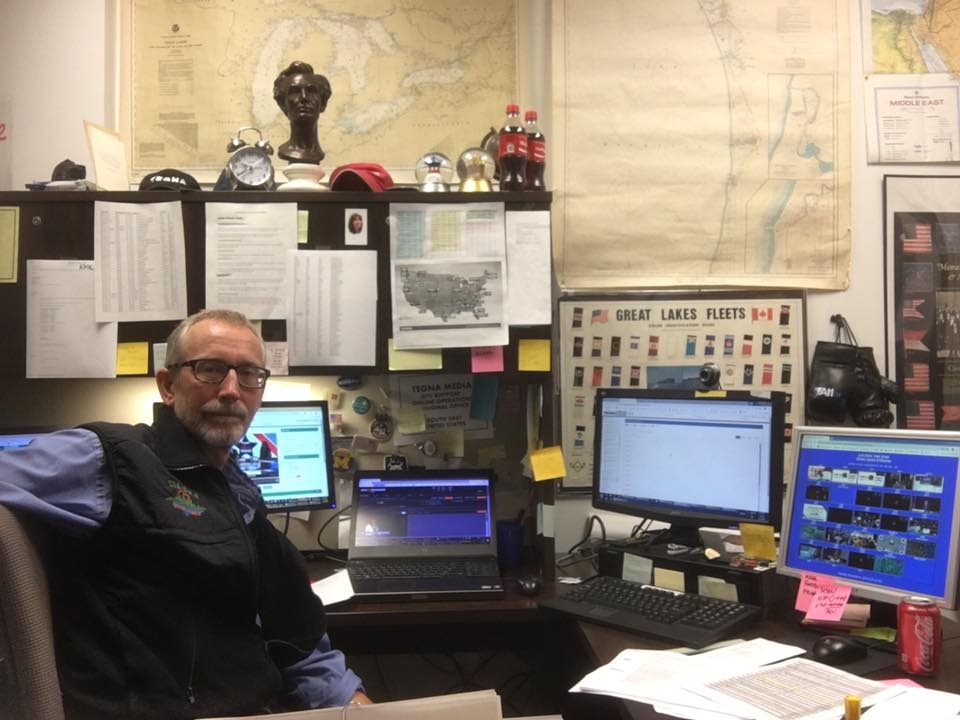
In the office at WXIA maybe 2012 – I was also asked who gave me permission to decorate my walls like this? Permission? I responded.

Almost entirely by accident and by being nosy, I started working in online tech back in 1995.

It was a dream job then and for me, its a dream job now.

And you know why?

Nobody really knows what I do and they are very happy with what I do and they are also happy to have me here to do what I do even though they aren’t sure what I do.

I have long counseled newbies to the field to TAKE OVER and be the expert because NO ONE ELSE WANTS to do this job.

Of course, you can get hired and then go to your new boss and say, WHAT DO I DO and your boss, because they are the boss, will come up with something.

But I am telling you, take the initiative, tell people what they should doing online and they WILL BE GRATEFUL.

Mostly because, the boss doesn’t want to have to think about online.

So you can do what you want.

What also makes this a dream job is or at least was, was the lack of rules.

I did so much stuff online because there was no one to tell me you can’t do that online.

People ask if I studied web design in college.

I tell them there was no web when I was in college.

Never learned what I couldn’t do so I did it all.

I launched my first major news website in the Spring of 2000.

That fall my boss said we needed a way to put High School football scores online.

I invented a way to do that.

A few weeks my boss said we needed a way to put school closings online.

I invented a way to do that.

Oh man oh man, but it was the wild wild west and anything goes and almost everything did.

Looking back through history you can spot jobs like people who can send Morse Code real fast or photographers or the early pilots.

Jobs before there were rules about having that job.

What a life.

What a dream.

I still feel that way.

Of course I never worked where the company’s cafeterias served steak and shrimp, kitchens were stocked with fresh juices and gyms offered free workout classes.

But today I work 5 blocks from the Atlantic Ocean where I can walk on my lunch hour.

I do agree with Ms Gray.

It’s better to have lunch and be scared to death than to not have lunch and be scared to death.

But its best to have lunch and walk the beach.

It’s great to be here.

If I am dreaming, don’t nobody wake me up.

Time to go back to work … Lunch over

6.22.205 – couldn’t be tempted …

couldn’t be tempted …
he’s into computer stuff
like all good young men

Adapted from the paragraph: His son couldn’t be tempted to take up the family business – “he’s into computer stuff, like all good young men are” – and so Friday also marked the end of the Harper legacy inside the Sydney Opera House.

In the article, For 50 years, Sydney Opera House has had one man on speed dial by Tiffanie Turnbull for the BBC News, Sydney.

In the midst of the headlines today, ICE Raids, Heat Domes, Iron Domes and Bombings, my brain was attracted by the headline on the BBC News Website that stated, For 50 years, Sydney Opera House has had one man on speed dial along with the tease, Terry Harper has been tuning pianos in the iconic venue since he was a teen – a family legacy started by his dad.

My first thought was of that college age REO record album, You Can Tune a Piano, but You Can’t Tuna Fish.

My 2nd thought was about the Sydney Opera House as I had just been rereading Bill Bryon’s 2000 book, In a Sunburned Country about Australia.

Anyway, I thought the story worth the click and the few minutes of my time it would take to read.

I thoroughly enjoyed the story of the a singular man in the right place at the right time and happy to be the peg that filled that particular hole of tuning the pianos in the Opera House in Sydney, Australia.

Sometimes when the Man and the Hour meet, the meeting is about tuning pianos.

For myself, it sounded like THE job.

There is a word sinecure that is defined as a position requiring little or no work but giving the holder status or financial benefit.

As I understand it, this usually meant political jobs assigned by political leaders or Kings as rewards to faithful servants.

The point is, that once I read about such jobs, sinecure or without cure, in the Latin, or as I defined it, without care, or without A care, it was the job I wanted.

I wanted to show up, do my time, leave and shut the door on the rest of the world when I got home.

As I got older and learned about the working world, I realized that sinecure’s rarely opened up and the list of applicants was vast.

I examined my skills, my likes, my dislikes and I searched out what for me would be the next best thing and decided I wanted to be a history teacher.

A United States History teacher.

This led to a course of study and a college degree and entering the job field at a time when history teachers weren’t much in demand.

So I took what I get which was two part time jobs working for both the Grand Rapids Public Library and the Kent Country Library systems at the same time.

At that moment, both Library systems had joined together to create their first online cataloging and registration system for managing the books in the library as well all the patron accounts for check out and check in and reservations.

While the two systems shared the computers, they maintained different access accounts and user policies.

And I had logins to both GRPL and KDL access.

Often, standing at the Reference Desk at the GRPL, I would hear a patron ask another staffer if they could check for a book at a KDL Library and put it on hold.

I would hear the staffer reply, “I can’t … but he can.”

And point at me.

I would smile (very smugly), access a terminal, login with my KDL credentials and put the book on hold.

While the goal was still to teach history, that logging into another account was the thin end of the wedge and another job field started to creep into my life through my fingertips.

I got to goofying around on the computer in my spare time at the reference desk.

Understand personal computers were just coming out and internet access, as it was then understood, was impossibly limited, and I had access to a multi million dollar system to … goof off.

Someone told me I could access the library at the University of Michigan through the GRPL terminal so I had to do it.

Then I figured out how I could access almost any library in the world.

This was the INTERNET.

The network of computers and cables and hardware that inter connected all the computers in the world.

This had been around since the dawn of computers pretty much.

In the early 90’s, the World Wide Web of INFORMATION that lived on the Internet was created and using my newly learned skill to access libraries, I could access the WWW.

Very limited at the time, and nothing but text, the WWW took up more and more of my time working at the library.

Almost overnight, I had a new job skill, a new line on my resume and a new job.

I was a webmaster.

And I was in demand, making more money than I could in the Libraries or as a teacher.

And I landed in online news and teaching history became a might-have-been in a long line of might-have-beens in my life.

I exchanged the hoped for life of academia for the world of news with its demand for immediacy in the online world of total adaptability.

Changes demanding change.

A million miles away from the world of the sinecure.

Today, I read with a shaking head that line, he’s into computer stuff, like all good young men are.

Was it fate?

Who was I to think I was good young man, but was it all a predetermined course of events, unavoidable and influenced by a higher power or a force beyond my control?

I think back.

Had I seen it coming, would I have made the same decisions?

Well, to be honest …

What a long strange trip it’s been.

And it led to being the ‘webmaster’ for a small resort on a resort island on the Atlantic Coast of South Carolina.

Been doing web stuff since 1995, I can make a website stand up and sing the Star Spangled Banner if I have too.

I am a dinosaur but one with skills that cannot be taught in any other way than by doing this for 30 years.

And I keep busy.

When I started this job, I promised the owner I would figure out a way to get the smell of the salt air and the feel of your toes in the sand into an online experience.

I work in an office 5 blocks from the coast and I spend my lunch hour walking the beach.

Not goofing off, mind you.

It’s research.

It just looks like I haven’t a care in the world.

More Thurber Drawings – click here

3.12.2025 – there was something

there was something
very real, work-like about
this new phase of it

Adapted from the passage: About this time Mr. Bixby appeared on the scene. Something like a minute later I was climbing the pilot-house steps with some of my clothes on and the rest in my arms. Mr. Bixby was close behind, commenting. Here was something fresh — this thing of getting up in the middle of the night to go to work. It was a detail in piloting that had never occurred to me at all. I knew that boats ran all night, but somehow I had never happened to reflect that somebody had to get up out of a warm bed to run them. I began to fear that piloting was not quite so romantic as I had imagined it was; there was something very real and work-like about this new phase of it.

In Life on the Mississippi by Mark Twain (Boston, James R. Osgood and Company, 1883).

In the book Mr. Twain recounts his adventures as a student or ‘cub’ pilot on the Mississippi River around 1855.

Pilots stood a four hour watch on and four hour watch off through out the day that required getting out of bed at Midnight every other day.

Mr. Twain writes that on his first day, “The watch was ended at last, and we took supper and went to bed. At midnight the glare of a lantern shone in my eyes, and the night watchman said —

‘Come! turn out!’

And then he left. I could not understand this extraordinary procedure; so I presently gave up trying to, and dozed off to sleep. Pretty soon the watchman was back again, and this time he was gruff. I was annoyed. I said: —

‘What do you want to come bothering around here in the middle of the night for. Now as like as not I’ll not get to sleep again to-night.’

The watchman said —

‘Well, if this an’t good, I’m blest.’

The ‘off-watch’ was just turning in, and I heard some brutal laughter from them, and such remarks as ‘Hello, watchman! an’t the new cub turned out yet? He’s delicate, likely. Give him some sugar in a rag and send for the chambermaid to sing rock-a-by-baby to him.’

It is at the this point that we get to the above quoted passage.

This morning I got up.

I have had to get up in the morning most of my life but there it was today.

Standing in the shower, I had time to ponder the act of taking a shower.

Using the Google I learn that home hot water heaters (as we might recognize them) were invented in 1897 but still by 1920, only 1% of US homes had indoor plumbing or even electricity.

One online article states: The establishment of standardized plumbing codes in the 1940s finally paved the way for widely available, safe indoor plumbing that relied on the storage tank water heater. 

My Dad was born in 1920 and I wondered when did he get used to a DAILY hot shower.

In 2024 I expect … EXPECT … to take a morning shower in not only HOT water but hot, fresh water.

I stood under the gush of water and tried to imagine all the I’s that had to be dotted and T’s that had to be crossed to make sure this minor miracle of the industrial age was so thoughtlessly made available to me at a rate that I was able expect my morning hot shower to work

If it didn’t work, it was some kind of an emergency for somebody.

But I digress.

I had a day yesterday and slept heavily last night to wake up a minute before the alarm and was able to switch that off before it sounded and woke up my wife.

Got the coffee going in the dark and into the shower.

Out in my robe, got my coffee and tablet and sat in the dark ready to find out how much the world had changed overnight.

My tablet glowed in the dark.

Morning coffee and reading out of the way I got dressed and packed up and off to the car to get to work by 7am.

Something was wrong or at least I thought it was as I am mostly confused in the morning anyway.

It was cool almost cold and it was dark.

But what was going on?

Something wasn’t right.

I felt, like I like to say, there was one boot off.

One boot off but I couldn’t tell which one.

Up in the dark and off to work.

I do it but I never get used to it.

I do it but I have never liked it.

Getting up and going to work in the dark adds something very real and work-like about this phase of a job.

And I pulled out on to the parkway and drove to work.

Between me and work are several high bridges over the Inter coastal water way.

From the top of these bridges I can spot the eastern edge of the United States and the Atlantic Ocean and the sun coming up.

And this morning was cold and dark and no sun.

Wait just a minute.

What was going on here.

Not any clouds or anything, but the Sun wasn’t coming up or something.

Something wasn’t right.

I checked the clock and I was on time.

I checked the traffic map and traffic was as it usually was.

I got to work and parked.

I got out in the dark, got my bag out of the back and locked the car.

As I walked the walkway to the front door I hauled my watch out of pocket and popped it open.

I held it in the light of the doorway light to read it.

6:00am!

I looked around the dark.

I looked at my watch that I hadn’t looked at since last Friday.

6:00am?

Boy Howdy, I hate the time change.

10.22.2023 – booksellers about

booksellers about
as uncommercial breed of
people possible

In a world gone crazy, when I am grasping at anything that points the compass in a positive direction, I found the recent article in the New York Times, Barnes & Noble Sets Itself Free By Maureen O’Connor to be something of a word of hope.

To quote Big Bill or better to quote Portia in the Merchant of Venice, So shines a good deed in a naughty world.

Or maybe best to quote Willy Wonka and say, “So shines a good deed in a weary world.”

At least, for a moment, this story about how Barnes and Noble  is pushing the chain to act more like the indie stores it was once notorious for displacing under the direction of a new CEO, James Daunt.

“The curious trick has been that if you actually let the local book-selling teams do what they think is best, you suddenly get much better bookstores,” Mr. Daunt said. Then he quickly added a caveat: “About a quarter of them become dramatically better, and a quarter become dramatically worse — but it is much easier to focus on that quarter and improve them.”

The change goes along with his strategy of embracing the mind-set of his typical employee. “Booksellers are about as uncommercial a breed of people as it’s possible to come across,” Mr. Daunt said. “The irony is that the less concerned we are with the commercial, the better it works commercially.

“You need to love books, and you need to know how our customers shop for books,” says a long term Barnes and Noble employee.

I read and I believe it, but only because I want to believe it.

I spent 12 years working for a chain bookstore.

For many employee’s it was a job.

For me and many employee’s and many of my good good friends that I worked with, it was a calling.

And it was a fight against those who went into it as business and tried to make it business while we tried to keep the faith.

So to read, “The curious trick has been that if you actually let the local book-selling teams do what they think is best, you suddenly get much better bookstores.” almost makes me want to cry.

I worked for Waldenbooks.

But I lived in Michigan.

If you loved books and you lived in the State of Michigan, at some point in your life you ended up at Border’s Book Store, a stand alone, independent love-affair with books in Ann Arbor, Michigan.

If you went down that path, you also at some point ended up at John King Used Books in Detroit but that’s another story.

Among booksellers in the State of Michigan, Border’s was the gold standard.

It had sofa’s and chairs and probably some sort of cafe before Starbucks.

They had a service desk set up and staffed by three people, in the pre computer era, who did nothing but researched hard to find titles so a customer could order the book.

They had floor upon floor of books.

The had an art print / map section and I still have prints on my office wall that I purchased there, using my grocery money instead of using my grocery money for groceries.

When I started with at my bookstore in a mall, I saw how it could embrace some of what Border’s was.

I fought for chairs in the store.

I fought for more and more copies of different books rather than 100 copies of the same bestseller.

We worked to create displays of content that meant something.

I started as a bookseller then assistant Manager and finally, Manager.

Though I used label tape and put the title, GUY IN CHARGE on my name tag.

One of the many, many things I did that got me trouble.

My battles can be kind of summed up when I made a display of books for Valentine’s Day.

Regardless of the topic or author, I took over a wall and made a display of every red book we had in the store.

My District Manager came in, took one look at Car Repair manuals next to Novels next to books on Knitting but ALL WITH RED COVERS surrounded by cardboard hearts and he ran back out to his car to get his camera.

That’s the type of thinking we want to see Mike!,” he told me.

I banged a big red American Heritage dictionary against my head.

This is Walden’s, Mike”, he would say, “Not Border’s.

The really funny part of this story is that after I was asked to leave the employ of company, another long story, Walden’s relocated it’s headquarters from Stamford, CT to ANN ARBOR and then bought out Border’s and in an effort to change the brand, changed the name of the Company TO Border’s Books!

In the end I guess I won.

To read Booksellers are about as uncommercial a breed of people as it’s possible to come across is a tonic to my soul.

Some where I have a book, I think it’s an autographed copy of Lake Wobegone by Garrison Keillor.

It was picked up for me by a Waldenbooks Regional Vice President.

Her office was in Ann Arbor and I got to know her when I worked at the Walden’s in Ann Arbor when I was in College.

I was allowed to switch back and forth between Grand Rapids, where I lived and Ann Arbor.

I would have long talks with this VP on bookselling as a calling and she would explain bookselling as a business.

She knew I liked Keillor and arranged to get an autographed copy when he made an appearance at some other Walden’s.

Inscribed above the author’s autograph was this sentiment.

To the most un-corporate person I know.”

And she signed it.

When James Thurber’s dog Mugg’s (The Dog that Bit People) died, he writes, “Mother wanted to bury him in the family lot under a marble stone with some such inscription as “Flights of angels sing thee to thy rest” but we persuaded her it was against the law. In the end we just put up a smooth board above his grave along a lonely road. On the board I wrote with an indelible pencil “Cave Canem.” Mother was quite pleased with the simple classic dignity of the old Latin epitaph.

To the most un-corporate person I know.

Should I have a tombstone someday, I would be quite pleased with the simple classic dignity of that sentiment.

,

8.17.2023 – cooking is something

cooking is something
that we human beings are
uniquely good at

I was refreshed to read the article, ‘AI cannot taste the way a chef can’: are chatbots a threat to fine dining? in the Guardian on Aug 16, 2023.

The article quotes tech entrepreneur Nikhil Abraham as saying, “AI will always be playing catch-up with human creativity, and the humans who are at the edge of creativity will always outsmart AI and have experiences that are more valuable.”

I don’t worry so much about AI so long as I can unplug my computer.

I hold that at least once a week you should unplug you computer and wave the end of the cord in front of your monitor.

To enlarge the scale on this theme, I bring up the story of the small town in North Carolina that lost power for several days when some nut put a bullet through some piece of equipment at a substation.

I hope AI remembers this story.

Maybe it does.

Maybe it does and someday it will design its own computer housing to be indestructible.

There is this story from back in the ’60s when some University Professors toured the at-that-time leader in computers for public use, Texas Instruments.

The Professors were looking for computers for their schools and they were shown the latest developments in machines that most likely had about 5000 bytes (5k) of memory and were cutting edge for their time.

According to the story, one of the Professors noticed this giant stainless steal box in a corner and asked what that was for?

The company tour guide said that was the computer housing they were developing for the Navy.

It had to be able to survive a missile attack the tour guide pointed out.

The Professors looked at the steel box then said, “That’s what we want!”

The tour guide looked at them and asked if they were expecting a missile attack?

“No”, said the Professors, “… grad students!”

And so was born the idea that any computer housing had to have at least 17 screws in it until Apple came along with their twist-and-pull to open box around 2005.

The point here is the human competent.

Those darn grad students wanted to get in there to see how the darn thing worked.

Those darn humans who, at the edge of creativity, will always outsmart AI and have experiences that are more valuable.

And cooking is where AI will lose.

As the article says:

“… robots and software can’t replicate what a chef does, even if you can codify a recipe. Like, an eggplant is smaller or larger than before, the fire is a smidge hotter than the last time I cooked.” When chefs create and execute a dish, they’re using all their senses, plus intuition. And as of now, AI doesn’t have senses of its own.

I guess I could be worried about that … as of now … but, as of now, I am not.

The article ends with this line.

AI cannot taste in the way a chef can.

Even if you’re repeatedly using the same ingredient, let’s say a piece of fruit, AI cannot account for ripeness, sweetness, texture.

Thinking of the human competent and the role of the chef in the statement AI cannot taste in the way a chef can, I though to that wonderful George Orwell book, Down and Out in Paris and London.

Mr. Orwell, needing employment, worked in the kitchens of Hotel X though tradition has it that he worked at Maxim’s, a landmark restaurant to THIS DAY in Paris..

Back in 1933, Mr. Orwell wrote this about Chefs and dining in a restaurant.

It is not a figure of speech, it is a mere statement of fact to say that a French cook will spit in the soup — that is, if he is not going to drink it himself.

He is an artist, but his art is not cleanliness.

To a certain extent he is even dirty because he is an artist, for food, to look smart, needs dirty treatment.

When a steak, for instance, is brought up for the head cook’s inspection, he does not handle it with a fork.

He picks it up in his fingers and slaps it down, runs his thumb round the dish and licks it to taste the gravy, runs it round and licks it again, then steps back and contemplates the piece of meat like an artist judging a picture, then presses it lovingly into place with his fat, pink fingers, every one of which he has licked a hundred times that morning.

When he is satisfied, he takes a cloth and wipes his fingerprints from the dish, and hands it to the waiter.

And the waiter, of course, dips his fingers into the gravy — his nasty, greasy fingers which he is for ever running through his brilliantined hair.

Whenever one pays more than, say, ten francs for a dish of meat in Paris, one may be certain that it has been fingered in this manner.

In very cheap restaurants it is different; there, the same trouble is not taken over the food, and it is just forked out of the pan and flung onto a plate, without handling.

Roughly speaking, the more one pays for food, the more sweat and spittle one is obliged to eat with it.

Hmmmmmmmmmmmmmmm.

Maybe this AI in the kitchen deserves a second look.

Post Script: Pictured above is Chef Paul Bocuse, named tje best chef of the Century in the 1900s, renowned for recipes like Poularde de Bresse au riz sauce supréme or Rable de liévre a la créme and Oeufs durs aux oignons dits a la tripe. I ran across an interview with him on YouTube where he was asked when was the best time to be a chef?

1946 – 1947!” he answered, “Right after the war …. People ate everything!