9.11.2025 – sun and softness and …

sun and softness and …
beaten hardness of the earth
song of all sun-stars

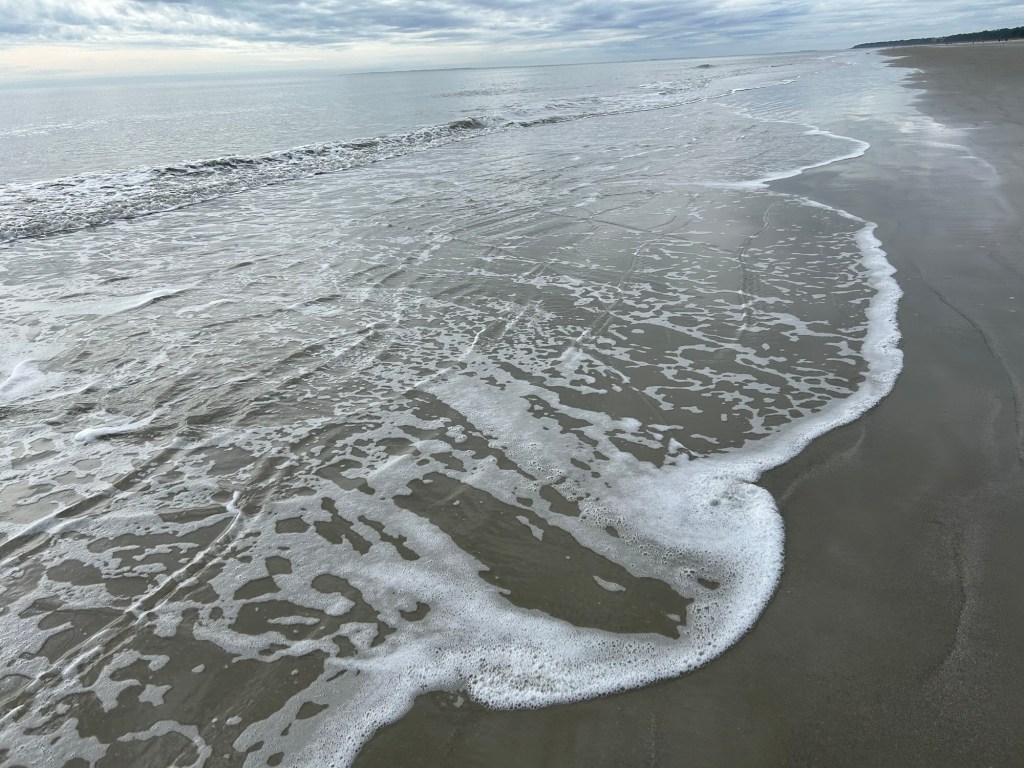
Sunrise over Broad Creek on Hilton Head Island, September 11, 2025

Adapted from:

Sun Song

by Langston Hughes

Sun and softness,
Sun and the beaten hardness of the earth,
Sun and the song of all the sun-stars
Gathered together —
Dark ones of Africa,
I bring you my songs
To sing on the Georgia roads.

As published in The Collected Poems of Langston Hughes by Langston Hughes (New York, Knopf, 1994).

My grand daughter called last night.

She had an assignment in class to interview someone who was alive on 9/11/2001.

She had 11 questions to ask; where was I, what was I doing, how did it change my day?

I worked in the TV News business so I was watching TV at work when the 2nd plane hit.

I spent the rest of the day working to provide coverage online of what was going on in New York and in Washington and the rest of the world.

The last question my grand daughter asked was how has life changed since 9/11?

Less safe.

Less trusting.

Less.

Driving to work this morning, the interview and 9/11 was on my mind.

It struck me that as I drove over the bridges to an island on the coast, that 24 years ago at this very minute, the sun was rising out of the Atlantic Ocean.

People were getting up, starting their day, safe and sound.

The events of the day were already in motion.

Coming up over the curve of the earth like a wall of clouds on the horizon at sunrise.

In the next 24 hours the tide would come in and out two times.

And the sun would be coming up again.

The tide and the sun the same with the softness of the sun and the beaten hardness of the earth.

But the world would be different place.

It would be less.

Sunrise on 9/11
—in the manner of Langston Hughes

The sky broke open,
not with fire,
but with gold.
September’s hush,
a whisper low,
before the sirens told.

Steel and sun,
stood side by side,
in morning’s proud parade—
no hint yet of the ash to come,
no shadow on the blade.

O Harlem,
O Brooklyn streets,
O sleeping Bronx and Queens—
the city stirred with coffee dreams,
and soft machines.

Children laughed.
Mothers prayed.
Builders raised the day.
Dreamers climbed their towered hopes
the American way.

But somewhere deep,
in silence coiled,
a storm prepared to rise—
and blue turned black,
and joy cracked loud
against the stinging skies.

Yet still, that sun,
it rose again—
above the smoke and cries.
And still it burns
in every soul
that dares to hope and rise.

Let morning break—
not just with light,
but with a voice that sings:
“We lived. We wept.
We stood. We fight—
for better, braver things.”

9.8.2025 – so much disturbing

so much disturbing
our lives, clouding our future
our unhappy land

Adapted from the essay Letter from the East (Allen Cove, February 8, 1975) written by EB White as published in The Essays of EB White by EB White (Harper and Row, New York, 1977).

Mr. White writes:

With so much that is disturbing our lives and clouding our future, beginning right here in my own little principality, with its private pools of energy (the woodpile, the black stove, the germ in the seed, the chick in the egg), and extending outward to our unhappy land and our plundered planet, it is hard to foretell what is going to happen.

I know one thing that has happened: the willow by the brook has slipped into her yellow dress, lending, along with the faded pink of the snow fences, a spot of color to the vast gray-and-white world. I know, too, that on some not too distant night, somewhere in pond or ditch or low place, a frog will awake, raise his voice in praise, and be joined by others. I will feel a whole lot better when I hear the frogs.

My take was the air of foreboding and doom for our unhappy land back in 1975.

I guess every generation has to handle this feeling and figure it out.

I was 15 in 1975 and the future did not seem to did not seem so bad

So here is the 15 year olds of today and a hope for their future.

We walk often late in the evening to beat the heat here in the low country and our sidewalks line deep dark forests with swampy marshland.

We walk along as dusk settles and 1,000s upon 1,000s of frogs wake up and raise their voices in praise.

As we walk along the treeland swamps, we think, what is that sound?

Tonight, maybe, when we hear it, I will feel a whole lot better.

And the radio is playing Jean Sibelius: Organ Symphony … how can someone be unhappy?

9.4.2025 – there is no native

there is no native
American criminal class
except for Congress

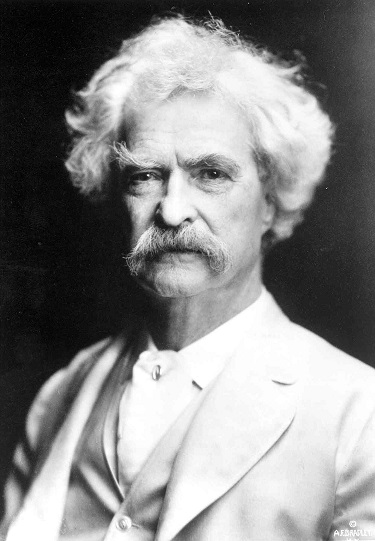
“It could probably be shown by facts and figures that there is no distinctly native American criminal class except Congress.”

From Pudd’nhead Wilson’s New Calendar, in Following the Equator by Mark Twain (Harper & Brothers Publishers, New York, 1897).

I am reminded of the old joke … if Pro is the opposite of Con, what is the opposite of Progress?

8.28.2025 – thought you was happy

thought you was happy
don’t know how you feel today
baby, I feel blue

Oh, I wish that yesterday
Yesterday was today!
Yesterday you was here
Today you gone away

I miss you, Lulu
I miss you so bad—
There ain’t no way for me
To get you out of my head

Yesterday I was happy
I thought you was happy, too
I don’t know how you feel today—
But baby, I feel blue

Yesterday and Today as published in The Collected Poems of Langston Hughes by Langston Hughes (New York, Knopf, 1994)

8.25.2025 – and not by eastern

and not by eastern
windows only, when daylight
comes, comes in the light

Adapted from Say not the Struggle Nought Availeth by
Arthur Hugh Clough as published in The Oxford Book Of English Verse (The Clarendon Press, Oxford, 1927).

Say not, the struggle nought availeth,
The labour and the wounds are vain,
The enemy faints not, nor faileth,
And as things have been they remain.

If hopes were dupes, fears may be liars;
It may be, in yon smoke concealed,
Your comrades chase e’en now the fliers,
And, but for you, possess the field.

For while the tired waves, vainly breaking,
Seem here no painful inch to gain,
Far back, through creeks and inlets making,
Comes silent, flooding in, the main.

And not by eastern windows only,
When daylight comes, comes in the light,
In front, the sun climbs slow, how slowly,
But westward, look, the land is bright.

If hopes were dupes, fears may be liars …

It may be, in yon smoke concealed,

Your comrades chase e’en now the fliers,

And, but for you, possess the field.

If hopes were dupes.

Fear may be liars.

And, but for you, possess the field.