5.15.2024 – though we achieved a

though we achieved a
first-rate tragedy, tragedy
was not our business …
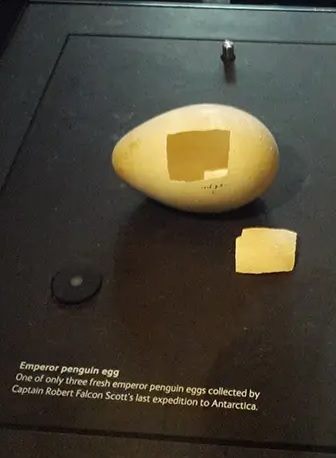
It was all those eggs you see?

According to Wikipedia, It was thought at the time that the flightless penguin might shed light on an evolutionary link between reptiles and birds through its embryo. As the bird nests during the Antarctic winter, it was necessary to mount a special expedition in July 1911, from the expedition’s base at Cape Evans, to the penguins’ rookery at Cape Crozier. Wilson chose Apsley Cherry-Garrard to accompany him and Henry R. Bowers across the Ross Ice Shelf under conditions of complete darkness and temperatures of −40 °C (−40 °F) and below. All three men, barely alive, returned from Cape Crozier with their egg specimens, which were stored.

It was this winter journey, not the later expedition to the South Pole, that Cherry-Garrard described as the “worst journey in the world”

When Mr. Cherry- Gerrard came to write about this trip to get penguin eggs, the book was in fact titled, The Worst Journey in the World.

In the opening preface, Mr. Cherry-Gerrard writes, “Polar exploration is at once the cleanest and most isolated way of having a bad time which has been devised.”

It is an incredible read and no less incredible when it is realized it is all true and written in the first person by someone who had been there.

While the story itself would captivate, the writing of Mr. Cherry-Gerrard is a wonder to enjoy.

Mr. Cherry-Gerrard was not in condition after this side trip to take part in the Captain Scott’s push to be first at the South Pole.

You may remember that while Scott reached the pole, what he found was a note from Swedish explorer Roald Amundsen that he had already been there.

Scott and his part all died on the trip back to camp.

Mr. Cherry-Gerrard led the team that discovered the bodies.
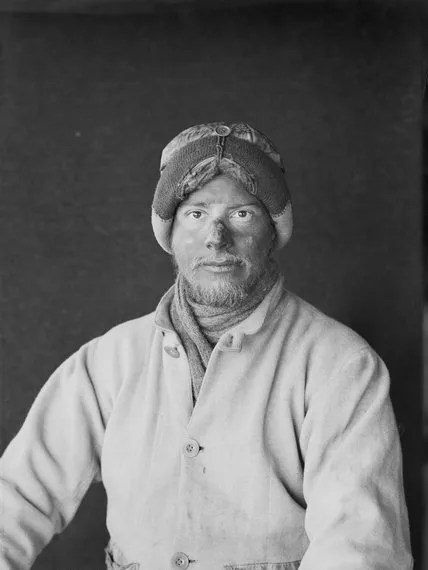
Between the egg adventure and writing the book, World War One took place.

Mr. Cherry-Gerrard closes his book with these passages:

This post-war business is inartistic, for it is seldom that any one does anything well for the sake of doing it well; and it is un-Christian, if you value Christianity, for men are out to hurt and not to help — can you wonder, when the Ten Commandments were hurled straight from the pulpit through good stained glass.

It is all very interesting and uncomfortable, and it has been a great relief to wander back in one’s thoughts and correspondence and personal dealings to an age in geological time, so many hundred years ago, when we were artistic Christians, doing our jobs as well as we were able just because we wished to do them well, helping one another with all our strength, and (I speak with personal humility) living a life of co-operation, in the face of hardships and dangers, which has seldom been surpassed.

I shall inevitably be asked for a word of mature judgment of the expedition of a kind that was impossible when we were all close up to it, and when I was a subaltern of 24, not incapable of judging my elders, but too young to have found out whether my judgment was worth anything.

I now see very plainly that though we achieved a first-rate tragedy, which will never be forgotten just because it was a tragedy, tragedy was not our business.
5.14.2024 – perhaps question is

perhaps question is
where are you in your moral
decision making

In the New York Times Opinion Piece (Part of the Conversation Series), NYT Opinion columnist Bret Stephens asks readers to ‘Ponder the meaning of the word “hineni.”’

The word hineni is linked to this definition/explanation of the word.

On several occasions, God asks Adam, Abraham and Moses, “Where are you?” Understood literally, it’s a nonsensical question. If God is all knowing, doesn’t God know where they are?

Perhaps the question isn’t about geographical location. Perhaps instead, God is asking: Where are you in your moral decision making?

The answer “hineni” means: “Here I am ready and waiting to do Your will. Here I am, a partner with You in the eternal covenant between You and our people. How can I fulfill my role more fully?”

Yet the word conveys so much more. To say “hineni” expresses a yearning for a spiritual awakening, a moment, however fleeting, in which we feel close to the heart of the Universe.

It signals the moment when the details of my own life story become one with the story of our people — a legacy I stand ready to pass down to those who follow.

Perhaps instead, God is asking: Where are you in your moral decision making?

What legacy do you stand ready to pass down to those who follow?

Hineni sounds like a dangerous word.

A word not to be taken lightly.

Especially if you accept who is asking the question.

Take us out of today’s legal news cycle.

Take us out of today’s political news cycle.

Take us out of today’s world news cycle.

And put the major players of those news cycles and picture them, not in courtroom, not in a legislative meeting room, not in a war room but in a room where a question is posed to these major players by God.

And God asks, Where are you in your moral decision making?

Okay, so forgot the major players.

How about me?

I am going off to ponder the meaning of the word hineni.

5.10.2024 – they both look down on

they both look down on
those that don’t read but merely
who go out and live

The Three Tigers

As to Tiger Number One, what he likes best is prowling and hunting. He snuffs at all the interesting and exciting smells there are on the breeze; that dark breeze that tells him the secrets the jungle has hid: every nerve in his body is alert, every hair in his whiskers; his eyes gleam; he’s ready for anything. He and Life are at grips.

Number Two is a higher-browed tiger, in a nice cozy cave. He has spectacles; he sits in a rocking-chair reading a book. And the book describes all the exciting smells there are on the breeze, and tells him what happens in the jungle, where nerves are alert; where adventure, death, hunting and passion are found every night. He spends his life reading about them, in a nice cozy cave.

It’s a curious practice. You’d think if he were interested in jungle life he’d go out and live it. There it is, waiting for him, and that’s what he really is here for. But he makes a cave and shuts himself off from it—and then reads about it!

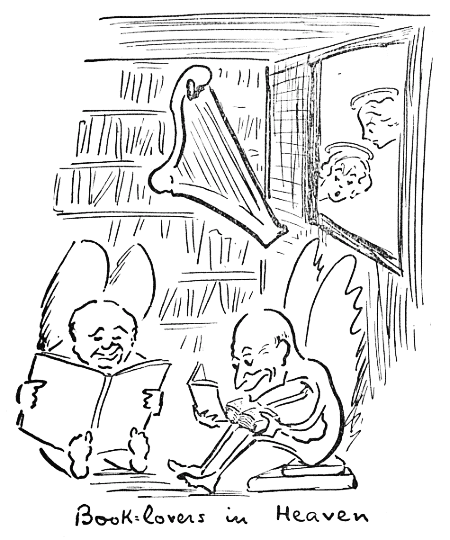
Once upon a time some victims of the book-habit got into heaven; and what do you think, they behaved there exactly as here. That was to be expected, however: habits get so ingrained. They never took the trouble to explore their new celestial surroundings; they sat in the harp store-room all eternity, and read about heaven.

They said they could really learn more about heaven, that way.

And in fact, so they could. They could get more information, and faster. But information’s pretty thin stuff, unless mixed with experience.

But that’s not the worst. It is Tiger Number Three who’s the worst. He not only reads all the time, but he wants what he reads sweetened up. He objects to any sad or uncomfortable account of outdoors; he says it’s sad enough in his cave; he wants something uplifting So authors obediently prepare uplifting accounts of the jungle, or they try to make the jungle look pretty, or funny, or something; and Number Three reads every such tale with great satisfaction. And since he’s indoors all the time[5] and never sees the real jungle, he soon gets to think that these nice books he reads may be true; and if new books describe the jungle the way it is, he says they’re unhealthy. “There are aspects of life in the jungle,” he says, getting hot, “that no decent tiger should ever be aware of, or notice.”

Tiger Number Two speaks with contempt of these feelings of Three’s. Tigers should have more courage. They should bravely read about the real jungle.

The realist and the romantic tiger are agreed upon one point, however. They both look down on tigers that don’t read but merely go out and live.

As published in The Crow’s Nest by Clarence Day, Jr., New York, Alfred Knopf, 1921.

5.8.2024 – everything is jake

everything is jake
what is life but a bubble
I ask anyway

I was looking for a specific James Thurber quote about being content to sit in the backseat of a car, not drive and read the burma-shave signs and found this blog that reviews the back issues of the New Yorker Magazine.

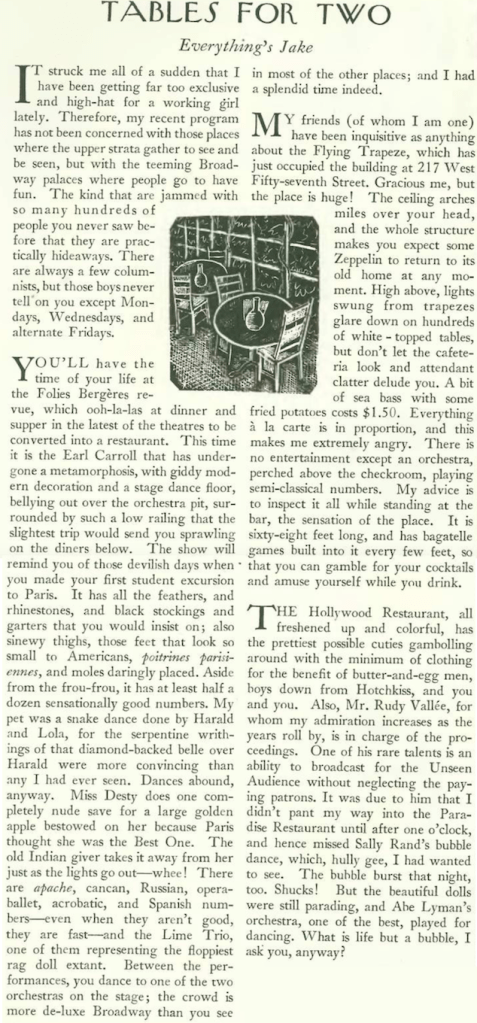
Scrolling through the posts, the column titled Table for Two and subtitled for this edition of the New Yorker, Everything’s Jake.

In the movie, The Sting, you might remember Robert Redford tells the waitress (the unknown hit lady assigned to kill Redford) to go open the window a back restroom saying, “Just do what I tell ya and everything’ll be jake.”

Everything’s Jake, according to Wikipedia  is “a slang expression from the Roaring Twenties in the United States, meaning “everything is in good order”.

The column was written by Lois Long, who at 23 years old, again according to Wikipedia, was hired to review the speakeasies of New York for the New Yorker. Her witty, satirical column was called “When Nights are Bold,” the title of which changed to “Tables for Two” with the issue for September 12, 1925 and ran until June 6, 1931.

In this column she closed with the line, “What is life but a bubble, I ask you, anyway?”

23 years old, living in New York during the Roaring 20’s and tasked with reviewing illegal speakeasies.

What is life but a bubble?

I ask you, anyway!

Everything is jake!


5.3.2024 – that something very

that something very
peculiar happening …
need to acknowledge

New York Times Opinion Columnist Paul Krugman was thinking about the question Ronald Reagan asked during a debate with Jimmy Carter back in 1980.

Mr. Reagan asked, “Are you better off now than you were 4 years ago?”

Mr. Krugman, in an Opinion Piece titled, The Peculiar Persistence of Trump-stalgia, pondered which of the two current Presidential Candidates comes off better asking that question.

Mr. Krugman writes, “So how can anyone think that the Reagan question favors Trump? Spoiler alert: I don’t have a full explanation. But at the very least, we need to acknowledge that something very peculiar is happening.

Mr. Krugman has been an Opinion columnist since 2000 and is also a distinguished professor at the City University of New York Graduate Center. He won the 2008 Nobel Memorial Prize in Economic Sciences for his work on international trade and economic geography.

And his opinion piece is a wonderful collections of ponderings on the economic patterns of the last 4 years.

But know what?

Who needs to confine his salient point to economics?

Mr. Krugman’s salient point being, as I see it, is at the very least, we need to acknowledge that something very peculiar is happening.

Boy Howdy, but at the very least, we need to acknowledge that something very peculiar is happening.

I am reminded of a baseball game I went to with my kids back in Grand Rapids, Michigan.

The home town team was the West Michigan Whitecaps, named after the white capped waves on Lake Michigan.

Of course the team wore Navy Blue caps with a wavy logo.

This night I am thinking of we were sitting in the Family Zone.

A section that was supposed to be family friendly with no drinking.

The whole stadium was no smoking of course.

The section was bench seating, bleachers with a back and me and my kids sat in a row

Another Dad sat with his kids in the same row.

Between me and the other Dad was a guy who looked like he played lead guitar for ZZ Top.

He had a heavy nylon biker jacker of some short and a baseball cap pulled down low and dark sunglasses.

He had long hair, a long beard down to his belt buckle and a long mustache flaring out over his cheeks and covering his mouth.

Peeking out from under his moustache was a cigarette that was replaced as soon as he finished smoking it.

In one hand was a beer.

The wind was such that the smoke went right into the face of this other Dad.

He looked like a nice enough guy with khaki slacks and a polo shirt and windbreaker topped off by a really nice haircut.

You know the type, a nice, well behaved, golf Buddy, at home in a world of people who followed rules.

Every time Mr. ZZ Top exhaled, Buddy would make a big show of waving at the smoke in front of his face.

Finally, he leaned over and said, “Sir, there is no smoking.”

Mr. ZZ Top reached up and with two fingers slowly removed the cigarette from his mouth, turned, ever so slowly, to Buddy and blew out a lungful of smoke and looked Buddy in the eye.

“No shit?” he said.

Mr. ZZ Top turned back to the game and returned the cigarette to his mouth.

Buddy caught my eye and I shrugged.

I wanted to say, at the very least, we need to acknowledge that something very peculiar is happening.

Thinking of Mr. Krugman’s article and its salient point, about all I can say is … well Mr. ZZ Top said it better than I ever could.