5.26.2024 – our time has seen that

our time has seen that
impulse going to war – seen
the circle complete

North and South they assembled, one cry and the other cry,
And both are ghosts to us now, old drums hung up on a wall,
But they were the first hot wave of youth too-ready to die,
And they went to war with an air, as if they went to a ball.

Dress-uniform boys who rubbed their buttons brighter than gold,
And gave them to girls for flowers and raspberry-lemonade,
Unused to the sick fatigue, the route-march made in the cold,
The stink of the fever camps, the tarnish rotting the blade.

We in our time have seen that impulse going to war
And how that impulse is dealt with. We have seen the circle complete.
The ripe wheat wasted like trash between the fool and the whore.
We cannot praise again that anger of the ripe wheat.

This we have seen as well, distorted and half-forgotten
In what came before and after, where the blind went leading the blind,
The first swift rising of youth before the symbols were rotten,
The price too much to pay, the payment haughty in kind.

So with these men and then. They were much like the men you know,
Under the beards and the strangeness of clothes with a different fit.
They wrote mush-notes to their girls and wondered how it would go,
Half-scared, half-fierce at the thought, but none yet ready to quit.

From John Brown’s Body by Stephen Vincent Benét, (Garden City, N. Y., Doubleday, Doran and Company, 1928).

That line there about the flowers.

About the flowers and raspberry lemonade.

Painting with words and scents and tastes in a way that anyone can feel it.

Not imagine it, but feel it.

The cool glass, the sweet liquid on the tongue, the smell of the flowers and pretty girls.

Back in the day when I worked in the Public Library I was cataloging a small collection of letters of one Byron Root Piece.

Dr. Pierce was a Dentist in Grand Rapids, Michigan back in the 1860’s.

I have always been attracted to Dr. Pierce as my Dad was also a Dentist from Grand Rapids, Michigan and ended up a Dentist in the Army of the United States in World War 2.

Dr. Pierce was also a captain of a militia company, the Valley City Light Guard and when Mr. Lincoln’s call for volunteers came, the company joined up and became part of the 3rd Michigan Volunteer Infantry.

Capt. Pierce served with distinction through the war with the Army of the Potomac and ended his career in the army as a Major General of Volunteers.

His grave in Fulton Street Cemetery in downtown Grand Rapids is marked with a small red flag with the two stars of a Major General.

He became a fixture of Decoration Day in Grand Rapids and he lived to the age of 95 and was Michigan’s last Civil War General when he died in 1924.

And I was transcribing letters written by him and too him during the Civil War.

The letters were mostly chatty and about nothing in particular.

Some gossip about Grand Rapids, some thoughts about life in the Army.

There was this one letter from General Pierce’s brother written sometime in the Spring of 1863.

The brother wrote the lines of, “Sorry you missed Sunday Dinner at Fathers. The dessert was Strawberry Shortcake. I did a double duty and ate yours for you.”

Understand this was written in the days before refrigerators or ice boxes.

The strawberries could not have been more than a day off the vine, if not picked that Sunday morning and still warm from the sunshine.

The biscuits could have been, might have been, hot out of the oven.

The cream was from cows milked that morning.

More than 100 years later, John Thorne would write about Strawberry Shortcake: “A bite of real strawberry shortcake is a mouthful of contrast. The rich, sweet cream, the tart juicy berries, and the sour, crumbly texture of hot biscuit all refuse to amalgam into a single flavor tone, but produce mouth-stimulating contrasts of flavor — hot and cold, soft and hard, sweet and tart, smooth and crumbly. The mouth is alert and enchanted at once.”

Painting with words that let you not just imagine it, but feel it.

Flowers and Raspberry Lemonade.

Strawberry Shortcake.

So then the contrast with the next stanzas of Mr. Benét’s poem can hit hard.

So with these men and then. They were much like the men you know.

Half-scared, half-fierce at the thought, but none yet ready to quit.

Painting with words that let you not just imagine it, but feel it.

Some thoughts on Memorial Day Weekend, 2024.
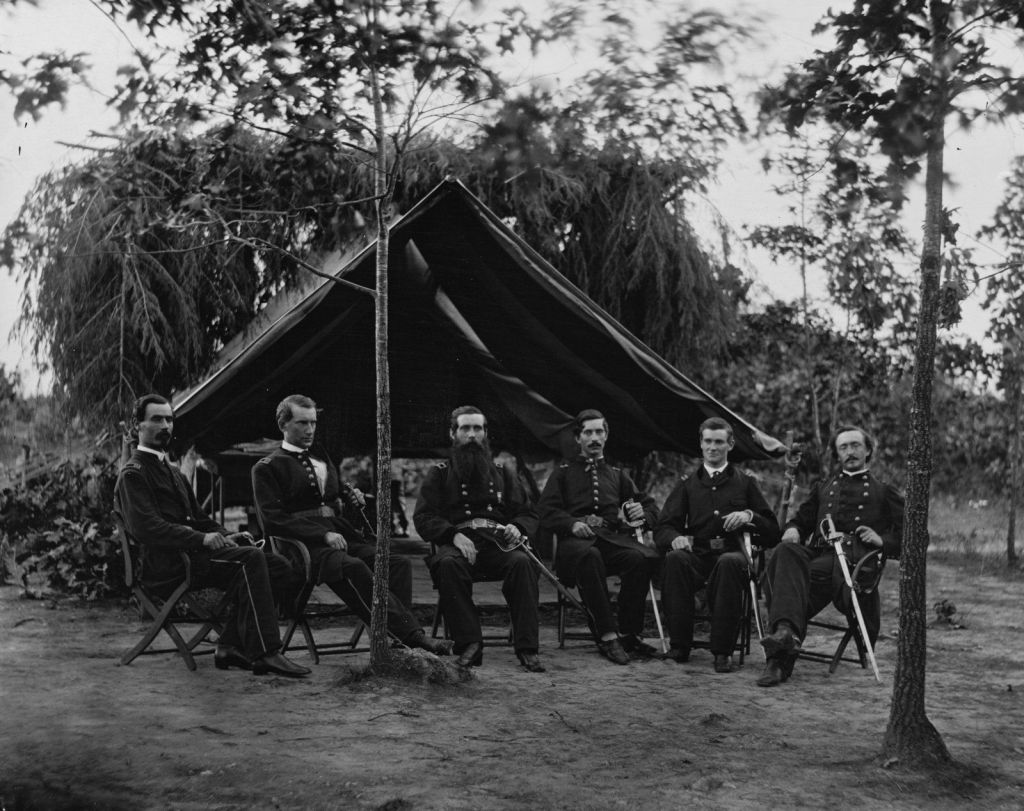
General Pierce, a Dentist from Grand Rapids, Michigan – Center with beard

5.22.2024- chief item in the

chief item in the
little library of hours
away from our lives

Recently reading The receptionist : an education at the New Yorker by Janet Groth (Chapel Hill, N.C. : Algonquin Books of Chapel Hill, 2012), I came across this passage where Ms. Groth reflects on her relationship with poet John Berryman.

Ms. Gorth writes: Since I could not watch John make his poems, the next best thing was to watch him teach. As a poet-teacher he so invested his ego in his work that he was ego-free, a fleshless, selfless lover and sharer of enlightenment, pure spirit. This part of him is neither personal nor notorious nor recorded anywhere at all except in his poems and in the memories of his students, where he exists as the chief item in the little library of hours we’ve brought away from our lives in the university.

I liked that last line, “ … and in the memories of his students, where he exists as the chief item in the little library of hours we’ve brought away from our lives in the university.

Or more specifically, “… the little library of hours we’ve brought away from our lives.”

I am reminded of Mr. Bernstein in the movie Citizen Kane.

Mr. Thompson, the reporter digging into the life of Charles Foster Kane questions Mr. Bernstein’s thoughts that maybe ‘Rosebud’ was some girl Mr. Kane met.

Mr. Thompson says, “It’s hardly likely, Mr. Bernstein, that Mr. Kane could have met some girl casually and then, fifty years later, on his death bed —

And Mr. Bernstein says (Note* if you haven’t seen the movie, read this passage slowly – pause after each line to get the effect of an old man thinking back 50 years):

Well, you’re pretty young, Mr…er…Mr. Thompson.

A fellow will remember a lot of things you wouldn’t think he’d remember.

You take me.

One day, back in 1896, I was crossing over to Jersey on a the ferry and as we pulled out there was another ferry pulling in.

And on it there was a girl waiting to get off.

A white dress she had on.

She was carrying a white parasol.

I only saw her for one second. and She didn’t see me at all.

But I’ll bet a month hasn’t gone by since that I haven’t thought of that girl.

The little library of hours we’ve brought away from our lives.

That little library of hours we’ve brought away from our lives.

Filled with chief items.

Multiple chief items.

I like that.

I like that a lot.

5.21.2024 – in truth that which could

in truth that which could
no longer be described was
no longer noticed

The literature of the eighteenth century in England is an admirable and most enjoyable thing …

The way to write real poetry, they thought, must be to write something as little like prose as possible; they devised for the purpose what was called a ‘correct and splendid diction’, which consisted in always using the wrong word instead of the right, and plastered it as ornament, with no thought of propriety, on whatever they desired to dignify. It commanded notice and was not easy to mistake; so the public mind soon connected it with the notion of poetry and came in course of time to regard it as alone poetical.

It was in truth at once pompous and poverty-stricken. It had a very limited, because supposedly choice, vocabulary, and was consequently unequal to the multitude and refinement of its duties. It could not describe natural objects with sensitive fidelity to nature; it could not express human feelings with a variety and delicacy answering to their own. A thick, stiff, unaccommodating medium was interposed between the writer and his work. And this deadening of language had a consequence beyond its own sphere: its effect worked inward, and deadened perception. That which could no longer be described was no longer noticed.

From The Name and Nature of Poetry, A. E. Housman, Cambridge, Cambridge University Press, 1933

That last line, That which could no longer be described was no longer noticed.

I can’t describe the current cycle of political news.

Does that mean I longer have to notice it?

Boy Howdy!

In Truth!

5.20.2024 – Miss Otis regrets …

Miss Otis regrets
she is … is unable to
lunch today, madam

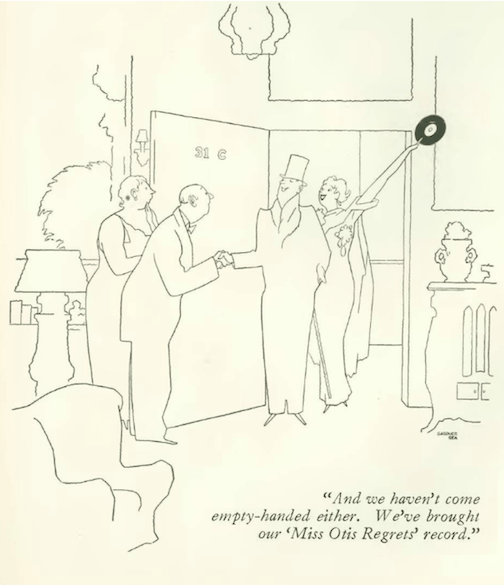
According to Wikipedia, Miss Otis Regrets is “a song about the lynching of a society woman after she murders her unfaithful lover, composed by Cole Porter in 1934.

The song began during a party at the New York apartment of Porter’s classmate from Yale, Leonard Hanna. Hearing a cowboy’s lament on the radio, Porter sat down at the piano and improvised a parody of the song. He retained the referential song’s minor-keyed blues melody and added his wry take on lyrical subject matter common in country music: the regret of abandonment after being deceitfully coerced into sexual submission. Instead of a country girl, however, Miss Otis is a polite society lady.

Garner Rea’s cartoon appeared in the Dec. 29, 1034 edition of the New Yorker. 

Just about everyone in the world recorded it as well but few captured the haunting theme as much as the covid era, #quarantunes (#live from home) version by Morgan James.

According to legend, Cole Porter wrote the song “Miss Otis Regrets” Ada Beatrice Queen Victoria Louise Virginia Smith, better known as Bricktop, for her to perform.

Bricktop Smith was an American dancer, jazz singer, vaudevillian, and self-described saloon-keeper who owned the famous nightclub “Chez Bricktop” in Paris from 1924 to 1961.

If you can find a recording of Bricktop’s version, please let me know.

If anyone has a good cowboy lament for 2024, also please let me know.

I am thinking of reworking the words to Miss Otis …

Here are the lyrics:

Miss Otis regrets she’s unable to lunch today,
Madam,
Miss Otis regrets she’s unable to lunch today.
She is sorry to be delayed,
But last evening down in lover’s lane she strayed,
Madam,
Miss Otis regrets she’s unable to lunch today.
When she woke up and found
That her dream of love was gone,
Madam,
She ran to the man
Who had led her so far astray,
And from under her velvet gown
She drew a gun and shot her lover down,
Madam,
Miss Otis regrets she’s unable to lunch today.
When the mob came and got her
And dragged her from the jail,
Madam,
They strung her upon
The old willow across the way,
And the moment before she died
She lifted up her lovely head and cried,
Madam,
“Miss Otis regrets she’s unable to lunch today.”

5.18.2024 – many delight in

many delight in
musty, badly arranged and
ill-lighted, bookshops

Many buyers delight in the musty, ill-lighted, badly arranged bookshops with their monastic atmosphere. Their fascination is unquestioned, they have added much to cultivation of readers

From the article, Intelligent and Aggressive Bookselling by Cedric R. Crowell, General Manager, Doubleday, Doran Books Shops, Inc. in Publishers Weekly, New York, November 26, 1932.

Growing up in Grand Rapids, Michigan, there were not a lot of bookstores.

The City Directory of Grand Rapids for 1960 lists just 15 bookstores.

Of those 15, Bakers, DeSales Catholic Books, Kregals, Northtown Bible and Books, Glad Tidings Book and Bible, Langerhost Bible, Pell’s Bible, Reformed Church Bookstore and Zondervan’s were all religious books stores.

Then there was Allen’s Bookstore, a big, old fashioned bookstore down on Division near where the Majestic Theater offices are today.

It was next to a Coffee and Nut shop called the Coffee Ranch and the smell of freshly roasted coffee often filled the bookstore even before the days of Starbuck’s in a Barnes and Noble.

Those smells sound good but the coffee roaster often malfunctioned at the Coffee Ranch and filled all the stores in the building with the smell of burned coffee beans.

Through my Dad, my family was familiar with the Coffee Ranch.

It had wooden floors, a big coffee mill, sacks of beans, bins of coffee, redskin peanuts the size of your thumb and cashews the size of your big toe.

It had all the atmosphere for real that today’s gift shops try to recreate.

At one time the Coffee Ranch supplied all the major restaurants in Grand Rapids with their own blends and then sold those coffee blends in their store under the name of the restuarant.

The walls of the Coffee Ranch were lined with these wooden bins with the names of the restaurants on a card on the front of the bin.

It was cool for us because there was one bin labeled with a card that said PANTLIND’S BEST.

The Pantlind was the biggest hotel in town at the time and has since been taken over by Amway.

The cool thing was that PAINTED on the bin, behind the card, was the label, HOFFMAN’S BEST.

I asked the owner about it and he said that back in the day, the Hoffman House had it’s start in Grand Rapids before moving to Wisconsin where it became a family run business success until being bought out in 1976 by some chain.

I was never able to prove this connection but you can guess what coffee blend I would buy.

Allen’s Bookstore, next door, was as close to a main stream bookstore as Grand Rapids had.

My Dad would take me there from time to time and my Dad would chat with Mr. Allen about what was new and good.

My Dad knew everyone and could talk with anybody.

I would walk around and day dream that Mr. Allen would look over and say, ‘Hey kid! You are the 100,000th customer this year and you win $100 in free books.’

That never happened but I had my $100 worth of books picked out just in case.

Besides Allen’s, the only bookstore in town, was Grant’s.

Grant’s Used Books at 449 Bridge St.

Well, Grant’s Used Everything.

It is now Bridge Street Lofts on that location but before it was torn down, Grant’s was one of those small building’s built into an existing house.

The shop was Mr. Grant’s hobby and he sold anything he could think of.

Those blue coin collecting books.

Odd auto and boat motor parts.

And books.

And books and books and more books.

My hunch is that Grant’s specialized in Grand Rapid’s Public School textbooks that he bought and sold to families in the area but he also stocked the most amazing collection of books I had ever seen.

The store could not have had a more musty, ill-lighted, badly arranged bookshop with a monastic atmosphere had Grant tried.

The main floor was high ceiling with book cases and books wedged in everywhere.

My Dad would take me over there from time and my Dad would talk to Grant.

My Dad knew everyone and could talk with anybody.

I remember one time he got into an argument with Grant over how the book, Anthony Adverse, ended.

To make a point, Grant had to find a copy which meant going down to the basement.

He led us to a back stairs that had a large sign with an arrow that said ‘Down.’

He moved some books stacked by the stairs around until he found a switch and turned on the lights and took us down a shaky, narrow staircase.

The basement made the upstairs look roomy.

The basement was a maze of cement floor to exposed ceiling beams bookcases, lit by bare light bulbs with aisles barely wide enough for me to get through and barely above my head.

There were 1,000s if not millions of books down there.

“All Fiction,” Grant said as he started looking for Anthony Adverse.

All fiction and somewhat arranged in alphabetical order by author.

Maybe suggestion if not by rule.

Books were wedged in maybe three deep and then sideways on top.

Books were stacked on the floor.

Books were everywhere.

I was in awe.

My Dad made no effort to leave the stairs and enter the maze.

He was just a little too big to fit in between the book cases.

Grant found the book and we returned to the main floor.

As Grant read the last page he said, ‘I remember now, public opinion made the author re-write the ending.’

I don’t remember who had what side of the argument.

I do remember Grant look at me once and asking, ‘What do you read?’

And I answered … CS Forester, Hornblower books.

My Dad smiled and Grant reeled off the list of Hornblower titles and which ones were his favorites.

Then he mentioned that Forester had other books including, Rifleman Dodd and The Gun.

For years I searched for a book called Rifleman Dodd and The Gun until I got to college and in the college library I found out that it was, as Grant said, two books, Rifleman Dodd and The Gun.

Odd twist to this story, when I finally got around to owning a copy of these books which I ordered from Amazon, it was a single edition that had both books, Rifleman Dodd and The Gun, in one volume that I still have to this day.

At some point, I started going to Grant’s Bookstore on my own.

I would ride my bike over to the west side of Grand Rapids which was like being in another world.

Grand Rapids had a North End, a South End and a West Side and you knew where you belonged and I would leave the North End on my bike, cross the river and ride across the foreign West Side to Grant’s.

Grant would hear the bell on the door and look up and see me and say, “The Hornblower Kid” and let me wander around.

If he heard the light switch to the basement click, he would yell, “Don’t go in the basement !

Then he would look and say, “Oh it’s you”

Don’t touch anything but the books.” he would say and down the stairs I would go, into another planet or maybe another dimension as time would stop when I was down there.

The rest of world continued on I am sure. but I felt like I had been transported to another place altogether.

All those books.

All those thoughts.

All those words.

It was a magical place.

Fascinating.

Another thing about Grant’s was the price.

I think all books were a quarter and he never charged tax.

I would get a $5.00 from my Grandma on my birthday and at Christmas and it translated to 20 new books in my mind.

20 new blocks of magic.

Fascinating.

Grant’s Used Bookstore came to mind when I read the lines:

Many buyers delight in the musty, ill-lighted, badly arranged bookshops with their monastic atmosphere.

Their fascination is unquestioned, they have added much to cultivation of readers.

Musty, ill-lighted, badly arranged bookshops.

Their fascination is unquestioned.