astounding result stunning act of collective responsibility
Yes I know I went to six syllables in responsibility.
From the Guest Opinion essay, What Just Happened in France Is Astounding by David Broder, in the New York Times where Mr. Broder writes:
This is a truly astounding result. Through a stunning act of collective responsibility, the far right has been stopped. But France is not suddenly fixed. With no group taking more than one-third of the National Assembly’s 577 seats, there is trouble ahead. The far right, though chastened, is in a stronger position than ever before, commanding a growing electoral coalition and decently placed for the presidential election in 2027. But France, on the back of pragmatic collaboration between parties and enthusiastic resistance from voters, has won a brilliant reprieve.
A stunning act of collective responsibility?
Yes, a stunning act of collective responsibility!
Could it happened that those words could be used to describe some action within the borders of the United States of America?
Stunning act of collective responsibility.
A consummation devoutly to be wished indeed.
What must it be like to be a political writer with the name David Broder and not be David Broder?
doesn’t read stories make her blue – world’s all bitched up it always was, will
Adapted from the passage, “She doesn’t read political or war stories because she can’t understand them and because they make her blue. “The world is all bitched up,” she once said. “Always was, always will be.” “Do you really believe that?” she was asked. “No,” she said, after a moment of deliberation, “I guess I don’t.” She spends half an hour in the diner. Then, practically every night, before going home to bed, she makes a Samaritan tour of the Bowery and its environs. She carries an umbrella and a large handbag, which contains a flashlight, a number of cakes of soap of the size found in hotel bathrooms, and a supply of nickels, dimes, and quarters.”
From the short essay, Mazie by Joseph Mitchell in his collection of essays, McSorley’s wonderful saloon originally published in 1943.
In the forward to this edition of Mr. Michell’s essays, Mr. Calvin Trillin writes, “What struck me as astonishing was that he was able to get the marks of writing off his pieces. The words seem to have just appeared on the page by some process that was the reverse of those magic slate pages that children lift to make what they’ve written or drawn vanish. … Like Joe DiMaggio, Joe Mitchell made it look perfectly natural, even though nobody else could exactly do it.”
Wikipedia writes of this essay, “Mitchell was open to taking on the challenge of profiling the female central character of Mazie. The writing process was challenging until his central character would give him “the revealing remark.” The 1938 World Telegram description of Mazie P. Gordon reveals she was known as “Miss Mazie” to the men she interacted with around the Venice Theatre. She is blonde, kind, and has exaggerated hair and makeup. Two years later, when Mitchell profiled Mazie in The New Yorker, some critics called Mitchell an anthropologist in his description. Mazie becomes more than just a blonde and kind woman, and instead is shown to be complex and strong-willed. Mitchell’s close observation of Mazie set a new standard for writers and reporters. Mitchell’s curiosity without judgement inspired writers to continue Mazie’s legacy.”
Faboulous.
Word painting.
Painting with words.
If I knew how it did it I would do it.
Like any ball player could do what Dimaggio did.
As a final word, as Mazie is quoted:
“The world is all bitched up,” she once said. “Always was, always will be.”
“Do you really believe that?” she was asked.
“No,” she said, after a moment of deliberation, “I guess I don’t.”
And have fun this summer and find a copy of , McSorley’s wonderful saloon (which I understand is still open in New York City and longest continuously in operation pub in town.)
I live in the what is called the low country of South Carolina, along the Atlantic coast, just north of Savannah.
I work closer to the beach than I live and I am able to spend my lunch time breaks walking along the wave line dodging the people who are spending untold amounts of money to be here for just one week.
We get to the beach when ever we can and in season, I spend a lot of time in the water.
I don’t worry to much about the things that live in the ocean.
They leave me alone and I leave them alone and we do just fine.
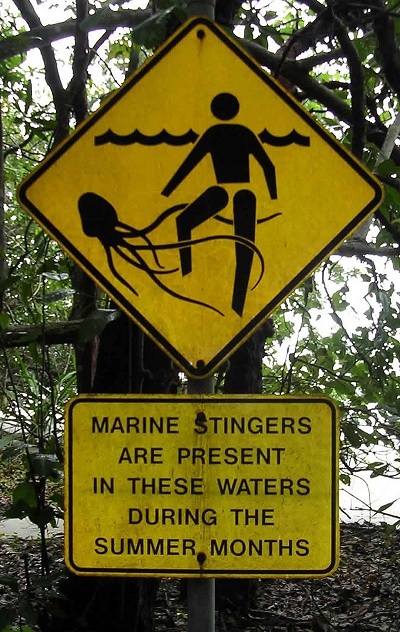
You see, Ms. Weise writes that “One concerning shift has been in the range of box jellyfish, some species of which can be deadly.
“The box jellyfish that we have an abundance of in Hawaii has recently caused injuries in various beaches in Florida. The changing range of these jellies and increasing human population density, these things all work together in U.S. waters,” said Angel Yanagihara, a research professor in the department of tropical medicine at the University of Hawaii who studies jellyfish venom.”
The only thing I know about box jelly fish is what Bill Bryon wrote in his book on travels in Australia, In a sunburned country (Broadway Books, New York, 2000) when Mr. Bryson said this:
(Remember this sounds much better if you read in the slow cadence of Mr. Bryson’s audio readings – especially that last sentence.)
But all of these are as nothing compared with the delicate and diaphanous box jellyfish, the most poisonous creature on earth. We will hear more of the unspeakable horrors of this little bag of lethality when we get to the tropics, but let me offer here just one small story.
In 1992 a young man in Cairns, ignoring all the warning signs, went swimming in the Pacific waters at a place called Holloways Beach. He swam and dove, taunting his friends on the beach for their prudent cowardice, and then began to scream with an inhuman sound.
It is said that there is no pain to compare with it.
The young man staggered from the water, covered in livid whiplike stripes wherever the jellyfish’s tentacles had brushed across him, and collapsed in quivering shock. Soon afterward emergency crews arrived, inflated him with morphine, and took him away for treatment.
And here’s the thing.
Even unconscious and sedated …
he was still screaming.
The idea of Box Jellyfish off the Carolina Coast would certainly make an impact on I spent my free time.
I had do some more research and was happy to have wikipedia tell me that 51 species of box jellyfish were known as of 2018. These are grouped into two orders and eight families.A few new species have since been described, and it is likely that additional undescribed species remain.
And not all of them have the terrible stings and venom as described by Mr. Bryson.
I was fascinated by the caption of a photograph of a jelly that had washed up on the beach that read: Box Jellyfish species Chiropsalmus quadrumanus; contradict the belief that Cubozoans are semelparity.
I was relieved!
And I don’t even know what it means.
Great words anyway!
I have yet to be stung, bit, tasted or in anyway made contact with by anything that lives in the ocean side from bumping into a dead cannon ball jelly fish so that doesn’t count as being something that lives.
I have read all the literature on what to do if I am ever stung by a jelly fish.
In my mind are countless remedies that are listed on posters, websites, beach guides and other informational websites so I feel I know what to do if I ever did get stung.
Then I got to the bottom of the Wikipedia page on Jellyfish.
Who ever wrote the contact had read all the same source information I had and had had enough.
For Wikipedia states:
Although commonly recommended in folklore and even some papers on sting treatment, there is no scientific evidence that:
urine,
ammonia,
meat tenderizer,
sodium bicarbonate,
boric acid,
lemon juice,
fresh water,
steroid cream,
alcohol,
cold packs,
papaya,
or hydrogen peroxide will disable further stinging, and these substances may even hasten the release of venom.
Heat packs have been proven for moderate pain relief.
The use of pressure immobilization bandages, methylated spirits, or vodka is generally not recommended for use on jelly stings.
Well GEE WHIZ .. there goes all my reading.
What does work?
Well this article says vinegar and that vinegar is made available on Australian beaches and in other places with venomous jellyfish.
But just to cover itself, the article also states, “A 2014 study reported that vinegar also increased the amount of venom released from already-discharged nematocysts; however, this study has been criticized on methodological grounds.”
For me?
Happy that Box Jellyfish species Chiropsalmus quadrumanus contradicts the belief that Cubozoans are semelparity, I will continue to walk along the beach.
If I could somehow block Bill Bryson out of my brain …
hatred of chaos falsenesses of memory bridges of delight
Remembering also the memories of these things, and the deep magic wrought upon them by the falsenesses of memory: the shell become a jewel, the sand become a desert, the waves become the ineluctable hatred of chaos, the weeds and mosses become as bridges of delight wonderfully windswept, archangelically designed, fairylifted and void-defying, between one fever of darkness and the next; whereover nimbly I send my messengers, and they return, swiftly, with that fantastic nonsense which feeds the soul.
From Landscape West of Eden as printed in Selected Poems by Conrad Aiken, Oxford University Press. 1961.
In just this one fragment of the 44 page poem Landscape West of Eden, Conrad Aiken uses grand words and phrases like:
memories of these things deep magic wrought upon them falsenesses of memory the shell become a jewel the sand become a desert the waves become the ineluctable hatred of chaos the weeds and mosses become as bridges of delight wonderfully windswept archangelically designed fairylifted and void-defying
All combining into fantastic nonsense which feeds the soul.
In the New York Times Review of the poem, written on May 5, 1935, Mr. C. G. Poore starts his review with, “WHEN Gertrude Stein became a national institution she incidentally gave readers courage to say they could not understand what they were reading. The custom has spread.“
But Mr. Poore closes his review with these words: “We admire Mr. Aiken’s Integrity, but we just do not understand what he is talking about. The fault is with us; poems about angels obviously should not look for understanding to earthly creatures.”
The fault is with us.
Poems about angels obviously should not look for understanding to earthly creatures.
regardless of wars rumours of wars and the rise and fall of nations
The Ojibways are probably the most numerous of the tribes that roam the vast Hinterland north of the fifty-first parallel; and regardless of wars, rumours of wars, and the rise and fall of nations, oblivious of the price of eggs, champagne, and razor blades, they wander the length and breadth of the land, which, with the one proviso of game being in plenty, is at once to them a kingdom and a paradise.
They overcome with apparent ease the almost insuperable difficulties incidental to a life in this land of violent struggle for existence.
By a process of elimination, the result of many generations of experience, they have arrived at a system of economy of effort, a reserving of power for emergencies, and an almost infallible skill in the detection of the weak points in Nature’s armour, that makes for the highest degree of efficiency.
From The Men of the Last Frontier by Grey Owl (Archibald Belaney) (1888-1938), Charles Scribners and Sons, New York, 1932.
What is the price of civilazation?
Take into regard of wars, rumours of wars …
the rise and fall of nations.
Pay attention to the price of eggs, champagne, and razor blades.
Stay in one place with the one proviso there is a Meijer or a Walmart filled with plenty.

 No Haiku For You