7.29.2024 – a frustrated

a frustrated
exhausted and divided
nation hungry for

Regardless of your side or point of view, there was a paragraph that resonated for most folks in the NYT opinion piece, I Was a Kamala Harris Skeptic. Here’s How I Got Coconut-Pilled by Lydia Polgreen where Ms. Polgreen wrote:

Americans have been through a lot since early 2020 —

a pandemic,

Jan. 6,

a turbulent economy and high inflation,

the invasion of Ukraine,

the slaughter in Israel and Gaza and the never-ending 2024 presidential race.

I also wondered if the Trump-Biden era changed what we want from a president.

We are a frustrated, exhausted and divided nation.

Most Americans believe we are on the wrong track, and we spent the past 20 months staring at a grim choice between Biden and Trump, the two men whose presidencies sent us down that track.

Many of us are hungry for something new.

We are a frustrated, exhausted and divided nation.

Wasn’t our political system supposed to deliver the best and the brightest

A frustrated, exhausted and divided nation forced into reelecting one of the two men whose presidencies sent us down that track.

I am reminded of Will Rodgers when he said, “Why don’t they pass a Constitutional Amendment prohibiting anybody from learning anything? If it works as good as Prohibition did, in five years we will have the smartest people on earth.”

7.25.2024 – people never know

people never know
more than vaguely where they are
in the scheme of things

People can be truly amazing …

I got this little theory, an utterly unimportant theory, that most people never know more than vaguely where they are, either in time or in the scheme of things.

People can’t read contracts or time schedules or identify countries on blank maps.

Why should they?

I don’t know.

There’s a wonderful fraudulence to literacy.

Yet these same people have emotional lives as intricate as that Bach piece …

From the book Sundog by Jim Harrison.

7.22.2024 – it was a problem

it was a problem
without other solution
than that of patience

It was a tantalizing problem that confronted us.

As long as we were vigilant, they could not escape; and as long as they were careful, we would be unable to catch them.

Charley cudgelled his brains continually, but for once his imagination failed him.

It was a problem apparently without other solution than that of patience.

It was a waiting game, and whichever waited the longer was bound to win.

To add to our irritation, friends of the Italians established a code of signals with them from the shore, so that we never dared relax the siege for a moment.

And besides this, there were always one or two suspicious-looking fishermen hanging around the Solano Wharf and keeping watch on our actions.

We could do nothing but “grin and bear it,” as Charley said, while it took up all our time and prevented us from doing other work.

From Tales of the Fish Patrol by Jack London, New York, Macmillan Company, 1905.

I was reminded of today’s political news cycle.

It was a problem apparently without other solution than that of patience

It was a waiting game, and whichever waited the longer was bound to win.

We can do nothing but “grin and bear it,” as Charley said, while it takes up all our time and prevents us from doing other work.

7.21.2024 – vividly to sense

vividly to sense
world’s precariousness and
the perils ahead

Based on the paragraph:

The subsequent fortnight has, of course, proved a very long time in geopolitics.

The UK has finally elected a grownup government;

France has perhaps temporarily averted the prospect of a far-right administration;

and Trump has dodged that bullet and raced ahead in the polls.

Having Applebaum’s book closely in mind through all those events is vividly to sense the underlying precariousness of our world, the perils immediately ahead.

In the article, Pulitzer-winning author Anne Applebaum: ‘Often, for autocrats, the second time in power is worse’ by Tim Adams in the Guardian on July 21, 2024.

The article is an interview with Anne Applebaum and a review of her latest book, Autocracy, Inc: The Dictators Who Want to Run the World.

I could comment on the content in the article but I think it speaks for itself.

I could comment on the context of the article but I won’t.

It is the words used to fill up the content that I want to focus on.

The focus of the interview, Ms. Applebaum, is renown for passages like:

“Nowadays autocracies are run not by one bad guy, but by sophisticated networks composed of kleptocratic financial structures, security services (military, police, paramilitary groups, surveillance), and professional propagandists.

Just on syllable count alone she wins.

But it is the words of Mr. Adams that I like.

First off, anyone who can get fortnight and even more wonderful how he used it the phrase, The subsequent fortnight , well Boy Howdy, I take my hat off to.

Then there was the use of vividly to sense.

With almost 5 years of high school and college Latin in my brain, the only grammatical error left (in the age of tweets and texts) is the dreaded split infinitive.

As Herman Wouk writes in his novel, The Caine Mutiny,… note that split infinitive in paragraph three. If you want a letter to sound official, split an infinitive.”

How easy would it have been for Mr. Adam to write, ‘to vividly sense.

Needless to say I was shocked, shocked I tell you, to read in Wikipedia, “In the 19th century, some linguistic prescriptivists sought to disallow the split infinitive, and the resulting conflict had considerable cultural importance. The construction still renders disagreement, but modern English usage guides have largely dropped the objection to it.

The split infinitive terminology is not widely used in modern linguistics. Some linguists question whether a to-infinitive phrase can meaningfully be called a “full infinitive” and, consequently, whether an infinitive can be “split” at all.”

It makes absolutely no difference in the history of the world or the happenings of today but for me and myself, but vividly to sense made my day.

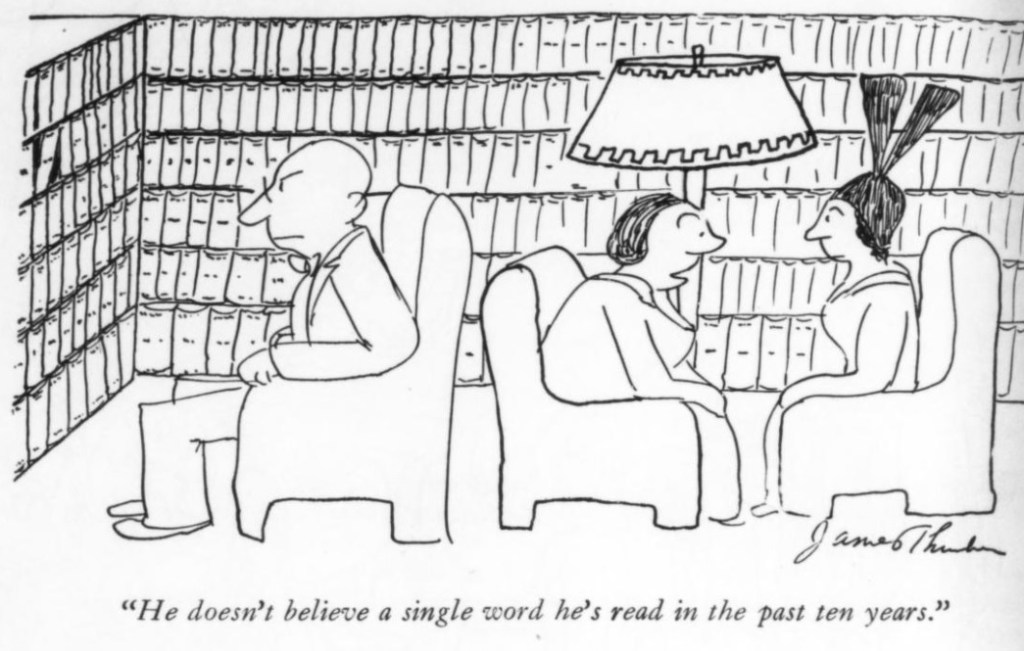
7.20.2024 – had I not the right

had I not the right
dislike dislikable man
feeling to this day

“… because it was a portion of the only genius he possessed to make me feel guilty for disliking him. It was a guilt I had no reason to feel — had I not the right to dislike a dislikable man? — and yet I go on unreasonably feeling it to this day. I perceive that even writing about him now, so long after his death, will not diminish my guilt. He has me locked in an embrace that nothing as simple as his death or the passage of time can release me from. It was his gift to gather a person in against his will and then never let go”

From Here at the New Yorker by Brendan Gill, New York, Random House, 1975.