8.13.2024 – never known woman

never known woman
who could weep about her age
way men I know can
Well, the characteristic fear of the American writer is not so much that as it is the process of aging.

The writer looks in the mirror and examines his hair and teeth to see if they’re still with him.

“Oh my God,” he says, “I wonder how my writing is. I bet I can’t write today.”’

The only time I met Faulkner he told me he wanted to live long enough to do three more novels.

He was 53 then, and I think he has done them.

Then Hemingway says, you know, that he doesn’t expect to be alive after sixty.

But he doesn’t look forward not to being.

When I met Hemingway with John O’Hara in Costello’s Bar 5 or 6 years ago we sat around and talked about how old we were getting.

You see it’s constantly on the minds of American writers.

I’ve never known a woman who could weep about her age the way the men I know can.

From Interview: THE ART OF FICTION: JAMES THURBER.
Paris Review, 3 (Fall, 1955), 34-49. Illustrated

This snippet made laugh.

I could picture Thurber in his mid 50’s, sitting in a bar with Mr. Hemingway and Mr. O’Hara and that alone is a picture to make me smile.

And that they were worrying about how old they were getting and that Mr. Thurber thought it was funny to the point of saying “I’ve never known a woman who could weep about her age the way the men I know can,” is but itself funny enough to make me laugh out loud.

For sure Mr. Thurber, who was being interviewed for this interview by George Plimpton, was having a great time tossing off the names of Faulkner, Hemingway and O’Hara with the confidence that he COULD toss off these names.

(I am reminded of the a story of Hollywood Movie Director John Ford going on a duck hunt with Clark Gable and William Faulkner and the conversation got around to writing and Gable says to Faulkner, ‘Who are the best writers right now?” Faulkner replies, “Oh Hemingway, Fitzgerald, Steinbeck … and myself.” Gable says “Oh, Mr. Faulkner, do you write?” “Yes,” says Faulkner, “Mr. Gable … what do you do?” … The kicker is John Ford swore both were on the level.)

BUT I DIGRESS …

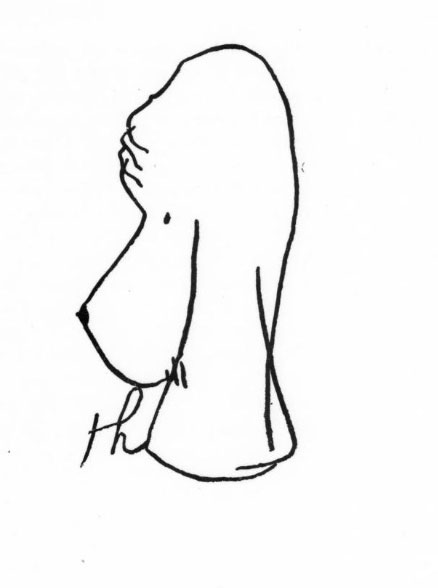
As a kind of post script to the James Thurber story, The Paris Review included this photo.

Notice the caption.

Notice it says CONSIDERABLY REDUCED.

By 1961, James Thurber was pretty much blind in both eyes.

One eye was damaged playing William Tell when he was a kid and the other eye went due to sympathetic eye syndrome.

When he died, EB White wrote in his New Yorker Magazine Obituary:

I am one of the lucky ones; I knew him before blindness hit him, before fame hit him, and I tend always to think of him as a young artist in a small office in a big city, with all the world still ahead. It was a fine thing to be young and at work in New York for a new magazine when Thurber was young and at work, and I will always be glad that this happened to me.

His mind was never at rest, and his pencil was connected to his mind by the best conductive tissue I have ever seen in action. The whole world knows what a funny man he was, but you had to sit next to him day after day to understand the extravagance of his clowning, the wildness and subtlety of his thinking, and the intensity of his interest in others and his sympathy for their dilemmas — dilemmas that he instantly enlarged, put in focus, and made immortal, just as he enlarged and made immortal the strange goings on in the Ohio home of his boyhood.

He was both a practitioner of humor and a defender of it. The day he died, I came on a letter from him, dictated to a secretary and signed in pencil with his sightless and enormous “Jim.” “Every time is a time for humor,” he wrote. “I write humor the way a surgeon operates, because it is a livelihood, because I have a great urge to do it, because many interesting challenges are set up, and because I have the hope it may do some good.” Once, I remember, he heard someone say that humor is a shield, not a sword, and it made him mad. He wasn’t going to have anyone beating his sword into a shield. That “surgeon,” incidentally, is pure Mitty. During his happiest years, Thurber did not write the way a surgeon operates, he wrote the way a child skips rope, the way a mouse waltzes.

Thurber looked in the mirror and asked I bet I can’t write today and then spit in the mirror and said I am going to write anyway.

And he did.
8.7.2024 – ask people to tell

ask people to tell
about one activity
not do for money

Based on the phrase, “When you ask people to tell you about the one activity they do not for money, not out of necessity, but to indulge their deepest passions and their wildest curiosities, well, you’re in for an intimate conversation“, quoting Amy Stewart in Fifty Shades of Trees, a review of her book, The Tree Collectors: Tales of Arboreal Obsession (Random House, 2024) in Scientific American, Jul/Aug 2024.

The reviewer writes:

Initially, trees struck Stewart as an odd thing to collect—trees being, for the most part, large and difficult to sell or tuck into a suitcase the way philatelists might their beloved stamps and brandophiles their cigar bands. Intrigued by this community of enthusiasts, she discovered educators, preservationists and visionaries, all hooked on a kind of curation, motivated by reasons as diverse as their projects. They plant trees in public and private spaces both modest and expansive, nurturing their collections to honor beloved dead, attract wildlife, preserve rare species, connect to history, invest in the future, grow food and create beauty. “When you ask people to tell you about the one activity they do not for money, not out of necessity, but to indulge their deepest passions and their wildest curiosities,” Stewart writes, “well, you’re in for an intimate conversation.”

Like all collectors, her subjects express a zeal for aesthetics, preservation, curiosity and delight. But it seems they know something else, too, something echoed by the recent rise in popularity of shinrin-yoku, or forest bathing, the Japanese practice of spending time in the woods: being around trees simply feels good.

I am reminded of the old saying, “Blessed is he who plants trees under whose shade he will never sit.”

Why?

Because being around trees simply feels good.

For that saying about planting shade trees and who said it, the Quote Investigator is worth checking out.

8.6.2024 – public libraries

public libraries
open, free civic spaces where
everyone’s welcome

The destroyed interior of the Spellow Hub community library after a night of violent disorder in Liverpool. Photograph: EPA

“Public libraries are particularly vulnerable during this kind of disorder as they are often in prominent locations and are, rightly, easily accessible. Yet they are also symbolic of community safety and cohesion – open and free civic spaces where everyone is welcome.”

Ed Jewell, the president of Libraries Connected – which represents library services in England, Wales and Northern Ireland – as quoted in the article, Liverpool library torched by far-right rioters raises repair funds Ella Creamer in The Guardian.

Not much makes me feel worse inside than a paragraph like this one:

Police said when firefighters arrived at the library, the rioters attempted to stop them from getting to the fire to put it out. “They even threw a missile at the fire engine and broke the rear window of the cab”, said police in a statement. The library has suffered severe fire damage to its ground floor.

At least in the same article was the paragraphs that said:

A fundraising campaign has raised more than £120,000 to help repair a Liverpool library and community hub that suffered severe fire damage after being targeted by rioters on Saturday night.

The fundraising page had an initial target of £500 but has gone on to raise more than £120,000 in two days, from more than 6,000 donations.

“I never imagined that the fundraiser would spread and far and wide as it has,” said McCormick, who is now liaising with the council and library management. “I’m so overwhelmed with the response and the sense of community”.

The sense of community.

Say it again outloud.

The sense of community …

Pull down your buildings and your freeways and your public arenas and you will build them again.

Pull down your libraries, and grass will grow in city streets.

(Okay so William Jennings Bryan said that about farms but …)

8.3.2024 – ignored needy, poor

ignored needy, poor
and God is going to hold
us responsible

Ezekiel the prophet once said, “Behold, this was the iniquity of Sodom, pride”.

Sodom was very proud.

They excluded God.

They were proud of themselves and the things they’d done.

And then they were filled with bread, it says. “And abundance of idleness was in her and in her daughters”.

In other words, they had all the things that they needed to give them leisure in their lives.

“Neither did she strengthen the hand of the poor and needy”.

They ignored the needy and the poor.

And the oppressed of the world.

Many times we ignore those of other races.

We ignore those people in Africa that are suffering from famine.

Or maybe we don’t ignore them, but we don’t do much about it.

Not as much as we could do.

And God is going to hold us responsible.

And they were haughty, and committed abominations before me.

In other words, they were proud, haughty, rich.

They had it all, and they neglected the poor and the oppressed of the world, and God said, “Judgment is going to come”

Billy Graham speaking at a Crusade in Sheffield, UK in June of 1985.

We hear a lot of Sodom the wicked city and this old place works its way into today’s new cycle more and more.

And what was Sodom’s sin?

NOT WHAT YOU’RE THINKING!

Behold, this was the iniquity of Sodom, pride” says Ezekiel.

Pride.

“Neither did she strengthen the hand of the poor and needy.”

As the Rev. Graham says, “In other words, they were proud, haughty, rich. They had it all, and they neglected the poor and the oppressed of the world, and God said, “Judgment is going to come”

Does raise a certain level of conversation does it not?

7.29.2024 – a frustrated

a frustrated
exhausted and divided
nation hungry for

Regardless of your side or point of view, there was a paragraph that resonated for most folks in the NYT opinion piece, I Was a Kamala Harris Skeptic. Here’s How I Got Coconut-Pilled by Lydia Polgreen where Ms. Polgreen wrote:

Americans have been through a lot since early 2020 —

a pandemic,

Jan. 6,

a turbulent economy and high inflation,

the invasion of Ukraine,

the slaughter in Israel and Gaza and the never-ending 2024 presidential race.

I also wondered if the Trump-Biden era changed what we want from a president.

We are a frustrated, exhausted and divided nation.

Most Americans believe we are on the wrong track, and we spent the past 20 months staring at a grim choice between Biden and Trump, the two men whose presidencies sent us down that track.

Many of us are hungry for something new.

We are a frustrated, exhausted and divided nation.

Wasn’t our political system supposed to deliver the best and the brightest

A frustrated, exhausted and divided nation forced into reelecting one of the two men whose presidencies sent us down that track.

I am reminded of Will Rodgers when he said, “Why don’t they pass a Constitutional Amendment prohibiting anybody from learning anything? If it works as good as Prohibition did, in five years we will have the smartest people on earth.”