11.10.2024 – America singing

America singing
each singing what belongs to
him or her, none else

I hear America singing, the varied carols I hear,
Those of mechanics, each one singing his as it should be blithe and strong,
The carpenter singing his as he measures his plank or beam,
The mason singing his as he makes ready for work, or leaves off work,
The boatman singing what belongs to him in his boat, the deckhand singing on the steamboat deck,
The shoemaker singing as he sits on his bench, the hatter singing as he stands,
The wood-cutter’s song, the ploughboy’s on his way in the morning, or at noon intermission or at sundown,
The delicious singing of the mother, or of the young wife at work, or of the girl sewing or washing,
Each singing what belongs to him or her and to none else,
The day what belongs to the day — at night the party of young fellows, robust, friendly,
Singing with open mouths their strong melodious songs.

I Hear America Singing by Walt Whitman as published in Leaves of Grass (Garden City, N. Y. : Doubleday, 1919 Edition).

According to Wikipedia, “The book received its strongest praise from Ralph Waldo Emerson, who wrote a flattering five-page letter to Whitman and spoke highly of the book to friends. Emerson called it “the most extraordinary piece of wit and wisdom that America has yet contributed.” Emerson had called for the first truly American poet, saying that aspects of America “are yet unsung. Yet America is a poem in our eyes.”

I like that last part a lot.

Aspects of America “are yet unsung. Yet America is a poem in our eyes.”

And I want to believe that holds through to today.

There are poems yet to be written.

Songs yet to be sung.

Each singing what belongs to him or her and to none else.

I look forward to hearing America singing, the varied carols to hear.

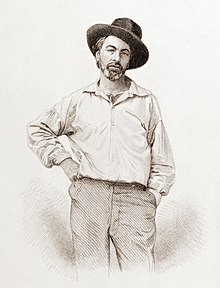
PS: According to Wikipedia this engraving of Mr. Whitman from 1856 was printed in the front piece of the Leave of Grass. Not yet the white haired, bearded old guy that first comes to mind now was he?
11.9.2-24 – did as the man said –

did as the man said –
one does what one is, then one
becomes what one does

It was the Austrian writer, Robert Musil, who said:

One does what one is; one becomes what one does

A lot of people have been explaining to how they voted in the last election.

They didn’t agree with the guy.

They felt the guy was less than perfect or maybe imperfect.

That other lady had so many things wrong with her (this is one that threw me as why did it count against her and not against him?).

But I don’t agree in this case.

I felt that the guy, regardless of any benefits, was unfit for office.

And I could not bend my mind or my standards enough to allow myself to consider voting for him.

A lot of people have tried to explain to me that that was how they voted but it wasn’t who they were.

I couldn’t get there.

You had to get on his train and go where the train was going.

I feel sorry for those people who think otherwise.

You see, one does what one is.

And one becomes what one does.

I hope you can live with yourself.

11.8.2024 – cultivate habit

cultivate habit
not being particular
about little things

Adapted from the essay, Tripping Over Trivia by Damon Runyon as published in Short Takes, Readers’ Choice of the Best Columns of America’s Favorite Newspaperman, Damon Runyon (Constable, Orange Street London, 1948.)

I am trying to cultivate the habit of not being particular about little things. I suppose that after years of being very particular, indeed, I will find it difficult to shake off some of my old exactions, but I must keep struggling. I have come to the conclusion that I have been wasting an enormous amount of time in being particular.

Take the small matter of boiled eggs. I used to be mighty particular about how long my boiled eggs should be boiled. I made a strong point of specifying that they should be boiled three minutes and a half. I had the idea that I could not even look at eggs boiled less than that time or two seconds beyond. The cooks could not fool me, either, though sometimes I suspected they exerted the most diabolical ingenuity in the effort. I could tell to a clock-tick how long they had boiled eggs the instant they were set before me.

One day I sat down and seriously contemplated the economic phases of the boiled egg situation as applied to me. I considered, through careful calculation, the hours I must have wasted in arguing with waiters that those eggs had not been boiled three and a half minutes, but only two and a half, or maybe four, and in sending them back to the kitchen and then waiting for another boiling.

When my figures showed that on being particular about my boiled eggs alone I had wasted fifteen years, I was appalled. It was then I made up my mind to cease being particular. I immediately made some progress on the boiled eggs. I began calling for them scrambled.

Mr. Runyon may be more well known for his musical Guys and Dolls, often thought to be THE American Musical ( up against Oklahoma and the Music Man).

In Guys and Dolls, the Hero Skye Masterson says:

On the day when I left home to make my way in the world, my Daddy took me to one side. ‘Son,’ my Daddy says to me, ‘I am sorry I am not able to bankroll you to a very large start, but not having the necessary lettuce to get you rolling, instead I’m going to stake you to some very valuable advice.

One of these days in your travels, a guy is going to show you a brand-new deck of cards on which the seal is not yet broken. Then this guy is going to offer to bet you that he can make the jack of spades jump out of this brand-new deck of cards and squirt cider in your ear. But, son, you do not accept this bet, because as sure as you stand there, you’re going to wind up with an ear full of cider.

Friends and neighbors, I woke up Wednesday morning and let me tell you friends, I had an ear full of cider!

Time to start calling for scrambled eggs!

11.5.2024 – build triumphal arch …

build triumphal arch …
build it out of bricks – something’
convenient to throw

Based on the line, “When ye build yer triumphal arch to yer conquering’ hero, Hennessy, build it out of bricks so the people will have something’ convenient to throw at him as he passes through,” attributed to Mr. Dooley.

Sorry but I cannot find a better citation.

According to Wikipedia, Mr. Dooley (or Martin J. Dooley) is a fictional Irish immigrant bartender created by American journalist and humorist Finley Peter Dunne. Dooley was the subject of many Dunne columns between 1893 and 1915, and again in 1924 and 1926. Dunne’s essays contain the bartender’s commentary on various topics.

Also according to Wikipedia, Finley Peter Dunne (born Peter Dunne; July 10, 1867 – April 24, 1936) was an American humorist, journalist and writer from Chicago. In 1898 Dunne published Mr. Dooley in Peace and in War, his first collection of the nationally syndicated Mr. Dooley sketches.[1] Written as though speaking with the thick verbiage and accent of an Irish immigrant from County Roscommon, Dunne’s fictional “Mr. Dooley” expounded upon political and social issues of the day from behind the bar of his South Side Chicago Irish pub.

I just feel like throwing bricks today.

I have also been looking for a specific snap shot of history and while looking for it, I came across this other snippet.

This is reported in the diary of John Colville, one of Winston Churchill’s private secretary.

This happened in May of 1940 just a week after Churchill took over as Prime Minister and led the showdown against Nazi Germany.

Mr. Colville writes that: Mrs Churchill who said that the preacher at St Martin-in-the-Fields had preached such a pacifist sermon that morning that she got up and left.

“You ought to have cried ‘Shame’,” said Winston, “desecrating the House of God with lies!”

I love that but that wasn’t the story I was looking for even though it fits a bit.

The story I wanted was in the Prophet of Truth.

Book V in Martin Gilbert’s multi volume biography of Mr. Churchill.

On the day Neville Chamberlin brought back the infamous Munich agreement, an agreement that allowed Germany to take over Czechoslovakia, an agreement that Mr. Chamberlin waved from his balcony, Mr Gilbert writes that:

​Throughout the morning the British Government urged the Czechs to accept the ‘Munich’terms; at noon Beneš agreed to do so. That afternoon Chamberlain flew back to London. ‘Vast crowds in the streets,’ Oliver Harvey recorded in his diary, ‘hysterical cheers and enthusiasm. PM on balcony at Buckingham Palace. But many feel it to be a great humiliation.’

In an unpublished note written ten years later Churchill recalled how, that day, ‘My wife and Lord Cecil solemnly discussed marching themselves with a select band to Downing Street and hurling a brick through the windows at No 10.’

I have been thinking about bricks today.

How there are some people and some windows I would love to throw a brick through.

Instead, I voted.

And I have to say that when I fed my ballot into the machine, unlike any other time I have ever voted, I felt like I had thrown my brick.

I hope he felt it.

11.3.2024 – that time of year when

that time of year when
yellow leaves, none or few, hang
shake against the cold

That time of year thou mayst in me behold
When yellow leaves, or none, or few, do hang
Upon those boughs which shake against the cold,
Bare ruin’d choirs, where late the sweet birds sang.

In me thou see’st the twilight of such day
As after sunset fadeth in the west,
Which by and by black night doth take away,
Death’s second self, that seals up all in rest.

In me thou see’st the glowing of such fire
That on the ashes of his youth doth lie,
As the death-bed whereon it must expire,
Consum’d with that which it was nourish’d by.

This thou perceiv’st, which makes thy love more strong,
To love that well which thou must leave ere long.

Sonnet 73 by William Shakespear, 1609.

According to Wikipedia, Sonnet 73 is an English or Shakespearean sonnet. The English sonnet has three quatrains, followed by a final rhyming couplet. It follows the rhyme scheme of the English sonnet form, ABAB CDCD EFEF GG. It is composed in iambic pentameter, a poetic metre that has five feet per line, and each foot has two syllables accented weak then strong. Almost all of the lines follow this without variation.

The organization of the poem serves many roles in the overall effectiveness of the poem. Yet, one of the major roles implied by this scheme revolves around ending each quatrain with a complete phrase. Given the rhyme scheme of every other line within the quatrain, as an audience we are to infer a statement is being made by the end of every four lines. Further, when shifted toward the next four lines, a shift in the overall thought process is being made by the author.

While I find the commentary fascinating, I have to admit I really don’t know what it means.

What I do know is I like the flow – the sounds – the thoughts and the idea that fall in 1609 England and the feelings that fall might bring aren’t too far from thoughts and feelings today.

Like a review I came across of a new biography of a much chronicled John Adams and the reviewer … nothing new here … but arranged and presented in a nice way.

As for how to read Shakespeare … have you seen this clip on the proper way to say, To Be of Not to be from Hamlet?