So now what? Delay McCarthy again? I’ve been told there were some concerns about how another year sitting on the bench would affect him. And would it even help? Every question has a cousin, and suddenly they’re multiplying. Can a raw but talented quarterback grow fast enough to match a team built to win yesterday?
I think that’s pretty good.
Good enough to repeat.
Every question has a cousin, and suddenly they’re multiplying.
Can a raw but talented quarterback grow fast enough to match a team built to win yesterday?
Applying to other topics … Can a Saturday Morning TV Anchor run something else like the Frosty Boy Ice Cream Stand in Grand Rapids, Michigan or, just wondering out loud, the Department of Defense?
Every question has a cousin, and suddenly they’re multiplying.
dolphins had always believed far more intelligent for the same reasons
Sunrise over Skull Creek with dolphins mucking about unseen – but I know they’re there.
Adapted from the passage:
“For instance, on the planet Earth, man had always assumed that he was more intelligent than dolphins because he had achieved so much—the wheel, New York, wars and so on—whilst all the dolphins had ever done was muck about in the water having a good time. But conversely, the dolphins had always believed that they were far more intelligent than man—for precisely the same reasons.”
From The hitchhiker’s guide to the galaxy by Douglas Adams (New York : Pocket Books, 1985).
I had a ride to work this morning so instead of defending myself from drivers who are intent on killing me, I was able to look out the window.
When you ride to work in the Low Country of South Carolina you get to look out the window at water.
You get to look out the window at water and look for dolphins.
Sometimes you spot one or two or more as they muck about in the water having a good time.
They have such a good time that just to see them makes you feel better.
And sometimes, when I get a ride to work I can look out the window and see dolphins.
There are worse places to ride to work.
I got to thinking about dolphins.
They do not labor or spin.
They spend the lives not knowing about borders, taxes, politicians, jobs or NFL Referees.
You know what?
I do believe that they ARE far more intelligent than man.
democracy most fragile thing on earth, it rests upon you and me
Democracy is the most fragile thing on earth, for what does it rest upon?
You and me, and the fact that we agree to maintain it.
The moment either of us says we will not, that’s the end of it.
It doesn’t rest on anything but us; it doesn’t rest on armed force, the moment it does it isn’t democracy.
It isn’t something to kick around or experiment with.
From the preface page to the 2017 Edition of the book, Advise and Consent by Allan Drury (WordFire Press: Colorado Springs, Colorado , 2017).
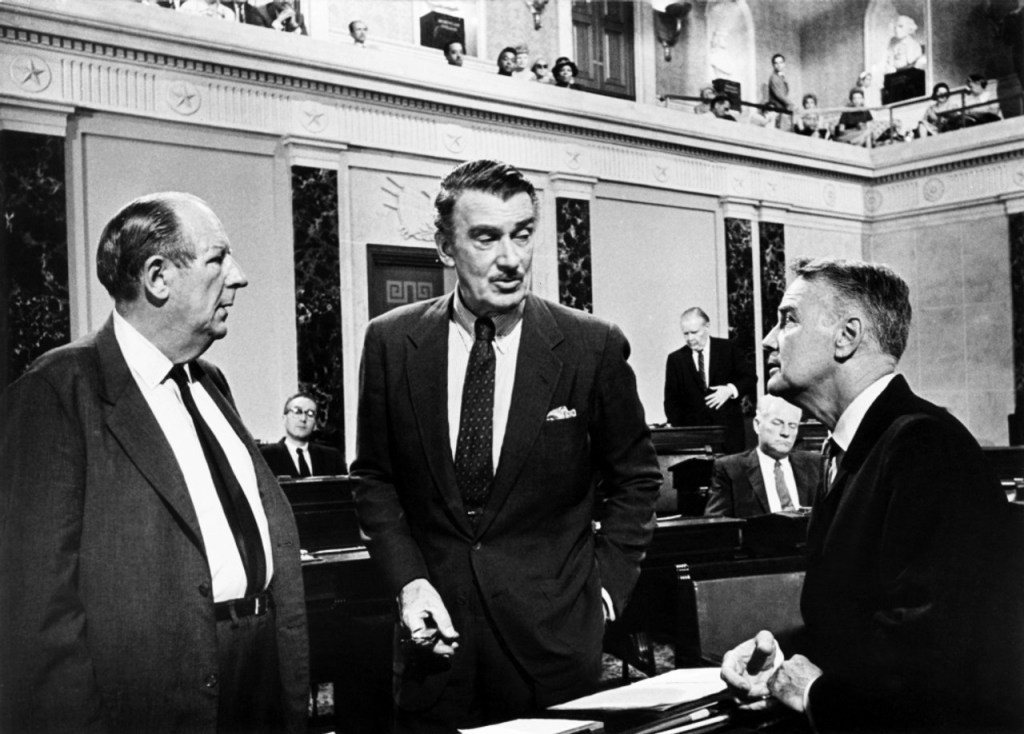
Advise and Consent is one of those books AND film adaptations that I can read or watch again and again.
Watching the movie today I have to laugh the Minority Whip of the Senate arrives a the Capitol Building in a cab, walks to a news stand and buys and paper and only then learns what the President did overnight.
In today’s instant news coverage, I marvel that anything got done back in 1959.
I mean the poor guy woke up, got dressed, had breakfast and got to work before he had any news on which to plan his day.
According to Wikipedia, “Advise and Consent is a 1959 political fiction novel by Allen Drury that explores the United States Senate confirmation of controversial Secretary of State nominee Robert Leffingwell, whose promotion is endangered due to growing evidence that the nominee had been a member of the Communist Party. The chief characters’ responses to the evidence, and their efforts to spread or suppress it, form the basis of the novel.”
A Mr. Tom Kemme, in his book, Political fiction, the spirit of the age, and Allen Drury (Bowling Green State University Popular Press: Bowling Green, Ohio. 1987), writes that, “The basic assumption underlying Drury fiction is that totalitarian Communism is intrinsically evil and that Communism’s ultimate goal is world domination, an end or goal that Communists will strive to achieve by whatever moral, immoral, or amoral means are expedient, including propaganda, lies, subversion, intimidation, infiltration, betrayal, and violence.”
Had anyone been able to tell Mr. Drury that such a threat would be coming, not from Communists buy from within the Government, he would have dismissed the plot as impossible to believe.
But if we make one slight change, that phrase can be read …
The current administration is intrinsically evil and that the current administration‘s ultimate goal is world domination, an end or goal that the current administration will strive to achieve by whatever moral, immoral, or amoral means are expedient, including propaganda, lies, subversion, intimidation, infiltration, betrayal, and violence.
Just that last bit is worth repeating.
The current administration will strive to achieve [its goals] by whatever moral, immoral, or amoral means are expedient, including propaganda,
lies,
subversion,
intimidation,
infiltration,
betrayal,
and violence.
It’s worth repeating Mr. Drury’s warning.
Democracy is the most fragile thing on earth, for what does it rest upon? You and me, and the fact that we agree to maintain it. The moment either of us says we will not, that’s the end of it. It doesn’t rest on anything but us; it doesn’t rest on armed force, the moment it does it isn’t democracy. It isn’t something to kick around or experiment with.
It isn’t something to kick around or experiment with.
so many books and amount of time to read them so clearly finite
In the goofy column in the Guardian, 10 Chaotic Questions, one of my favorite goofy writers, Bill Bryson is asked 10 goofy questions by Dee Jefferson.
One of the questions is What book, album or film do you always return to, and why?
Mr. Bryson replied, “There are so many books in the world, and the amount of time to read them is so clearly finite, that I find it slightly a waste of time to go back and read something again. Same with movies. I did rewatch The Grand Budapest Hotel – not all the way through, but I went back and watched certain parts of it because I was just kind of enchanted with it and there were some scenes where I wanted to know, how did they film that?”
Let me repeat that first line again: There are so many books in the world, and the amount of time to read them is so clearly finite, that I find it slightly a waste of time to go back and read something again.
I understand where Mr. Bryson is going.
Years ago I had a conversation with a friend who pointed that you read for 60 years and read a new book a week, you will have time to read … 3,120 books.
In 2010, Google made the estimate that there had been 129,864,880 books written since the invention of the printing press.
Google added the caveat that This number does not include all historical manuscripts, self-published works, or books with non-standard identifiers.
With that in mind, you have to agree with Mr. Bryson that there are so many books in the world, and the amount of time to read them is so clearly finite, that one could find it slightly a waste of time to go back and read something again.
Years ago it came to me that my destiny was the South Pacific and I entered into a long correspondence with the United States Department of Education to qualify to be hired as a teacher for the American Territory of Western Samoa.
I actually got to the point where I was informed that I had made to the ‘eligible to be hired list’ and I would be notified as soon as the next position was avaialble.
That was in the 1980’s.
I am still waiting.
I guess there isn’t a lot of turnover.
Here is the point though, for several months I made plans to move myself to a dot in the Pacific Ocean.
I looked over my library and mentally reduced it to about 100 books that would have to travel with me.
All 100 books were my FAVORITES.
Books I had read and reread and would reread again.
I have long wished that I had made a mark in my copy of the Caine Mutiny to record how many times I have read it as I know its over 100 times.
BTW, I got that idea of marking a book each time I read it when I watched an interview with Civil War Historian Shelby Foote who said he had reread the complete seven volume In Seach of Lost Time by Marcel Proust NINE TIMES. He considered it his reward after finishing major writing projects and took about two months to complete the reading each time.
I like to say I learn something new each time I read the Caine Mutiny … or at least I relearn or remember something new each time I read it.
I can also say that using E books I found that a book can read differently by how the text is laid out and if I change the font size or turn my tablet sideways and the text is laid out differently, the book reads differently.
One instance sticks in my mind where in one of the Hornblower books, Hornblower and the Hotspur, by CS Forester, my paperback copy hyphenated a word on a line break so that sentence read as:
from where he sat, he saw that a rib- boned Officer climbed the side of the ship
and I always thought it meant a skinny, rib boned person … whatever that meant, and I reread that volume countless times.
Then I got a new edition and the line read:
from where he sat, he saw that a ribboned Officer climbed the side of the ship,
and I said to myself OH IT WAS A GUY WITH A RIBBON AND STAR on his uniform … duhhhhhhhhhhhhhhhhhhhh.
Well, there you are.
So little time, so many books.
Much like the Church with not enough parking, it’s a really good problem to have.
I will continue to read what catches my interest and when I want, I’ll grab an old friend and reread and you what?
I could never find it even slightly a waste of time to go back and read something again.
still, half a sixpence better than half a penny is better than none
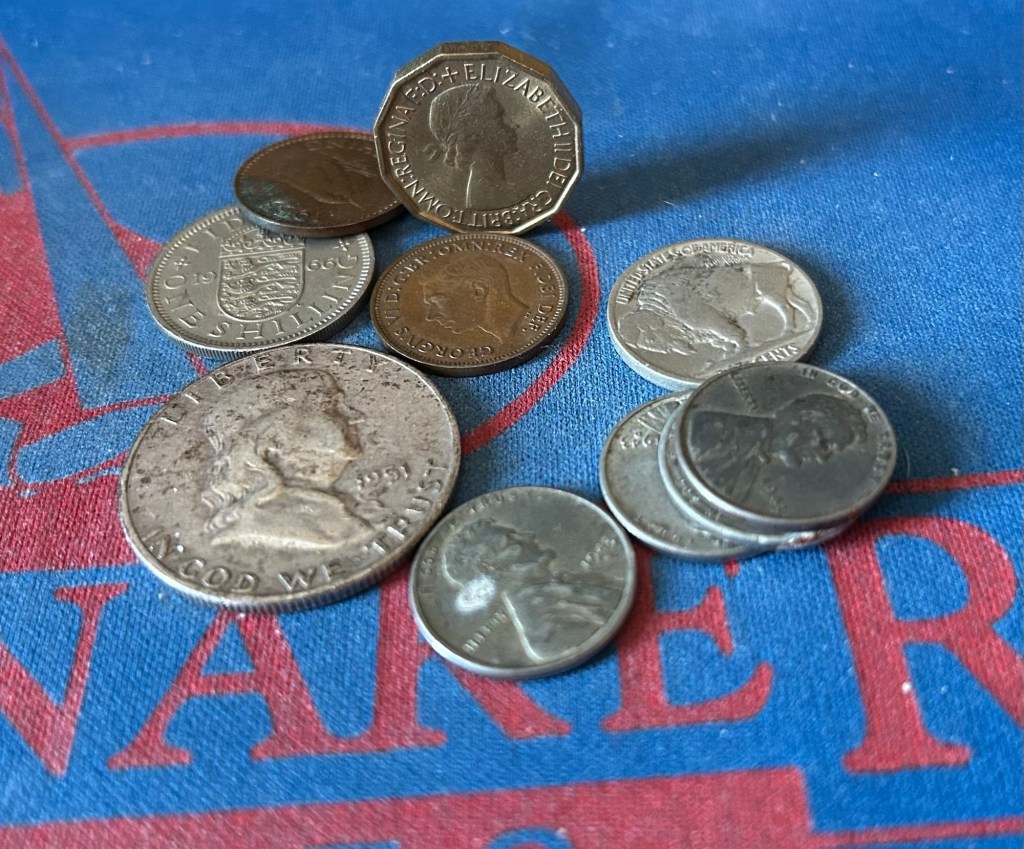
Clockwise from the top, a UK 3 penny piece or a thrupence, Buffalo Nickel (also known as an Indian Head Nickel), Steel Pennies from WW2, Franklin Half Dollar, UK Shilling and UK Brass Farthings (KGVI – worth 1/4 of a cent)
Today’s Haiku is based on some verse from the 1963 Musical, Half a Sixpence). According to Wikipedia, Half a Sixpence is a 1963 musical comedy based on the 1905 novel Kipps by H. G. Wells, with music and lyrics by David Heneker and a book by Beverley Cross. It was written as a vehicle for British pop star Tommy Steele.
I had no idea it was a based on a book by HG Wells.
The line in question goes:
Still, half a sixpence Is better than a half a penny Is better than a half a farthing Is better than none
I do remember it was selected as the High School Musical at Grand Rapids Creston High School when my little brother Steve was in the choir and he got the part of the evil brother who tries to steal the fortune of the hero.
Never thought much about the play until years later when I read the autobiography of John Cleese who wrote that in 1963 he and a bunch of his buddies from college took a comedy review to New York City and the shows producer saw him and offered him the role mostly due to his British accent. Cleese writes that was astounded to find himself, at age 24, in a Broadway Musical playing the evil brother.
And it clicked.
Hey, that was Steve’s part!
The idea that the United States Penny with Mr. Lincoln on it is no longer being made go me thinking about coins.
According to some sources, the visage of Mr. Lincoln on the penny is the single most viewed work of art in history.
At one time Branniff Airlines had Alexander Calder paint some of their planes and claimed that one of them, “The Flying Colors of the United States”, christened by First Lady Betty Ford and flown on its inaugural flight to Grand Rapids, Michigan was also a work of art and IT was seen by more people than any other single work of art in the history of the world. There is some question about that number as it would appear that when the plane flew over New York City, Braniff would claim that 8 million people looked up and saw it … as a tiny dot in the sky. As Mr. Frank Lloyd Wright would have said, “There you are.”
But I digress.
Thinking again about coins, I thought back to when I friend of mine was planning a trip to Great Britain and asked if I wanted anything.
I did.
I wanted some British coins.
Thinking of the line from My Fair Lady, whenever Alfred P. Doolittle comes on the scene, everyone prepares for him to ask for money and they cut him off saying, ‘NOT A BRASS FARTHING.”
I had to look it up.
Understand coins had some value based on what they were made of.
Golden Guineas.
Silver Shillings. (I always loved this bit of useless knowledge that Brits use £ and in each £ are 20 silver shillings. Back in the day and I mean Henry Vth days, 20 Silver Shillings weighed … one pound.)
Copper Pennies.
Farthings, worth 1/4 of cent or 4 to a penny were made of brass.
So I asked for some brass farthings.
And maybe a two penny or three penny or even a six penny piece, knowns as Tuppence, Thrupence and Sixpence coins.
My friend returned from her trip and came in my office and slammed the coins down on my desk.
“I had to go to three different antique stores,” she said.
As un aware as any of what happened in Great Britain, the coinage system of the revolutionary war, Dicken’s and Yeats, Forester and Orwell had disappeared in the late 1970’s though it took decades for people to forget about ‘New Money’.
I mean it was time.
As Alistair Cooke wrote about Thomas Jefferson on old money, “His objections to the laboriousness of pounds, shillings, and pence anticipated by two hundred years the wisdom of the British government: the ordinary man or woman “is used to be puzzled by adding the farthings, taking out the twenties and carrying them on; but when he came to pounds, where he had only tens to carry forward, it was easy and free from error.” He suggested that, since “everyone knows the facility of decimal arithmetic,” it should be adopted in the coinage “to the great ease of the community.”
Still hard to understand that we no longer need the penny.
Or that it costs more to make a penny that a penny is worth.
In other words, for every Penny that got minted, the US Government lost 2 cents.
Right there is the old Catch 22 of buying eggs for 5 cents and selling them for 3 cents.
Boy Howdy but it gets confusing.
What was the worth of a penny today?
And the old saying, at one point you reach the age where anything less than a Quarter isn’t worth picking up.
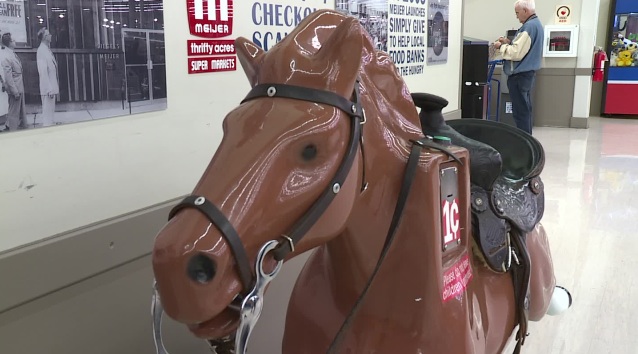
But it was good to hear that up north, Meijer Stores will continue its penny pony rides.
If you grew up in West Michigan, like I did, you rode one of those Penny ponies.
My wife would take our 2 year son, in full Cowboy Regalia, to ride that penny pony.
What’s the worth of that?
To many of us, priceless.
So shines a good deed in a weary world.
Still, half a sixpence Is better than a half a penny Is better than a half a farthing Is better than none.




 No Haiku For You